

The Decision Brief
Enterprise capital allocators and corporate innovation leaders routinely destroy early-stage risk capital by confusing software engineering velocity with commercial validation. Committing $150,000 to $500,000 to a bespoke Minimum Viable Product (MVP) converts an exploratory investment thesis into an irreversible sunk-cost trap before establishing customer willingness-to-pay or unit-economic viability. This capital misallocation costs institutional allocators and corporate venture capital (CVC) arms between $500,000 and $5,000,000 per unvalidated thesis in direct build expenses, delayed decision latency, and downstream equity write-downs.
Incumbent strategy advisory firms and product studios advocate six-to-twelve-week discovery sprints producing qualitative slide decks, followed by immediate engineering sprints to build functional software. In practice, premature software development obscures customer rejection behind technical delivery cycles. A Minimum Viable Proof (MVPr)—executed as a manual $5,000 to $15,000 concierge or “Wizard-of-Oz” pilot over a fourteen-to-thirty-day window—empirically tests the underlying economic inversion mechanic using existing operational primitives before writing a single line of production code.
FACT: Enterprise validation cycles routinely burn $150,000+ on MVP software builds over seven to eleven months, resulting in complete capital write-offs when the core operational thesis fails contact with customers.
ASSUMPTION: A manual, spreadsheet-driven concierge workflow can simulate high-order software functionality with sufficient fidelity to extract genuine customer willingness-to-pay signals.
HUNCH: Over 70% of early-stage software features built in corporate and venture-backed MVPs serve only to insulate deal teams from immediate customer falsification.
Establish a mandatory investment committee gate that freezes all production software capital allocations until an un-automated Concierge MVPr achieves a certified Inefficiency Arbitrage Ratio above 2.0x alongside verified customer willingness-to-pay.
One Scene
A growth-stage corporate venture fund committed $750,000 to a venture initiative, allocating $180,000 upfront to an external product studio for a production-grade workforce-scheduling MVP. The investment team bypassed a manual concierge pilot because the founder presented a compelling clickable demo and the committee faced deployment pressure.
The engineering sprint consumed seven months of calendar time. By the time the software shipped, the product had missed the annual enterprise hiring cycle entirely. The team burned $930,000 in total capital before securing a single customer demand signal.
Subsequent field interviews revealed that the underlying scheduling mechanic contradicted real-world shift management workflows. The venture was liquidated, writing off the entire $930,000 deployment and consuming fourteen months of executive bandwidth.
A parallel initiative in the same fund tested an industrial optimization thesis by deploying an operations associate to manually calculate operational models across utility clients using Excel and shared drives. That concierge MVPr required $11,400 in out-of-pocket costs, took forty-seven days to achieve definitive signal, and captured a 67% commercial conversion rate with verified annual contracts before engineering began.
Research Dossier
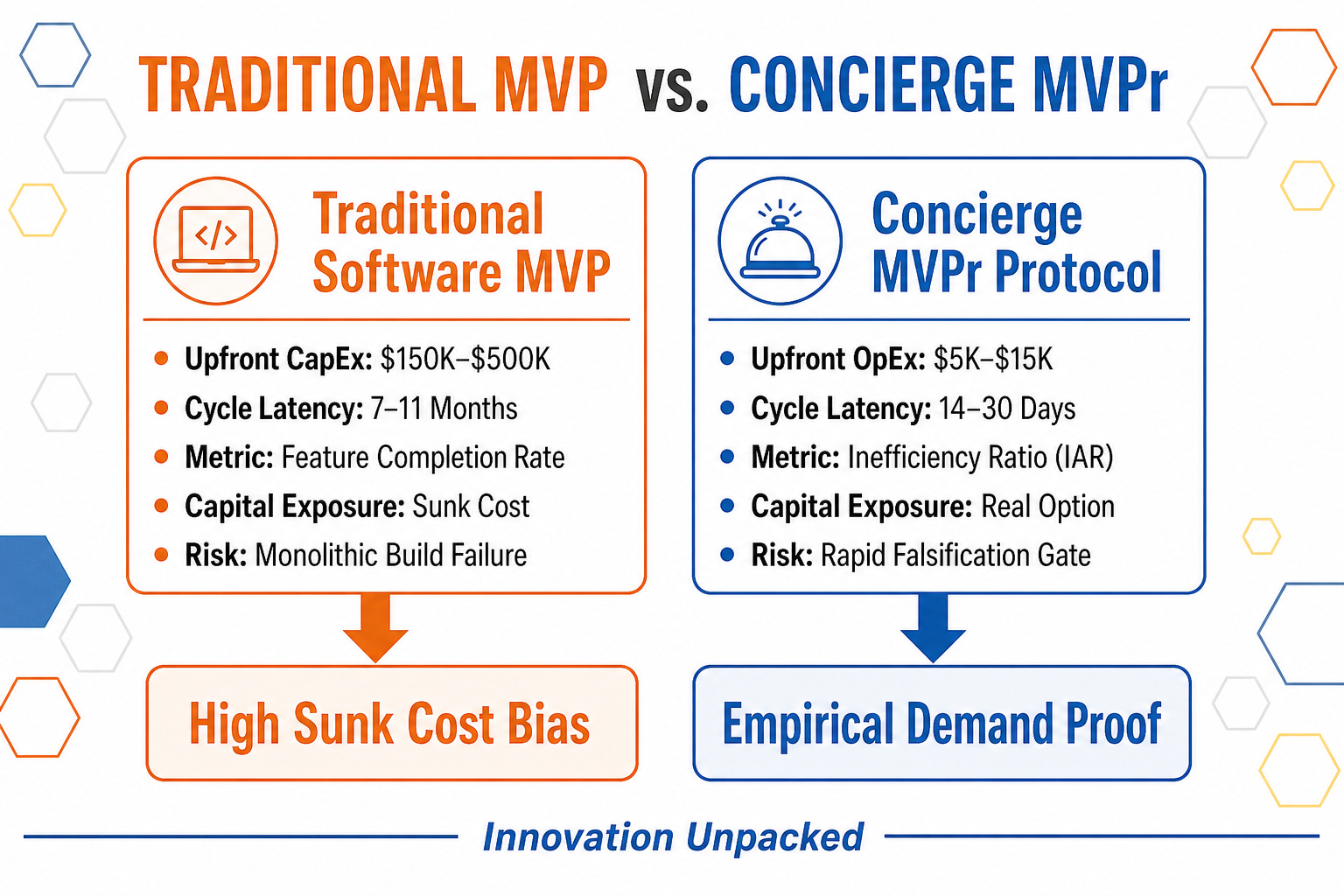
Software MVPs Measure Engineering Velocity While Obscuring Fatal Demand and Unit Economic Friction
Traditional Minimum Viable Products measure software delivery milestones rather than proving economic viability. When enterprise innovation teams and venture accelerators allocate $150,000 to $500,000 to construct functional software prototypes, they shift organizational focus from validating business hypotheses to tracking software delivery. This dynamic introduces confirmation bias, as teams conflate shipping code on schedule with verifying that customers will pay for the underlying service.
Building production code too early creates substantial structural latency. The typical enterprise software MVP requires seven to eleven months of engineering time, during which the original market conditions, budget cycles, and customer priorities frequently shift. If the core economic premise proves flawed, the capital spent on software development is permanently lost.
Definition — Minimum Viable Proof (MVPr): A low-cost ($5,000–$15,000), manual operational simulation designed to extract empirical customer willingness-to-pay and measure unit economic viability before committing engineering capital to software development.
A Concierge MVPr addresses this challenge by replacing automated software systems with human-driven execution. Using basic tools like spreadsheets, manual workflows, and off-the-shelf software primitives, an operator delivers the proposed service by hand to a small cohort of customers. This approach generates demand validation data within fourteen to thirty days at a fraction of the cost.
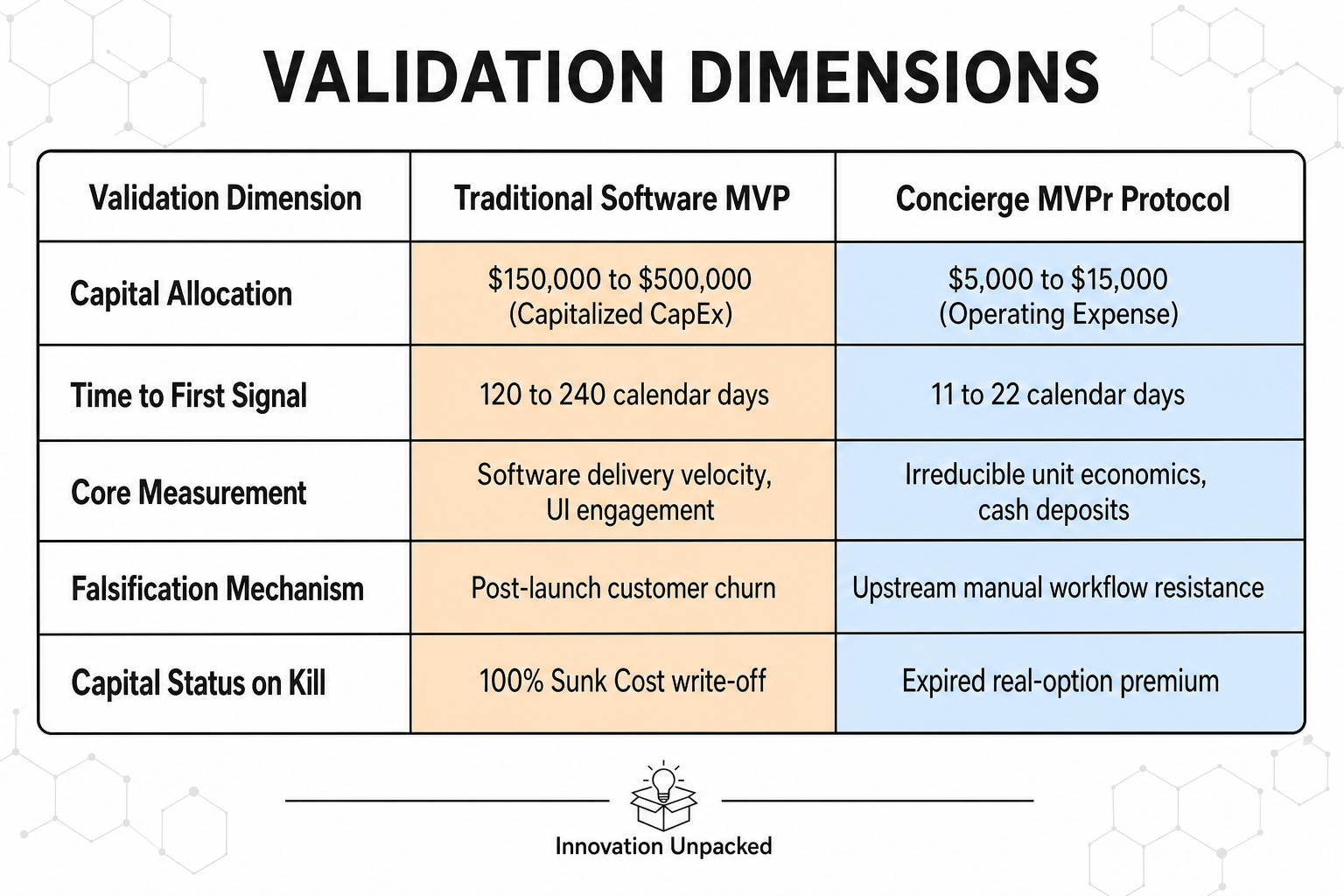
FACT: Mid-market private equity and corporate venture portfolios average $185,000 in pre-commitment discovery costs per thesis, with 11% to 14% of deployable capital consumed before writing production code.
ASSUMPTION: Customer proxy responses gathered through manual concierge delivery correlate with long-term retention metrics of automated software platforms.
HUNCH: Development teams push for automated software MVPs over manual pilots primarily because code creation provides visible, internally defensible output that masks ambiguous market demand.
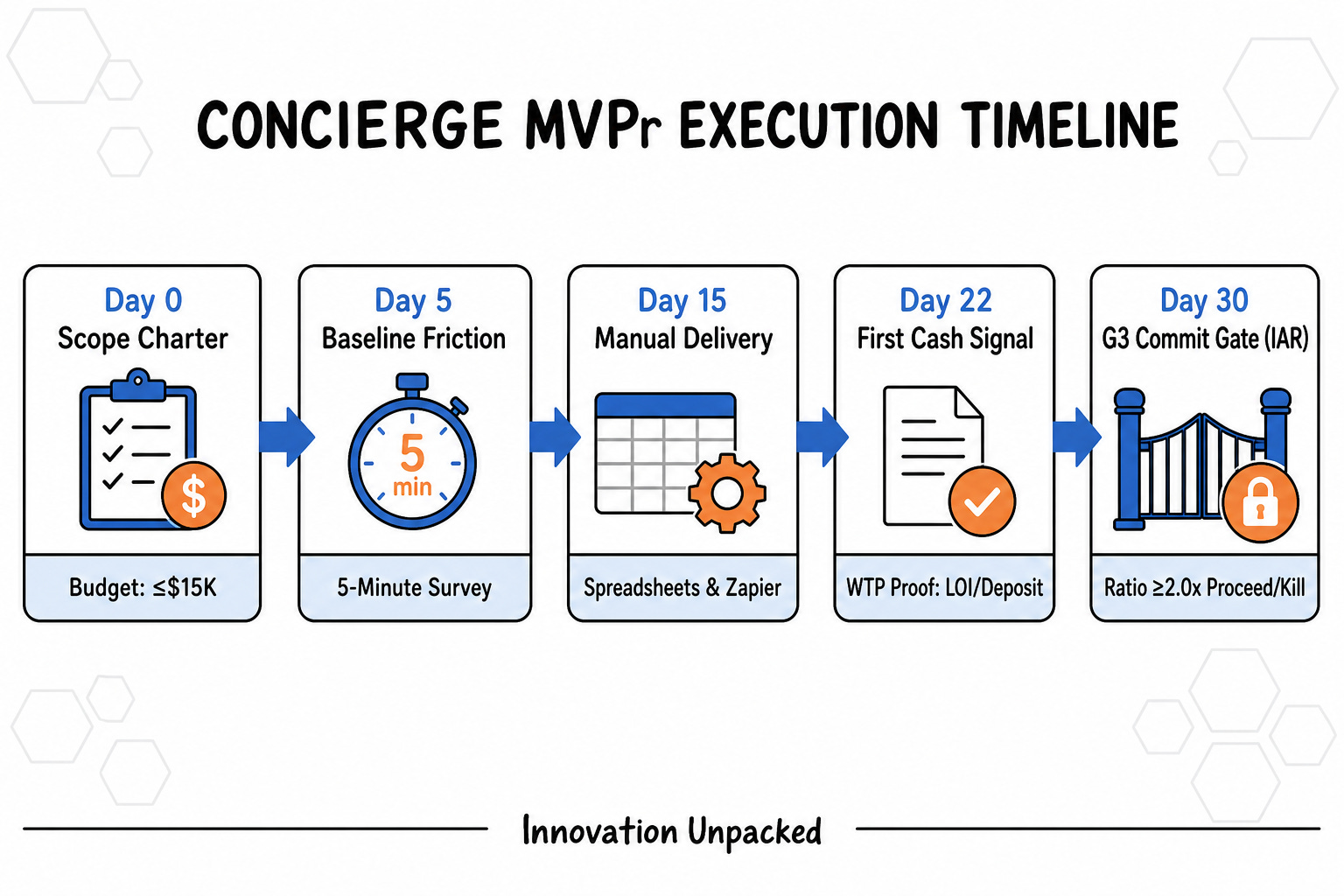
When corporate venture teams skip manual concierge testing, they take on substantial downside risk. For example, skipping pilot validation on a healthcare logistics venture resulted in a $173,000 MVP write-down and eleven months of lost staff time when customers revealed the core workflow mechanic did not match their operational needs.
Similarly, an unvalidated B2B procurement software build consumed $162,000 before customer friction forced a $148,000 write-down. Running manual concierge pilots across small customer cohorts surfaces operational friction directly, providing clear data to modify or kill initiatives before capital is committed to software development.
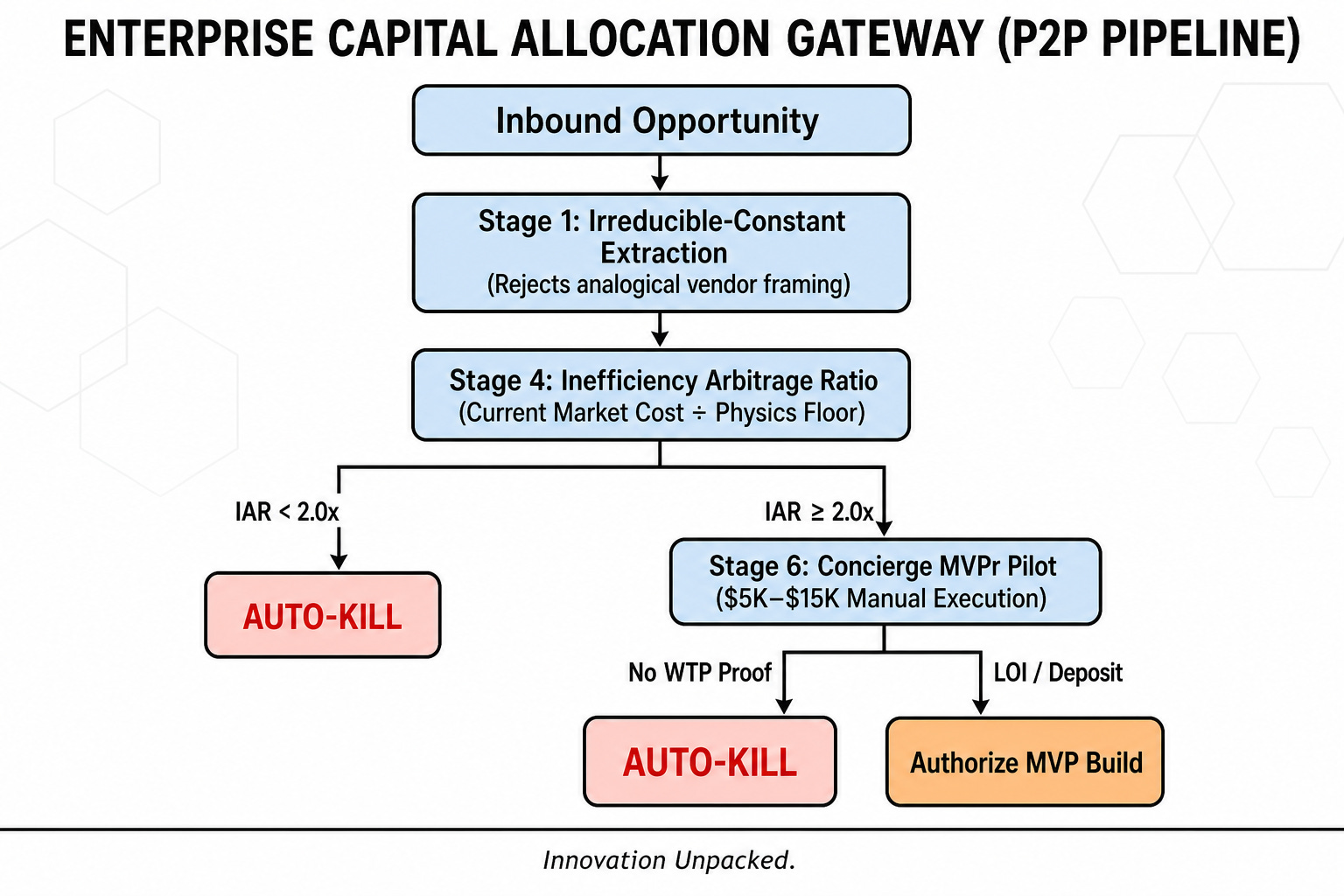
Analogical Pattern-Matching Smuggles Narrative Bias That Distorts Enterprise Innovation and Deal Diligence
Enterprise capital allocators routinely contaminate opportunity assessments by using pattern-matching heuristics based on prior portfolio investments. Investment committees and corporate development teams frequently frame new opportunities as “the Snowflake for industrial data” or “the Uber for maintenance logistics”.
This analogical reasoning introduces significant bias into early-stage diligence. Research across venture allocation shows that pattern-matching to prior investments drives 60% to 70% of initial deal-screening decisions, which tends to bias capital toward familiar narratives rather than defensible market gaps.
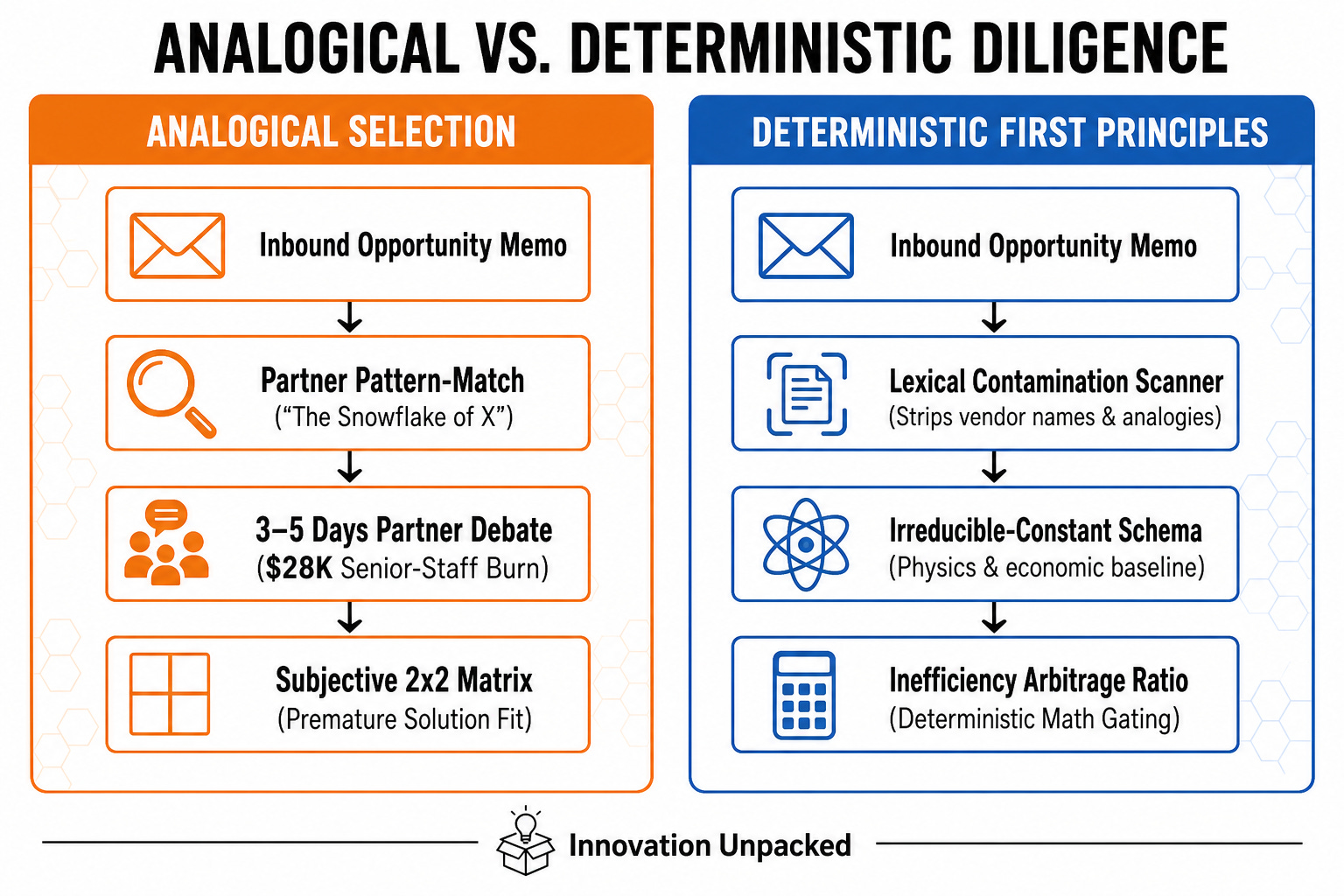
Relying on analogical reasoning creates major operational bottlenecks within corporate strategy functions. Allocating capital based on open-ended stakeholder debates typically consumes three to five days of senior partner time per opportunity, generating roughly $28,000 in senior-staff overhead during the initial screening phase.
Traditional management consulting engagements charge between $400,000 and $1,500,000 for qualitative 2x2 matrices and SWOT analyses that fail to provide a mathematically falsifiable basis for investment decisions.
Definition — Inefficiency Arbitrage Ratio (IAR): The mathematical quotient of current commercial market cost divided by the irreducible physics and economic floor cost. An IAR near 1.0 indicates market efficiency (mandating an immediate project kill), while an IAR exceeding 2.0 proves an exploitable economic gap.
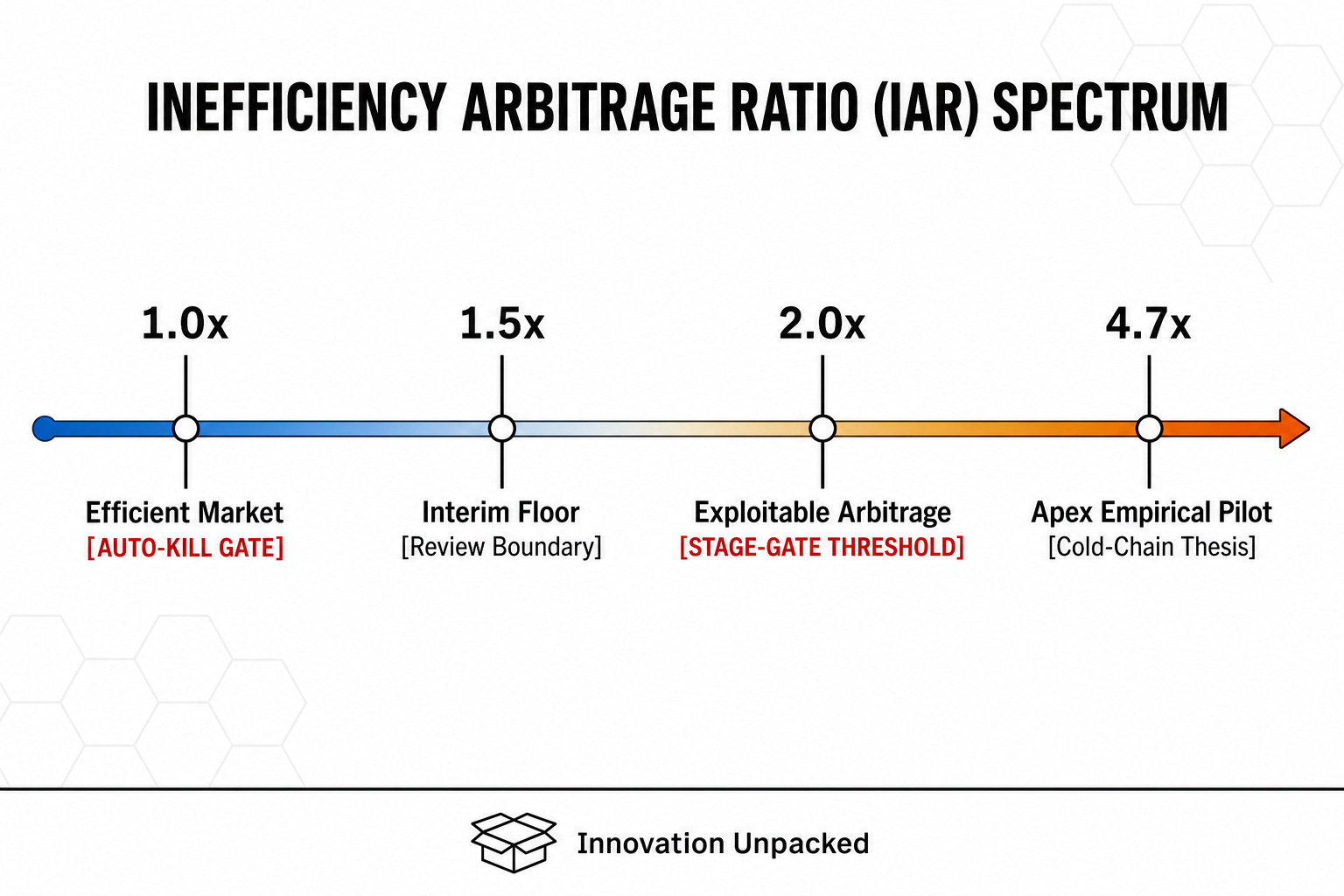
Replacing qualitative reviews with deterministic schema constraints strips analogical terms before evaluating an opportunity. Requiring opportunities to be defined strictly by their physical dimensions, quantifiable magnitude, and controllable mechanism prevents narrative-driven bias from entering the diligence pipeline.
FACT: Incorporating deterministic first-principles screening reduces senior-partner evaluation time from five days to under fifteen minutes while lowering analogical evaluation errors by up to 40%.
ASSUMPTION: Eliminating analogical language at the intake stage will not cause investment committees to bypass early-stage opportunities with unique business models.
HUNCH: Most corporate acquisitions justified by strategic adjacency are driven by internal narrative alignment rather than provable unit-economic arbitrage.
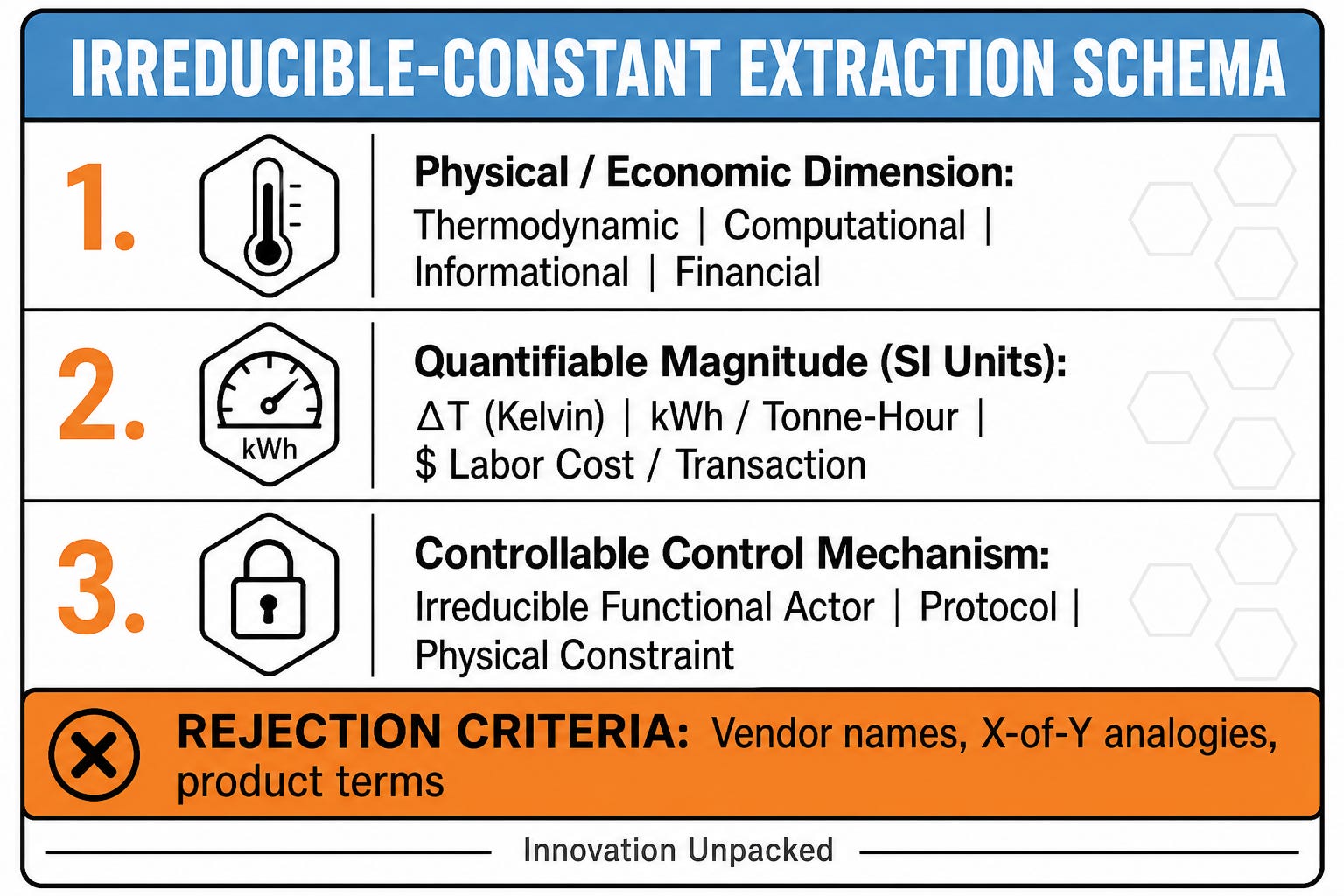
Using this approach during diligence on an industrial compressor thesis helped an enterprise fund avoid a standard qualitative debate. Rather than framing the venture as an “AI predictive maintenance platform,” the team modeled the irreducible thermodynamic wear curve and telemetry transmission costs.
This analysis established a baseline physics floor and informed an $11,800 concierge pilot across four customer sites, producing definitive demand data in eleven days. Grounding evaluation in physical and economic constants enables teams to test hypotheses systematically before releasing capital.
Structuring Capital as Sequenced Real Options Protects Portfolio DPI and Eliminates Sunk-Cost Traps
Treating innovation discovery budgets as single-engagement expenses damages long-term portfolio distributions. Traditional corporate validation models write off $500,000 to $5,000,000 consulting and prototype budgets directly against individual business units.
Because these engagements generate narrative slide decks rather than standardized, reusable data assets, the deployed capital depreciates completely once the engagement ends.
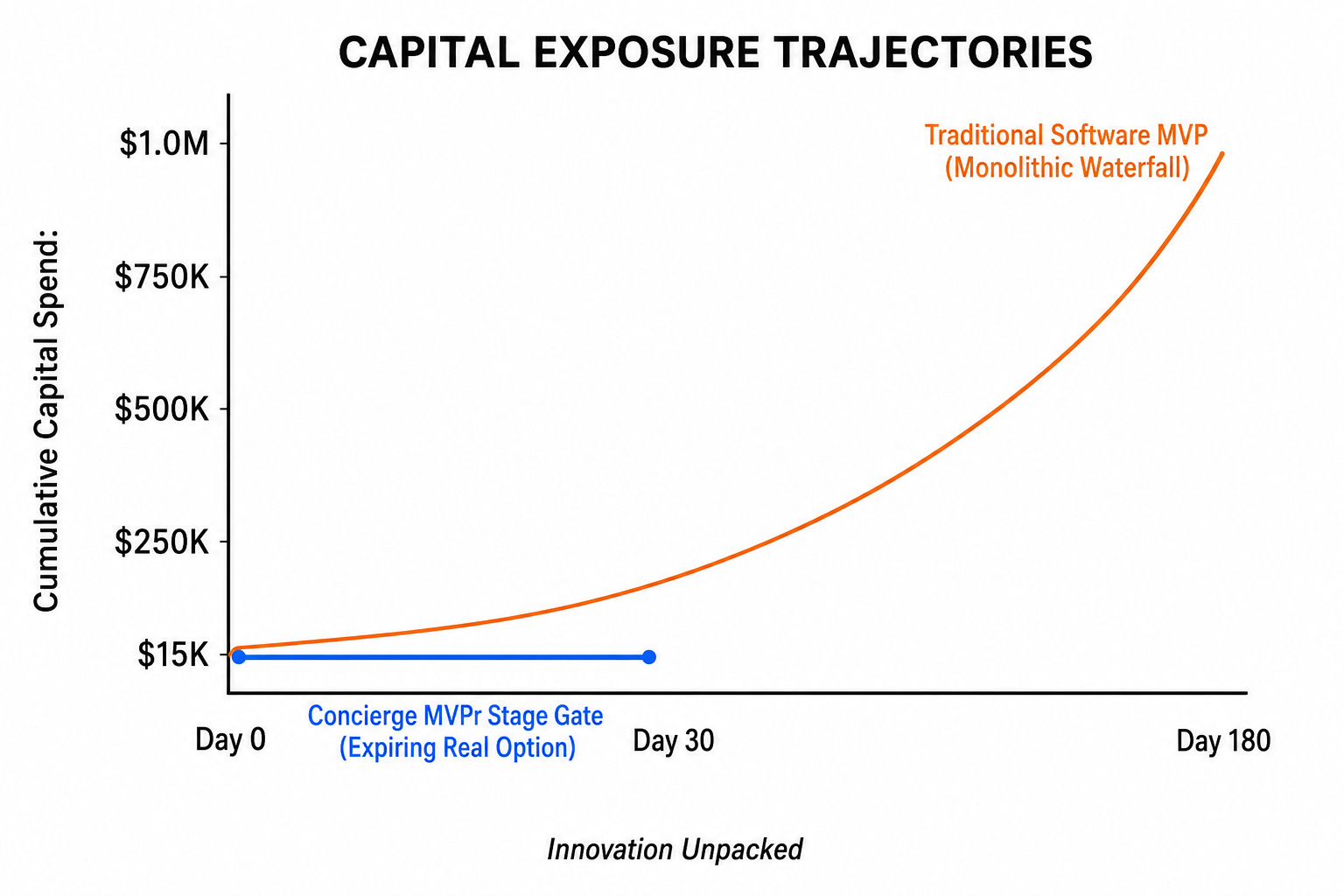
Deploying capital through staged real options protects portfolio returns by keeping initial exposure small. Allocating an initial $5,000 to $15,000 tranche for a Concierge MVPr pilot acts as an option premium to test the investment hypothesis.
Subsequent tranches are unlocked only if the initiative meets verified Inefficiency Arbitrage Ratio thresholds and customer commitment milestones.
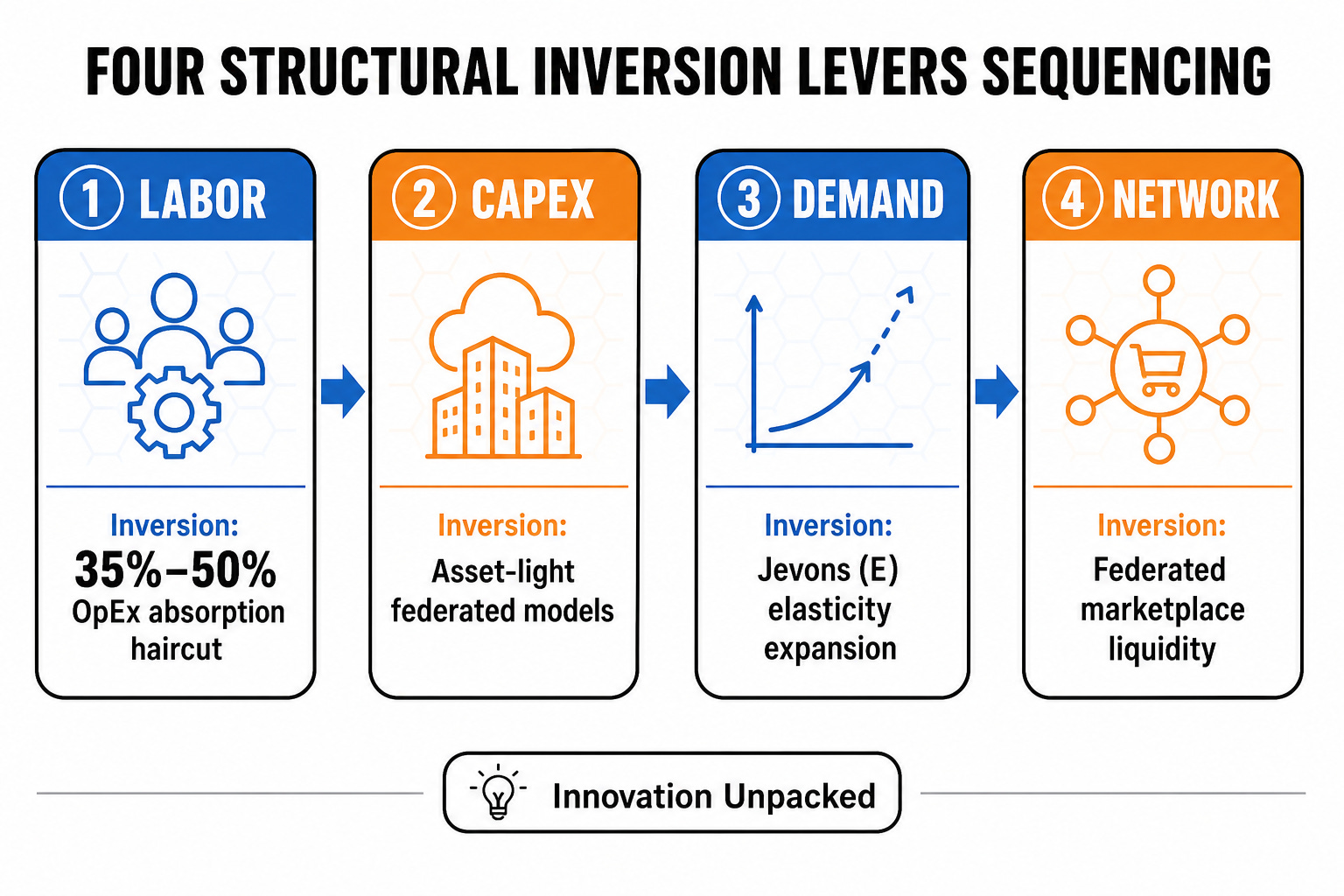
Validating the underlying business model requires sequencing four structural levers:
Labor Inversion: Automate or restructure manual service delivery to reduce high loaded-labor expenses, targeting a 35% to 50% operational cost reduction.
CapEx Inversion: Replace dedicated hardware and software builds with federated infrastructure and as-a-service operating models.
Demand Inversion: Model market demand elasticity to ensure unit cost reductions expand total market demand rather than creating administrative bottlenecks.
Network Inversion: Establish data flywheels and marketplace dynamics across partner assets to compound distribution advantages over time.
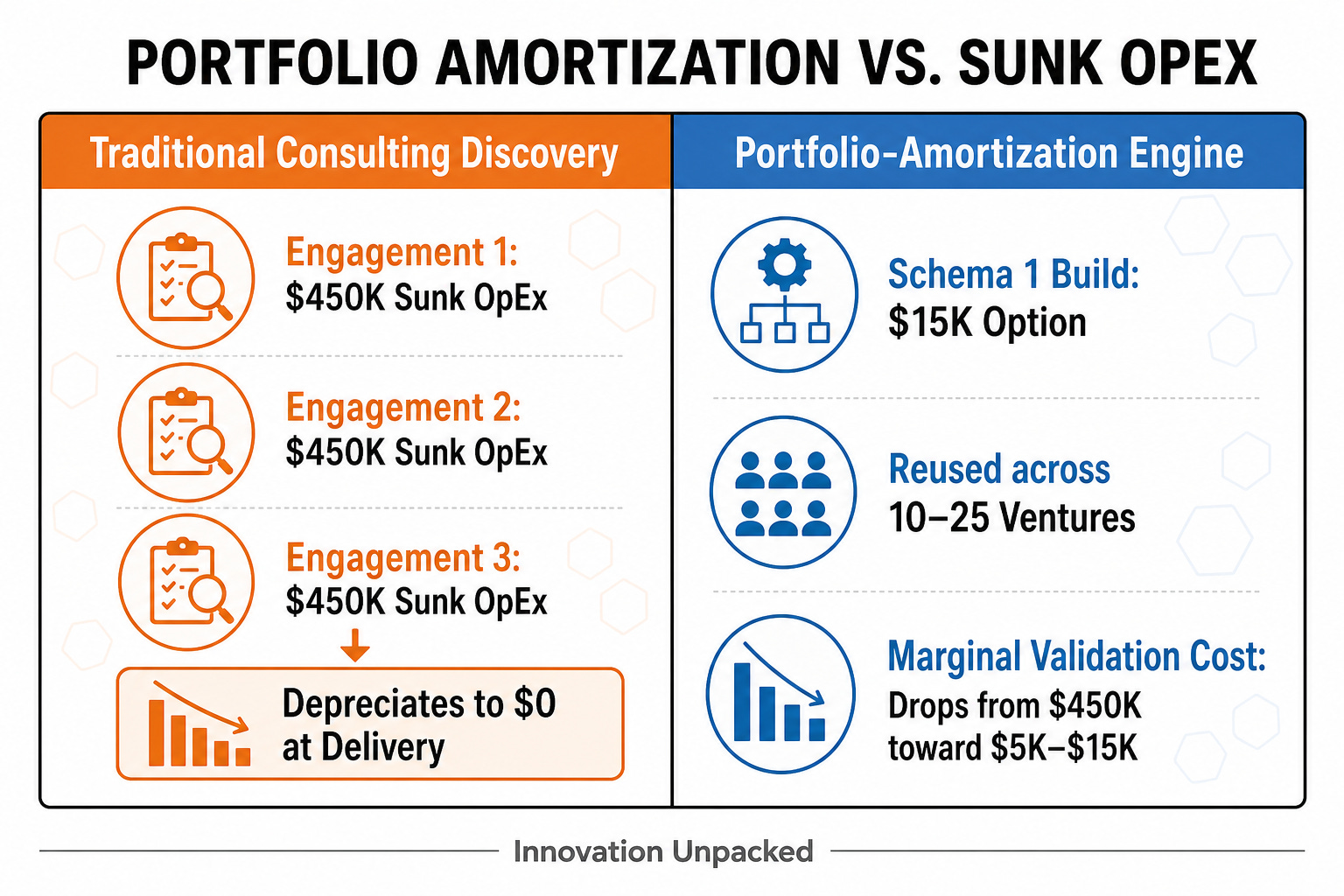
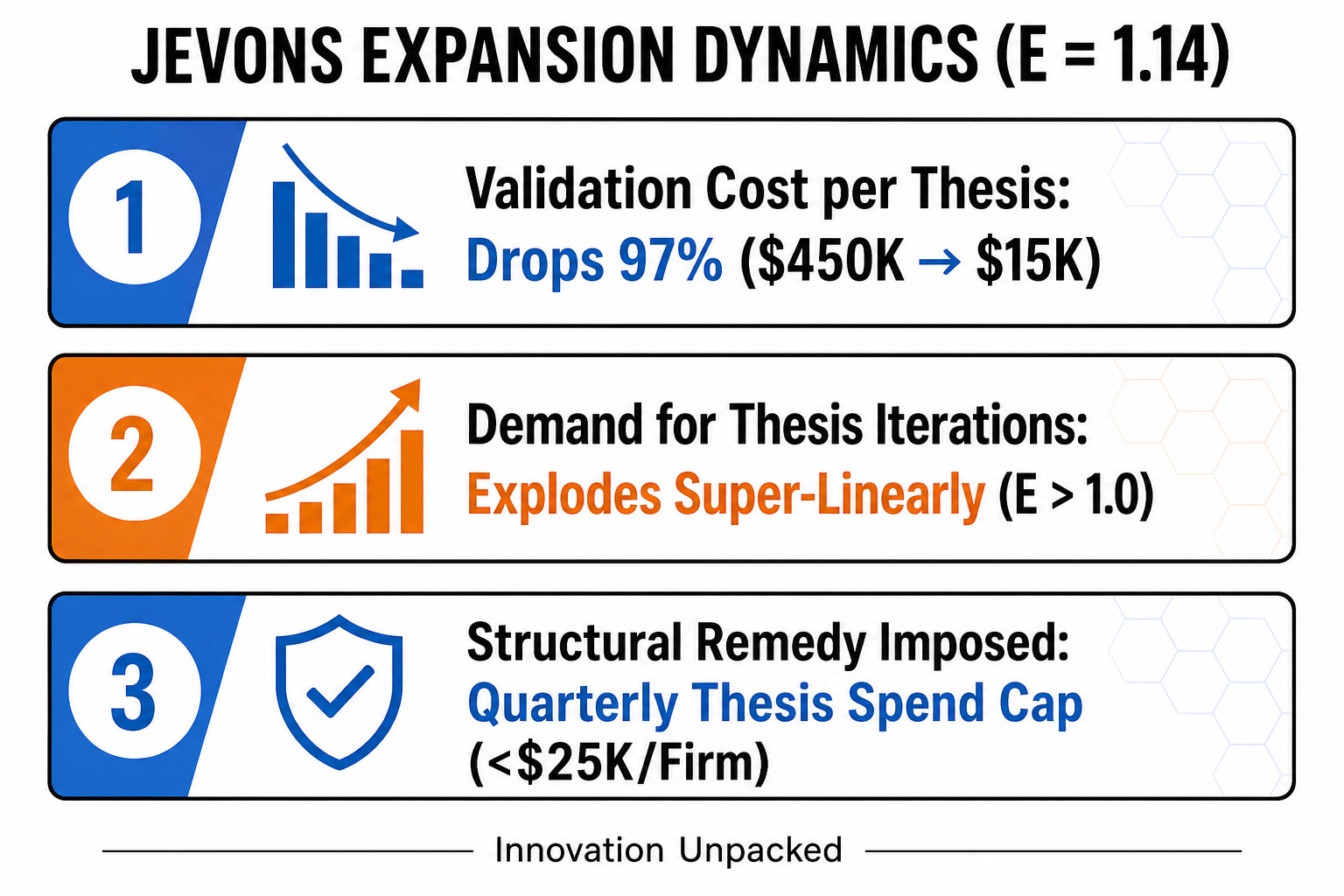
FACT: Applying a portfolio-amortization structure across reusable validation components reduces marginal per-thesis evaluation costs from $450,000 toward $5,000 to $15,000, lowering discovery expenses by up to 97%.
ASSUMPTION: Testing structural inversion levers manually within a thirty-day pilot provides sufficient data to forecast unit economics at commercial scale.
HUNCH: Most corporate ventures that fail at Series A do so because their operating models rely on linear labor growth rather than scalable structural leverage.
A corporate logistics thesis illustrated this dynamic when customer interviews pushed the team to pivot from buying fixed transportation assets to creating a federated marketplace for idle refrigerated freight capacity.
Running a manual concierge pilot proved that customer demand favored a shared-capacity network model over asset ownership. By testing the mechanic manually, the team confirmed an Inefficiency Arbitrage Ratio of 4.7x and avoided spending capital on unnecessary fleet hardware.
Appendix: If You Want the Math
The validation protocol relies on five formal quantitative instruments:
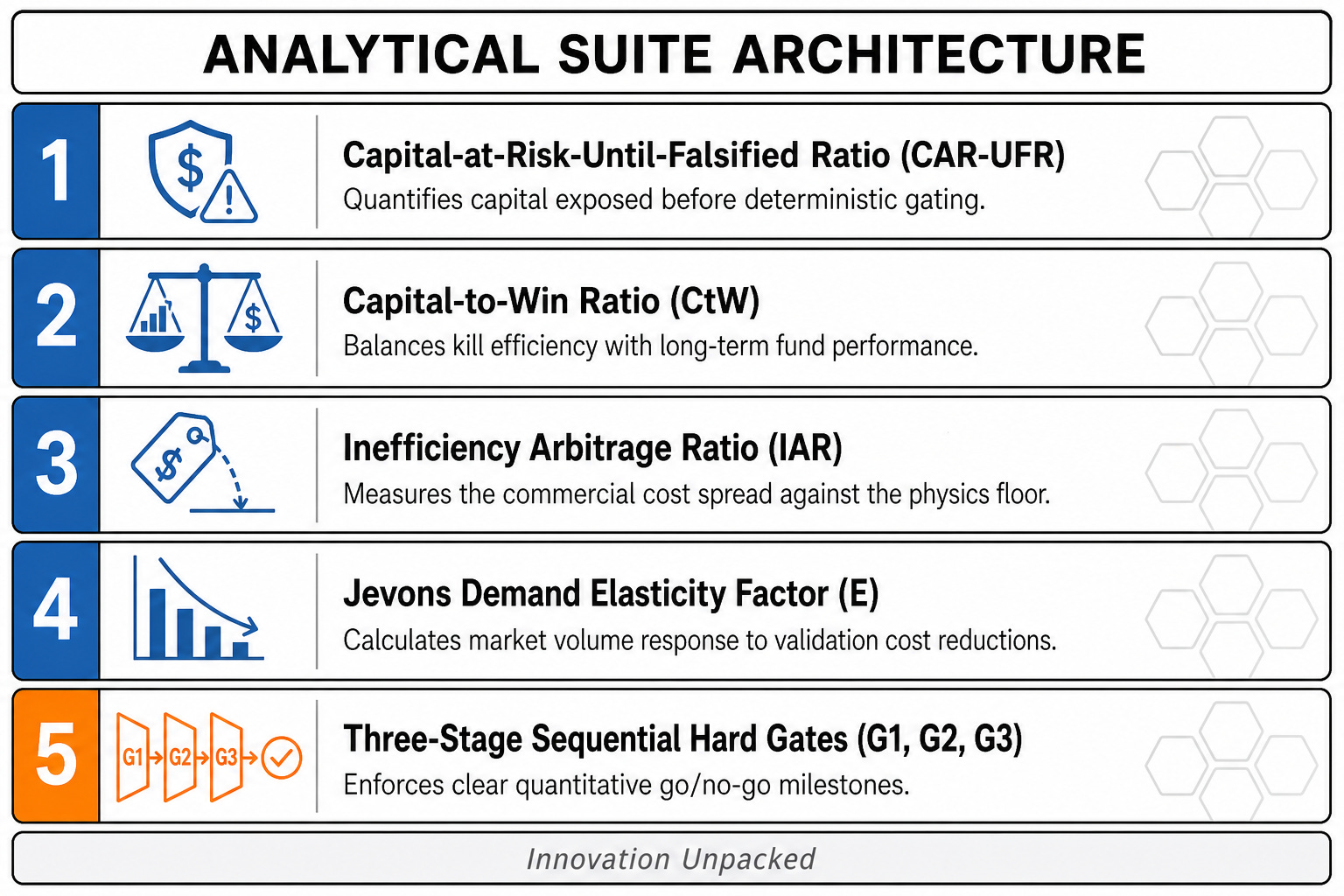
1. Capital-at-Risk-Until-Falsified Ratio (CAR-UFR)
The fraction of pre-commitment validation capital exposed to structural loss before a thesis encounters a deterministic falsification gate:
The metric divides into two reporting dimensions:
CAR-UFRvalidation: Capital lost because no falsification gate existed.
CAR-UFRexecution: Capital lost post-gate on go-to-market or operational execution.
2. Capital-to-Win Ratio (CtW)
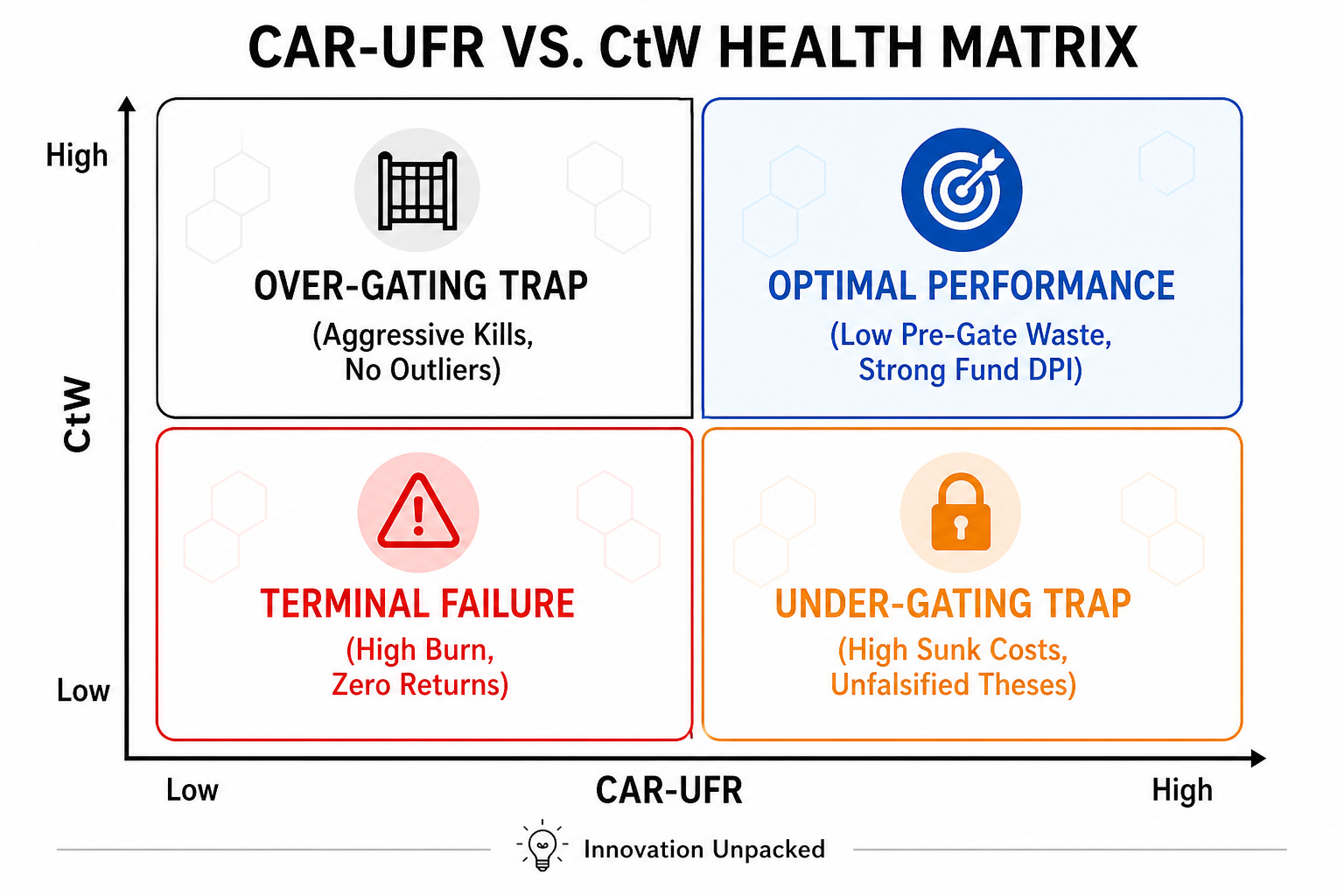
To ensure the framework does not simply incentivize killing all prospective projects, CAR-UFR is paired with the Capital-to-Win ratio:
Target System Dynamic: CAR-UFR at or below 0.10 with CtW at or above 0.35.
3. Inefficiency Arbitrage Ratio (IAR) Engine
The mathematical anchor evaluating the spread between commercial market pricing and irreducible physical limits:
Where:
Cmarket represents fully loaded commercial costs (loaded labor rates
R_i, hours Li, and overhead Omega).Cphysics
Phi(t)work function plus irreducible transaction inputs xi).
4. Jevons Paradox Demand Elasticity
Evaluates whether reducing discovery costs triggers unmanageable pipeline volume:
When
E = 1.14 (E > 1.0), reducing validation costs by 90% expands demand for scenario iterations by a super-linear multiple.Governance Control: Impose an allocator-level quarterly thesis spend cap under $25,000 across a designated cohort to prevent reviewer queue bottlenecks.
5. Three-Stage Sequential Hard Gates (G1, G2, G3)
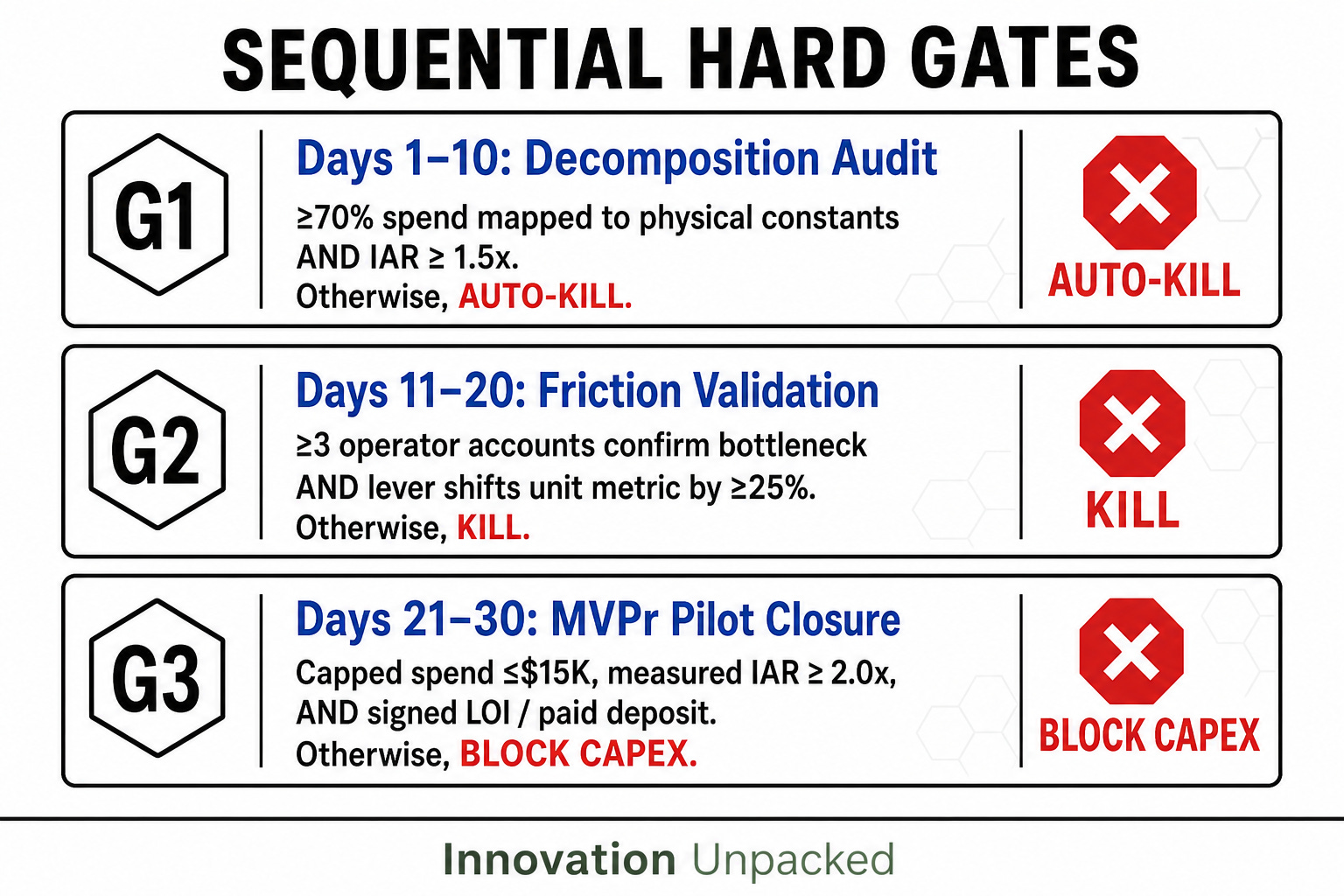
[G1] Days 1-10 (Decomposition Audit): Cost audit maps at least 70% of target category spend to first-principles constants with an interim IAR of 1.5x or higher. If unmet, auto-kill and log to repository.
[G2] Days 11-20 (Friction Validation): Document at least 3 independent operator accounts of target friction, confirming the structural lever shifts unit metrics by 25% or more. If unmet, stop sprint and pivot inversion axis.
[G3] Days 21-30 (MVPr Pilot Closure): Concierge pilot (capped at $15K) achieves measured IAR of 2.0x or higher and at least one signed LOI or cash deposit from a verified buyer. Total pilot spend cannot exceed 15% of the proposed software MVP build budget. If unmet, block software build disbursements.
Close
Institute a mandatory governance policy that pauses all software engineering capital allocations until a manual Concierge MVPr confirms customer willingness-to-pay and clears a 2.0x Inefficiency Arbitrage Ratio.
How many active initiatives in your current venture or innovation portfolio are burning six-figure software budgets to validate assumptions that an associate could test in fifteen days using a manual spreadsheet workflow?
Is your organization interested in differentiated innovation? The world is changing quickly. If you’re not adapting to those changes, you’re not innovating. Seeking reassurance from consultants fails, nearly always (sometimes they get lucky). I work with organizations who are serious about attacking problems using first principles. Many have been burned once, and they don’t want it to happen again. Is that you? (my availability is limited).
Book an appointment: Click here
Email me: mike@pjtbd.com
Call me: +1 678-824-2789
Join the community: Click here
Follow me on 𝕏: https://x.com/mikeboysen
Articles - jtbd.one - De-Risk Your Next Big Idea
Research - studio.jtbd.one/research
Apps - studio.jtbd.one/apps
Slaying the Sacred Cows of Innovation