


Most Heads of Product 😕 lack clarity on innovation problems
They release features that add cost and complexity to an overserved market segment 📈 or completely miss the market altogether
They blame marketing and sales for not hitting their numbers 📉
They use backward-looking behavioral data that doesn’t account for non-customers 🔙who are also trying to solve a problem
They obsess over competitor features - as though their competitors have a crystal ball or something 🤔
They treat pain points but don’t understand the root customer problem 🚑
They focus on surface-level problems because their cognitive dissonance is too extreme to easily overcome. Blaming external factors is an easy escape. 🏃♂️💨
"Let's fire the influencers and industry analysts, they have no clout" 🔫
"The Sales team couldn’t close a deal if their life depended on it!" 💼❌
"Let’s get a new CDP so we can upscale our personalization strategy" 🔄
They are re-arranging the deck chairs while the ship is sinking 🚢⬇️
And the causes are often the same:
Too product-centric → "Our product is the best, we worked so hard on it" 🏆
Not customer-centric enough → “If we build it, they will come" 🛠️🚶♂️
Too much sunk cost to chart a new course → "We can't change this now, that wouldn’t look good" 💸
As a result, innovation problems, bias, and egos are silently destroying the business and brand. 💔 Sometimes before they really get started.
How can you move forward to leave these problems in the past? 🛤️
Head of Product: “I recently completed a two-week meditation and fasting retreat in the mountains and feel as though my ego has dissolved. What steps should I take next?” 🧘♂️🏔️
Me: “Let’s take a closer look at the 4 layers of innovation problems.” 🔍
Your organization should not be a portfolio of siloes…
Tactical Problems - Surface Level 🎯
You may need to change the way you engage with your customers. However, these are not the critical issues in your product responsibilities. Have your teams develop a backlog fast, easy, and cheap experiments to see what shorter-term levers you can pull 🛠️💡
Operational Problems ⚙️
You may need to plan for operational changes, so consider auditing your systems, teams, and performance measures to realign your operations 📊
Strategic Problems 🧭
You need to align your business strategy with the market ASAP. Work with your peers to ensure the organization understands and agrees to your ideal customer profile, your product positioning, the offering, and also the messaging. Each day you procrastinate without addressing these strategic issues the perceived value of your product and brand diminishes ⏳
Insights Problems - Core🌱
You need to reconsider the way you define your market, as well as how you identify, capture, and measure customer needs. Without that, you have no way of truly innovating - and innovation has a definition that suggests it needs to be demonstrated in the market - which you’re not doing. You're not an innovator until you can identify the true nature of markets, how to identify value gaps that will serve you and your customers well into the future, and exploit them successfully, demonstrably, and repeatedly. It might be time to find a new problem to solve 🚀
Product Leaders really need to rethink things…
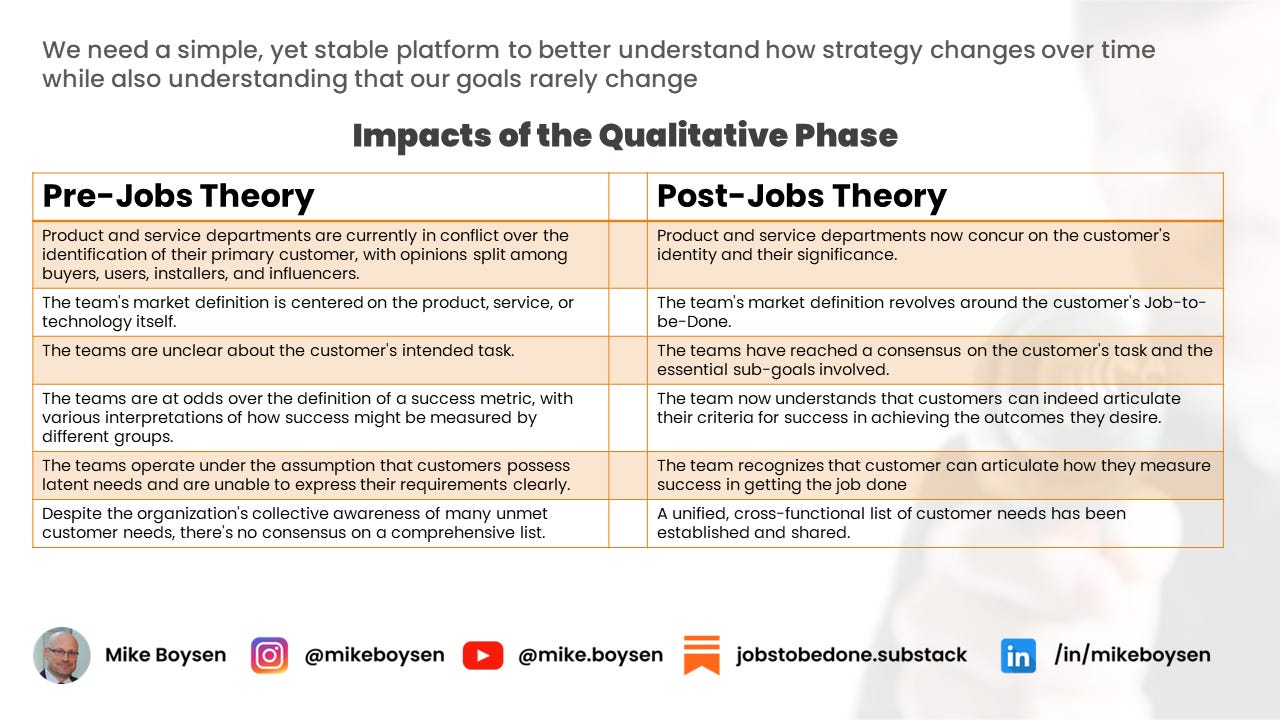
Upon completion of the qualitative phase, the product and service design teams will share a common (yet understandable) innovation vocabulary and possess a unique set of customer insights (a semantical value model of the problem-space / market) that can be used to make customer-centric marketing and development decision. Because the Jobs and performance metrics are stable over time, these qualitative insights are an indispensable, long-term guide to success at developing innovative strategies.
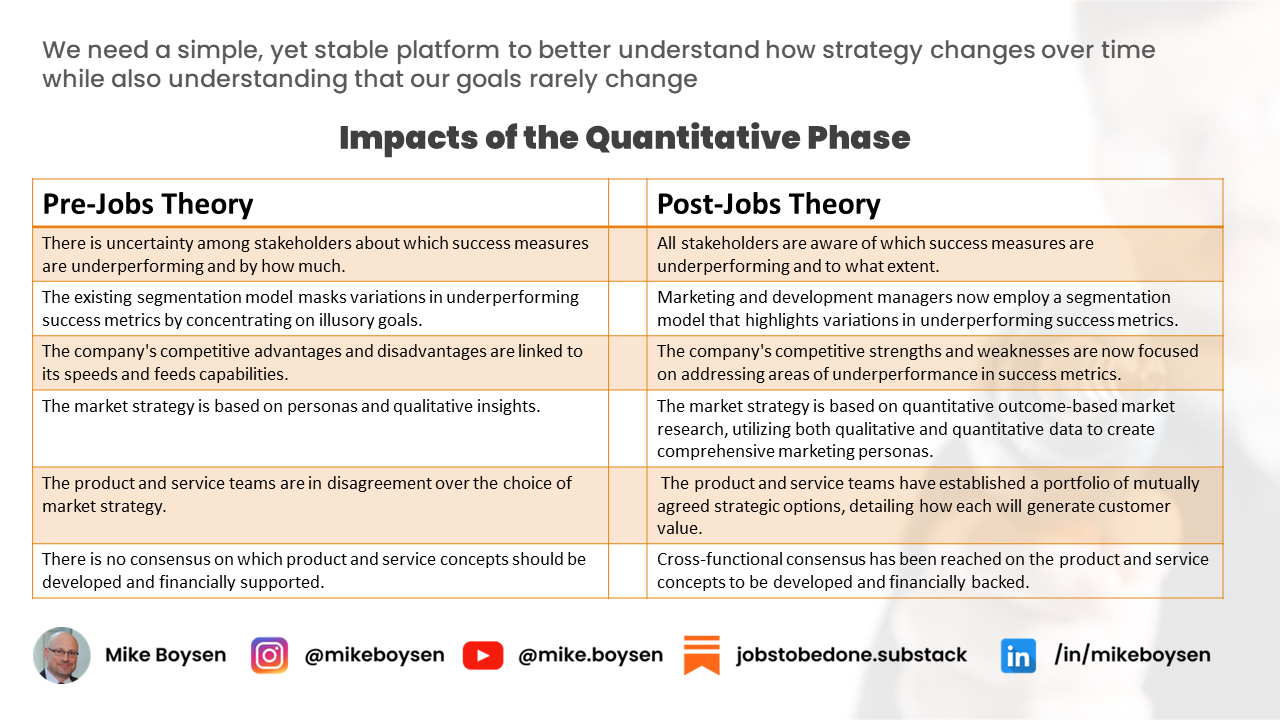
For years to come, the model built from this data will help the team conceptualize target and valuable ideas for possible pursuit.
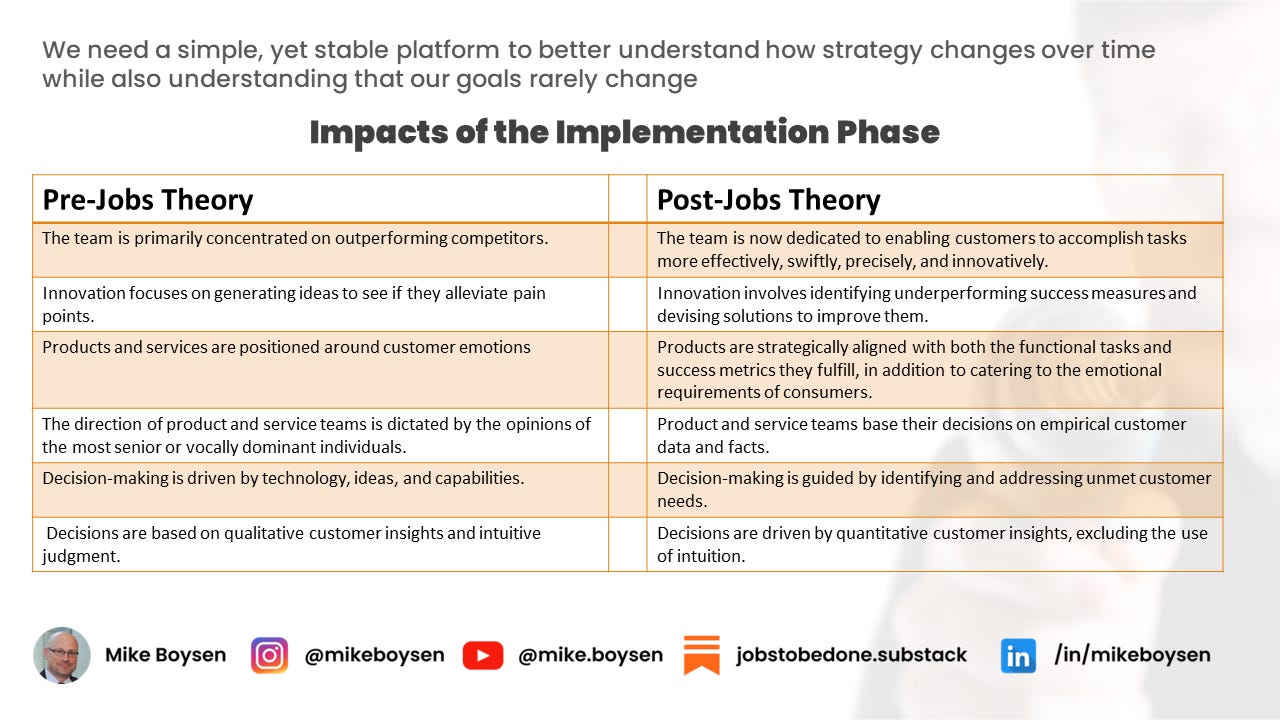
Upon completing of the Implementation Phase, the product and/or services teams will possess the ability to use outcome-oriented market research data as well as market and product strategy insights to consistently make business decisions that create customer value. They will have an outcome-oriented mindset, and your company will have successfully created a customer-centric culture of innovative strategy design. A product and/or services team can expect to complete its three-phase outcome-oriented journey (including several no cost iterative cycles) in one to two months (not one cycle in four to six months).
I help enterprises of all sizes - and stages - to better understand customer needs 20x faster, and 10x less expensively than old school practitioners (experts who have never innovated)👨🏻🦽 that can result in business model, product and service, and customer experience innovations. 💡
My schedule fills up fast, so if you have an urgent problem to solve, reach out and I’ll try to get you on the schedule 🤝
#marketdefinition #marketsegmentation #valueproposition #portfoliostrategy #customerexperiencestrategy #innovationroadmap #productdevelopment #jtbd