

Some of you have followed me for a long time, and others have just stumbled upon me. I’m sure the latter group is confused about my take on Jobs-to-be-Done (JTBD), so I’ve decided to take some time to explain things — and what I’m building — with as little confusion as possible. I assume everyone reading this is interested in innovation — not the word (which is heavily abused), but the concept. The first thing you need to know about me is that while I haven’t created the next Facebook, I do have an innovator’s mindset.
I’m not an inventor.
I’ve always cobbled things together to solve problems that no one else wanted to tackle. This was true when I was a bank examiner, when I was coding solutions in the digital transformation space, and now as I try to close the numerous gaps in what has been my favorite theory and methodology for the past 15 years.
The Problem with JTBD
JTBD has been adopted across many disciplines that have nothing to do with innovation. Yes, I realize they will all claim that they are responsible for innovation — from designers to marketers. BUT THEY’RE NOT! 😂 There’s a reason we have different words. If you can’t accept that, I can’t help you.
JTBD has been about innovation since it’s inception — and no one really knows what that was. 🤣
Everyone is essentially a consumer of innovation research outputs, though. Innovation is an end-to-end process. Unfortunately, each function in the chain rarely gets useful inputs.
What I’ve learned in my career is that when something is failing, upstream roles absorb the responsibilities of downstream functions just to get their own jobs done. When a Type-A sales person — compensated to close deals this period — has to hunt for their own leads because the marketing organization is ineffective, it’s a disaster. Closers generally don’t have the personalities, or the motivations, to nurture opportunities that will close in future periods.
The other thing I’ve learned is that every industry drives to zero (eventually) and that solutions that don’t get the job done stagnate, or die. I’ve seen many family-owned businesses well into the middle market in this exact situation. They reason from analogy a lot. Sure, they’re surviving, and the family is doing well. But when growth is zero and GDP growth is 4%, you’re actually shrinking. You’re destroying value and no longer creating it.
If I’m not making sense, or you don’t like where this is heading, you probably shouldn’t read any more of this because it’s about to get brutal. 😉
The long and short of it is this: JTBD lives in two camps. One camp is built on word-salad. The other generates data that doesn’t always mean anything.
Some New Concepts
There are several concepts I’m going to bring up as you read further, so let me get them out on the table early.
First Principles
Within my Principle to Priority framework, First Principles thinking serves as the foundational deconstruction mechanism — designed to systematically strip away analogical reasoning, industry dogma, and premature solution-bias before any capital is deployed. Operationally, this is executed during the initial “Option to Explore” phase by pairing Socratic interrogation with a dedicated First Principles Calculator that reduces business challenges down to their undeniable physical, digital, or statutory axioms. By establishing this theoretical minimum baseline (the denominator), the framework calculates an “Inefficiency Index” to quantify commercial bloat, directly driving 136 subtractive innovation levers that mandate aggressive deletion and simplification over incremental additions. This approach ensures that the subsequent stages of Jobs-to-be-Done mapping, mathematical validation, and structural inversion are anchored to absolute bedrock truths — transforming enterprise innovation from a high-risk, analogy-based gamble into a deterministic, de-risked pipeline.
10 Types of Innovation
Within the Principle to Priority framework, the 10 Types of Innovation methodology is deployed to move beyond easily replicable product features and construct highly defensible market positions. Operationally, this is utilized by the Multipath Synthesizer to formulate comprehensive strategic directions — specifically, sustaining and disruptive investment pathways that are complementary and designed to build funding and trust bridges toward a properly designed agentic future. By explicitly shifting focus away from mere “Offering” updates, the framework wraps the core product in Configuration moats — such as innovating the Profit Model, Network, Structure, or Process — and Experience moats — like elevating Brand, Service, and Customer Engagement. This ensures that the strategic Real Options generated for the Value Creation Plan not only solve validated customer pain points but also surround the solution with robust, multi-layered business model defenses that competitors cannot easily duplicate.
Minimum Viable Prototype
Within the Principle to Priority framework, the Minimum Viable Prototype (MVPr) methodology is deployed to de-risk the core logic of a solution before committing to building scalable infrastructure. Operationally, this is utilized during the “Option to Build & Test” phase to construct a manual, “Wizard of Oz” concierge service that directly targets the highest-ranked Job-to-be-Done pain points and friction. The purpose is to prove the unit economics and the new solution mechanic in reality — without requiring premature, massive capital expenditure on software or factories. By explicitly shifting focus away from immediately building scalable Minimum Viable Products (MVPs), the framework tests the structural inversion using targeted prototype capital. This ensures that any strategic initiative provides empirical proof of 10x value creation, granting the ultimate right to the “Option to Scale” only when the solution’s efficacy is undeniably validated.
In other words: what do you actually do with dots on a plot — OR — what does Product-Market Fit actually mean?
Real Options
Within the Principle to Priority framework, the Real Options methodology is deployed to reframe innovation funding from a monolithic, high-risk gamble — often driven by the five-year forecast fallacy — into a staged, systemic process of buying information. Operationally, this approach breaks capital deployment into three distinct, gated bets: the Option to Explore (deconstructing the problem to its physics and mathematics first principles), the Option to Validate (quantifying the market opportunity via rigorous statistical scoring, if necessary), and the Option to Build & Test (proving the unit economics through a targeted Minimum Viable Prototype). The core insight is that R&D budgets should not be treated as sunk costs, but as strategic premiums paid to purchase the right to proceed or the right to abandon an initiative with minimal capital loss. This ensures that organizations only unlock the ultimate “Option to Scale” once they have systematically de-risked market, financial, and technical assumptions — allowing disruptive ideas to be securely funded while killing incremental waste early.
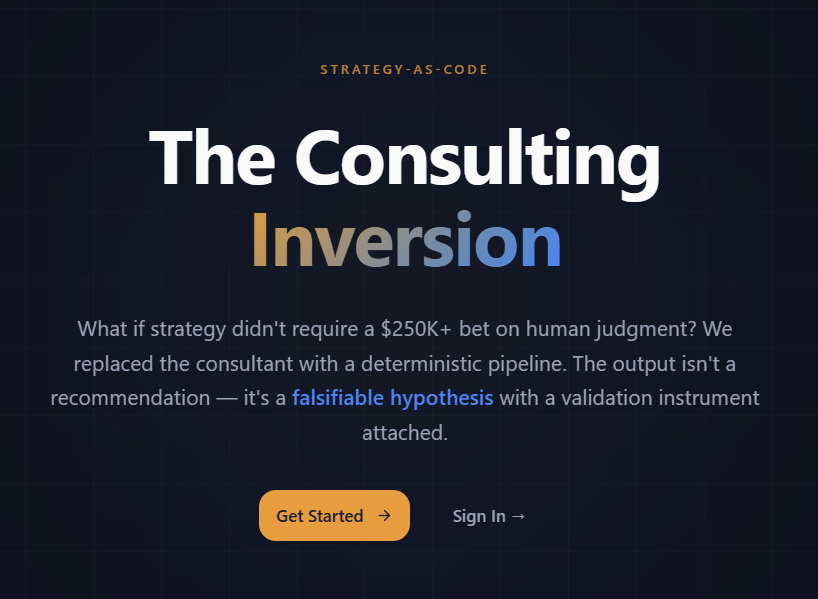
The Tear Down
This is where I begin carving up the sacred cow. It’s not going to taste as good as the beef you normally eat, because this one is nearly 35 years old. It’s been a milking cow for that entire time — milked to death 🤢. The beef needs a generational leap forward so we can all get that 95% bioavailable innovation nutrition and move beyond the survivorship bias and consulting math used in marketing. 😂
The Algorithm (aka the Musk Loop)
This concept should not be new to experienced transformation consultants. We’ve all joked about others who didn’t get it like we did 🤡. We joke about things like:
Old Organization + New Technology = Expensive Old Organization
However, as is usually the case, these cutesy sayings never give you a real solution. While everyone can agree with this saying, most don’t know how to avoid it. I’m going to rectify that right now.
The Musk Loop is a strict, sequential heuristic designed to aggressively eliminate bureaucracy, waste, and physical complexity. It must be executed in the exact order below; otherwise, it risks “optimizing waste.”
First: Question Every Requirement or Idea (Make them “less dumb”) — Assume all requirements are inherently flawed to some degree (regardless of who they came from). Every rule or requirement must be tied to a specific, named individual — not a vague department like “Legal” or “Safety” — so they can be rigorously interrogated and challenged.
Second: Delete the Part or Process — The default corporate bias is to add; this step demands ruthless subtraction. The guiding metric is the “10% rule”: if a team isn’t eventually forced to add back at least 10% of the parts or processes they removed, they simply aren’t deleting enough.
Third: Simplify and Optimize — Only optimize what has survived the aggressive deletion phase. The most common and catastrophic error made by smart engineers is spending immense intellectual capital perfecting a component or process that shouldn’t exist in the first place. 😜
Fourth: Accelerate Cycle Time — Once the process is justified, stripped of all fat, and simplified to its absolute core function, the focus shifts to sheer velocity. Move faster. Shave time off the cycle — but only after completing the first three steps (”If you’re digging your grave, don’t dig faster”).
Fifth: Automate — Robotics and software automation are introduced strictly as the final step. Attempting to automate an un-optimized or bloated process will only bottleneck production. Clean up the engineering, shake out the bugs, and only then automate the verified, frictionless process.
What Have I Challenged?
The end result of this step is a clear foundational principle which we use to identify the Job Executor and the Job to be Done. No more consulting opinions from people who have never been there and done that.
With regard to JTBD, I challenged quite a few things:
I challenged whether the human-based process of the past 35 years creates the proper starting point. Every problem-solving technique I’ve read about begins with a clear problem. JTBD does not. We leap to the conclusion that a 3-to-4-word job statement (an objective) has enough context. We then recruit people that fit the job to validate the job. Of course they will validate the job. 100% of the time!
I challenged the pureness of the 100% human approach due to the variety of cognitive biases that come with it.
I challenged whether we need to have surveys at all.
I challenged whether innovation requires a human to create a job map, metrics, and all of the other dimensions of a traditional JTBD value model.
I challenged whether the opportunity landscape — or a BCG Matrix — is good enough to have a high success rate in innovation or to formulate a strategy.
I challenged why it takes 4–6 weeks to build and validate (see above) a JTBD value model before a survey can even take place.
I challenged why it typically takes 4 months to get a market survey to completion, just to look for a problem (that may not exist).
I challenged whether you need a data scientist to find nuggets that might correlate to growth.
Essentially, I’ve challenged the time and cost associated with strategy consulting that almost always fails to produce the results that were hoped for by the client. (They all claim wild success, though. Isn’t that interesting?)
What Have I Deleted?
This is where it gets really ugly — but I think beauty comes from simplicity. No smoke, no mirrors. There comes a point where things have to be deleted. Seriously, if you’re an innovation consultant, you simply can’t continue believing that your methodology can’t be improved. Not only improved — disrupted. That’s what you preach, so why is it only true for everyone else?
The point of deletion is about getting the ultimate job done completely differently. We always say this, but the reality is that the violent deletion of the current ways is the only way to make that happen.
I deleted the 200-question surveys that are based on a biased starting point. They are ridiculously expensive and there is almost no guarantee that you’ll find a real problem, or know what to do with the data points. They are designed for the consulting lifestyle, not innovation. I no longer intend to replace them with simulations either. Average executive decision-makers wouldn’t know what to do with them — and it would add undue complexity, needing to be simplified in the next step, regardless.
I deleted the consultant as the doer. They are no longer useful and are far too expensive for the entire market to embrace. That’s right — we aren’t all Fortune 500 companies, but we all want to grow. Traditional consultants don’t care about you if you don’t have a $500K to $2M budget (per project).
I deleted the human doer internally as much as possible. Their role is elevated to a governance role — the human-in-the-loop that approves, challenges, and steers rather than manually constructing every artifact.
I deleted the automation-slapped-on-top of a tired methodology. If you see that (like using AI to analyze survey data), you’re witnessing a group that has never successfully implemented a true transformation. They certainly haven’t gone through this process. The have not eliminated any of the expense. And time? If you don’t trust the LLM then you’re spending just as much time.
I deleted the expensive exploration for a problem and introduced the strategic hypothesis (based on first principles) that needs to be tested instead.
Elon Musk: Don’t ignore the richest human on the planet — the guy who lands 30-story rockets in chopsticks and creates cars that drive themselves (amongst other things). Do ignore people who have never done these things. Elon does not do surveys. In fact, like Steve Jobs, he doesn’t talk to people before he builds things because he works from First Principles, and consumers are not engineers. He does talk to them after he launches a product. Throw your politics (or pride) out the door; innovation has nothing to do with that. You need to make your choice.
What Have I Simplified and Optimized?
Job Executor identification is automatic. You no longer need to ask yourself who is the job executor and what is their job? The system derives the first principle, identifies the executor, and presents you with candidates — you just pick one (or challenge it).
Qualitative Interviews become the first decision-gate. (see below) Questions are develop for the friction steps only, with probes. If 6-8 people who have this problem do not validate that, your option to explore expires. But, the data gets saved to a semantic graph.
Surveys are not always required and when they might be useful, they are dramatically shortened — targeting the specific friction points the data has already surfaced, not fishing for problems.
Bad ideas are filtered out quickly and no longer require a $250K+ consulting engagement that leads to nowhere. If the Inefficiency Index (N/D ratio) shows a gap near 1.0, the system tells you — no amount of storytelling changes that number.
First principles are agentically determined and human-validated. No need to attend seminars on Socratic interrogation. The system deconstructs the problem to its physics floor; you review and bless the result.
I use a mathematics and physics approach to define the relevance and size of the problem, and use this data to identify which steps in a job have the most friction in the current state. I also do this across proposed future paths since the level and cause of friction will change. This means surveys — when used — are shorter, simpler, and laser-focused on the true problem(s).
Workshops — while sometimes still useful — are no longer used for ideation. They take concepts the system has surfaced and perform final validation on them. The system uses 4 structural inversion levers and 136 subtractive innovation triggers to make surfacing innovation concepts simple and systematic.
Every job step is traceable to an axiom. Deleted the consultant.
Every success metric is traceable to an axiom. Deleted the consultant.
There is no longer a need to rely on scaling through highly talented headcount for data collection and analysis. That’s no longer sustainable when you will soon be competing against agentic-first competitors.
What Have I Accelerated?
What used to take months or even quarters now takes minutes or hours. The key is applying agentic AI at the correct locations in the pipeline — not automating the existing process, but accelerating a completely new way of getting to an investment decision faster and less expensively.
We leap forward to a strategic hypothesis based on first principles and validate that — instead of wasting half a year and a fortune hoping to develop a strategy with a method that is often inconclusive.
Interview guides are generated for you — targeted at the highest-friction steps in the job map. Transcripts are analyzed for you. The resulting analysis is incorporated into your strategic hypothesis for you.
Now we are testing a hypothesis, not a consultant’s imagination. The system produces a falsifiable claim (the N/D ratio) — not a narrative.
Falsifiable components are created for you — including explicit PASS/FAIL thresholds and kill conditions so you know when to proceed and when to walk away.
Initial design of the MVPr is created for you. A full 7-section Wizard-of-Oz concierge execution plan is generated from the research package. You only need to tweak it.
Business systems are developed automatically from the data already generated — Business Model Canvas, strategic pathways, competitive positioning, and more. Human governance only.
What Have I Automated?
This is the final step in the algorithm for a reason. Everything above — the challenging, the deleting, the simplifying, the accelerating — had to happen first. If I had automated the old methodology, I would have built an expensive machine that produces the same mediocre results faster. That’s what most “AI-powered JTBD” tools have done. They are exhibit A of OO + NT = EOO.
Here’s what is now automated inside a deterministic, schema-validated pipeline:
Deep research and OSINT dossier generation. The system programmatically searches the web for real-time labor rates, pricing benchmarks, CapEx figures, and empirical elasticity proxies — then extracts structured variables from raw search results. No stale data. No invented numbers. Source URLs preserved for auditability.
First Principle derivation. The LLM deconstructs the user’s strategic problem to its indivisible physical, digital, or economic truth — forced through strict structural schemas, not freeform essays. The output is reviewed by the human, not created by them.
Job Executor identification and Job Statement generation. Executor candidates are surfaced with reasoning. The user selects or overrides. The ODI-compliant job statement is derived from the first principle, not from a brainstorming session or worse, a consultant.
Job Map construction. A chronological, solution-agnostic process map — with measurable success criteria for every step — is generated automatically. The human reviews, reorders, and blesses it.
ODI (or the Practical version) success metrics generation. Outcome-Driven Innovation-style success metrics are generated per step, traceable to axioms. Batch or individual — either way, the consultant is not building these by hand.
Structural inversion evaluation. Four disruption lenses (Labor, CapEx, Demand, Network) are evaluated at the highest-friction steps — deterministic scoring with temperature locked to 0.0 for reproducible results.
136 subtractive innovation triggers. Twelve categories of innovation triggers are automatically evaluated against the strategic problem and the job map — surfacing specific mechanisms for deletion, simplification, and structural change.
Three-pathway strategic synthesis. Paths A, B, and C are generated and conditioned on the Elasticity Factor — determining whether sustaining innovation is bankable or a Jevons rebound trap, and whether structural inversion is optional or existential. This is not a judgment call; it’s a computation.
Competitive analysis. 10 competitors are extracted (Direct Traditional + Non-Traditional Disruptors), each with defensibility scoring across 7 dimensions, catchability diagnostics, and lock-in indicators.
Adversarial stress testing (Tribunal). A 3-agent adversarial tribunal — Prosecutor, Defender, Judge — attacks the strategy. The resilience score is deterministic arithmetic:
100 − (100 / total_charges) × upheld_charges. No LLM math. No hallucinated scores.Business Model Canvas generation. Automatically synthesized from the full research package — inversions, triggers, pathways, competitive moats — not from a sticky-note workshop.
Multi-chapter strategic report. A 10+ chapter document is generated via streaming — including Playing to Win Cascade, Real Options Pipeline, and a full competitive landscape — with chapter navigation and PDF export.
MVPr concierge execution plan. A 7-section Wizard-of-Oz pilot plan is generated in parallel — covering the falsifiable hypothesis, concierge roles, customer pilot profile, day-by-day playbook, data systems map, success/kill criteria, and a pre-mortem failure mode inventory.
Interview guide generation. Friction-targeted interview questions are generated from the scored job map — with follow-ups, ODI-compliant phrasing, and metric anchors. Ready to copy and use.
Semantic knowledge compounding. Validated strategy intelligence is archived into a semantic graph. The system extracts nodes and edges from evaluations — linking frictions, evidence, and rulings with
WITHSTOODorFALSIFIED_BYproperties — so every future analysis benefits from every past analysis.
The human’s role across all of this? Governance. Review, challenge, bless, override, and make the final investment decision. The system does the work. The human does the thinking.
The Solution (So Far)
The platform is called Venture Proof. It is a deterministic, Strategy-as-Code engine that replaces subjective consulting with a programmatic, mathematically defensible strategy pipeline.
Here’s what it does in practice:
A user enters any strategic problem and a target persona. The system then executes a seven-step universal sequence:
DECOMPOSE → QUANTIFY → MAP → SCORE → INVERT → SYNTHESIZE → VALIDATE
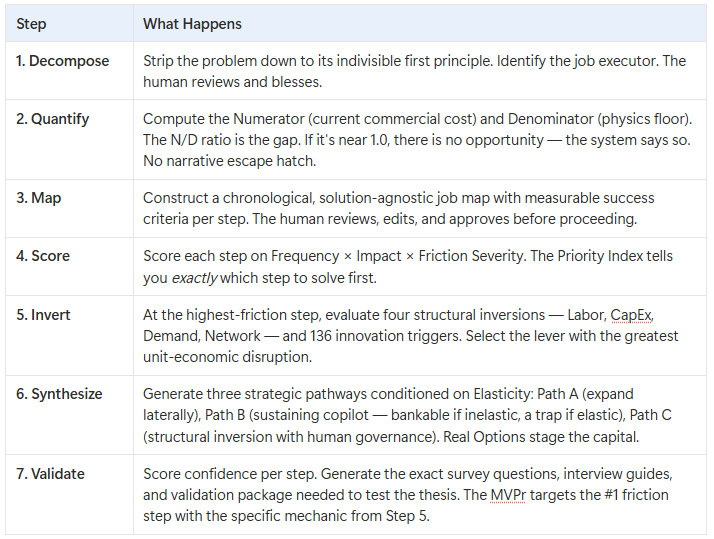
The pipeline is the same regardless of topic. A compliance audit, a supply chain optimization, a clinical trial recruitment — they all enter the same funnel. The inputs change. The math changes. The assembly line does not.
What Makes This Different
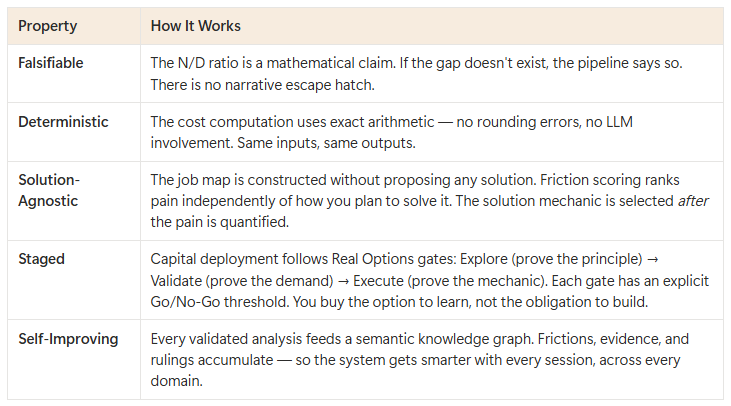
The Core Inversion
Traditional consulting: A team of humans applies judgment, experience, and pattern-matching to produce a strategy recommendation. The quality depends on which humans are in the room. The output is a narrative that cannot be mathematically falsified.
Venture Proof inverts the model:
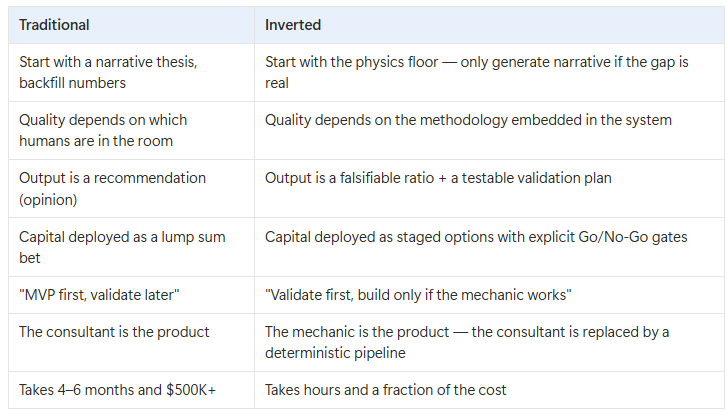
The fundamental inversion: Instead of paying for human judgment to estimate whether an opportunity exists, the system computes whether the opportunity exists and gives you the exact test plan to prove it.
What You Learned
If you made it this far, here’s the takeaway — stripped to its bones:
JTBD is a powerful theory trapped inside a broken delivery model. The insight that people “hire” solutions for functional jobs is correct. The methodology wrapped around it — expensive surveys, biased starting points, consultant-dependent analysis, months of lead time — is the bottleneck. The theory deserves better infrastructure.
First Principles eliminate the biggest risk in innovation: starting from the wrong place. Traditional JTBD begins with a job statement that sounds right and then recruits people to confirm it. That’s not validation; that’s confirmation bias with a budget. Starting from first principles forces you to prove the problem exists mathematically before you ever talk to a customer.
The Musk Loop is not optional. You cannot automate your way to better innovation. You must first challenge every assumption, delete what doesn’t survive scrutiny, simplify what remains, and accelerate the new — then automate. Most “AI-powered” JTBD tools skip straight to automation and produce expensive mediocrity at higher speed.
Surveys are a tool, not a religion. When you start from a properly derived first principle, quantify the gap with real arithmetic, and map the friction with solution-agnostic rigor — you often don’t need a 200-question survey to find the problem. You already know where it is. Surveys become targeted validation instruments, not fishing expeditions.
Innovation consulting has a consulting problem. The industry that preaches disruption has not disrupted itself. The model depends on expensive human headcount to perform tasks that can be systematically decomposed and executed by deterministic pipelines — with humans elevated to governance, not grunt work. The Innovation Industrial Complex profits from complexity. Venture Proof profits from simplicity.
The output is not a strategy. It’s a falsifiable hypothesis with a validation instrument attached. Every research package produced by this system includes an N/D ratio (the mathematical claim), a friction-scored job map (the prioritized pain), a structural inversion (the mechanic), a staged Real Options plan (the capital deployment), and a Wizard-of-Oz concierge playbook (the test). If the hypothesis is wrong, the system tells you. Early. Cheaply. Before you build anything.
The human’s role is elevated, not eliminated. This is not about replacing human judgment with AI. It’s about replacing human labor with AI and redirecting human judgment to where it actually matters: reviewing the first principle, blessing the job map, challenging the inversion, making the Go/No-Go decision, and governing the MVPr. The system does the work. You do the thinking.
This is a work in progress. The platform is live and evolving every day. If you want to see it in action, reach out (my contact info is below). If you think I’m wrong, tell me why — with first principles, not opinions. 😉
You don’t need to see it unless you’re interested in successful innovation.
Book an appointment: https://pjtbd.com/book-mike
Email me: mike@pjtbd.com
Call me: +1 678-824-2789
Join the community: https://pjtbd.com/join
Follow me on 𝕏: https://x.com/mikeboysen
Articles - jtbd.one - De-Risk Your Next Big Idea
Many wow moments reading this. Amazing what you've done with JTBD; took it, shredded it to basic principles, and converted into an end to end innovation enabler.