

My POV on the future of CX — a domain in which several truly cool technologies have failed miserably over the past decade or more. This might be an opportunty to correct that if we can set some egos aside (and flip some business models). 🙃
Before you can even begin thinking about customer-centricty you need to face some serious facts first:
Enterprises: The architecture of your enteprise is a problem
Startups: The architecture of your industry of choice is a problem
You need to fix these things first. If your only play is to either port your high cost and friction-filled architecture to more customer types, or to attempt to make a localized efficiency gain somewhere in your delivery capability, you’re ultimately going to lose.
You need to change the cost basis of your operation before you ever hope to truly be customer-centric. Once you do, then what you’re about to read becomes possible. You’ve got to do both.
The Crisis of the 3% Retention Stall: Deconstructing the Experience Economy
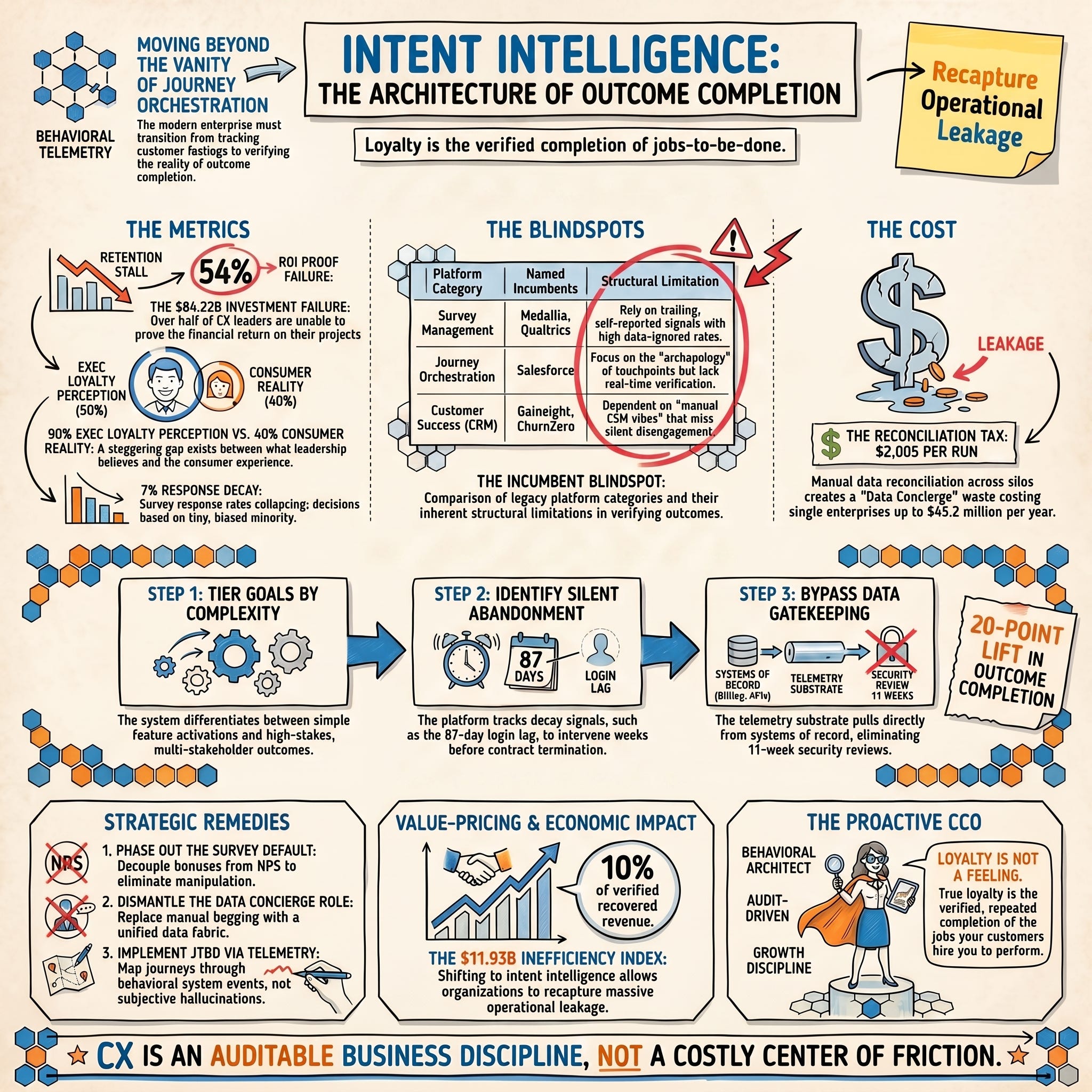
The modern enterprise is currently trapped in a cycle of systemic entropy. Despite an $84.22 billion investment in Customer Experience Management (CEM) software, retention growth has reached a critical stall at a mere 3% over typical three-year cycles. As a recovering CRM industry consultant and current innovation engineer, I observe a landscape where leadership has prioritized attitudinal data—the ephemeral “vibes” of how people feel—over the behavioral telemetry of what people actually do. This reliance on sentiment has created a state of Epistemic Conflict: organizations are willfully pretending that high satisfaction scores equate to operational health, even as their customers migrate to competitors.
The Dysfunction of Vanity Metrics
The Execution Deficit: US customer experience quality has plummeted to its lowest level since 2016, creating a stark contradiction against the soaring market valuations of CEM incumbents.
The Perception Chasm: A staggering “Executive-Consumer Perception Gap” exists; while 90% of executives believe they have fostered customer loyalty, only 40% of consumers agree.
The ROI Proof Failure: 54% of CX leaders are fundamentally unable to prove the ROI of their projects, resulting in their departments being categorized as “discretionary cost centers” during the first signs of fiscal tightening.
Survey Response Decay: With response rates collapsing to 7%, critical multi-million dollar decisions are being made based on a tiny, biased vocal minority, while the 56% “quiet majority” of dissatisfied customers leave without uttering a word.
This structural failure is not a lack of effort; it is a failure of the telemetry substrate. When decisions are rooted in “Goodhart’s Law”—where the metric (NPS) becomes the target—the integrity of the data collapses under the weight of metric manipulation.
Naming the Legacy: Why Orchestration Platforms Fail at Intent
Current Journey Orchestration (JO) platforms act as “behavioral archaeologists.” they are excellent at mapping where a customer has been but are structurally incapable of verifying if a goal was ever achieved. There is a fundamental architectural difference between tracking a path and verifying a job-to-be-done. Legacy platforms rely on manual reconciliation and subjective inputs, creating a Cognitive Load Collapse for the teams tasked with managing them.
The Incumbent Blindspot
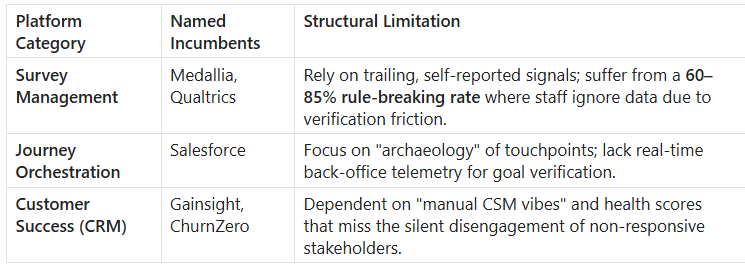
The prevailing “Data Concierge” model—where senior analysts spend 60% of their time begging for data access—is a primary driver of systemic waste. Navigating silos across Snowflake, NetSuite, and Zendesk via JIRA tickets and 11-week security reviews creates a “Reconciliation Tax” of 2,005 per run. For a single enterprise, this Single-Client Scale Waste reaches 43,297,200 per year. By the time a “Data Concierge” manually reconciles a billing event with a product log, the customer is already 87 days into a silent abandonment cycle.
The Behavioral Engine: How the Solution Identifies and Tracks True Intent
The transition to Intent Intelligence requires an Agentic Inversion of the Jobs-to-be-Done (JTBD) framework. We must treat the customer’s functional progress as the primary unit of analysis, governed by an Outcome Verification Liability Architecture. This ensures that the verification of a goal is an auditable, defensible record that can survive the scrutiny of a CFO.
The Outcome Completion Rate (OCR): Precise Telemetry Our solution bypasses the “Compliance Theater” of legacy systems through a Federated Telemetry Substrate, which:
Tiers Goals by Complexity: It differentiates between simple feature activations and multi-stakeholder outcomes (e.g., a healthcare system consolidating three legacy EHRs), requiring higher rigor for higher-stakes tiers.
Identifies Silent Abandonment: It tracks decay signals, such as the 87-day login decay lag, allowing for interventions weeks before a contract is formally terminated.
Bypasses Gatekeeping: The substrate pulls directly from systems of record (API usage, billing logs) without requiring the 11-week security reviews that paralyze traditional analysts.
Verifying a goal through “Continuous Behavioral Telemetry Chains” transforms CX from a narrative-based department into a growth discipline. If you cannot measure progress behaviorally through back-office events, the progress simply does not exist.
The Economic Architecture of Precision: Recapturing the $11.93B Waste
To move CX from a cost center to a growth driver, we must recapture the massive operational leakage inherent in current manual processes. The total addressable opex waste recapturable across the customer base—our Inefficiency Index—sits at $11.93 billion.
The Cost of Inefficiency vs. The Power of Outcome Verification
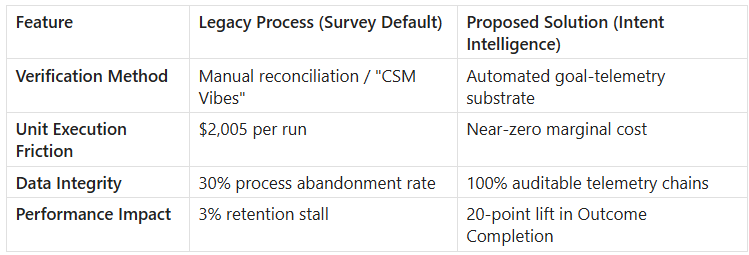
Our alignment is cemented through a Value-Pricing Hook. We move beyond flat licensing fees to a performance bonus model: 10% of verified recovered revenue, capped at 3x the platform fee. For a mid-market firm with 50M ARR, verifying and closing the gap on Outcome Completion typically recovers between 1.5M and $2.5M in revenue—specifically targeting the $400,000+ silent-decay losses common in healthcare and logistics enterprises.
Strategic Remedies: The Executive Path to Outcome-Driven Loyalty
The path forward requires leadership to absorb the political and cognitive labor currently spent arguing over dashboard definitions. To succeed, CCOs must stop spending 8-15 hours a week on political reframing and start architecting behavioral evidence.
Strategic Imperatives for Leadership
Phase Out the Survey Default: Decouple all performance bonuses from NPS and CSAT. This eliminates the incentive for metric manipulation and restores the integrity of your operational data.
Dismantle the Data Concierge Role: Replace manual data-begging with a unified, secure data fabric. If your analysts are spending 60% of their time negotiating access to Snowflake or NetSuite, you do not have a CX program; you have a data-entry bottleneck.
Implement JTBD via Telemetry: Map your 22-step customer journeys through behavioral telemetry, not whiteboards. If a step cannot be measured via a system event, it is a “hallucination” in your journey map.
Externalize the Political Battle: Use technology to produce behavioral evidence that pre-empts conflict. When the data is auditable and tied to a dollar, the “Epistemic Conflict” between the CCO and CFO evaporates.
Call to Action Customer Experience must evolve into an auditable, outcome-driven business discipline. We must move from a reactive save motion to a proactive value motion. Without this architectural shift, CX will remain a “costly center of friction,” forever vulnerable to the next budget cut. Loyalty is not a feeling; it is the verified, repeated completion of the jobs your customers hire you to perform.
Appendix
How does this evolve current CJA platforms?
Shift in the Unit of Analysis (Goal Attainment vs. Path Completion)
Journey Orchestration: Traditional platforms track whether a customer successfully navigates a series of pre-designed steps or funnels (e.g., opened an email, logged in, completed a checkout screen).
This Solution: It completely ignores “journey completion” as a success metric. Instead, it uses the customer’s declared Job-to-be-Done (JTBD) as the primary unit of analysis. It does not measure whether the customer followed the vendor’s intended path, but rather whether the customer verifiably accomplished their own functional goal (such as passing a regulatory audit or reducing cycle time).
2. Behavioral Telemetry as the Primary Substrate (Not a Tertiary Overlay)
Journey Orchestration: Legacy platforms typically optimize for the breadth of front-end sentiment ingestion, mapping, and basic touchpoint triggers, treating behavioral data as an accessory to surveys.
This Solution: It treats observed behavioral evidence as the primary verification substrate, demoting surveys to a tertiary sentiment overlay that can never override a behavioral verdict. If a customer submits a glowing survey score but telemetry shows they failed to execute the core workflow, the system flags the account as failing.
3. Automated Goal-to-Event Mapping (Eliminating Manual Flow Design)
Journey Orchestration: Orchestrating journeys manually is a labor-intensive engineering task that requires teams to write custom rules, map schemas, and build workflows for every account cohort.
This Solution: It utilizes a pre-trained goal-tiering and evidence-mapping engine (trained on approximately 50,000 historical customer success plans with ground-truth ratings). This engine autonomously ingests messy, free-text customer success plans, converts them into canonical JTBD statements, and automatically generates candidate behavioral evidence chains across product, billing, and support systems without manual coding.
4. Cross-System Back-Office Integration (Silo-Piercing Telemetry)
Journey Orchestration: Most journey tools focus primarily on front-end interaction channels and marketing/product analytics integrations.
This Solution: It builds a federated data fabric that unifies front-end customer touchpoints with deep, back-office transactional records. It continuously correlates product usage telemetry with billing events, support ticket resolution logs, and CRM records to construct an unbroken, auditable chronological evidence chain.
5. Goodhart Divergence Visualization
Journey Orchestration: Legacy tools often suffer from “Goodhart’s Law” drift, where teams optimize touchpoint scores to hit bonus thresholds while the underlying account silently churns.
This Solution: It features a “Goodhart Divergence Toggle” that displays a side-by-side view of behavioral goal attainment versus legacy survey-based sentiment. This directly exposes accounts that are “green” on paper (due to positive relationship surveys) but are silently disengaging behaviorally, protecting the enterprise from late renewal surprises
How do we detect the customer’s JTBD?
The system detects a customer’s intent and defines their “Job-to-be-Done” (JTBD) by autonomously extracting and normalizing unstructured data from existing enterprise platforms, converting messy text into structured, verifiable behavioral hypotheses. Rather than relying on customers to fill out surveys or expecting customer success teams to manually draft goal taxonomies, the platform automates this detection through a multi-step semantic pipeline:
1. Multi-Source Document Ingestion
The process begins by establishing API connectors to the software suites where customer expectations and operational metrics are already recorded. The system continuously ingests:
Customer Success Plans & QBR Decks
Salesforce, Gainsight, and HubSpot repositories
Renewal contract addenda and CRM opportunity notes
Product usage telemetry exports
If success plans are missing entirely or are highly unstructured, the system’s goal-telemetry agent can programmatically infer candidate goals from renewal contract language, deal metadata, and product usage patterns (though these carry a lower confidence score until explicitly validated).
2. Semantic Extraction and Canonical Normalization
Once the raw, unstructured documents are gathered, a fine-tuned Large Language Model (LLM) parses the free-text objectives. It strips away corporate jargon and translates the text into a standardized, machine-readable Canonical JTBD Syntax built on three strict components:
For example, a messy note like “Help the hospital system cut down on their claims being rejected” is automatically restructured into:
Verb: Reduce
Object: denied claims
Contextual Clarifier: in the emergency department service line
3. Ontological Clustering
To prevent duplicate goal tracking and maintain data integrity, the system clusters the normalized job statements against a domain-specific ontology (such as Salesforce administration, med-device compliance, or fintech onboarding). This step groups similar objectives across accounts, flags redundant entries, and highlights underserved customer needs across the portfolio.
4. Automated Complexity Tiering
After defining the Job-to-be-Done statement, the engine runs a pre-trained gradient-boosted model (trained on approximately 50,000 historical customer success plans with ground-truth ratings) to score and categorize the goal into one of three complexity bands:
Simple Goals: Binary, short-term tasks (e.g., single-user feature adoption) that require only basic product telemetry to verify.
Moderate Goals: Multi-step workflows requiring product telemetry plus back-office systems validation.
Complex Multi-Stakeholder Goals: Long-term business outcomes involving several user cohorts (e.g., economic buyers, technical evaluators, and end-users).
The engine assigns these tiers deterministically by analyzing account metadata, including Annual Contract Value (ACV), distinct stakeholder count, product module depth, and contract length.
5. Last-Mile Executive Ratification
To ensure absolute strategic alignment, the auto-generated job catalog is surfaced in a single-pane Executive Ratification Workspace. Instead of spending 8 to 15 hours a week hand-crafting JTBD statements, the Chief Customer Officer (CCO) or Customer Success Manager (CSM) acts as a curator rather than an author. They can approve, edit, or reject the synthesized goals in under 30 seconds. This human-in-the-loop interaction trains the underlying matching model, progressively sharpening the system’s accuracy with every ratification cycle.
Is your organization interested in true innovation? Or does it prefer to just look busy and hire consultants? The world is changing quickly. If you’re not adapting to it, you’re not innovating. I work with organizations who are serious about attacking problems and who are tired of defending the current paradigm. Is that you? (my availability is limited).
Submit a problem or challenge: Click here
Book an appointment: Click here
Email me: mike@pjtbd.com
Call me: +1 678-824-2789
Join the community: Click here
Follow me on 𝕏: https://x.com/mikeboysen
Articles - jtbd.one - De-Risk Your Next Big Idea
Always attack…Never defend