

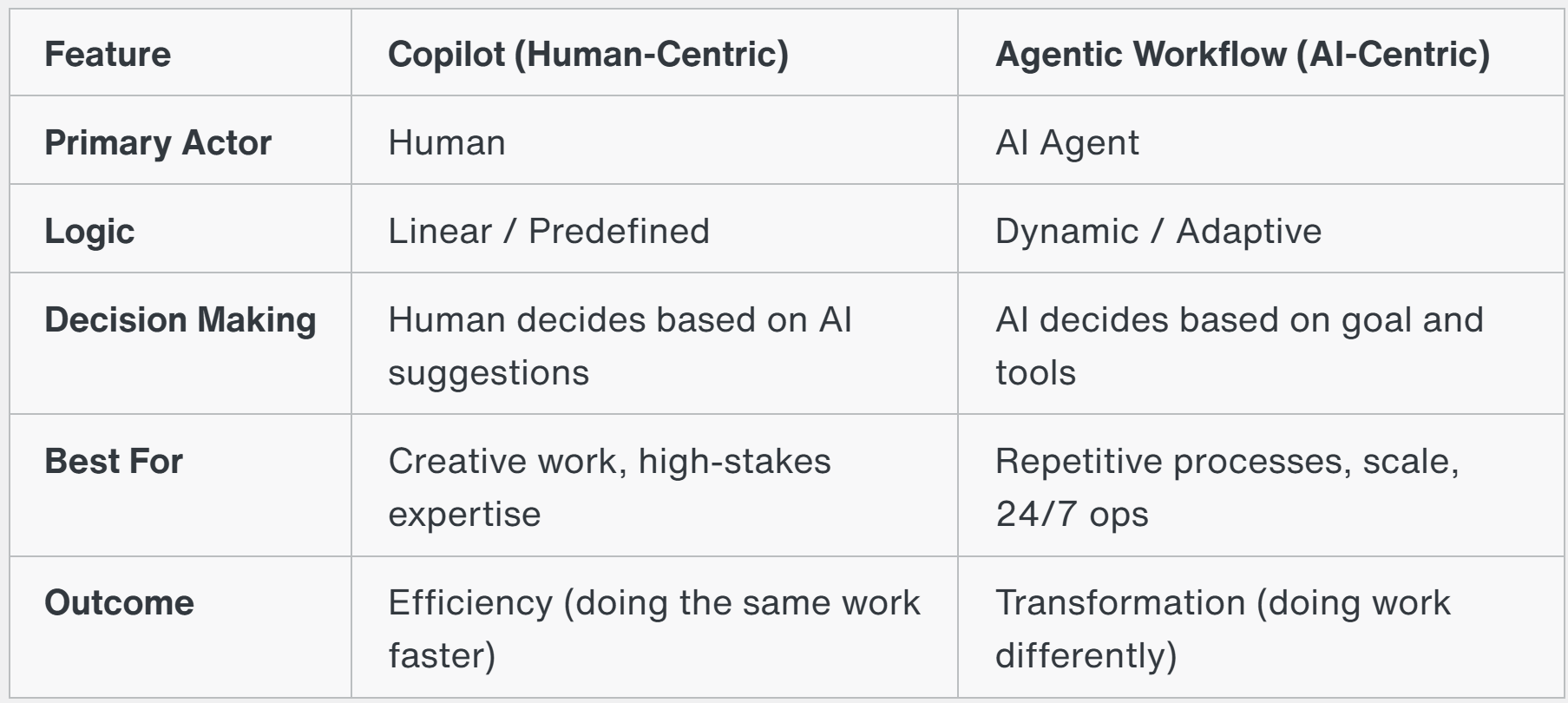
The core difference between accelerating human workflows (Copilots) and designing fully agentic workflows lies in who holds the steering wheel and how the path is determined.
Copilots: Accelerating Human Workflows
In this model, the human remains the primary driver. The AI acts as a high-powered assistant that speeds up individual steps within a process that the human still manages.
Role: Assistive and suggestive. It provides the “right information” or “contextual support” to help a human complete a task faster .
Interaction: High-touch. The human must review, verify, and often manually trigger the next step. It is best for tasks requiring a “human touch” for expertise or personalization.
Example: An AI that looks up answers in a knowledge base so a customer service agent can convey them to a user without searching manually.
Agentic Workflows: Autonomous Execution
Agentic workflows shift the AI from a “suggester” to a “doer.” Instead of just helping a human with a step, the AI is given a goal and the tools to achieve it independently.
Role: Autonomous and goal-driven. The AI can plan, execute, and iterate toward a result with “low-touch” from the human .
Interaction: The human defines the outcome and the constraints, but the AI determines the specific sequence of actions.
Example: An accounts system that automatically invokes an LLM to analyze an invoice, extracts data, and routes it for final submission without a human manually moving the file between steps.
Key Comparison
The “Workflow” vs. “Agent” Nuance
It is also helpful to distinguish between Agentic Workflows and Pure AI Agents:
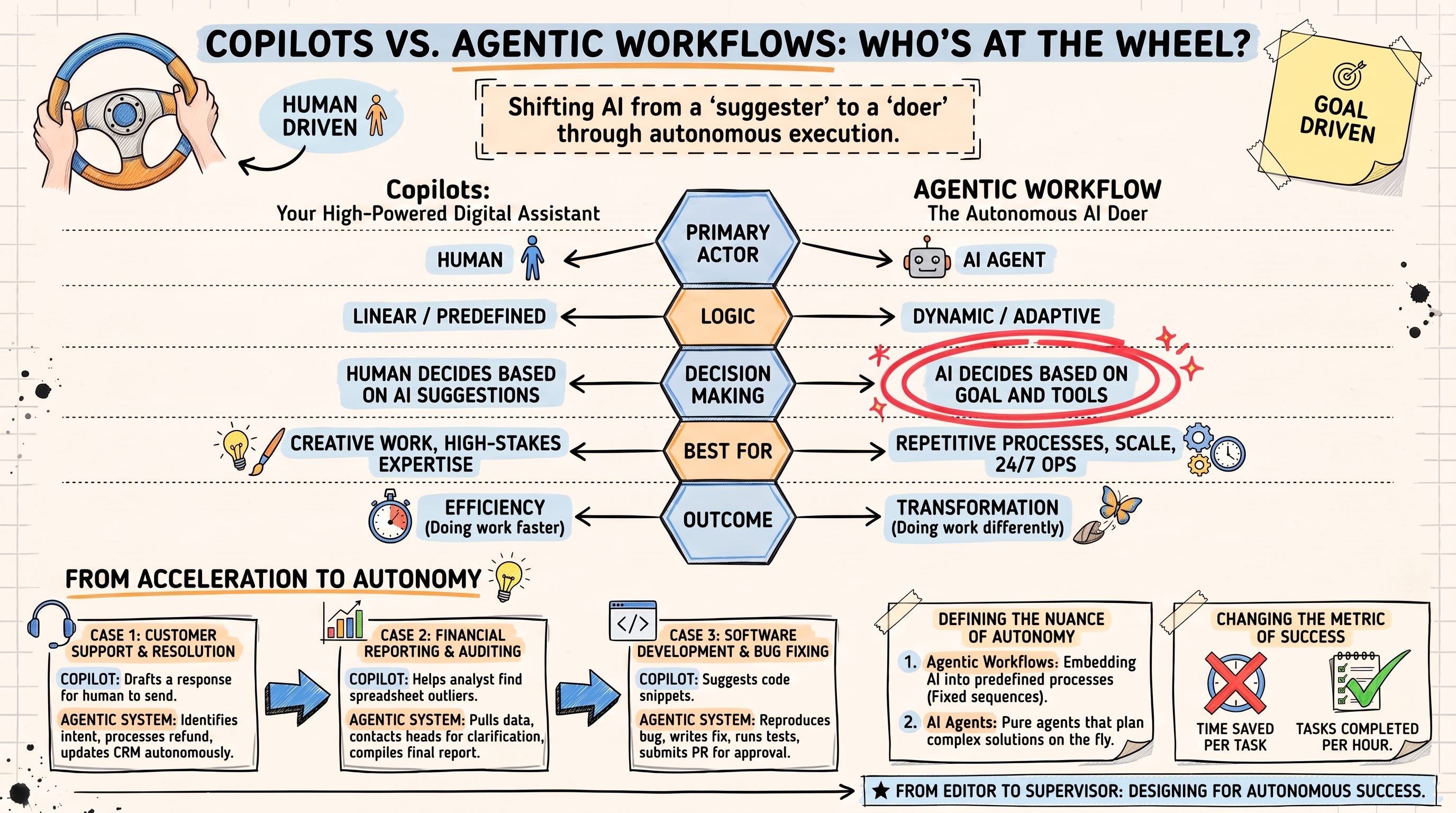
Agentic Workflows: Embed AI into predefined, deterministic processes for predictable outcomes (e.g., a fixed sequence of AI-driven steps) .
AI Agents: Fully autonomous entities that can dynamically adapt to changing circumstances and “plan on the fly” to solve complex issues .
The High-Elasticity Trap: Accelerating human work with a Copilot improves step-by-step efficiency, but it doesn't change your fundamental cost curve. In high-elasticity operations where volume fluctuates rapidly, relying on Copilots still ties your capacity directly to human headcount. When demand spikes, you are forced to scale expensive labor alongside software costs. True scaling requires shifting from assisting the worker to decoupling execution from human bandwidth entirely through autonomous agentic workflows. Always challenge your “transformation” consultant if they don’t mention this.
To demonstrate the shift from accelerating human workflows (Copilots) to fully agentic workflows, here are three mini-cases across different industries.
Case 1: Customer Support & Resolution
Accelerating Human Workflow (Copilot): A customer submits a complex refund request. The Copilot instantly retrieves the customer’s purchase history, summarizes their previous complaints, and drafts a suggested response based on company policy. The human agent reads the summary, tweaks the draft, and clicks “Send.”
Value: Reduces “search and type” time for the human.
Agentic Workflow: The customer submits the same request. An AI Agent identifies the intent, checks the refund eligibility against the database, initiates the refund in the payment gateway, updates the CRM, and sends a confirmation email to the customer. It only flags the case for a human if the refund amount exceeds a specific threshold or the sentiment analysis detects extreme frustration.
Value: Completes the entire business process autonomously.
Case 2: Financial Reporting & Auditing
Accelerating Human Workflow (Copilot): An analyst is preparing a quarterly report. They use a Copilot to “summarize this 50-page spreadsheet” or “find the three biggest outliers in this month’s spending.” The analyst then copies those insights into a PowerPoint deck and writes the executive summary.
Value: Speeds up data synthesis and insight discovery.
Agentic Workflow: At the end of the quarter, an Agentic system is triggered. It automatically pulls data from multiple ERP systems, runs a series of predefined “integrity checks,” identifies discrepancies, contacts the relevant department heads via Slack to ask for clarification on those discrepancies, and compiles the final report with the gathered explanations included.
Value: Manages the coordination and data-gathering lifecycle independently.
Case 3: Software Development & Bug Fixing
Accelerating Human Workflow (Copilot): A developer is writing code and encounters a bug. The Copilot suggests a code snippet to fix the error. The developer reviews the suggestion, realizes it needs a slight modification for their specific architecture, applies it, and runs the tests manually.
Value: Acts as an “autocomplete” for complex logic.
Agentic Workflow: A bug report is filed in GitHub. An AI Agent is assigned to the issue; it creates a new branch, reproduces the bug by writing a failing test, searches the codebase for the root cause, applies a fix, runs the entire test suite to ensure no regressions, and submits a Pull Request for the developer to approve.
Value: Executes the end-to-end engineering task from problem to proposed solution.
Summary of the Shift
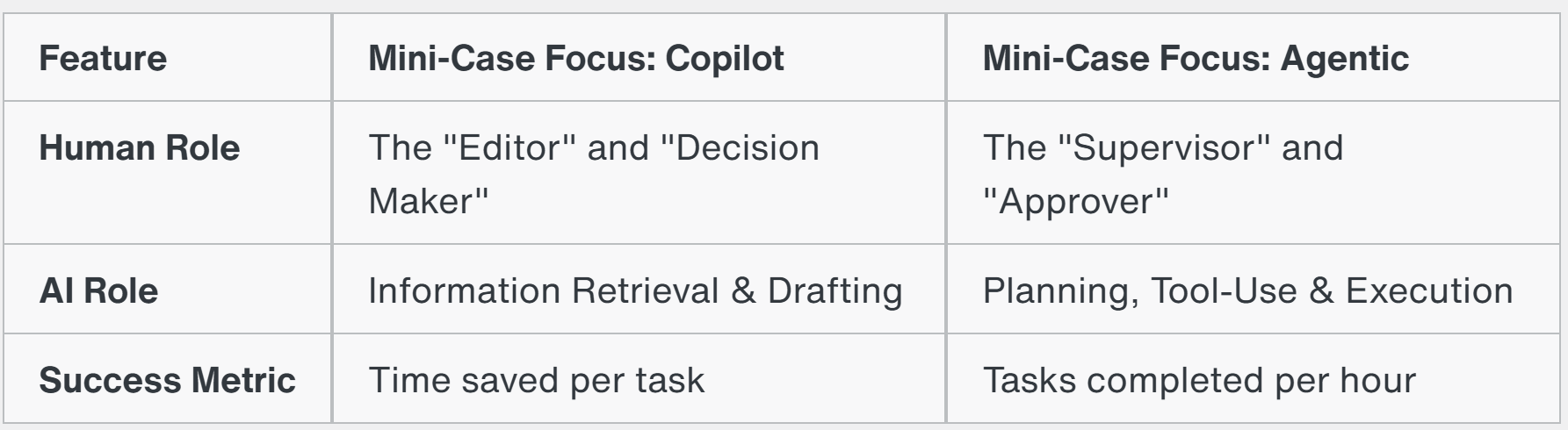
When humans are not substantively taken out of the equation, the enterprise often faces an acceleration of work which causes friction in the more expensive part of the workflow. This is why sustaining innovations aren’t true inovations; because they simply add cost and complexity — which is not scalable.
Inverting the model — Labor, CapEx, Demand, Network — is always a characteristic of disruptive innovation. Agentic workflows are the current path forward. Applying AI to Co-Pilots might be beneficial in the short-run; but only as a bridge to the more disruptive future.
What I see today: companies are in the FOMO mode and slapping AI onto the current workflow paradigm and not taking the time to identify the true desired outcome, how to measure it, and how to achieve it in a completely novel way.
Is your organization interested in true innovation? Or does it prefer to just look busy and hire consultants? The world is changing quickly. If you’re not adapting to it, you’re not innovating. I work with organizations who are serious about attacking problems and who are tired of defending the current paradigm. Is that you? (my availability is limited).
Submit a problem or challenge: Click here
Book an appointment: Click here
Email me: mike@pjtbd.com
Call me: +1 678-824-2789
Join the community: Click here
Follow me on 𝕏: https://x.com/mikeboysen
Articles - jtbd.one - De-Risk Your Next Big Idea
Always attack…Never defend