

I realize these are long posts. They are designed for strategists or executives who have spent a fortune on strategy decks — with nothing to show for it. These posts attempt to explain why and offer you a solution.
Executive Summary & Epistemic Triage
The Epistemological Crisis of Semantic Job Elevation
In enterprise strategy and product architecture, formulating a Job-to-be-Done (JTBD) statement at an “elevated level of abstraction” is routinely treated as a creative exercise. Even the most seasoned strategists attempt to escape feature-level myopia by substituting verbs and broadening the scope of the customer’s goal. This semantic drift creates severe strategic exposure: a team shifts from “drilling a quarter-inch hole” to “fastening items to drywall,” then to “decorating personal space,” and finally to “achieving domestic self-actualization.”
When elevated through linguistic generalization rather than structural decomposition, the job statement detaches from physical constraints and enters a semantic vacuum. It ceases to describe an addressable struggle and becomes an unfalsifiable platitude.
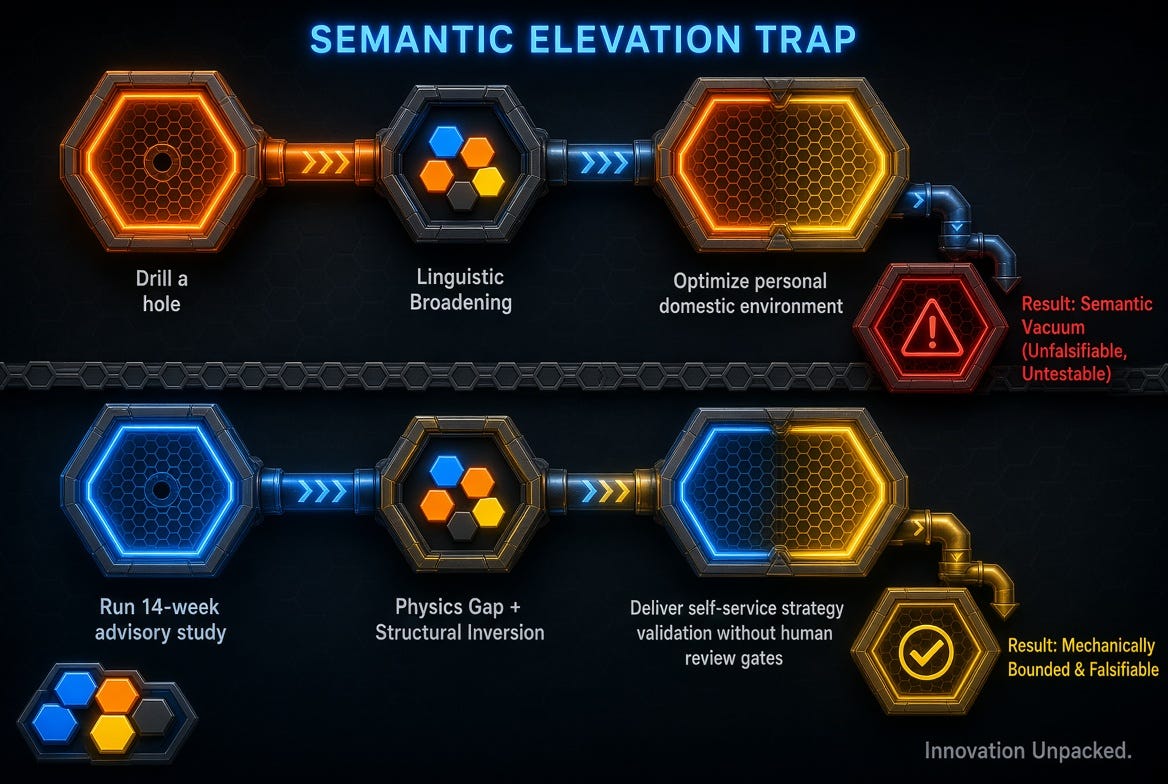
Traditional innovation frameworks (anything over 5 years old or based on theater and trust me bro’ ) lack an objective coordinate system to govern this elevation. Without mathematical boundaries, strategists cannot determine whether an elevated job statement reflects a genuine expansion of the addressable problem space or an un-executable corporate hallucination.
A Job Statement elevated to a higher level of abstraction can be predictably, repeatably, and deterministically derived through two non-subjective anchors: the Physics Gap and Structural Inversion. Operating within the deterministic Strategy-as-Code pipeline of the Venture Proof platform, the proper boundary of an elevated job is computed at the intersection of computational reality and the inversion of legacy delivery substrates.
Epistemic Triage: Purging Analogies via the Innovation Lattice Hierarchy
To construct a falsifiable strategic architecture, all operational inputs must be evaluated against the strict epistemological hierarchy codified in the Innovation Lattice. The Innovation Lattice establishes three categorical states of strategic inputs:
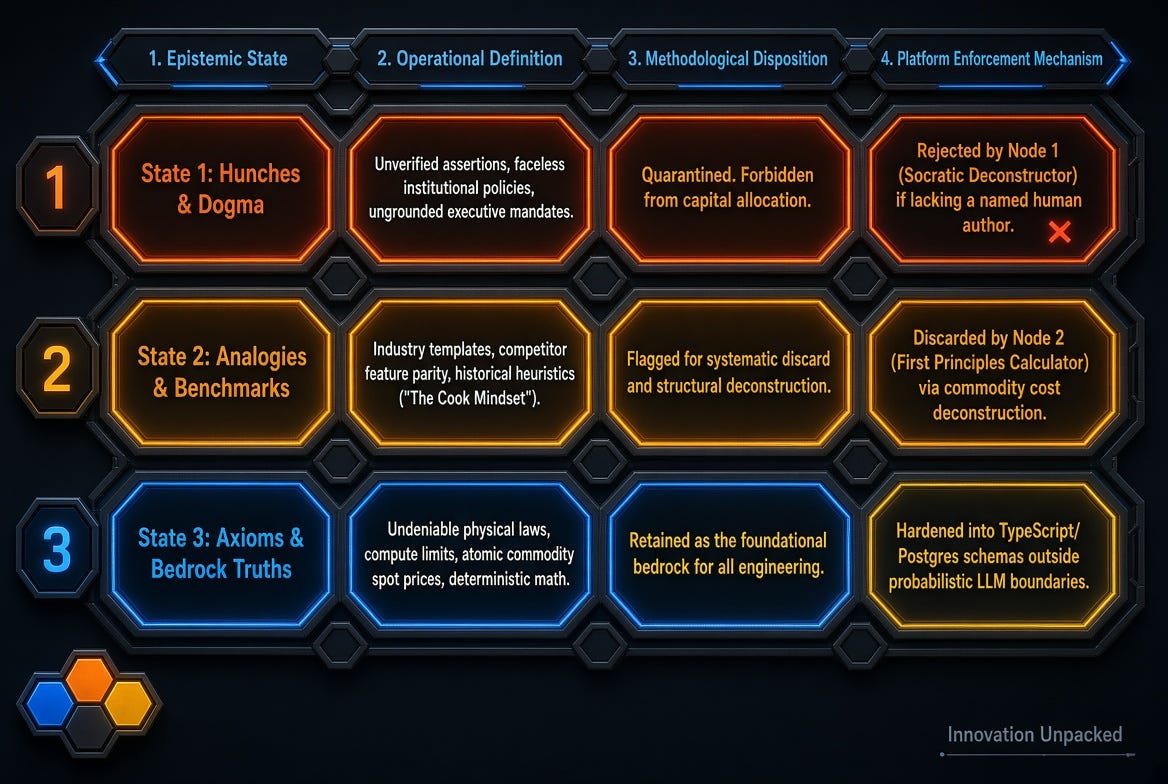
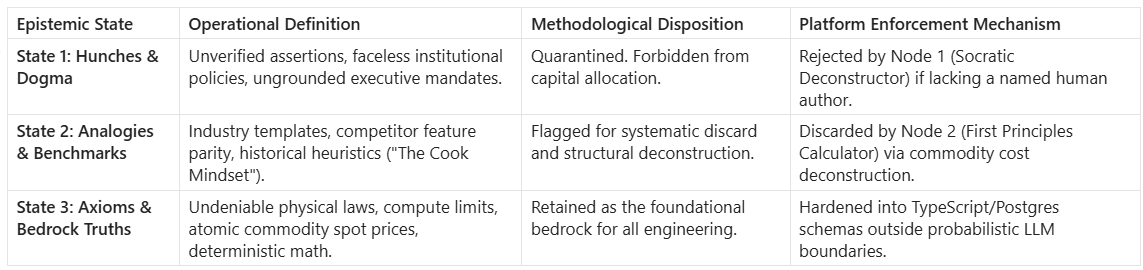
Legacy strategy frameworks fail because they operate almost entirely within State 2. They evaluate market problems by reasoning by analogy—studying how incumbents deploy armies of human analysts, how competitors structure multi-week advisory retainers, or how enterprise buyers navigate fragmented software tooling. They then formulate job statements that merely describe the incremental optimization of those analogies.
The Innovation Lattice enforces an immediate triage:

When applied to the problem of elevating a job statement, the Innovation Lattice dictates that an architect cannot look to competitor benchmarks or customer requests to determine the job’s higher level of abstraction. Customer requests are merely adaptations to current system inefficiencies; they describe workarounds within hardened incumbent architectures.
To elevate a job statement without introducing narrative bias, strategic architects must bypass human opinion and anchor directly into State 3 Axioms: the physical limits of compute, data transmission, and capital, analyzed through the lens of the Physics Gap and executed via Structural Inversion.
The Law of Deterministic Elevation
The central architectural thesis governing this methodology is defined as:
The Law of Deterministic Elevation: The maximum stable level of abstraction for a Job Statement is reached when the Object of Control is stripped of all delivery-chassis dependencies via Structural Inversion, and bounded by the point where the Physics Gap (N/D) approaches its irreducible computational or physical limit (D). Any elevation beyond this point degenerates into an unfalsifiable semantic vacuum; any elevation below this point codifies legacy operational waste.
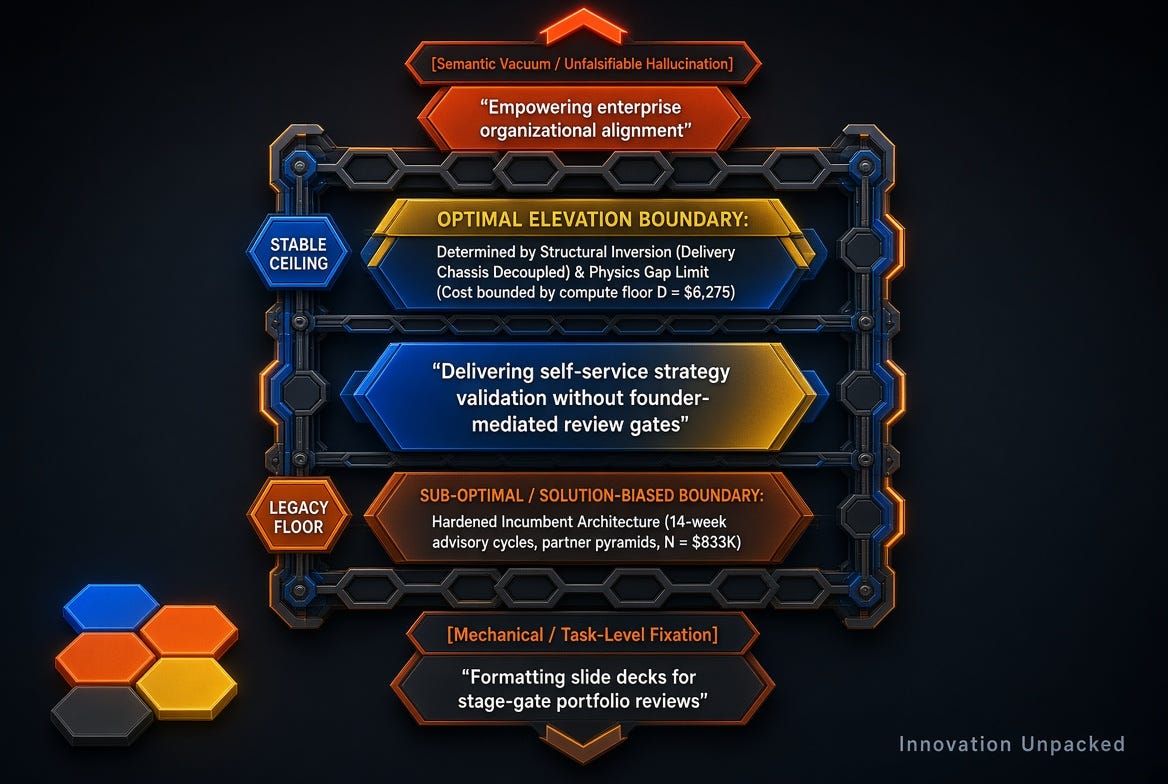
Within the Venture Proof platform, this law governs the transition from human-mediated consulting to automated Strategy-as-Code. By deploying Node 2 (First Principles Calculator) and Node 5 (Structural Inversion Strategist) of the Innovation Lattice, Venture Proof eliminates reliance on subjective interpretation.
The elevation of a job statement ceases to be an unconstrained art. It becomes a deterministic engineering derivation that reveals the exact functional boundary where enterprise capital can be deployed with zero risk of optimizing obsolete operational bloat.
Problem Deconstruction
The Semantic Trap: Unbounded Elevation into Functional Meaninglessness
In standard innovation theory, elevating a job statement is prescribed as the antidote to myopic solution-jumping. Theodore Levitt’s observation that “people don’t want a quarter-inch drill, they want a quarter-inch hole” represents a first step in functional abstraction. However, when corporate strategists attempt to apply this logic to complex B2B ecosystems, they lack a governing boundary condition.
Consider the failure mode of unconstrained abstraction when applied to corporate strategy validation:
Level 0 (Micro-Task / Tool Specific): “Authoring 14-week PowerPoint slide decks for executive investment committees.” (Critique: Fully solution-biased; codifies incumbent deliverables).
Level 1 (Direct Functional Job): “Evaluating early-stage venture hypotheses through structured expert interviews.” (Critique: Better, but embeds the human delivery mechanism directly into the job).
Level 2 (Elevated Abstraction - Heuristic): “De-risking corporate capital allocation decisions across the portfolio.” (Critique: Crosses into semantic ambiguity; fails to isolate an actionable Object of Control).
Level 3 (Hyper-Elevated Platitude): “Empowering organizational potential and driving collective strategic enlightenment.” (Critique: A pure semantic vacuum. It is unmeasurable, non-falsifiable, and offers zero engineering guidance).
The fundamental defect of heuristic elevation is that it relies on linguistic generalization rather than structural decomposition. As the statement moves up the ladder of abstraction, the strategist strips away physical details without replacing them with structural invariants. The resulting statement provides no guidance on what to build, what to delete, or how to measure success.
To be operationally valid, an elevated job must remain mathematically bounded. It must retain a precise Job Executor, an unambiguous Directional Verb, a concrete Object of Control, and a tightly scoped Contextual Clarifier, all while remaining completely solution-agnostic.
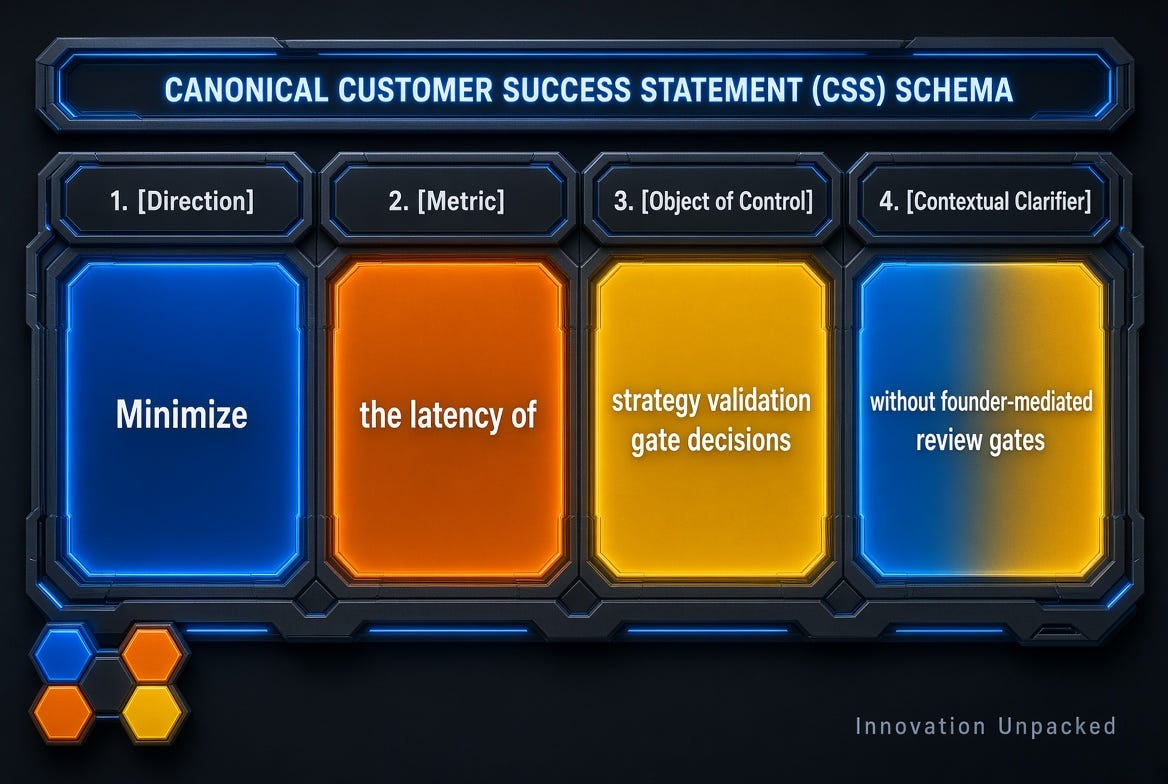
When an abstraction is elevated without anchoring in the Physics Gap, the Object of Control dissolves. The system cannot determine what is being manipulated, what constitutes a valid transformation, or when the process has achieved its physical limit.
The Solution-Jumping Anti-Pattern and Hardened Industry Architectures
The inverse of the semantic vacuum is the “Solution-Jumping Trap”—also classified in the Innovation Lattice as the Project Apex Trap. In this failure mode, strategists accept the symptoms of friction within an existing operational system as permanent requirements. They construct job statements that codify the incumbent industry’s delivery architecture.
Established industries are not collections of neutral methodologies; they are hardened architectures. An industry architecture is a rigid structural arrangement of:
Labor Allocation: The volume of human professional hours required to manufacture a unit of trust or synthesis.
Capital Expenditure (CapEx): The physical, infrastructural, or software assets that must be leased, owned, and maintained to deliver the outcome.
Operational Latency: The uncompressed calendar time that elapses between the request for service and its delivery, dictated by human scheduling constraints.
Margin Tolls: The economic extraction demanded by intermediaries to coordinate transactions and mediate information asymmetry.
The traditional management consulting industry (e.g., Strategyn, Innosight, McKinsey) is a hardened architecture built around billable human hours, partner-led interview campaigns, and bespoke narrative slide decks. When an enterprise hires a traditional firm to validate an innovation hypothesis, the engagement is structured around an 8- to 14-week timeline with costs ranging from $250,000 to over $2,000,000 per project.
If an innovator examines this market through State 2 reasoning by analogy, they observe client frustration with long readouts, partner scheduling friction, and high costs. If they formulate a job statement based on these observed pain points, they generate:
Flawed Job Statement: “Accelerate the delivery of consultant-led strategy interview synthesis decks.”
