

Free Access to Research Artifact
If you point an LLM at the public internet, you get pattern-matching and slide-deck filler—a race to the middle executed at lightspeed. In modern strategy, the model is not the moat; the proprietary data payload you query is. To prove this, I’m opening my research vault: every week, I compile a complete, industry-wide research payload (job maps, physics floors, and inversion plans) into a secure Google NotebookLM workspace. If you have a Gmail account, you can enter the workspace, query the raw math, and stress-test the data yourself. Today’s artifact is about Breaking the Bi-lateral Connectivity Tax 👈
If you’ve ever sat in a doctor’s office, filled out a clipboard of medical history, and then watched a receptionist immediately fax that identical information to your insurance company, you have witnessed the edge of a $1 trillion black hole.
The United States healthcare system doesn’t just suffer from an administrative burden; it is suffocating under a structural crisis of trust. Between $265 billion and $300 billion of our annual healthcare expenditure is pure, unadulterated waste. But why? We live in an era of cloud computing, massive AI models, and instant global financial transactions. Why does it take 11 days for a hospital to get a prior authorization for a knee replacement?
Prefer to Listen to the Details?
This is a podcast that breaks the entire research package down for you.
The answer isn’t that the technology is broken. The answer is that we’re forcing brilliant human beings to act as the “API” between systems that already know how to talk to each other.
After reviewing a massive, highly structured strategic semantic graph and deep-dive research dossier examining payer-provider connectivity, a fascinating, counter-intuitive reality emerges. The core issue of healthcare interoperability isn’t a software problem. It’s a physics problem disguised in a lab coat and a compliance binder.
Here are the top six most surprising, mind-bending takeaways about healthcare’s “Bilateral Tax”—and the blueprint for how we finally dismantle it.
1. The “Swivel-Chair Economy” is Healthcare’s Biggest Employer
What is the “swivel-chair economy” in healthcare? It’s the hidden administrative reality where highly trained clinical and operational staff spend their days manually reading data on one screen, swiveling in their chairs, and physically re-typing that exact same data into a different system.
It’s easy to assume that when healthcare data fails to transfer, it’s because of a technical glitch. The reality is far more absurd. In an average cross-departmental interaction (spanning Claims, Utilization Management, Provider Relations, and Member Services), a single discrete data element—like a patient’s date of birth or a provider’s National Provider Identifier (NPI)—is manually re-keyed 6 to 11 times per resolved case.
This creates a massive “shadow workforce.” Clinicians and integration analysts currently spend 15% to 25% of their working hours acting as the manual integration layer between broken trust primitives. They aren’t practicing medicine; they’re performing data entry.
“Our ambulatory physicians spend, on average, two hours per day on EHR documentation for every one hour of direct patient care... maybe 40 minutes per day per physician is rework driven by bilateral exchange failures.”
When a system fails to share identity-resolved records natively, human labor patches the gap. This redundancy translates into a manual execution cost of $71.21 per bilateral information exchange—a cost that scales linearly with every new partner added to a network.
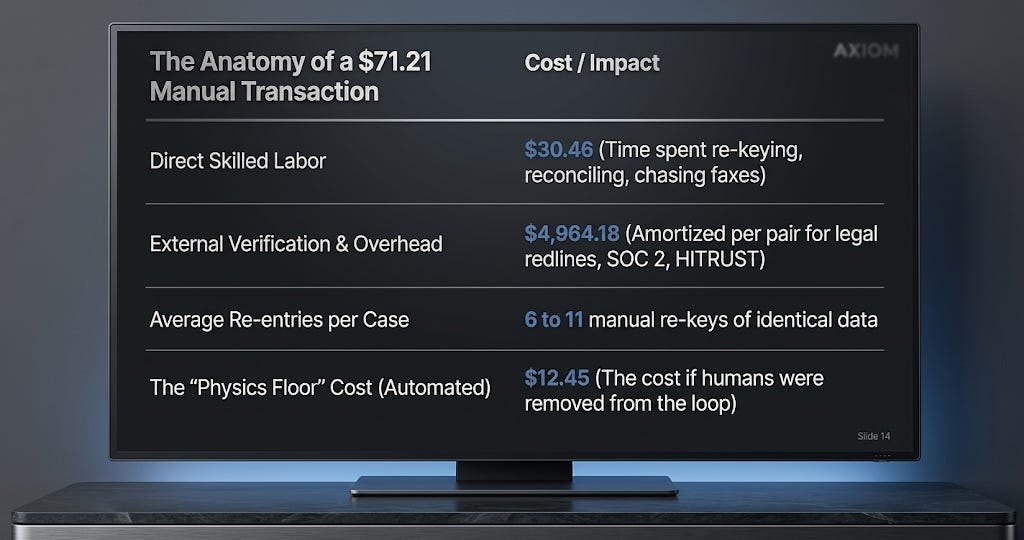
By maintaining this manual swivel-chair loop, the system burns nearly six times the energy it physically needs to on every transaction.
2. The “Directory Decay” Crisis: Why 70% of Digital Healthcare Addresses are Wrong
Imagine if you tried to mail a letter, but the post office, the internet, and your phone book all gave you completely different addresses for the recipient—and 70% of the time, the recipient had moved 11 months ago without telling anyone. That is the current state of healthcare endpoints.
To establish a data connection, an Interoperability Outcome Owner must locate the “authoritative endpoint” (the digital address) for a new partner node. You’d think there is a master directory for this. There isn’t. Administrators must query fragmented sources: EHR vendor app stores, middleware directories, state HIEs, and payer provider portals.
The conflict rate across these fragmented sources is a staggering 40% to 70%.
“The Epic App Orchard will list one endpoint. The payer’s own provider portal will list a different endpoint. The state HIE directory... might list yet another. It’s like 50/50 whether I get it right on the first try.”
Because these directories rely on manual updates rather than real-time cryptographic validation, endpoint data goes stale within roughly 11 months. This leads to silent failures where protected health information (PHI) is routed to deprecated servers. In one transcript, a hospital sent 800 prior authorization requests into a “black hole” for 11 days before realizing the payer had rotated their security certificate without notice.
The fix isn’t building a “better directory.” The fix is inverting the architecture: partners must self-publish and cryptographically sign their own endpoints, allowing the network to validate them against live exchange activity automatically.
3. The Math Paradox: Quadratic Value vs. Linear Cost
This is the most critical conceptual breakthrough in the entire research dossier. It explains why every major healthcare interoperability initiative eventually hits a brick wall.
In any network, value scales quadratically. If you have n nodes (hospitals, payers, clinics), the number of possible connections is
Every new node makes the entire network exponentially more valuable.
However, in healthcare, the cost to establish these connections scales linearly. Why? Because every single connection requires a bespoke Business Associate Agreement (BAA), a unique HITRUST inheritance validation, a one-off SOC 2 review, and a manual mapping of data fields.
“Every new payer relationship starts with a blank Word doc. I literally copy-paste the previous one, change the names, and hope I remember to delete the references to the prior payer.”
You cannot run a quadratic-value network on a linear-cost architecture. This is known as the Bilateral Connectivity Tax. When a regional payer hits roughly 20 to 25 partners, the cognitive load and legal overhead cause the system to stall. The marginal cost of onboarding the 21st partner exceeds the marginal value it produces.
The solution? Treat trust as a reusable software primitive, not a bespoke legal service. By introducing a standardized, multi-party cryptographic agreement (a “Federated Trust Alliance”), the legal and compliance overhead is paid once and amortized across the network.
4. The 11-Day Forensic Audit (Solving the Wrong Problem)
When a prior authorization stalls or gets denied, what happens next?
You might assume an automated system flags the error code and corrects it. In reality, it triggers a grueling, manual forensic audit. Because the systems lack shared state, human analysts must pull X12 transaction logs, cross-reference them with EHR document audit trails, and physically call payer representatives to figure out where the data broke down.
This manual triage cycle takes an average of 11 to 21 business days and consumes 32 to 40 hours of highly skilled analyst labor per incident.
“It took me, I want to say, two and a half days of basically staring at spreadsheets and pivot tables before I could even isolate which payer node was generating the loop.”
This is a massive misallocation of resources. The system is already producing the answer—every FHIR resource and X12 transaction emits a log line. By scraping these logs and running probabilistic entity-resolution joins, systems can generate a real-time “Friction Heatmap” that identifies resubmission loops in milliseconds, without spending a single human auditor hour. We are paying humans to do a machine’s job, simply because we haven’t given the machines permission to trust each other.
5. The Jevons Paradox: Why “Efficiency Bots” Will Never Save Us
The natural impulse of any tech executive looking at this mess is to buy a fleet of Robotic Process Automation (RPA) bots to automate the swivel-chair data entry. This is known as “Pathway B” (Sustaining Innovation).
It seems logical: if manual labor is the problem, automate the labor. But the strategy dossier reveals a fascinating economic reality based on the Jevons Elasticity Factor.
In this market, the elasticity factor (E) sits at 0.9. This means demand is inelastic relative to cost reduction. If you cut the cost of a transaction by 60% using bots, transaction volume will grow, but sub-linearly (it won’t explode out of control). Therefore, RPA and efficiency bots are a bankable dividend. They will save you money and extend your operational runway.
But they are a mathematical trap.
Even if you perfectly optimize the human workflows with copilots and bots, dropping the cost from $71.21 down to roughly $27, you are still permanently trapped 117% above the $12.45 physics floor. Why? Because humans are still in the loop. A human still has to confirm the legal BAA, a human still has to verify the SOC 2 report, and a human still has to click “approve” on the exception queue.
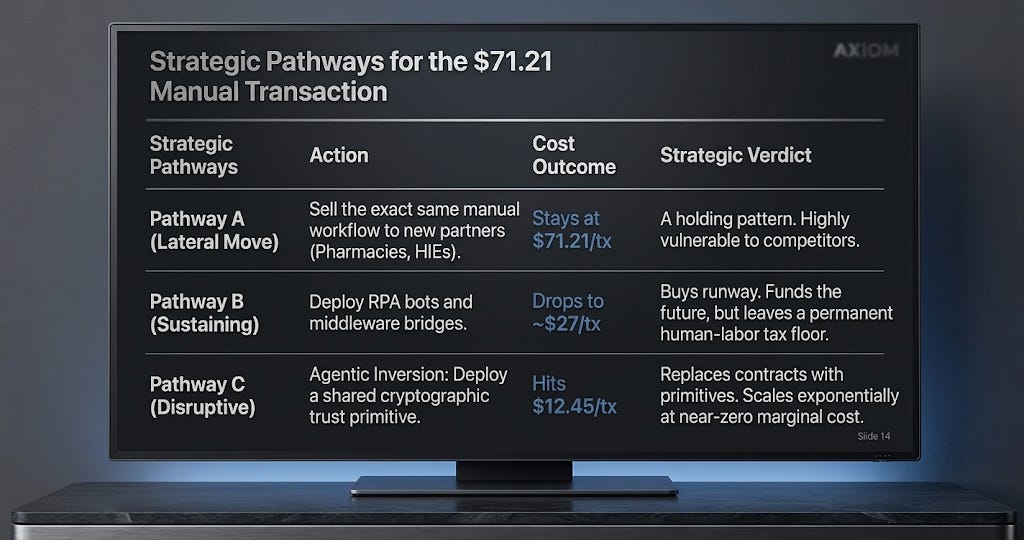
Pathway B (Bots) is the bridge. Pathway C (Cryptographic Trust Primitives) is the destination. If you confuse the bridge for the destination, your competitors will eventually crush your margins.
6. The 15% Ghost: The Devastating Cost of Abandonment
When we talk about the cost of healthcare friction, we usually focus on the direct operational expenditure (OpEx)—the salaries paid to staff doing redundant work. For a standard boutique health system unit, this direct waste is about $17,628.00 annually.
But there’s a much darker, much larger number hiding in the shadows.
Because the manual authorization process is so labyrinthine, error-prone, and slow, roughly 15% of bilateral transactions are simply abandoned. Providers stop submitting appeals. Patients give up on getting their elective imaging approved. They just walk away.
This 15% friction-driven abandonment rate represents $80,111.25 in stranded transaction pipeline value per unit, annually.
When you implement a deterministic trust standard—when a patient’s clinical history is pulled seamlessly from an authoritative EHR source without a human having to press a “Submit” button—that 15% doesn’t just stop bleeding. It converts into active, recurring transaction volume. The relationship value that was leaking out of the funnel stays in the funnel. The direct savings are just the appetizer; preserving the relationship pipeline is the main course.
The Final Diagnosis: Trust is a Primitive, Not a Meeting
The United States healthcare system is currently running a quadratic-value network on a linear-cost architecture. We are paying brilliant people to act as the tape holding broken legal and technical frameworks together.
The path forward is clear, though it requires a radical shift in perspective. We must stop viewing interoperability as a matter of building better “pipes” to move data, and realize that we must build better trust primitives to give that data permission to flow. By externalizing trust from bespoke legal contracts into standardized, machine-readable cryptographic attestations, we can drop the marginal cost of onboarding a new healthcare partner to near zero.
The $1 trillion question isn’t whether we can fix it. The technology exists today. The question is: who will be the first to stop competing on manual labor, and start compounding on primitives?
Ready to dive deeper into the mathematics of the Bilateral Connectivity Tax? Click here to access the deeper analysis model and our interactive NotebookLM oracle to explore the full strategic proof.
Is your organization interested in true innovation? Or does it prefer to just look busy and hire consultants? The world is changing quickly. If you’re not adapting to it, you’re not innovating. I work with organizations who are serious about attacking problems and who are tired of defending the current paradigm. Is that you? (my availability is limited).
Submit a problem or challenge: Click here
Book an appointment: Click here
Email me: mike@pjtbd.com
Call me: +1 678-824-2789
Join the community: Click here
Follow me on 𝕏: https://x.com/mikeboysen
Articles - jtbd.one - De-Risk Your Next Big Idea
Always attack…Never defend