

The Decision Brief
FACT: The legacy prenatal industry’s reliance on static high-volume deposition plants guarantees a massive clinical failure rate because the static pills deliver identical nutrient ratios for 40 weeks, ignoring that maternal biological needs undergo a paradigm shift every 8 to 12 weeks. Expectant mothers spend 14 to 40 hours building complex spreadsheets cross-referencing on average 19 different brands to combat this.
ASSUMPTION: Large Obstetric Network Administrators and Chief Medical Officers assume their clinical interventions are isolated medical events, but they are actually subsidizing the supply chain failures of their patients’ retail supplements. The financial and clinical waste of research labor, abandoned bottles, switching brands, and subsequent medical interventions to treat preventable nutritional deficiencies costs the healthcare ecosystem $2,171.34 per pregnancy.
The incumbent multi-billion-dollar manufacturers will claim that a $15 mass-market bottle is a USP-verified equivalent and that customized subscriptions are just an expensive luxury. The structural reality is that incumbent giants like Pharmavite invested $250,000,000 in a continuous gummy and softgel deposition plant engineered solely for high-speed, massive batch volumes. This infrastructure physically cannot perform small-batch, dynamic trimester compounding without suffering catastrophic financial losses in manufacturing downtime.
HUNCH: Clinical networks that continue to rely on the static wholesale model will face accelerating margin erosion as patient adherence drops.
Large clinical networks must immediately stop defaulting to retail brand recommendations and instead mandate a federated, trimester-adaptive clinical substrate that drives the systemic waste down to a physics floor of $296.91 per pregnancy.
Premium Content
Paid subscribers have access to special content below. It consists of free access to this research package inside my research hub — as well a link to the interactive NotebookLM oracle. These research packages can be found at https://studio.jtbd.one/research for a one-time fee for select artifacts or an optional fee for access to all of the complete Notebook — which includes a RAG-like interface you can use to interrogate the research, and ask for answers to questions I may not have asked for you.
This section is for premium readers only. If you don’t see anything and want to, I hope you’ll subscribe
Patient #003 and the Hyperemesis Failure Mode
FACT: Patient #003 suffered from hyperemesis gravidarum severe enough to require prescriptions for Zofran and Phenergan, alongside twice-weekly intravenous fluid interventions. Her baseline prenatal vitamin adherence was two days out of seven because standard capsules triggered vomiting within an hour of ingestion.
ASSUMPTION: The clinical network originally treating her likely recorded this as a standard pathology of high-risk pregnancy rather than a fundamental failure of supplement delivery architecture.
When transitioned to a custom-engineered enteric-coated variant—which bypasses the stomach entirely to release in the small intestine at an incremental cost of $1.40—Patient #003 achieved an adherence rate of five out of seven days. This targeted engineering shifted her nutritional status from inadequate to adequate gestational nourishment. The operational feedback loop was so immediate that the patient’s husband provided a strong repurchase-intent signal. The incident proves that sensory-driven abandonment is an engineering problem with a measurable structural solution, not an inevitable medical reality.
Static manufacturing architecture directly generates an 18 percent physical rejection rate
Industrial mass-market supplement production physically creates the sensory rejection that drives maternal non-adherence. Expectant mothers experience a spike in hCG hormones that triggers hyper-olfactory sensitivity. Mass manufacturers squeeze cheap, unstable ethyl ester fish oil and unchelated iron, specifically ferrous fumarate, into giant pills. This specific iron compound literally “rusts” and irritates the stomach lining, directly causing an 18% outright abandonment rate by women who cannot keep the foul-smelling pills down.
FACT: First-trimester baseline adherence sits at a dismal 50% to 65% on legacy static options.
The incumbent supply chain cannot pivot to solve this sensory crisis because of rigid technological debt. Upgrading an ingredient, such as moving from synthetic folic acid to organic methylfolate, triggers complete FDA 21 CFR part 111 cGMP revalidation and USP monograph stability testing. This process requires proving a 3-year warehouse shelf stability, freezing product development for 12 to 18 months at a bare minimum.
ASSUMPTION: Institutional buyers rely on these brands under the false pretense of safety, ignoring that the product is engineered for the warehouse, not the human body.
Mass-market brands optimize for shelf stability and shelf velocity, forcing the use of synthetic forms like pteroylmonoglutamic acid instead of methylfolate because they are chemically stable and cheap.
“When you look at the total healthcare ecosystem, including corrective doctor visits and brand hopping, the legacy model actually costs $2,171.34 per pregnancy. NatalBae’s trimester-adaptive subscription drives that waste down to a physics floor of $296.91, delivering a 90% clinical adherence rate—meaning your body actually receives the nutrition we promise.”
This failure mode is operationally expensive for obstetric networks to ignore because non-adherence translates directly into uncompensated clinical time. Providers waste valuable appointment minutes manually auditing patients’ “brown bags” of retail supplements to verify dosage.
The gummy matrix enforces a dangerous physiological deficiency
Gummy vitamins introduce a severe Jevons Paradox into maternal healthcare by increasing product adherence while secretly starving the patient of macro-minerals. To avoid pill aversion, mothers turn to tasty gummies, but pectin and gelatin matrices have rigid volumetric limits. They physically cannot hold the bulky macro-minerals required for pregnancy, such as 27mg of iron or 450mg of choline.
FACT: Manufacturers must completely remove the iron and slash the choline to prevent the gummy from turning into a puddle of goo or tasting like a mouthful of rusty pennies.
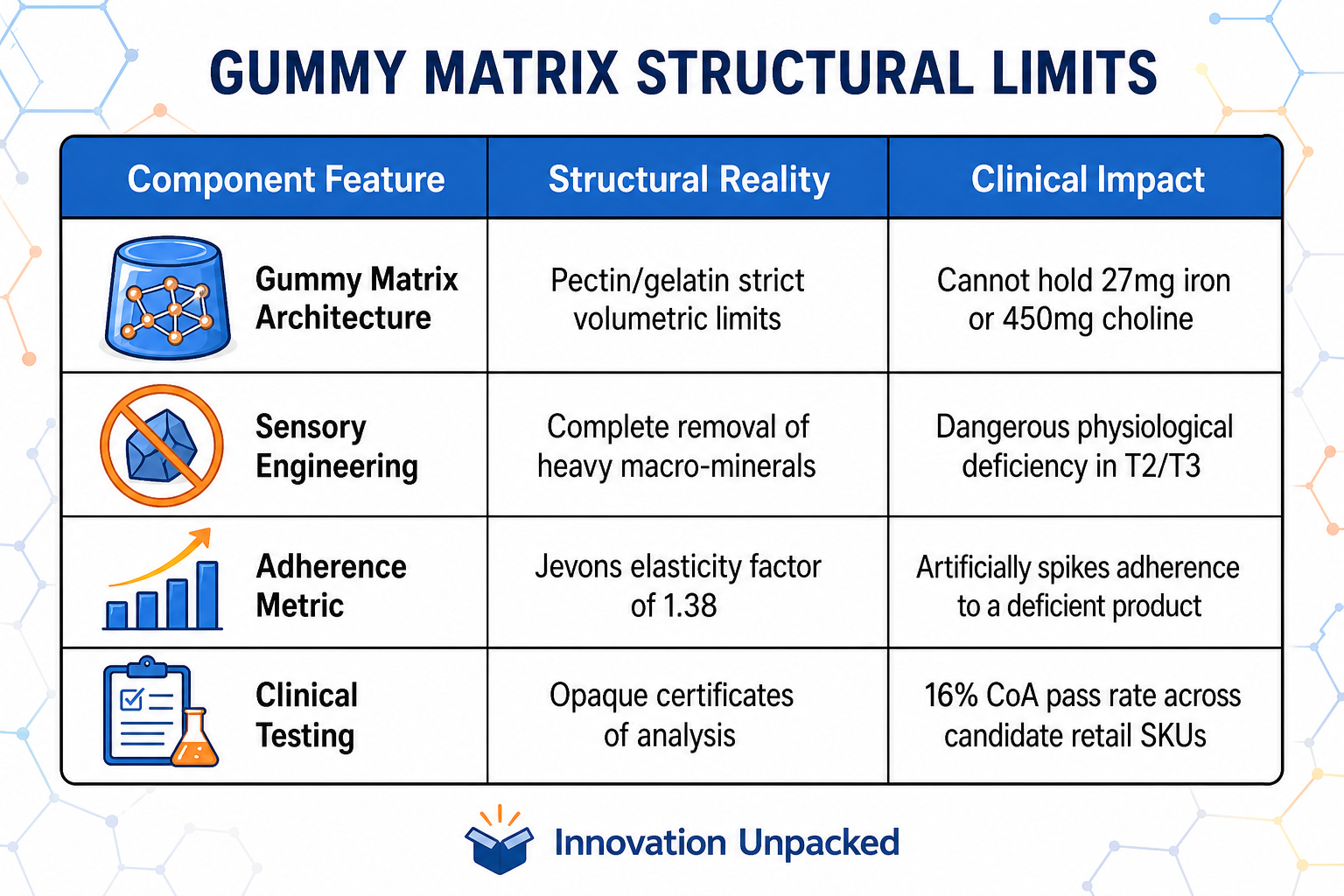
This architectural limitation creates a Jevons elasticity factor of 1.38, meaning gummies reduce sensory friction but drive expectant mothers to consume a biologically deficient product.
HUNCH: Obstetric networks that do not actively screen for gummy usage are unknowingly incubating late-pregnancy iron-deficiency anemia in their patient populations.
Solving sensory rejection without compromising nutrition requires isolating the volatile ingredients. Lipid-matrix encapsulation surrounds gentle iron (ferrous bisglycinate) and triglyceride DHA in a cold-pressed phospholipid carrier, preventing “fishy burp-backs”. Furthermore, pH-responsive microencapsulation ensures bitter B-vitamins remain taste-neutral at a mouth pH of roughly 6.7 and only release active nutrients once gastric pH drops below 5.0.
Federated clinical outcome clean rooms eliminate maternal research friction
Secure data environments fundamentally alter the clinical trust model by replacing blind retail purchasing with verified, privacy-compliant feedback loops. The system dynamically cross-references the mother’s daily symptom telemetry with de-identified EHR data from partner OB-GYN clinics via SMART-on-FHIR protocols. This infrastructure is built on a highly secure cryptographic protocol known as Multi-Party Computation (MPC).
FACT: No raw personal health information (PHI) is ever exposed in plaintext, maintaining absolute HIPAA compliance while allowing the system to continuously retrain its formulation algorithms.
This technical architecture allows clinicians to reclaim their operational capacity. At patient onboarding, the system generates a single-page digital brief called an OB Hand-Off Pack. This document details active SKU lot numbers, nutritional prioritization rationale, and a Clinical Confidence Tier backed by rigorous cohort data. It enables a physician to verify, adjust, or sign off on a personalized formulation in under 90 seconds, integrating the prenatal directly into an active care plan.
The federated data model also enforces ruthless statistical governance over formulation changes. Algorithmic shifts are strictly gated, requiring a minimum 0.15 Cohen’s h effect-size threshold at 80% statistical power in peer-reviewed clinical science. This blocks unverified wellness fads and provides clinical networks with an evidence-based shield against consumer marketing noise.
Appendix / Architecture of the Trimester-State Machine
The core engine replacing the static retail planogram is the Trimester-State Machine Orchestrator. This architecture deconstructs the 40-week gestation into distinct metabolic windows.
Pre-Staging and Compounding: The system automatically pre-stages, compounds, and ships the correct formulation ahead of trimester boundaries, effectively eliminating mid-pregnancy repurchase churn.
Freshness Loop Constraint: A strict 21-Day Freshness Loop eliminates the need for chemical stabilizers and prevents the oxidation-induced rotting smells of legacy prenatals.
Supply Chain Upstream: Raw materials are sourced directly from USDA-certified organic farms via pre-paid forward contracts, completely bypassing the broker networks that blend 40+ source farms into one opaque ingredient pool.
The economic contrast is stark. Pharmavite operates a split digital brain using Microsoft Dynamics NAV and J.D. Edwards, glued together by aging BizTalk middleware. A single master data adjustment to swap raw materials requires months of IT remapping, and a sync failure risks shutting down their entire factory. The legacy enterprise is technologically trapped, unable to match the dynamic formulation capabilities of a federated micro-compounding network.
Close
Enterprise healthcare buyers must immediately sever ties with static, mass-market supplement recommendations and mandate a trimester-adaptive, clinical-grade formulation architecture for their obstetric populations.
Will your network continue to absorb thousands of dollars in preventable clinical waste per pregnancy, or will you mandate a supply chain built for human biology?
Is your organization interested in differentiated innovation? The world is changing quickly. If you’re not adapting to those changes, you’re not innovating. Seeking reassurance from consultants fails, nearly always (sometimes they get lucky). I work with organizations who are serious about attacking problems using first principles. Many have been burned once, and they don’t want it to happen again. Is that you? (my availability is limited).
Book an appointment: Click here
Email me: mike@pjtbd.com
Call me: +1 678-824-2789
Join the community: Click here
Follow me on 𝕏: https://x.com/mikeboysen
Articles - jtbd.one - De-Risk Your Next Big Idea
Research - studio.jtbd.one/research
Apps - studio.jtbd.one/apps
Slaying the Sacred Cows of Innovation