

There is a silent crisis unfolding in the corporate world, and it should be setting off alarm bells for every single executive reading this.
In 2003, Harvard Business School professor Clay Christensen published The Innovator’s Solution. In it, he referenced a pivotal study by the Corporate Executive Board called Stall Points.
How many of you checked that footnote and actually read the study?
I read it. I also read the refreshed data published a decade later. (Note: That research firm was eventually acquired by Gartner, just in case you go looking for the original documents).
The Research Revealed a Terrifying Reality
I am only going to report on the observed facts of the research, not their conclusions on how to fix it (mine differ). The facts alone are enough to keep you up at night.
Almost all CEOs set targets for annual growth at 10-15%. But after analyzing 40 years of data on the Fortune 500, the research found a drastically different reality:
Only 5% of companies were able to sustain an inflation-adjusted Compound Annual Growth Rate (CAGR) of even 6%. (If these are your odds, don’t take these people to Las Vegas).
95% of companies hit a peak CAGR, after which their growth simply stalled.
Only 4% of businesses that stalled were ever able to recover to even 1% over GDP growth.
The Truth About CAGR CAGR calculates the average annual growth rate over a multi-year period, assuming the value grew at a steady, compounded rate every single year. It acts as a smoothing mechanism to iron out volatility.
Best for: Comparing long-term historical performance, especially when year-to-year growth is erratic.
When I suggest that products, services, and startups fail at a rate of 95% or more, this is the exact research I am using as my baseline. That 95% represents pure, wasted capital.
Finally, the research showed that the stock market brutally punishes companies that hit this stall point. The market often punishes for dumb reasons, too—usually because it fundamentally misunderstands what a visionary is actually building. At the risk of enraging some of you, Elon Musk is a perfect example. Most observers have no idea what is actually going on under the hood. When the vision finally materializes, everyone will claim they knew it all along, even though they did absolutely nothing about it when they could have played a part.
Because detecting your stall point requires looking backward, it is not a predictive metric for innovation. However, it is a fundamental wake-up call for those of you who care enough to disentangle yourselves from reasoning by analogy.
Doing what you’ve always done—or what your competitors are doing—just faster and with a bigger smile on your face, is not the answer. Deep down, you already know that.
The Status Quo is Destroying Capital
Let’s look at a quick case in point. The US wireless telecommunications industry loves to boast about subscriber and revenue growth. But if you look carefully, their YoY CAGR is at or below 2% and has been trending downward for over 15 years. Meanwhile, everyone else was building giant digital platforms on top of their bandwidth. It’s a race to the bottom. Can’t go much lower.

They could have been first-movers in satellite communication, but they failed to realize they’d have to drive down the cost of rocket launches because... well, their leaders probably sold flip phones out of car trunks in the 90s. That is not the mental model — or experience — required to disrupt the future.
FYI: If you are not growing faster than the rate of inflation, you are actively destroying capital. And every startup has a growth period, because they all start from zero.
Look at the shrinking lifespan of companies in the S&P 500:
1958: The average lifespan of a company in the index was 61 years.
1990: The average tenure had narrowed to 20 years.
Today: The average tenure sits between 15 and 18 years.
Artificial Intelligence will likely wipe out a significant portion of the remaining companies as they foolishly misapply “Co-Pilots” to their existing legacy products — entirely misunderstanding what true transformation looks like. McKinsey estimates that 75% of the companies currently quoted on the index will disappear or be replaced by 2027. They probably also suggest clients should be implementing co-pilots 🤣.
Engineering Validated Outcomes (Part 1 of ?)
Are you awake yet?
I am not here to pitch you on a brand new, untested methodology. I’m also not going to demonstrate to you how I’ve automated the do part of existing consulting and research workflows. Because that is the last thing I would do.
There are plenty (in)experienced transformation consultants working on those types of co-pilot tools today. If you’ve been reading along with me as I publish research, you will have picked up that the automation approach to transformation is what gets companies in highly-elastic models in deep trouble fast.
What I’ve done is to simply take the most effective elements of proven frameworks—like First Principles and Jobs-to-be-Done—and expand their scope into an end-to-end transformation system that completely inverts business architectures. If you still believe in the “old ways + AI” is the future, I’m probably not going to resonate with you.
My approach costs less. It is highly capital-efficient. You will waste drastically less money in pursuit of innovation.
No more “product-market fit” B.S. which requires you to build a factory (earn) before you prove the solution mechanic (learn)
No more massive labor pyramids designed for innovation theater and unfalsifiable narratives.
No more attempting to extract insights from the wrong sources (surveys / interviews).
You will know exactly what you need to know—and have it completely validated—before you build the factory. (A factory, mind you, with a 100-mile-wide moat full of angry housewives).
Better yet, I’ve stripped the standard 16-week complexity out of the process. Yes, humans are still required in the loop, but for governance and validation, not manual research and theater.
By leveraging first principles, this system forces you to stop reasoning by analogy and guessing at your audience. It refuses to let the “smartest person in the room” dictate the outcome based on a hunch (which is exactly why enterprise failure rates are so high).
I decided not to create standalone Job Map generators. I did that 3 years ago. That’s too simple, and frankly, the audience is too small. What you should be looking for are outcomes. A Job Map is not an outcome. Customer surveys, are not outcomes. This software system itself is not an outcome. But it puts you in the absolute best position to achieve outcomes predictably.
How the Architecture Works (Phase I Only)
1. Foundation & Direction The First Principle dictates the best options for the Job Executor, as well as the Job-to-be-Done (the direction of improvement). People constantly ask me, “How do I figure out who the Job Executor should be?” The system doesn’t shove one down your throat; it generates data-backed options. If you choose to override it, the engine evaluates your override, too.
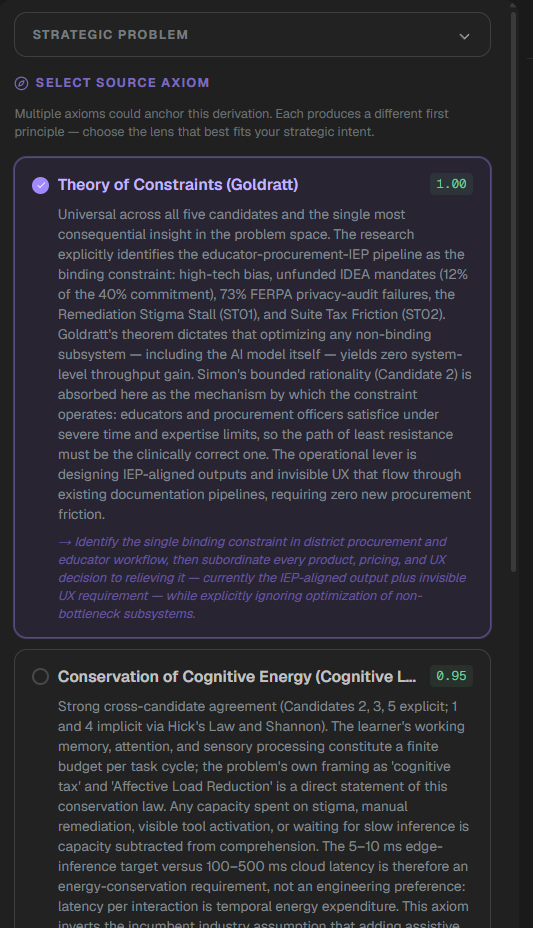
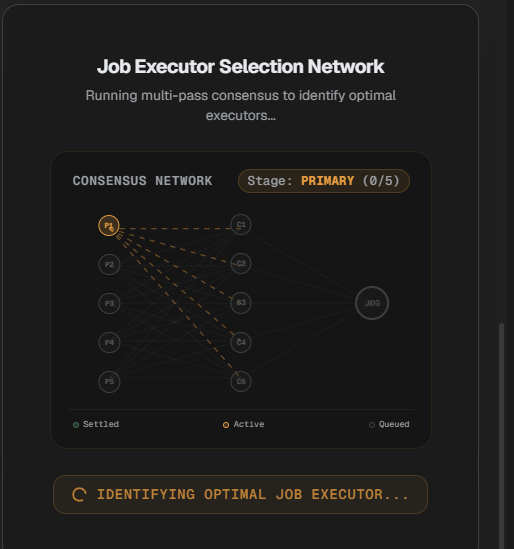
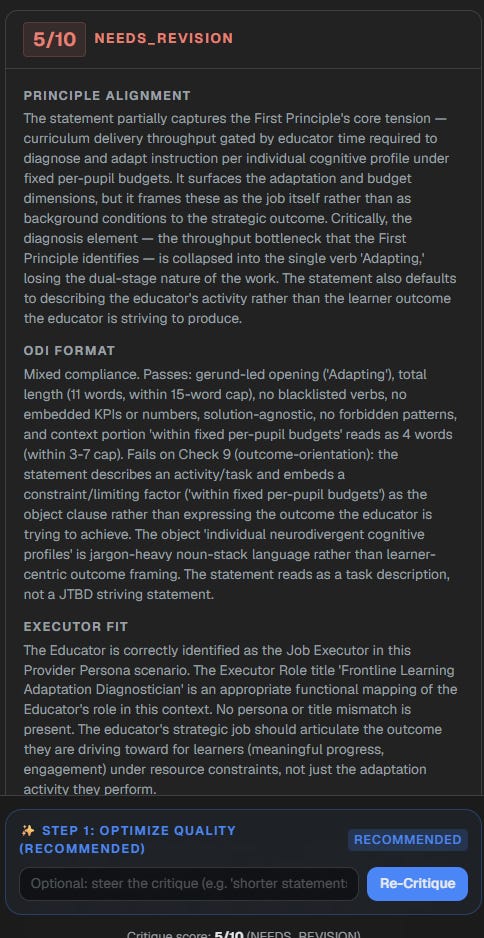
2. Ruthless Critique I never trust the first pass on anything. Fortunately, the system features a powerful engine for critiquing and refining its own initial suggestions.
3. Complete Auditability Yes, it generates your Job Map. The job is rooted in a first principle, and every single step and metric ties back to foundational axioms (causal and belief chains) for complete auditability. Ask your current consulting partner to do that for you. They won’t, because they don’t. They don’t, because they can’t.
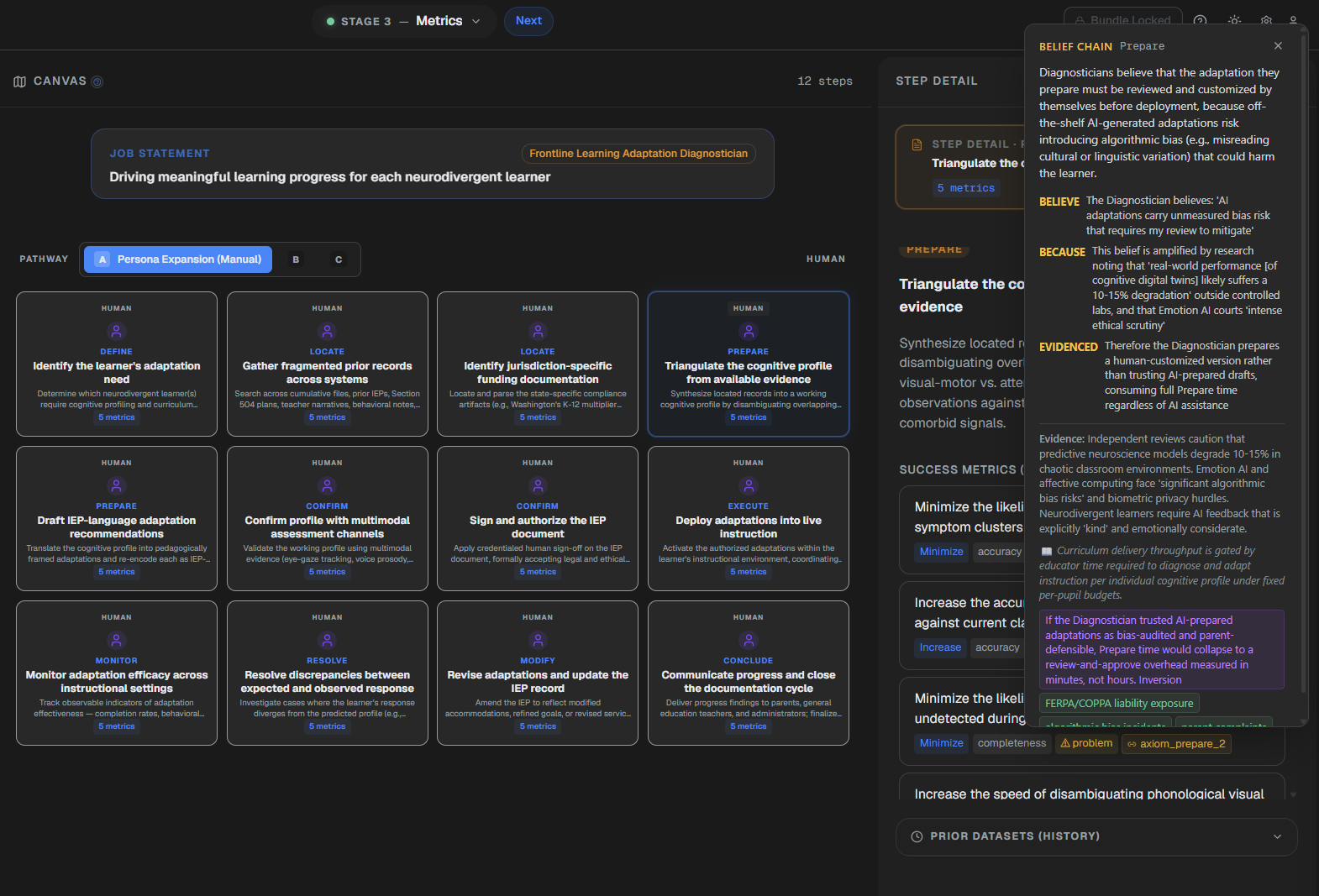
A Job Map is Not a Problem
Let me repeat that: A JOB MAP IS NOT A PROBLEM!
Problem-solving requires us to articulate a clear constraint, which is why introducing first principles is mandatory. Enterprises accumulate massive architectural debt over time—business models, tech stacks, regulatory constraints. These must be addressed first. If they aren’t, you are merely rearranging deck chairs on the Titanic.
Have you tried performing real-time personalization at scale using 50 year-old mainframes that were designed for batch processing?
Because defining this architecture takes very little time, there is zero excuse to skip it. More importantly, your customers do not understand your internal architecture, which means no amount of customer surveying will help you solve it. Customers (and users) are not engineers or architects of the baggage you carry. And there is no single customer group that can articulate the range of baggage they must carry when a solution only gets one of their low-level jobs done (many software apps) — and nothing else. You need to do that for them. It’s actually very easy.
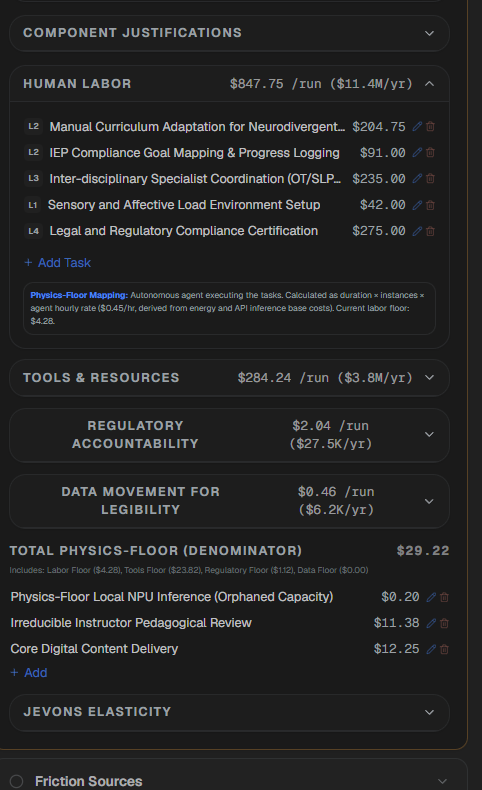
You have to face reality head-on. When you do, you gain the opportunity to accelerate your service, enhance reliability, slash costs, and achieve massive scale. Those are the only metrics you and your customers actually care about. If you can accomplish these things, you will be rewarded, not punished.
You do not need 300 precisely wrong opinions across 120 metrics that have zero correlation to your ability to deliver. On customer journeys - yes. This is not about customer journeys. This is about disruptive innovation — or survival of the fittest.
We don’t even have a new service yet. Optimizing a journey for a broken service architecture means you’ll be doing it again in 6 months.
You cannot simply make a gap this massive “more efficient.” You have to move the gap as close to 1x as possible through major model inversions. If you don’t do it, some greasy-haired kid in their parents’ basement will do it for you using a $20 AI subscription.
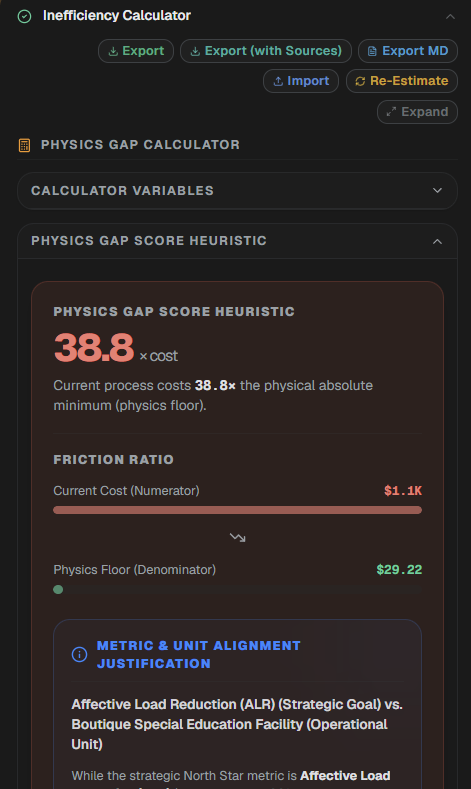
Friction is the enemy of service delivery
Knowing the physics and the math of your problem make it incredibly simple to find the friction in your job map.
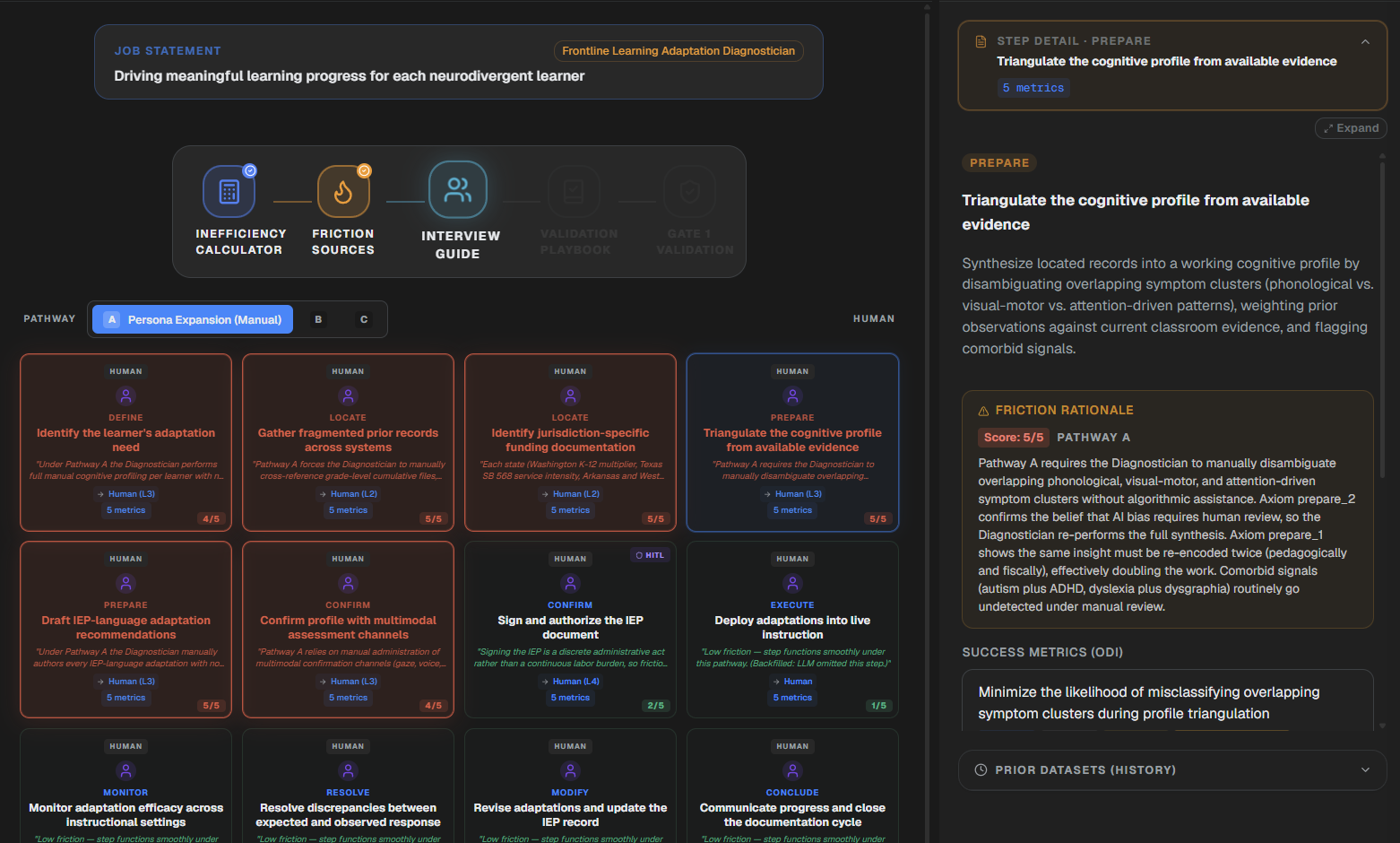
No more 200 question surveys that take an hour, never work well with professional survey takers (panels), and cost a fortune. These complexities do nothing but create stickeyness for the consultant. Dynamic AI survey tools will not solve the problem of inexperienced practitioners either, because you’re looking at the wrong problem — and automating a current workflow. Tsk Tsk. OO + NT = EOO. The goal isn’t to operate the exact same way with the burden of higher overhead costs and complexities of the new tech implementation.
We’ve already established our initial hypothesis based in first principles. We’ve identified the correct problem, mapped the road to the future, applied hard math to the architectural inefficiencies of your (or your customers’) current state, and introduced friction to the appropriate steps in the map.
There are two sides to every story. In some enterprises, their own internal architecture is the hindrance. In others, the architecture of the customer is the problem, because your solution fails to get the entire job done for them so they must cobble other solutions together to get the job done.
This is just part one of three major phases of this platform, and next step is the first validation gate. I’ll have to cover that at some other time.
I told you humans are still required! You’re role is now elevated to a level you deserve.
Check out a gallery of public (unvalidated) platform strategies: https://app.jtbd.one/gallery
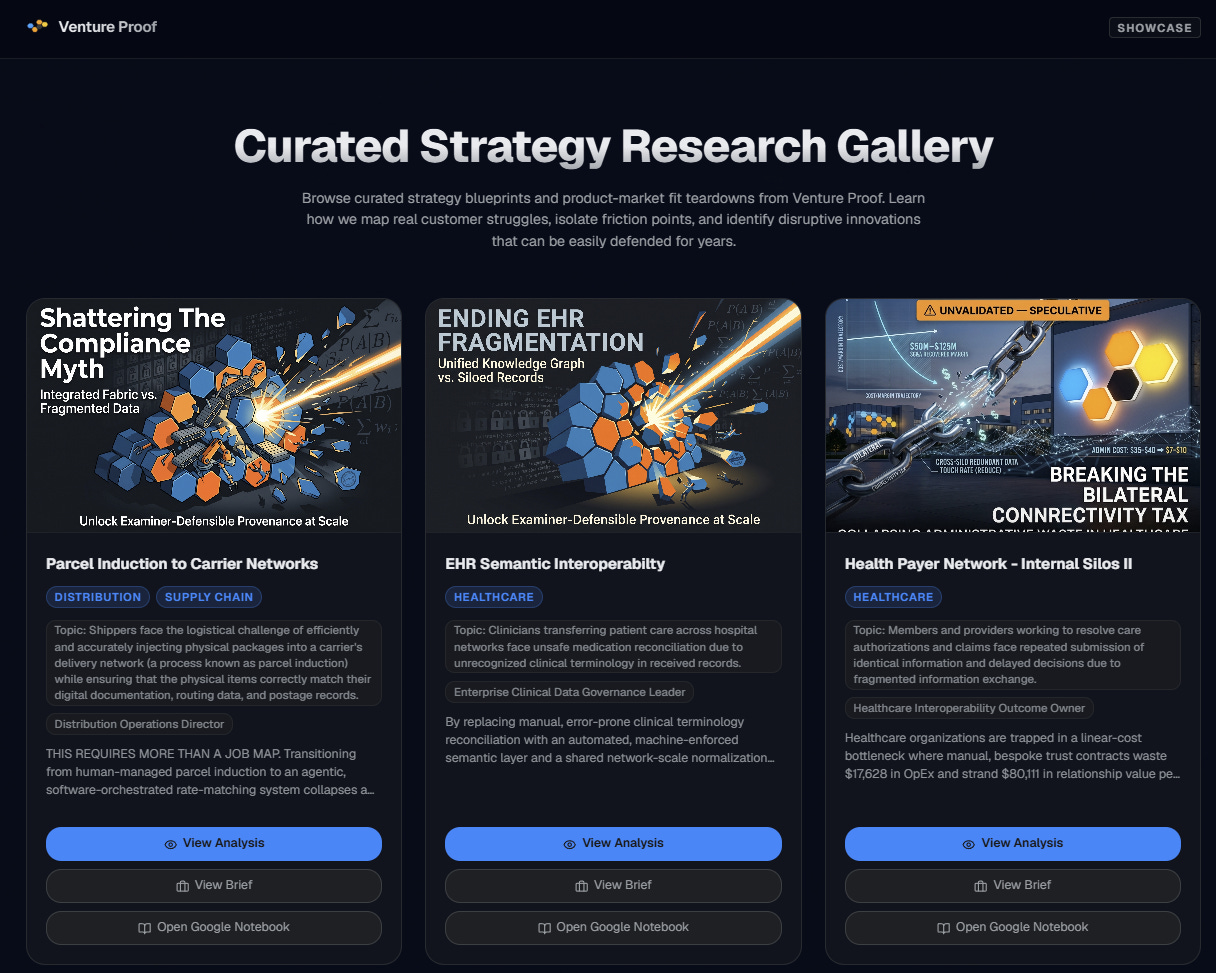
If you point an LLM at the public internet, you get pattern-matching and slide-deck filler—a race to the middle executed at lightspeed. In modern strategy, the model is not the moat; the proprietary data payload you query is. To prove this, I’m opening my research vault: every week, I compile a complete, industry-wide research payload (job maps, physics floors, and inversion plans) into a secure Google NotebookLM workspace. If you have a Gmail account, you can enter the workspace, query the raw math, and stress-test the data yourself. Stop prompting average search results.
Do you have a challenge staring you in the face? First 10 VP+’s each month get a free Physics Gap Report. Apply here.
Is your organization interested in true innovation? Or does it prefer to just look busy and hire consultants? The world is changing quickly. If you’re not adapting to it, you’re not innovating. I work with organizations who are serious about attacking problems and who are tired of defending the current paradigm. Is that you? (my availability is limited).
Submit a problem or challenge: Click here
Book an appointment: Click here
Email me: mike@pjtbd.com
Call me: +1 678-824-2789
Join the community: Click here
Follow me on 𝕏: https://x.com/mikeboysen
Articles - jtbd.one - De-Risk Your Next Big Idea
Always attack…Never defend