

The Hidden Tax on Everything
In nearly every sector of the modern economy, we are being gaslit by the “market rate.” We accept the prohibitively high cost of complex products—from medical devices to aerospace hardware—as an inevitable consequence of sophistication. This is a mistake. Most industries are currently operating under a self-imposed delusion of necessity, mistaking legacy inefficiency for fundamental value.
To see through this fog, the elite innovator uses a diagnostic tool of radical transparency: the “Physics Gap.” This framework is not merely an accounting trick; it is a first-principles weapon used to strip away the layers of human friction masquerading as “cost of doing business.” It forces us to ask: what does nature actually require this to cost, and why are we tolerating the difference?
The Math of Inefficiency: The Core Equation
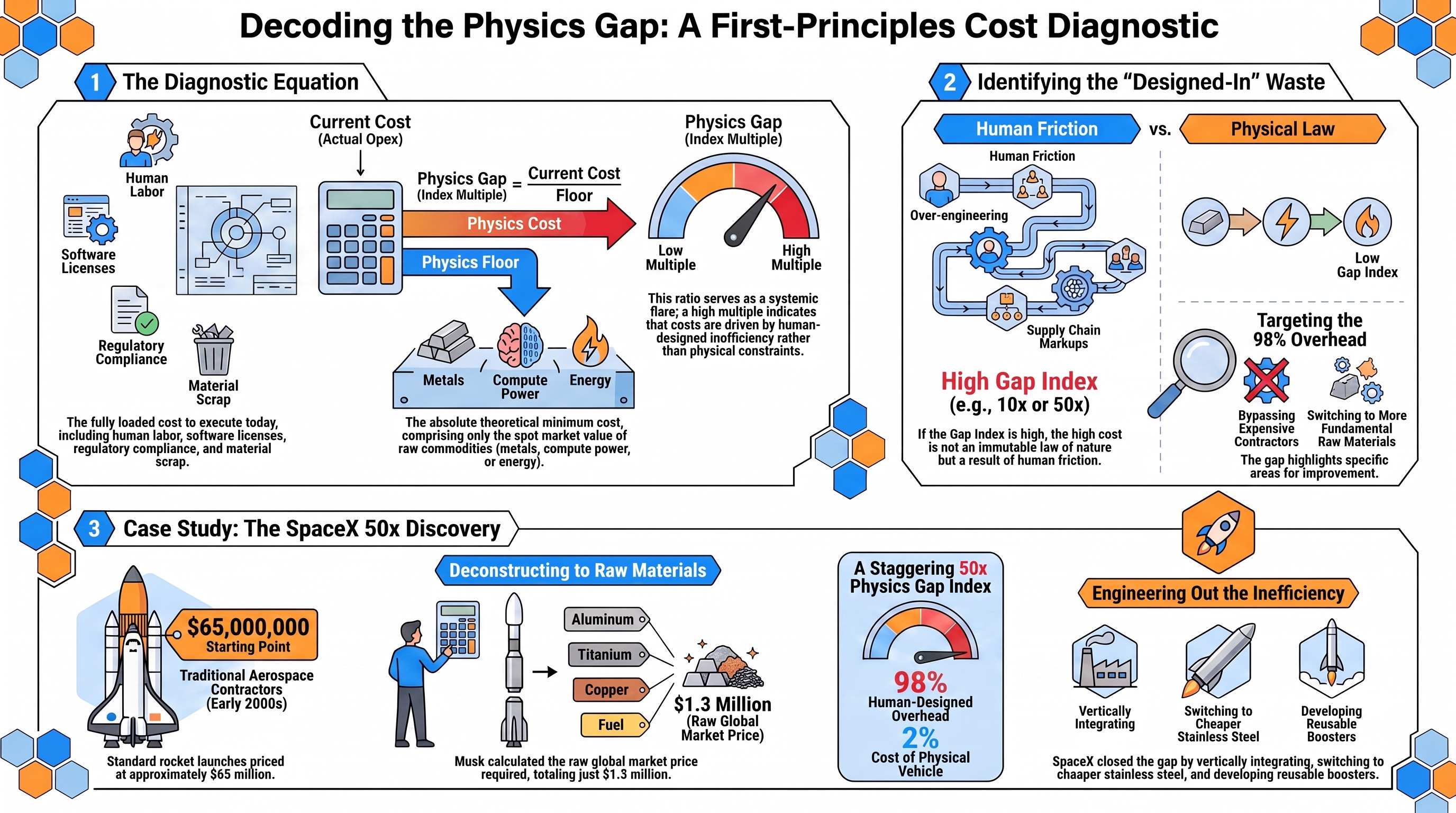
The Physics Gap is a mathematical measure of structural waste. It treats the distance between current pricing and theoretical perfection as a “systemic flare”—a signal that a product’s cost has been “designed in” by human error rather than dictated by the universe.
The calculation is expressed as an Index Multiple:
Definition: The Physics Gap is a mathematical heuristic used to measure structural inefficiency. It serves as a diagnostic tool to identify when high costs are the result of human decisions—such as process friction, middleman markups, or over-engineering—rather than immutable physical constraints.
Finding the “Physics Floor”
The power of this equation lies in the Denominator: the “Physics Floor.” This is the ground truth. It represents the absolute minimum cost theoretically possible if all process waste and human friction were obliterated.
Nature vs. Industry Consensus
The Physics Floor (Nature): This is calculated using the spot market value of raw commodities. It is the cost of the raw aluminum, the fundamental compute power, the bandwidth, and the fuel. Nature does not care about your “industry standard” or your overhead; it only cares about the atoms and energy required.
The Industry Consensus: This is a collection of legacy habits. It’s what your competitors charge because that’s what they’ve always charged. It is a baseline built on top of decades of accumulated waste.
Your customers cannot solve this problem for you. They aren’t engineers. While their opinions are helpful related to consumption, they simply know nothing about your version of accumulated waste. And it not their job to know that.
The $65 Million Reality Check: The SpaceX Case Study
The most aggressive act of defiance against “Industry Consensus” occurred in the early 2000s when Elon Musk applied the Physics Gap to the aerospace industry. Traditional contractors insisted that a standard rocket launch had to cost $65 million.
By deconstructing the rocket into its physical constituents—aerospace-grade aluminum, titanium, copper, carbon fiber, and fuel—Musk found the raw materials totaled only $1.3 million. Nature said a rocket could cost $1.3 million; the industry was charging a 50x premium.
SpaceX didn’t just try to be “more efficient”; they engineered away the human-designed overhead through a series of radical pivots:
Aggressive Vertical Integration: SpaceX stopped paying the “tribute” of supplier profit margins by manufacturing the vast majority of components in-house, bypassing the bloated supply chains of legacy contractors.
Material Defiance: They abandoned expensive, difficult-to-handle materials like carbon fiber in favor of stainless steel—a material dictated by cost-efficiency and physical resilience rather than aerospace tradition.
Asset Reusability: They treated the $60 million gap as a lost investment, engineering boosters to land and fly again rather than discarding tens of millions of dollars of hardware into the ocean after a single use.
The 98% Invisible Overhead
When the materials for a rocket account for only 2% of the price tag, the remaining 98% is the “Numerator”—the “legacy-burdened” cost. This figure is composed of human labor, software licensing, data movement, regulatory compliance, material scrap, and the compounded profit margins of five layers of middlemen.
A Moment of Clarity: It is a shocking realization for any strategist to recognize that in many industries, up to 98% of the cost is actually human-designed friction. This is the “surprising” pivot point: we’re not paying for the product; we’re paying for the inability of an organization to organize itself effectively. When 98% of a cost is “process,” that process is not an asset—it is a liability that can be engineered into oblivion.
High Multiples as Opportunities
For the first-principles analyst, a high Physics Gap index is the ultimate “buy” signal. While a 50x gap looks like a broken industry to a pessimist, it looks like a roadmap for total disruption to an innovator. And they didn’t need a Job Map to see it.
A high multiple proves that the current price is a choice, not a requirement. Identifying a 10x or 50x gap provides the exact coordinates for where a competitor can commoditize a legacy player’s profit center. If a cost isn’t an immutable law of physics, it is a variable that can be optimized. The gap is your profit margin; the floor is your competitive moat.
The First-Principles Challenge
Most of the costs you accept as “fixed” in your business or life are actually a voluntary tribute to legacy inefficiency. The “market price” is often just a reflection of how much waste a customer is willing to tolerate.
As you look at your own industry or the products you rely on, look past the invoice and see the atoms. Stop asking if a price is “fair” compared to the competition and start asking if it is “fair” compared to the laws of physics.
What is the physics floor of your industry, and how much of your budget is a tribute to legacy inefficiency?
If you point an LLM at the public internet, you get pattern-matching and slide-deck filler—a race to the middle executed at lightspeed. In modern strategy, the model is not the moat; the proprietary data payload you query is. To prove this, I’m opening my research vault: every week, I compile a complete, industry-wide research payload (job maps, physics floors, and inversion plans) into a secure Google NotebookLM workspace. If you have a Gmail account, you can enter the workspace, query the raw math, and stress-test the data yourself. Stop prompting average search results.
Do you have a challenge staring you in the face? First 10 VP+’s each month get a free Physics Gap Report. Apply here.
Check out a portfolio of strategy outcomes: https://app.jtbd.one/venture-proof/gallery

Is your organization interested in true innovation? Or does it prefer to just look busy and hire consultants? The world is changing quickly. If you’re not adapting to it, you’re not innovating. I work with organizations who are serious about attacking problems and who are tired of defending the current paradigm. Is that you? (my availability is limited).
Submit a problem or challenge: Click here
Book an appointment: Click here
Email me: mike@pjtbd.com
Call me: +1 678-824-2789
Join the community: Click here
Follow me on 𝕏: https://x.com/mikeboysen
Articles - jtbd.one - De-Risk Your Next Big Idea
Always attack…Never defend