

THE EPISTEMOLOGICAL PROBLEM: THE “PROJECT APEX” TRAP
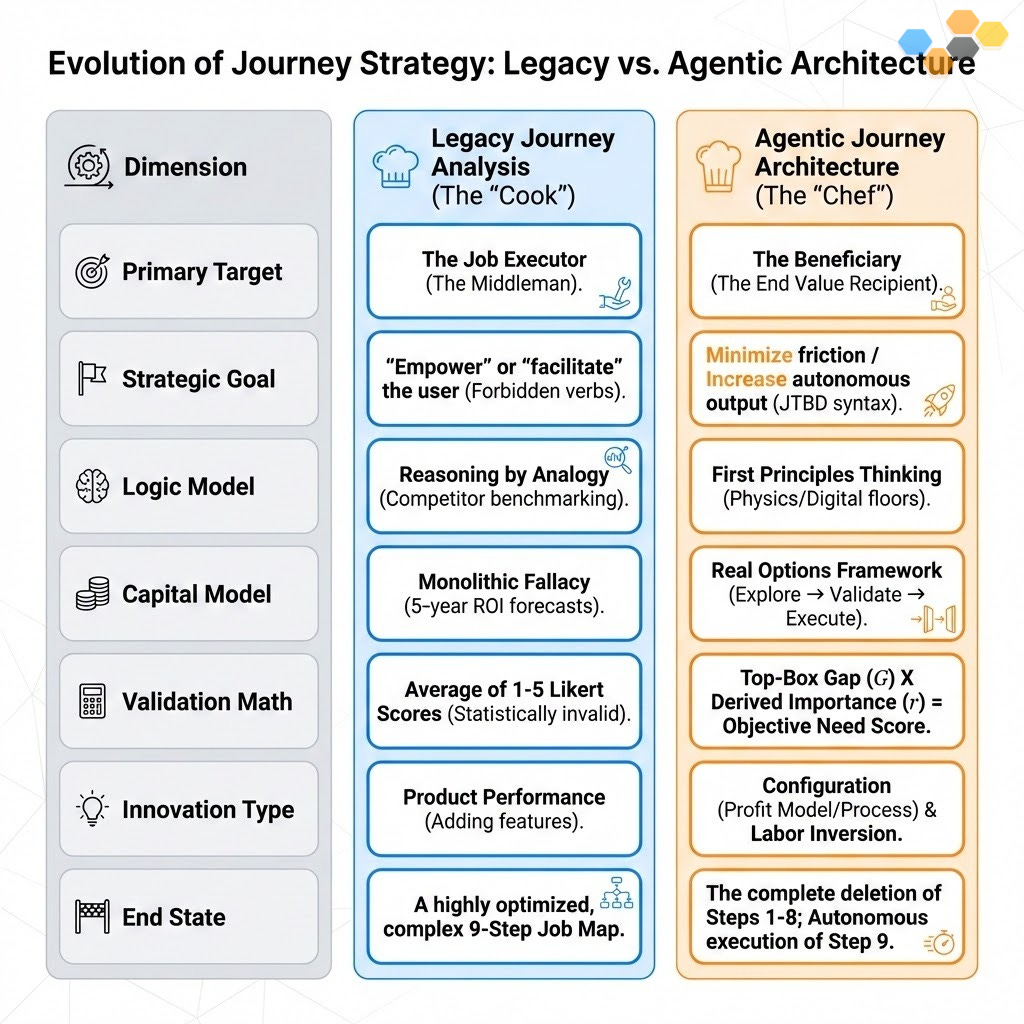
For decades, enterprise innovation has been paralyzed by the “Monolithic Fallacy.” We map customer journeys by observing how people currently work, relying heavily on “Reasoning by Analogy.” We survey users using flawed 1-5 Likert scale averages, assuming that if an intermediary employee is struggling, we must build them a tool to “manage,” “facilitate,” or “empower” them.
This is the Project Apex Trap: spending millions to build a dashboard for a sales rep (the Executor) to solve a “visibility” pain point, only to realize the root cause was a misaligned incentive structure. We optimize processes that should not exist. We act as firefighters extinguishing symptoms, rather than architects designing systems.
Project Apex is a cautionary case study about a company that spent half a million dollars building a sales dashboard to solve a perceived "visibility" problem for its reps. Ultimately, the project failed because it merely addressed a surface-level symptom instead of the actual root cause, which was a deeply misaligned incentive structure.
The Customer Perspective: Journeys are Friction. We must fundamentally recognize that customers do not buy “journeys,” “workflows,” or “touchpoints”—they buy outcomes. From the perspective of the Beneficiary, every step in a journey map is not a value-add; it is a tax on their time, energy, and resources. A journey is simply the friction standing between a user and their desired result. Traditional journey analysis ignores this reality, treating human Operational Expenditure (OPEX) as a permanent fixture. We build Experience Moats around the Executor, creating a bloated ID10T Index (Inefficiency Delta) where the commercial cost of a journey massively outpaces its theoretical digital or physical floor.
The Antidote is the Agentic Approach. We must deploy First Principles Thinking to smash the “Problem As-Is” down to its indivisible truth. By deploying the Socratic Scalpel, we shift from horizontal exploration to vertical drilling. We apply Musk’s Algorithm:
Step 1: Question every requirement.
Step 2: Delete any part or process you can.
If we are not forced to add back 10% of the steps we cut, we did not delete enough. The goal is no longer to make the Job Executor’s life easier. The goal is Labor Inversion: decoupling value delivery from human OPEX, shifting the fundamental unit of work to scalable AI, and collapsing the journey entirely around the Beneficiary.
COMPARATIVE ANALYSIS: LEGACY VS. AGENTIC JOURNEY ARCHITECTURE
To cross the chasm from incrementalism to defensible monopolies, we must abandon the old metrics of journey optimization.
DECONSTRUCTING THE 17 UNIVERSAL JOURNEYS
By running the 17 Universal Journeys through my Innovation Lattice (Nodes 1-6), we apply Labor Inversion to each. We eliminate the Executor, radically alter the unit economics, and deliver the First Principle value directly to the Beneficiary. Note: we can run this through scores of creativity triggers because labor inversion may not always be the answer; just the most likely answer when interactions are designed more for agents, and less for humans.
1. The Selection Journey
The First Principle: Identifying the mathematically optimal match between a problem and a solution.
Legacy (Executor Focus): Sales engineers and procurement officers spend weeks evaluating RFI/RFPs.
Agentic Inversion: Delete the procurement officer. AI agents negotiate synchronously via APIs, analyzing the contextual domain and executing a selection based on a predefined Top-Box Job Map. The Beneficiary simply confirms the mathematical output.
2. The Purchase Journey
The First Principle: Verifiable transfer of value and assumption of liability.
Legacy (Executor Focus): Accounts Payable teams processing invoices, chasing signatures, and managing POs.
Agentic Inversion: Delete Accounts Payable. Smart contracts and autonomous programmatic purchasing execute the transaction the millisecond the Selection Journey concludes.
3. The Delivery Journey
The First Principle: The physical or digital transfer of atoms or bytes from origin to destination.
Legacy (Executor Focus): Logistics coordinators, dispatchers, and human drivers navigating bottlenecks.
Agentic Inversion: Decentralized autonomous routing. Digital delivery is instantaneous (latency floor). Physical delivery is automated via autonomous networks. The Beneficiary receives the asset without tracking it.
4. The Installation Journey
The First Principle: Establishing the baseline environment for functional capability.
Legacy (Executor Focus): Implementation specialists and IT teams spending months standing up environments.
Agentic Inversion: Delete the Implementation Specialist. “The best process is no process.” Shift to zero-config, serverless deployment where the digital solution auto-provisions instantly upon the Purchase Journey’s completion.
5. The Configuration Journey
The First Principle: Aligning system parameters to specific contextual requirements.
Legacy (Executor Focus): Sysadmins manually toggling settings and reading documentation.
Agentic Inversion: Delete the Sysadmin. The system utilizes machine learning to observe the Beneficiary’s environment and auto-tunes itself. Configuration becomes a continuous, invisible background process rather than a discrete setup phase.
6. The Integration Journey
The First Principle: Data and state synchronization across disparate systems.
Legacy (Executor Focus): Integration developers mapping APIs and writing custom middleware.
Agentic Inversion: Delete the Middleware Developer. LLM-driven agents read API documentation in real-time, write their own schema translations, and dynamically weave systems together.
7. The Learning Journey
The First Principle: Closing the cognitive gap between user capability and system utility.
Legacy (Executor Focus): Trainers, LMS platforms, and extensive onboarding flows.
Agentic Inversion: If a user has to learn the system, the design is flawed. Apply Step 3: Simplify and Optimize. The UI becomes invisible. The agent learns the Beneficiary’s intent via natural language, eliminating the need for the human to learn the software.
8. The Customization Journey
The First Principle: Adapting form and function to evolving desires.
Legacy (Executor Focus): Customer Success Managers taking feedback and submitting feature requests.
Agentic Inversion: Delete the CSM. Generative interfaces adapt the Experience Moat in real-time. The product molds itself to the Beneficiary based on predictive utilization data.
9. The Utilization Journey
The First Principle: The conversion of potential energy/logic into actualized value.
Legacy (Executor Focus): Human operators clicking, typing, and manually executing workflows.
Agentic Inversion: The ultimate Labor Inversion. The system executes the core task autonomously. The Beneficiary transitions from an Operator to a Supervisor, only intervening for extreme edge-case approvals.
10. The Maintenance Journey
The First Principle: Entropy prevention.
Legacy (Executor Focus): Maintenance crews running scheduled, periodic diagnostics.
Agentic Inversion: Delete scheduled downtime. Shift from Periodic Action to Continuous Monitoring. Systems self-diagnose via IoT/telemetry and deploy patches or order replacement parts autonomously before the Beneficiary is even aware of degradation.
11. The Repair Journey
The First Principle: State restoration following a failure.
Legacy (Executor Focus): IT helpdesks, ticketing systems, and Level 1/2/3 support tiers.
Agentic Inversion: Delete the ticketing system. Apply self-healing architectures. If a failure occurs, the system automatically rolls back to a stable state or isolates the faulty microservice, resolving the issue without human troubleshooting.
12. The Cleaning Journey
The First Principle: Removal of accumulated waste or data-debt.
Legacy (Executor Focus): Data stewards or physical janitorial staff executing batch purges.
Agentic Inversion: Continuous, algorithmic garbage collection. Waste is identified and dissolved dynamically as a byproduct of the Utilization journey, requiring zero conscious effort from the Beneficiary.
13. The Storage Journey
The First Principle: Preservation of asset integrity during dormancy.
Legacy (Executor Focus): Archivists and warehouse managers organizing static inventory.
Agentic Inversion: Dynamic, liquid storage. Data is automatically compressed and moved to cold storage based on predictive access models. Physical assets utilize automated high-density retrieval systems.
14. The Relocation Journey
The First Principle: Spatial or environmental migration of an asset.
Legacy (Executor Focus): Migration consultants mapping legacy data to new databases.
Agentic Inversion: Delete the Migration Consultant. State-transfer protocols execute instantaneous cloud migrations. The Beneficiary experiences zero friction or downtime, unaware the underlying infrastructure has changed.
15. The Upgrade Journey
The First Principle: Augmentation of core capabilities.
Legacy (Executor Focus): Project managers orchestrating massive weekend rollout windows.
Agentic Inversion: Continuous shadow-deployment. Upgrades are pushed via compressed feedback loops (Musk’s Cadence). New capabilities are toggled on seamlessly, treating the “factory as the product.”
16. The Replacement Journey
The First Principle: Substituting an obsolete asset with a superior equivalent.
Legacy (Executor Focus): Purchasing agents restarting the Selection Journey from scratch.
Agentic Inversion: Predictive lifecycle substitution. The agent monitors the ID10T index of the current asset. When the efficiency delta drops below a mathematical threshold, the agent automatically orchestrates a replacement, bypassing the human decision loop.
17. The Disposal Journey
The First Principle: Secure, compliant termination of an asset or data.
Legacy (Executor Focus): Compliance officers executing manual offboarding and data deletion protocols.
Agentic Inversion: Ephemeral architecture. Assets and data are designed to digitally “evaporate” or cryptographically shred themselves the moment their utility function reaches zero, ensuring absolute compliance with zero human oversight.
CONCLUSION: THE REAL OPTION TO DISRUPT
The 17 Universal Journeys are not a mandate for 17 different software features; they are a hit list for systematic deletion.
By applying the Unified Validation Engine to map the True Objective Need Score, and utilizing Structural Inversion to bypass the Job Executor, we stop building better shovels (incrementalism) and start delivering the hole directly (disruption).
We do not forecast this transformation; we buy the Real Option to explore it, validate it with Top-Box metrics, and execute it via Minimum Viable Prototypes. The future of the enterprise belongs not to those who optimize the workflow, but to those who possess the intellectual ruthlessness to delete it entirely.
If you find my writing thought-provoking, please give it a thumbs up and/or share it. If you think I might be interesting to work with, here’s my contact information (my availability is limited):
Book an appointment: https://pjtbd.com/book-mike
Email me: mike@pjtbd.com
Call me: +1 678-824-2789
Join the community: https://pjtbd.com/join
Follow me on 𝕏: https://x.com/mikeboysen
Articles - jtbd.one - De-Risk Your Next Big Idea
Q: Does your innovation advisor provide a 6-figure pre-analysis before delivering the 6-figure proposal?