

The modern enterprise software landscape is currently experiencing a profound operational crisis that industry insiders and strategic architects refer to as the “CRM meltdown”. Legacy customer relationship management (CRM) platforms, originally designed and sold as active productivity engines, have devolved over the past decade into static, bloated systems of record. Instead of enabling workers, these legacy architectures rely heavily on manual data entry, trapping highly-paid professionals in a state of continuous “swivel-chairing”. Employees are forced into the deeply inefficient act of manually navigating across disconnected software tools, data lakes, and approval workflows just to complete a single task.
This profound operational friction manifests in prolonged sales cycles, delayed issue resolution times, and elevated customer churn due to fragmented, siloed insights across sales, service, and fulfillment departments. The strategic imperative for modern enterprises is the transition toward autonomous execution platforms, where the system does not merely log human action but autonomously executes end-to-end workflows on behalf of the employee.
Yet, the transition to autonomous CRM is fraught with misconceptions. Vendor marketing often promises that simply bolting generative AI onto an existing database will solve the enterprise execution problem. However, a deep dive into comprehensive strategic analyses, architectural benchmarks, and enterprise deployment data reveals a completely different reality.
Here are the top five most surprising, counter-intuitive, and impactful takeaways about the autonomous future of the SaaS industry.
1. The Shocking $1,465 vs. $45 “Physics Gap”
What does it actually cost a major corporation to execute a single, cross-functional sales quote? Intuitively, we think of software operations as cheap and instantaneous. But when you map the true end-to-end execution of a complex enterprise workflow, the financial reality is staggering. Right now, in massive multinational enterprises, a company is paying exactly $1,465.37 to execute a single basic sales quote.
If you look at the absolute laws of computing—the pure compute power, the storage input/output, and the network transit—that exact same operation should only possess a “physics floor” cost of roughly $44.84.
Where does this massive discrepancy come from? It is the ultimate manifestation of the swivel-chair tax. The nearly $1,500 cost is dominated by manual labor. It includes the cumulative hourly rates of sales operations specialists, legal reviewers, and finance controllers who spend fractions of their day manually cross-referencing disconnected CRM, CPQ, and ERP systems. For example, highly educated professionals are literally hand-reformatting pricing waterfalls on PDF documents because data formatting breaks when copy-pasted between systems.
“The first-principles verdict is unambiguous. The $1,465 manual cost per CRM execution is a labor tax, not a value-add. The $45 physics floor is achievable only through structural inversion — zero-copy federation plus governed autonomous agents — and any path that preserves humans in the execution loop cannot mathematically close the 32.68x gap.”
To understand the magnitude of this gap, consider the breakdown of legacy execution versus the autonomous ideal:
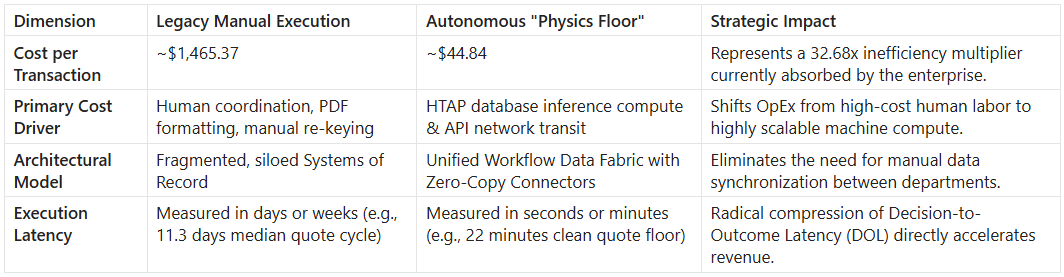
The Analysis: Legacy CRM vendors have historically tried to solve this by providing slightly better user interfaces or adding digital helper tools. But a sleeker UI doesn’t close a 33x efficiency gap. The only way to reach the physics floor of $45 is through a complete structural inversion: replacing manual coordination with zero-copy data federation and autonomous execution agents. Treating the CRM meltdown as a software feature problem misses the point; it is a fundamental labor allocation problem disguised as a software issue. The platforms that win the next decade will be the ones that own the execution seam between quote, fulfillment, and billing without a single human translation hop.
2. The “AI Copilot” is a Dangerous Trap (The Jevons Paradox)
What happens when you give an employee an AI copilot to make them execute tasks faster? The entire SaaS industry is currently obsessed with “copilots”—digital assistants designed to help human workers draft emails, summarize long incident threads, and generate knowledge articles. Intuitively, accelerating the human worker seems like a pure productivity win. Counter-intuitively, the exact opposite often happens.
By deploying generative AI as a mere band-aid over fundamentally broken, manual legacy workflows, enterprises trigger a well-documented economic phenomenon known as the Jevons Paradox. When you significantly lower the time and friction required to process a single request, you inadvertently incentivize a much higher volume of inbound requests.
The mathematics of this rebound effect are unforgiving. In the CRM execution market, the “Jevons Elasticity Factor” (E) sits at roughly 1.30.
“We define the Jevons Elasticity Factor (E) for CRM execution as the ratio of new transaction volume generated per unit of cost reduction. In this market, E = 1.30. Read that carefully: every one-percent reduction in execution cost creates 1.30 percent in incremental volume... When E exceeds 1.0, the rebound effect consumes the savings.”
If a company buys an AI copilot that compresses per-execution costs by 30%, the demand response at an elasticity of 1.30 will generate 39% more executions globally. The cost per execution looks fantastic on a vendor’s slide deck, but the total operating cost actually goes up. The CFO, the procurement team, and the board see absolutely no savings; they only see a fancier tool with a higher bill.
The Analysis: If you speed up a human with an AI copilot, they simply hit the next un-automated human bottleneck faster. A sales rep might draft a quote in two minutes using AI, but that quote will still sit in a legal or finance approval queue for three days. The volume surge eventually overwhelms human approval layers, forcing the enterprise to abandon the “human-in-the-loop” copilot model. True structural transformation only occurs when the graphical user interface (GUI) is bypassed entirely. Instead of building faster swivel-chairs, modern architecture must remove the swivel-chair entirely, shifting human roles to strategic relationship management while autonomous agents handle end-to-end task execution.
3. Zero-Copy Architecture is the Ultimate Tactical Trojan Horse
How do you unify enterprise data for AI without spending millions on a massive, multi-year migration project?
Historically, extracting actionable value from a CRM required massive, multi-year Extract, Transform, Load (ETL) projects to physically migrate data into a centralized data warehouse or data lake. Platform engineering teams burn six-to-ten-week pre-deployment sprints manually mapping schemas and deduplicating records across disconnected CRM, ERP, and fulfillment systems before any AI agent can safely read or write data. This process is notoriously slow, incredibly expensive, and deeply unpopular with IT departments.
The counter-intuitive shift disrupting the SaaS industry is the rise of Zero-Copy Architecture. Platforms are increasingly utilizing standards like the Apache Iceberg REST Catalog and Delta Lake integrations to query and act upon data natively where it already rests—whether that is inside external hyperscalers like AWS and Azure, or data lakes like Snowflake and Databricks.
“Enterprise data does not need to be physically migrated; zero-copy connectors allow disparate data sources to be unified into a single workflow system for visibility and AI action.”
By deferring entity resolution to query time rather than ETL time, zero-copy architecture collapses the integration timeline by an order of magnitude.
The Analysis: Zero-copy is acting as a massive competitive wedge in the enterprise software market. It serves as a highly effective “tactical Trojan horse” during complex enterprise sales cycles. By assuring Chief Information Officers and IT departments that they can achieve advanced, AI-driven workflow automation without enduring the massive risk, cost, and latency of physically moving their legacy databases, disruptive platforms completely bypass traditional IT friction. It shifts the competitive moat away from who stores the data to who orchestrates the workflow across the federated data plane.
4. The Imminent Collapse of the “Per-Seat” SaaS Empire
If AI agents do the work of humans, why would a company continue paying for human software licenses?
For decades, the undisputed economic engine of the Software-as-a-Service (SaaS) industry has been the “per-user, per-month” seat license. The valuation multiples of massive legacy CRM providers are built entirely on expanding headcounts and multi-year seat expansions.
But the autonomous CRM thesis inherently promises that early adopters can drastically scale their operational throughput and double customer volume without scaling their sales or support headcount.
This creates a terrifying existential paradox for legacy SaaS incumbents: if your AI successfully makes your clients highly efficient, they will ultimately fire a portion of their middle-office staff. This directly cannibalizes your own core seat-license revenue base. As AI agents improve resolution efficiency, customer human seat rationalization structurally threatens core subscription Annual Recurring Revenue (ARR).
“If this autonomous paradigm is successful, the traditional per-seat Software-as-a-Service (SaaS) licensing model will structurally collapse, as enterprises will require drastically fewer human seats.”
To survive, platforms must fundamentally decouple revenue growth from raw human headcount expansion.
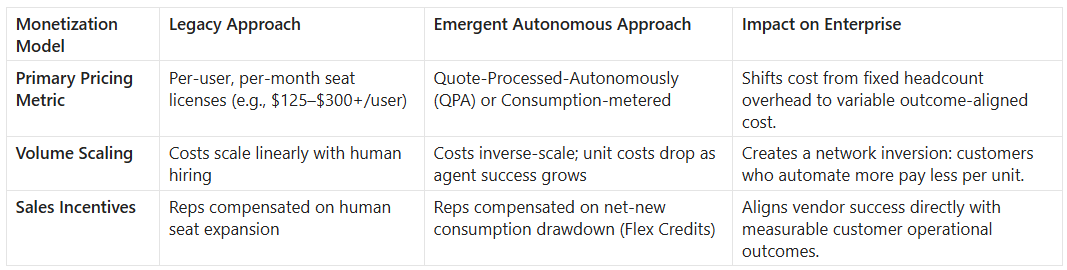
The Analysis: We are witnessing the forced evolution of SaaS monetization. The traditional pricing model punishes customers for automation success—if an AI agent enables a company to execute more work with fewer people, a per-seat model forces them to pay a penalty for empty seats. The future belongs to outcome-based and consumption-based pricing models—charging via “Flex Credits,” per-resolution billing (e.g., $2.00 per autonomous case resolution), or Quote-Processed-Autonomously metrics. The SaaS vendors that survive the AI transition will be the ones who successfully transition their enterprise customers to paying for verified machine execution rather than human application access.
5. “Human-in-the-Loop” is a Telemetry Harvesting Operation, Not a Final Destination
Are humans permanently necessary to govern AI in the enterprise?
Currently, enterprise security, legal, and compliance teams are rightfully terrified of handing over core revenue-generating workflows to autonomous AI agents. Because legacy enterprise data is often a fragmented swamp of custom JavaScript, bespoke GlideRecord queries, and undocumented rules, full autonomy is currently viewed as a massive, unquantifiable liability.
When executives are asked to sign off on AI, they inevitably ask questions like the one posed by a CFO during a real-world enterprise deployment: “If this autonomous system breaks at 2am on a quarter-close Saturday, who do I call?”.
To bypass this antibody resistance, platforms are enforcing “Human-in-the-Loop” (HITL) gates. An AI agent might draft a complex quote, classify a support ticket, or flag a churn risk, but a named human approver must click a button before the system executes the action. However, viewing HITL as a permanent safety feature is a profound misunderstanding of the long-term strategy.
“By placing a familiar IT governance interface (the CMDB) over the abstract concept of generative AI, a vendor habituates deeply conservative compliance officers and executives to algorithmic decision-making.”
The human-in-the-loop is simply a strategic “Trust Bridge” and a vital data priming mechanism.
The Analysis: While human workers are manually correcting AI drafts, catching margin floor violations, and approving routing suggestions, the system is not just waiting; it is silently capturing rich operational telemetry in the background. The AI observes which hidden tables are manually checked, which exceptions trigger overrides, and maps the unwritten business rules of the organization.
Over twelve to eighteen months, these millions of human micro-corrections build a massive, perfectly labeled training corpus. This telemetry actively trains the machine-enforced semantic layer required for true autonomy. Platforms utilize a “Stratified-Sampling Graduation Engine”. Once an agent’s error rate drops below a configured threshold and human reviewers consistently agree with its borderline decisions, the workflow is automatically promoted from HITL-mandatory to fully autonomous. The human is just the training wheels, entirely necessary to generate the dataset that eventually makes them obsolete.
Conclusion: The Era of Execution Has Arrived
The “CRM Meltdown” isn’t a surface-level problem that can be solved with a sleeker interface, a better dashboard, or a conversational chatbot wrapped around a legacy database. It is a fundamental labor allocation problem deeply disguised as a software issue.
The companies that will dominate the next decade of enterprise SaaS will not be the ones who build the most comprehensive systems of record. They will be the ones who successfully orchestrate cross-system seams, utilizing zero-copy data architecture, federated excess capacity, and outcome-based pricing to drive execution costs down from the $1,465 manual labor tax to the $45 physics floor.
The era of merely logging corporate data is rapidly ending. The era of autonomous, machine-driven execution has begun.
A Final Thought to Ponder: If your company’s software pricing model is still strictly tied to how many humans sit at a desk, what happens to your operational budget and competitive velocity when your rivals figure out how to operate reliably at the $45 autonomous physics floor?
Is your organization interested in differentiated innovation? The world is changing quickly. If you’re not adapting to those changes, you’re not innovating. Seeking reassurance from consultants fails, nearly always (sometimes they get lucky). I work with organizations who are serious about attacking problems using first principles. Many have been burned once, and they don’t want it to happen again. Is that you? (my availability is limited).
Submit a problem or challenge: Click here
Book an appointment: Click here
Email me: mike@pjtbd.com
Call me: +1 678-824-2789
Join the community: Click here
Follow me on 𝕏: https://x.com/mikeboysen
Articles - jtbd.one - De-Risk Your Next Big Idea
Slaying the Sacred Cows of Innovation