

Disclaimer: I do not consider myself to be a serial innovator. I’ve done some very innovative things in the software world 10-15 years ago that are just now surfacing on the current platforms. I did these things to solve problems for clients. Really cool then, but the technology is so much better now and I see the platform solutions as being the real innovations.
Solving for opportunities in the market has been a thing for as long as humans have conducted business of any kind. Some are able to zero in on an actual problem and find a root cause. Others come up with ideas and iterate solutions until they find a problem. Both can be successful. But one is prone to excessive failures and expense in the pursuit of those successes.
We’ve all heard the term “throwing good money after bad.” Some people recognize that we are failing to innovate at a pace that would benefit everyone; both businesses and society as a whole. So in good conscience, they come up with solutions that embrace our collective strength - failure - and make it look pretty.
Yet they keep failing.
Some write books about how to do it but they don’t give the tools to do it because…they don’t really have any tools that are purpose-built. Too many of us look at templates and canvases and think “a ha! I found the solution.” In fact, the author found the solution. The solution to hoovering your wallet.
The rate of product failures and wasted investments has not changed. Just driving this point home.
Don’t get me wrong, there are tools out there that work, but none of them are perfect. You might be lucky enough to have heard about some of them, but the tools and methods that work also require a lot of rigor. It’s the systems in these methods that make them work. It’s also the systems that make them look painful to many; especially the creative minds. Even the best of these have not yet been able to wring out the last of the value-eroding bottlenecks. It’s extremely difficult to design an inventor out of the process, for example.
So, that leaves us with the reality that someone - who doesn’t take the time to understand the method - simplifies or changes the focus of the method and slaps the same label on it.
Making matters worse
Egos are the worst ingredient in any system. I’m talking about the clash of egos back in the late 1990’s when an innovator’s solution meets the guy who wrote a book about the innovator’s dilemma. A truly engineered method for problem framing, measurement and analysis colliding with people who sit in fast food restaurants and take notes of what they observe - think about it - and then synthesize their data subjectively.
These are the types of people that put a shiny wrapper on something like Customer Case Research and rename it Jobs-to-be-Done. I’m not going to go any further into the history because from that point on it was simply the battle of egos and one side continually moving the goal posts until their framework could do anything! A playing field where you can interview someone buying a mattress and miraculously develop a better skateboard! Sure you can, fella.
So as we fast forward 20+ years, what do we have? We have one faction who’s output is a modified User Story - which is the end result of much (or not so much - a week, maybe) qualitative intake and synthesis. They use to call them Job Stories, but now the world has become so confused that they are called Job Statements. Or are they? I’m not sure. Either way, a clear rip-off. And also, clearly worthless to anyone because they are laced with assumptions, there are more than one (so many problems!), and they are not traceable back to a true and provable set of customer needs.
The other method begins by framing a problem with a job statement so it has a clear scope and boundaries - very much like a process. And the level of abstraction is right in the sweet spot for innovation. It’s not too aspirational (not at all, in fact) and not too solution-y (not at all in fact).
To confuse matters even more, there are many others - and I’m not questioning their motives - that have put their twist on things. Typically, that looks like a hodge-podge of the two primary schools of thinking. Listen, if one doesn’t work, combining it with one that does doesn’t work either. It’s like designing a ship’s power plant that pushes and pulls at the same time. Just sayin…
How do we resolve this?
We don’t. Instead, I’m going to lay out - once again - a logical sequence of capabilities that must be true in order to be successful if your ultimate desire as a an enterprise is to experience repetitive, predictable, and successful innovation, design and marketing over time. It doesn’t matter if this is one person wearing multiple hats in a startup, or a Fortune 50 company with distinct functions. The same principles must apply.
Allow me to throw this horribly designed infographic in your face one more time…
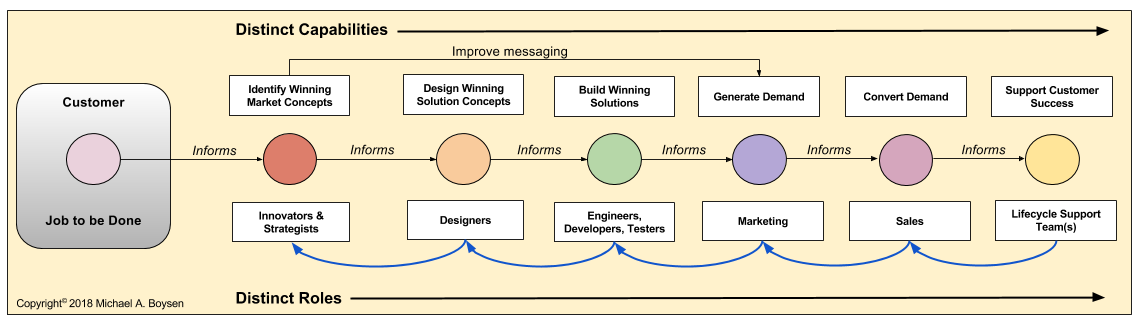
The problem we are facing is that Step 1 & Step 2 are being combined. Who do I blame? No one. Sales teams often go out and develop their own leads because the Marketing organization has failed them. In many cases, the Marketing organization attempts to do Step 1. 🤣 Instead, they should be focused squarely on supporting their clients - either a sales organization, or a digital platform that enables consumers’ to purchase. The insights factory that should be Step 1 needs to be independent and directly tied to senior enterprise leadership.
Designers (to a large extent embedded in the product development team) are also out of their depth - generally - when they take on exercises that extended forward beyond the physical (digital) world, where they have deep expertise. Like the Sales teams that get low quality leads, they are getting low quality innovation inputs (usually from themselves). Sales professionals then take it upon themselves - a process which is not repeatable or predictable. Designers also take it upon themselves (and so does marketing) when they feel they are not getting the correct inputs to their respective processes.
The reason for this is that no one is using a semantic (and data-driven) problem-solving model on the front-end of innovation. Applying techniques that work in design do not garner the same results when working on market-level problems, problems that must be studied independent of solutions. In fact, they get the definition of the market wrong nearly 100% of the time.
I get it, when you’re a customer and you get frustrated, you try to solve the problem yourself. I’ve seen this time and time again in my work in the CRM (now CX?) world. At the end of the day, there really is no difference between getting 10,000 crappy leads from your marketing organization, and generating 10,000 crappy ideas in an ideation workshop.
The result is nearly always the same
Mike, you make a good point. Start with sale or client success and work backwards from there. Everything starts with sales including what we call a business.