

Workflow in the CRM world quite often involves a consultant (in cahoots with a willing client) automating everything; simply because they can. I’ve been there myself (kicking and screaming); I once developed a really cool approval routing system that was end-user configurable. Unfortunately, as in my example, what was really happening was something Bill Gates warned us about:
“The first rule of any technology used in a business is that automation applied to an efficient operation will magnify the efficiency”
And
“The second is that automation applied to an inefficient operation will magnify the inefficiency”
This is actually pretty simplistic in that there is no discussion of value or whether making something faster actually aligns with your organization’s competitive differentiators; but it’s still something worth remembering. To make things even simpler, we can also use this old adage…
OO + NT = EOO
(Old Organization plus New Technology equals Expensive Old Organization)
Any organization ready to take on a workflow project needs to take a few things into consideration first:
What are the true end-to-end business processes and can you see them?
Which actors play a role in the process(es) today?
What are the discrete results of each process; who are the customers (internal and external) and what job does it help them get done?
What are your competitive differentiators in the market?
What are the drivers & enablers for value creation?
Until you know these things, it’s impossible to know what to fix, or whether the process itself creates a result that customers give a hoot about. In many cases, you don’t need to dig down into the nitty-gritty details of service procedures and tasks. Simply identifying what the true process is, and looking at how a work item is handed off between actors over time will show you all you need to know. Even without getting into group sessions one can get a good sense of the waste occurring in an organization through an initial discovery process.
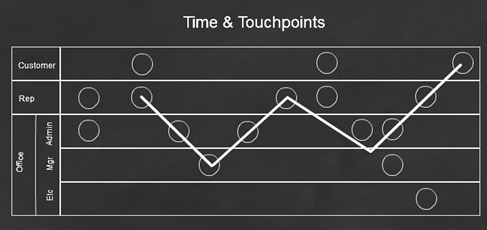
What the “W” Often Means
Putting together a basic swimlane diagram of hand-off level events (not details) can sometimes quickly show you that a problem is hiding in plain site. Excessive back and forth of work items between actors can create various types of waste. While context is important here (perhaps there are regulatory issues), generally one can quickly see where more probing might be necessary by simply looking for the “W”. This “W” essentially depicts areas of potential waste and examples might include:
Sales rep calling the office to retrieve phone number, or address because it takes too long to boot up their laptop while driving 85 mph in the wrong direction
A paper or spreadsheet-based tracking system which requires a work item to pass back to an actor after each stage or work is completed, so the log can be updated.
Excessive auditing of transactions: e.g. all quotes or sales orders must be processed by office staff
I’m sure you can come up with a lot more examples; waste is a very prevalent problem in most organizations and outside of Lean operations seldom is there a process designed to eliminate it incrementally over time.
7 Types of Waste
If you’re looking for waste in your organization, here is a list of 7 types of waste that you can look for:
Overproduction — more, or sooner than is needed by the customer of the process. In the front office, this could actually mean selling more than can be fulfilled
Inventory — Any form of batch processing or work in process. This could mean partially completed tasks or documents or items prepared in advance of an anticipated future need.
Waiting — Delays in getting information or some other result. Most often I will see excessive approval processes or team members that have information or resources required, but are not available when they are needed.
Extra Processing — Time spent doing unnecessary steps. I see the re-keying or re-formatting of data quite often, creating unused/unnecessary reports, etc.
Correction — Any kind of defect or rework required. In the front office is this is most often related to stored data about customers or transactions
Excess Motion — Movement of people. Retrieving anything essential that is out of reach. Data, information that is physically stored in a centralized location or in a system that is inaccessible in your current context (such as on the road)
Transportation — Movement of work between locations, offices, floors, buildings, systems and people. We see this in email today, in the context of handoffs or approvals
A closing note about automating work; don’t speed things up that your customer doesn’t expect to be speeded up. For instance, if you are Jesse James, building killer custom motorcycles, your customer is willing to wait; speeding this process up would inevitably lead to defects, and waste, that they are not willing to tolerate (i.e. Correction). However, that same customer might value regular updates regarding the status of the job (including production stage pictures so they can see the progress). This is a something that automation can certainly help with.
Also, automating steps that do not add value are simply making a worthless step happen faster. This will lead to the slippery slope of believing that you can now introduce more of these steps or processes. An example would be the approval system I developed that supported a management directive that everything needed to be pre-approved and re-approved by a hierarchy of approvers (from travel to entering a new Opportunity into their CRM system). The actors in this process were actually excited about this system because when looking at the problem through the lens of the current implementation; faster looked better; even if it added no value.
This post was written as part of the IBM for Midsize Business program, which provides midsize businesses with the tools, expertise and solutions they need to become engines of a smarter planet. I’ve been compensated to contribute to this program, but the opinions expressed in this post are my own and don’t necessarily represent IBM’s positions, strategies or opinions.
