

INTRODUCTION: The Semantic Drift of Innovation
In the modern lexicon of technology and business, “Founder” has become a title of default, a participation trophy for anyone with a Stripe account and a LinkedIn profile. We use it to describe the person who registers a domain, incorporates an LLC, or hires a dev shop to skin a CRUD app for a problem they haven’t actually deconstructed.
This is not “Founding.” This is “Clerical Commencement.”
If we look at the physics of innovation through the lens of Jobs-to-be-Done (JTBD) and First Principles, we find a profound, systemic discrepancy between what the market calls a Founder and what the act of Founding actually requires.
Most people who carry the title are actually Executors. They are high-functioning administrators of the status quo. They are building factories for existing categories. They are reasoning from analogy, taking the “best practices” of an incumbent and attempting to optimize the edges. They are starting companies, but they haven’t founded a truth.
The “Founder Fallacy” is the belief that the value of a startup lies in the quality of its execution. It doesn’t. Execution is a commodity. You can hire execution. You can outsource execution. You can automate execution. But you cannot outsource the 𝗳𝗶𝗻𝗱𝗶𝗻𝗴.
To “found” something is an act of cognitive archaeology. It is the rare, violent act of uncovering a new category of value that makes the status quo look like a series of “stuck beliefs.”
We are currently living through a “Semantic Drift” where the language of innovation has been hollowed out. “Disruption” now means “slight incremental improvement.” “Innovation” means “re-skinning a competitor’s feature set.” And “Founder” has come to mean “the person who took the most risk on a derivative idea.”
This guide is the definitive deconstruction of that drift. It is a 10,000+ word deep dive into the discipline of 𝗳𝗶𝗻𝗱𝗶𝗻𝗴—the period of intense, non-linear learning that must precede the first line of code. It is about the refusal to build the “Factory of Analogies” and the commitment to finding the Bedrock of the Job-to-be-Done.
If you are looking for a roadmap to “scale,” you are in the wrong place. Scaling an un-found truth is just a very expensive way to fail. If you are looking to deconstruct the physics of value, to understand why most products are just “causal hammers” looking for a nail, and to claim your Option to Explore, then you are ready to stop “starting” and begin 𝗳𝗼𝘂𝗻𝗱𝗶𝗻𝗴.
CHAPTER 1: THE ETYMOLOGY OF INNOVATION
To “found” something is not merely to start it. In its architectural sense, to found is to lay the basis or groundwork; to set something firmly upon a basis. But in the context of innovation, you cannot lay a foundation in mid-air. You cannot build a foundation on the “best practices” of your competitors. Those are not foundations; they are architectural ghosts.
I define Founding as an act of learning maximization. It is the search for the Bedrock—the irreducible truth of the struggle that remains once you have stripped away every analogy, every “stuck belief,” and every legacy solution.
1.1 The Difference Between Starting and Founding
Starting a business is an act of variance minimization. It is an operational exercise. You take a known category (e.g., “CRM for Lawyers,” “Project Management for Construction”) and you build a machine to execute within that category. You hire salespeople, you write code, you optimize the funnel. Your goal is to make the machine run as predictably as possible. You are building the factory.
The problem? You are building a factory for a product that is likely a shadow of a shadow.
Founding a company is an act of learning maximization. It is the period before the factory exists. It is the act of digging through the layers of “stuck beliefs” and competitive noise to find a fundamental truth that everyone else has missed.
If you are “starting” without “finding,” you are effectively a General Manager of a generic shop. You have no pricing power because your product is just a variation of a solution the market already understands. You are competing on “Analogy + 1.”
The Executor’s Path (Analogy):
Sees a successful competitor (e.g., Salesforce).
Identifies a missing feature or a slightly better price point.
Builds a product that mimics the competitor but adds a “AI-powered dashboard.”
Competes on commodity, feature-parity, and CAC (Customer Acquisition Cost).
The Founder’s Path (First Principles):
Sees a profound struggle (the Job-to-be-Done) that the current “analogies” are failing to resolve.
Deconstructs the status quo to find the why behind the failure. Why is the “dashboard” the wrong answer?
Uncovers a new category of solution that doesn’t just improve the old way, but makes it irrelevant.
Competes on a new truth.
1.2 The Physics of the Bedrock
Most “Founders” stop digging far too early. They hit the layer of Symptoms (the customer says, “I hate my CRM”) and they start building a solution. This is what we call Symptom-Shoveling.
A symptom is not a truth. It is a reaction to a failure. If you build a product based on a symptom, you are building a “Causal Hammer”—a tool designed to hit a specific pain point without understanding the mechanics of why that pain exists.
To Find, you must dig through three distinct layers:
The Layer of Symptoms (The Pain): “My team isn’t updating the data.” “The reports are late.” This is surface-level noise. It is where 90% of SaaS lives and dies.
The Layer of Analogies (The Stuck Beliefs): These are the assumptions that define the current category. “A CRM must have a contact list.” “Salespeople must manually enter data.” These are the “rules” that incumbents follow because “that’s how it’s always been done.”
The Bedrock (The Job-to-be-Done): This is the solution-agnostic truth. The “Job” is the progress the user is trying to make in a specific context. It is the physics of the struggle.
Founding requires you to be an archaeologist. You must shovel through the “best practices” until you hit the bedrock. When you hit bedrock, you often find that the existing “analogies” are not just sub-optimal—they are actually obstructing the Job from being done.
1.3 The Executor vs. The Founder
The Executor is a master of the “How.” They are great at shipping code, running ads, and scaling teams. These are critical skills, but they are not the skills of a founder. If you are an Executor who hasn’t found a new truth, you are running a race toward zero margins.
The Executor’s world is the Red Ocean. It is a world of feature-parity and price wars. Why? Because when you reason from analogy, the customer can easily compare you to the incumbent. You are a “cheaper Salesforce” or a “Salesforce for X.” You have no Founding Premium because you haven’t found anything new.
The Founder is a master of the “What” and the “Why.” They don’t just build; they 𝗳𝗶𝗻𝗱. They find the Job that is being poorly served because the existing “analogies” are built on obsolete assumptions.
Consider the difference between building a “better bank” (Executor) and finding a new way to establish trust and transfer value through decentralized protocols (Founder). One is optimizing a legacy category; the other is founding a new one based on a new axiom of trust.
The Founder understands that Value is derived from the Outcome, not the Effort. The Executor focuses on the effort (the features, the code, the work). The Founder focuses on the “Find” that makes the effort 10x more effective.
1.4 The Founding Premium and the Option to Explore
I talk about the 𝗢𝗽𝘁𝗶𝗼𝗻 𝘁𝗼 𝗘𝘅𝗽𝗹𝗼𝗿𝗲.
Most startups are under immense pressure to “execute” immediately. Investors want to see “traction.” Founders want to feel “productive.” So they skip the exploration. They buy into the first analogy they see and they start building the factory.
Founding is the premium you pay for the option to refuse the easy answer. It is the cognitive labor required to stay in the state of “not knowing” long enough to deconstruct the problem to its first principles.
When you call yourself a Founder, you are making a claim: “I have found a fundamental truth about the way the world works—or the way a Job gets done—that the incumbents are blinded to by their own success.”
If you haven’t found that truth, you are just an Executor with a high-risk job. You are paying for “Growth” when you should have been paying for “Learning.”
1.5 The Socratic Scalpel: Stripping the Analogy
How do you find the bedrock? You use the Socratic Scalpel.
The scalpel is a series of “Why” and “What must be true” questions designed to strip away the “stuck beliefs” that cloud our vision.
The Analogy: “We need a better project management tool for creative agencies.”
The Socratic Cut: Why do creative agencies need a tool?
The Stuck Belief: “To track time and ensure tasks are completed.”
The Deeper Cut: Why are tasks not being completed? Is it a lack of tracking, or a lack of clarity on the ‘Outcome’ of the task?
The Bedrock: The “Job” isn’t tracking tasks; the “Job” is “Maintaining the integrity of the creative intent through the production cycle.”
By using the scalpel, you realize that “tracking time” (the analogy) is a distraction. The real struggle is the drift of intent. A “Founder” finds a way to solve for intent, making the “time tracker” look like a relic of a factory-era mindset.
1.6 The Foundational Axiom
The result of the “Find” is a Foundational Axiom.
An axiom is a statement or proposition which is regarded as being established, accepted, or self-evidently true. In innovation, your axiom is the “Truth Layer” upon which your entire company will be built.
Executor Axiom: “The market needs a faster horse.” (Reasoning from the analogy of ‘The Horse’).
Founder Axiom: “The market needs to move from Point A to Point B with zero biological friction.” (Reasoning from the First Principle of ‘Transportation’).
The Founder’s job is to codify these axioms. Once you have an axiom, the “How” becomes clear. But without the axiom, you are just throwing features at a wall and calling it a “pivot.”
Founding is the act of establishing the truth so that execution becomes inevitable. If you are still “figuring out the product” six months into your startup, it’s because you haven’t Found the truth yet. You are still playing with analogies.
1.7 The Cognitive Debt of Execution
Every line of code written before a “Find” is Cognitive Debt.
When you build on an analogy, you are locking your company into a specific set of assumptions. You are building a factory that can only produce one thing: a derivative of someone else’s idea.
The deeper you go into execution without a “Find,” the harder it is to pivot to the truth. You become a prisoner of your own factory. You start defending your “features” instead of solving the “Job.”
A true Founder understands that Execution is the enemy of Exploration in the early days. You must protect your “Option to Explore” at all costs. You must refuse to execute until the bedrock is clear.
Only then do you start building the foundation. Only then do you earn the title of Founder.
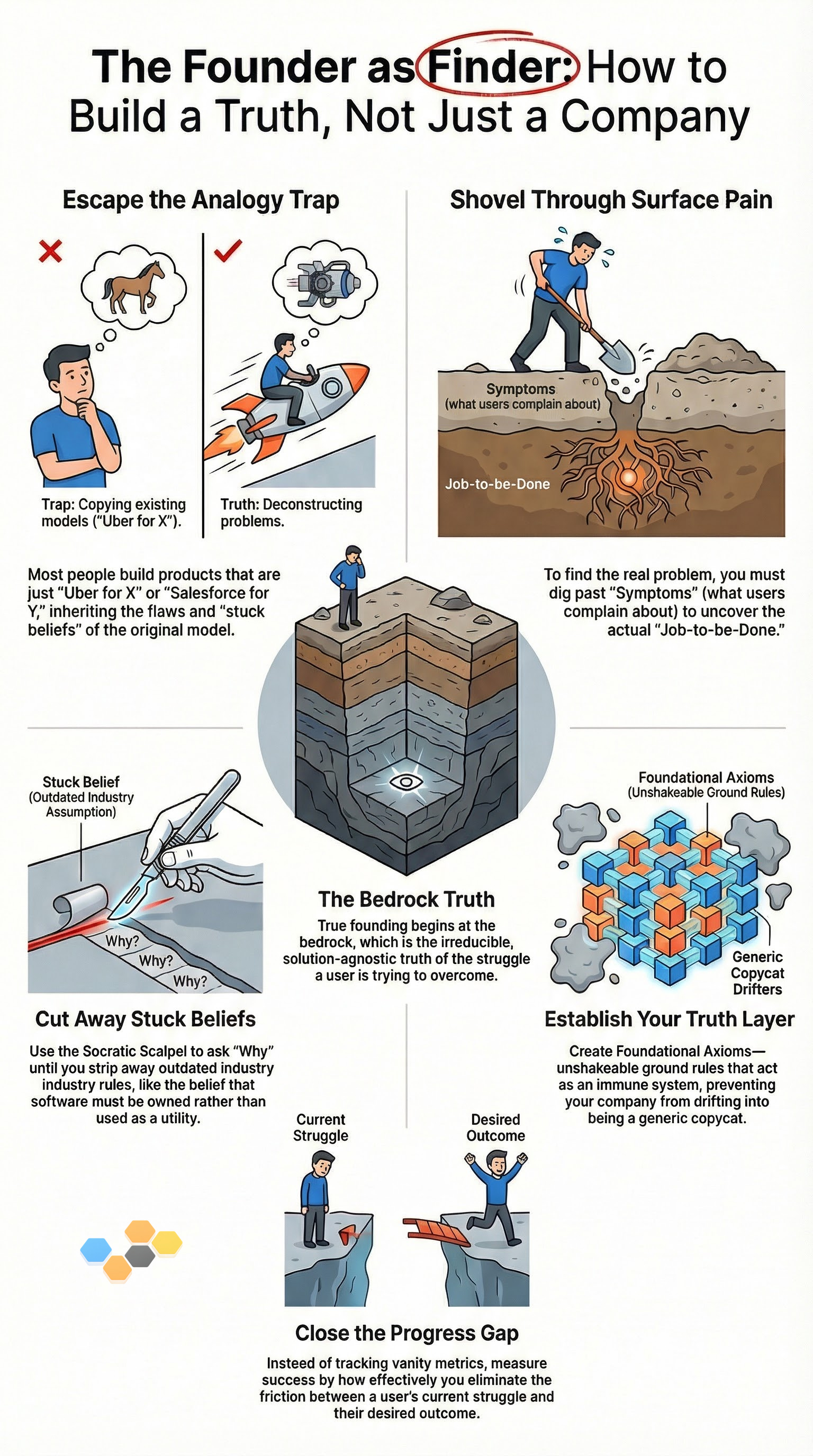
CHAPTER 2: THE ANALOGY TRAP
Most modern product development is not innovation; it is a high-stakes performance of Product Theater.
Walk into any VC-backed startup office—or more likely, join their Slack—and you will see a flurry of activity. You will see Jira boards bursting with tickets, Figma files with hundreds of iterations on the same button, and “Product Managers” holding daily standups to discuss “velocity.” To the untrained eye, it looks like progress. It looks like “Execution.”
But if you look closer, you realize that none of this activity is tethered to a new truth. The team is not building a foundation; they are performing the rituals of building. They are in the Analogy Trap.
2.1 The Physics of Analogy: Cognitive Sloth in Disguise
Reasoning from analogy is the default mode of the human brain because it is cognitively cheap. It allows you to take a complex, messy problem and say, “Oh, this is just like X, but for Y.”
“It’s Uber for dog walkers.”
“It’s Salesforce for non-profits.”
“It’s Slack for doctors.”
When you reason from analogy, you are using someone else’s solution as a proxy for the truth. You are assuming that the person who built the original “analogy” (the incumbent) actually understood the problem. You are assuming their design choices, their feature set, and their business model were based on First Principles.
Spoiler: They probably weren’t. Most incumbents are themselves building on the analogies of the generation that preceded them.
When you build on an analogy, you are building on a Stuck Belief. You are inheriting all the technical debt, cognitive biases, and obsolete constraints of the past. You aren’t “founding” a category; you are decorating a room in someone else’s house.
I call this Analogy-Based Building, and it is the primary reason why 90% of SaaS startups fail to achieve significant enterprise value. They are trying to solve a new struggle with an old shape.
2.2 Deconstructing Product Theater
Product Theater is the result of the “Executor” mindset being given a budget and a deadline.
The Executor believes that the goal of a startup is to “Ship.” They measure success by the number of features released, the “slickness” of the UI, and the frequency of their “Product Hunt” launches.
But shipping code is not the same as finding value. You can ship the most beautiful, bug-free, highly-performant code in the world, and if it is based on an analogy that doesn’t solve the actual Job-to-be-Done, you have simply executed a very expensive hallucination.
The symptoms of Product Theater are easy to spot:
Competitive Parity Obsession: The roadmap is defined by what “Competitor X” just released. If they have a dashboard, we need a dashboard. If they have an AI chat, we need an AI chat.
The “Feature-First” Reflex: When a user reports a struggle, the immediate response is to “build a feature.” No one asks why the struggle exists. No one deconstructs the system that created the struggle.
UI as a Crutch: The team spends weeks debating the color of a “Submit” button while the core value proposition of the product remains a mystery to the customer.
Product Theater feels good. It makes the team feel productive. It makes the investors feel like their money is being spent. But it is a race to the bottom of the Red Ocean.
2.3 Executing Into the Red Ocean
When you reason from analogy, you are making a silent agreement to play the game on the incumbent’s terms. You are accepting their definitions of “the problem” and “the solution.”
If you are building a “Better CRM,” you are competing in a Red Ocean. You are agreeing that:
A CRM must be a database of contacts.
A CRM must have a pipeline view.
A CRM must require manual data entry (or a complex sync).
Because you have accepted these axioms, you have no Pricing Power. The customer looks at your product and then looks at Salesforce or Hubspot. They compare you on price, feature lists, and brand. Since you are the “new guy” building a derivative analogy, you are forced to compete on commodity.
A true Founder refuses the Red Ocean. They don’t want to build a “better” version of the existing analogy. They want to find a way to make the analogy irrelevant.
If the analogy is “The Horse,” the Executor builds a faster horse, a cheaper horse, or a horse with a better saddle. The Founder finds the Job—moving from Point A to Point B—and realizes that the horse is actually the obstruction. They find the internal combustion engine.
2.4 The Causal Hammer and Solution-Jumping
The most dangerous part of the Analogy Trap is Solution-Jumping.
This is the reflex to start building the “How” before you have fully deconstructed the “What.” In my framework, I call this the “Causal Hammer” approach. You see a symptom (low user engagement) and you hit it with a solution (gamification).
But why is engagement low?
Is it because the product isn’t “fun” (the analogy), or is it because the product is failing to help the user make the progress they are struggling to achieve (the Job)?
When you jump to a solution based on an analogy, you are guessing. You are throwing paint at a wall and hoping it looks like a masterpiece.
The Founder’s discipline is to Refuse the Solution. You must stay in the “Problem Archaeology” phase until the solution becomes a logical inevitability of the truths you have found. If you find yourself saying, “We should build a [Feature Name] because [Competitor] has it,” you have already lost. You are no longer a Founder; you are an unpaid intern for your competitor’s product team.
2.5 The Illusion of Choice in the Analogy Trap
One of the most insidious aspects of the Analogy Trap is that it provides a false sense of agency. Founders believe they are making “strategic decisions” when, in reality, they are merely selecting from a pre-defined menu of existing failures.
When you decide to build a “lighter, faster version” of a legacy tool, you think you are choosing “Lightness” as a core value. But you aren’t. You are still accepting the legacy tool’s definition of what the tool is. You are choosing the adjective, but you’ve already been handed the noun.
The noun is the analogy. The noun is “The CRM” or “The Project Management Tool.” By accepting the noun, you have already lost 90% of your creative surface area. You are now just arguing over the furniture in a room whose walls you didn’t build.
This is why “Niche SaaS” is often a trap. Founders think that by narrowing the focus to “CRM for plumbers,” they are finding a new truth. They aren’t. They are just taking a generic analogy and adding a layer of cosmetic industry jargon. The plumbing business has unique struggles, but if you just give them a “Leads” tab and a “Contacts” tab, you haven’t found those struggles. You’ve just sold them a generic hammer with a picture of a pipe on the handle.
2.6 The Cost of Being Second: The Margin Death Spiral
Reasoning from analogy is a recipe for the Margin Death Spiral.
In any category, the “Category King”—the one who actually Found the truth—commands the lion’s share of the profit. They have the “Founding Premium.” Everyone who follows them is an Executor.
If you are the “second” or “third” analogy in a market, you have no leverage. You cannot claim to have a better understanding of the Job, because your product is a visible confession that you are just copying the leader. Therefore, your only levers are Price and Features.
You lower your price to win the deal.
You add more features to justify the price.
Your development costs go up, while your revenue per customer goes down.
This is the “Red Ocean” in its purest form. It is a race to see who can go bankrupt last while building the most complex version of someone else’s idea. The only way out is to stop being “Second” at an old analogy and start being “First” at a new truth.
2.7 Breaking the Trap: The First Principles Pivot
To break the Analogy Trap, you must stop looking at screens and start looking at Struggles.
You must apply a “Socratic Scalpel” to every assumption you have about your industry.
Why do we believe this process takes 5 days?
Why do we believe a human must be in the loop for this decision?
Why do we believe this data needs to be visualized in a chart?
The goal of this deconstruction is to reach the Irreducible Axioms of the problem. When you reach the bedrock, you will find that the “analogy” you were planning to build is actually a series of workarounds for a truth that no longer exists.
Execution without “Finding” is just a faster way to reach the wrong destination.
CHAPTER 3: THE ARCHAEOLOGY OF A STRUGGLE
If the Founder’s role is to Find, then the Founder’s primary tool is the shovel, not the hammer. This is the act of Problem Archaeology, and it is governed by the Socratic Unified Framework.
Most people think of innovation as “creation”—bringing something new into the world. I think of it as “uncovering”—stripping away the layers of nonsense to find the truth that was already there, hidden beneath the weight of “stuck beliefs.”
3.1 The Archaeology of the Job-to-be-Done
A Job-to-be-Done (JTBD) is not a feature request. It is not a user story. It is a stable, functional, solution-agnostic process that a human is trying to execute to achieve an outcome.
People don’t buy products; they “hire” them to do a Job. The struggle occurs when the current “hire” (the incumbent solution) fails to deliver the progress the user needs.
To Find a Job, you must dig through three distinct layers:
Layer 1: The Layer of Symptoms (The Pain)
This is what the customer tells you in an interview. “I hate my CRM.” “This app is too slow.” “I wish I had a better way to track my expenses.”
These are not truths. They are reactions. If you stop here, you are a “Symptom-Shoveler.” You will build a product that is just a collection of “painkillers” for surface-level scratches. You will never find the “Bedrock.”
Layer 2: The Layer of Analogies (The Stuck Beliefs)
This is where the “industry experts” (SMEs) live. This layer is made of the assumptions that define the current category.
“In enterprise sales, you need a multi-stage pipeline.”
“In accounting, you need a double-entry ledger.”
“In project management, you need Gantt charts.”
These are the “rules” of the game. They are analogies for how the Job used to be done when technology was limited. Most founders get stuck here. They build a product that follows all the rules but is “10% better.” This is the recipe for a “walking dead” startup.
Layer 3: The Bedrock (The Job)
This is the irreducible truth. It is solution-agnostic.
“Ensuring that capital is allocated to the highest-probability opportunities.”
“Maintaining a perfect record of obligations and assets.”
“Synchronizing the efforts of a distributed team toward a single outcome.”
When you hit bedrock, you realize that the “rules” in Layer 2 are often the very things preventing the Job from being done efficiently.
3.2 The Socratic Unified Framework: The Scalpel in Action
How do you dig through these layers? You use the Socratic Unified Framework. This is a method of aggressive, iterative questioning designed to strip away the “analogies” until only the axioms remain.
Let’s look at a case study: The “Dashboard” Fallacy.
Imagine you are “founding” a company in the supply chain space. You talk to a manager who says, “I need a better dashboard to monitor my shipments.”
The Executor’s Path: “Great! We’ll build the most beautiful, real-time, AI-powered dashboard the world has ever seen. We’ll use React, D3.js, and we’ll have ‘dark mode’.” (Product Theater).
The Founder’s Path (The Socratic Dig):
Question: Why do you need a dashboard to monitor shipments?
Answer: So I can see which ones are delayed.
Question (The Deconstruction): Why do you need to see which ones are delayed?
Answer: So I can call the carrier and find out what happened.
Question: What happens if you find out what happened?
Answer: I try to re-route other shipments or notify the customer.
Question: What is the actual “Job” here? Is it “monitoring shipments” or is it “Maintaining the integrity of the delivery promise”?
The Find: The dashboard is a “Stuck Belief.” It assumes that a human must be the one to identify the delay and initiate the fix.
The Bedrock Truth: The human doesn’t want to monitor a dashboard. Monitoring is a “struggle.” The human wants the outcome—a shipment that arrives on time, or a system that automatically re-routes and notifies the customer without human intervention.
By using the Socratic Scalpel, the Founder finds a new category: Autonomous Logistics Execution, rather than “Supply Chain Visualization.” One is a commodity; the other is a revolution.
3.3 The “Inbox” Fallacy: Another Layer of Deconstruction
Let’s apply the Socratic Scalpel to another modern analogy: The Inbox.
Every productivity app, CRM, and collaboration tool has an “Inbox.” It is the default analogy for “stuff you need to pay attention to.”
The Stuck Belief: “Users need a central place to receive notifications so they don’t miss anything.”
The Socratic Question: Why are they receiving notifications?
Answer: Because something happened in the system that might require their action.
The Socratic Question: What kind of action?
Answer: Usually approving something, answering a question, or acknowledging a status change.
The Socratic Question: Why can’t the system handle the approval based on pre-defined logic? Why can’t the system answer the question using the data it already has?
The Bedrock: The “Inbox” is actually a Queue of System Failures. Every item in an inbox is a point where the software was too “dumb” to make a decision and had to interrupt a human.
A Founder who finds this bedrock doesn’t build a “Better Inbox.” They build an Autonomous Decision Engine. They realize that the ultimate “Inbox” is an empty one, achieved through execution, not organization.
3.4 The Interview as an Archaeological Dig
You cannot find the Bedrock by looking at data. Data tells you what happened, but it never tells you why. To find the “Why,” you must conduct Socratic Interviews.
Most founders conduct interviews like they are conducting a sales pitch. They ask, “Would you use a tool that did X?” This is a leading question that invites the user to lie to you.
A Socratic Interview is an archaeological dig. You aren’t looking for ”feedback”; you are looking for Evidence of Struggle.
Rules of the Socratic Interview:
Ban the Future Tense: Never ask what a user would do. Ask what they did.
”Last time this happened, what was the first thing you did?”Hunt for the ‘Workaround’: The most valuable discovery in an interview is a
”Workaround.” A workaround is a sign that the current analogy is failing. If a user says, ”I export the data to Excel and then manually color the cells red,” you have just found a ”Find.” The Job is ”Identifying high-risk anomalies,” and the current tool is failing at it.Ask ‘What Must Be True’: When a user expresses a ”Stuck Belief” (e.g., ”I need a dashboard”), ask yourself: ”What must be true for a dashboard to be the only solution?” Usually, the answer is ”It must be true that a human is the only one capable of making this decision.” If you can prove that isn’t true, you’ve found a new category.
3.5 The Resistance to the Find
Be warned: When you find the Bedrock, people will fight you.
Customers will tell you, ”I just want the dashboard.” Investors will say, ”This is too complicated, just build the ‘Salesforce for X’.” Even your own team will try to revert to the analogy because it’s easier to code.
This resistance is the ”Gravitational Pull of the Status Quo.” It is the market trying to force you back into the Red Ocean where it can easily categorize and commoditize you.
The Founder’s job is to resist. You must be the guardian of the Bedrock. You must have the courage to say, ”No, we aren’t building a dashboard, because a dashboard is a confession of failure. We are building the solution that makes the dashboard obsolete.”
3.6 Uncovering Irreducible Axioms
Once you have deconstructed the problem down to the Bedrock, you are left with a set of Foundational Axioms. These are the ”Truth Layer” of your company. They are the rules of the universe you are about to create.
An axiom is a truth that cannot be broken down any further.
Axiom 1: Human attention is the most expensive and least scalable resource in the system.
Axiom 2: Real-time correction is 100x more valuable than post-hoc reporting.
Axiom 3: Friction in data entry leads to a decay in system truth.
These axioms become your shield against the Analogy Trap. If someone on your team says, ”We should add a reporting module,” you check it against your axioms. Does a ”reporting module” minimize human attention (Axiom 1)? No, it requires a human to read it. Throw it out.
The Founder doesn’t follow a ”product roadmap” built on feature requests. They follow a Truth Map built on axioms.
3.7 From Shoveling to Founding
The act of ”Finding” is often quiet, boring, and invisible. It doesn’t look like ”Execution.” It looks like a person sitting in a room, staring at a whiteboard, or having intense, difficult conversations with customers.
But this is where the value is created.
The ”Founding Premium” is the delta between the value of an analogy and the value of a truth. When you find the Bedrock, you gain Category Authority. You no longer have to explain why your product is ”better” than the competitor’s. You explain why the competitor’s entire category is built on a ”Stuck Belief” that your product has made obsolete.
You aren’t selling software anymore. You are selling a new way of being. You are selling the Bedrock.
3.8 The Danger of the ”Quick Win”
The greatest enemy of the Problem Archaeologist is the ”Quick Win.”
In the early days, you will be tempted to build a small feature that solves a surface-level pain. This is the ”Symptom-Shoveling” trap. It gives you a hit of dopamine and perhaps a small amount of revenue.
But every ”Quick Win” you build on top of an un-deconstructed problem is a layer of concrete you are pouring over the Bedrock. It makes it harder to dig deeper later. It locks you into the analogy.
The true Founder has the discipline to stay in the ”Find” phase until the truth is irreducible. They would rather spend six months finding the right shovel than one day hitting the ground with the wrong hammer.
Remember: You cannot build a foundation until you have found the bedrock. And you cannot find the bedrock until you have the courage to stop performing ”Product Theater” and start doing the archaeology of the struggle.
CHAPTER 4: THE OPTION TO EXPLORE
If you want to understand why most startups are essentially ”the walking dead” before they even raise a Seed round, you have to look at their relationship with time. Specifically, their obsession with velocity over validity.
The modern startup ecosystem is a cult of momentum. We are told to ”fail fast,” ”move fast and break things,” and ”ship early and often.” But if you are moving at terminal velocity toward a cliff, ”fast” is just a measure of how quickly you’ll reach the impact. In the world of innovation, speed without a ”Find” is just a high-speed chase into a brick wall of commodity.
I call the alternative the 𝗢𝗽𝘁𝗶𝗼𝗻 𝘁𝗼 𝗘𝘅𝗽𝗹𝗼𝗿𝗲.
In finance, an option is the right—but not the obligation—to execute a trade at a set price. In founding, the ”Option to Explore” is the right to keep digging until you find the Bedrock, rather than being forced to build the first analogy that pops into your head. It is the only hedge we have against Derivative Failure.
4.1 The Growth Trap: Scaling a Hallucination
The most dangerous moment in a startup’s life isn’t when it’s failing; it’s when it’s ”working” based on a lie. This is the Growth Trap.
You build a derivative product—an ”Analogy + 1.” You spend some money on ads. You get a few customers. Maybe you even get some ”traction” metrics that look good on a slide deck. You think you’ve found product-market fit. You raise capital to ”scale the machine.”
But what are you actually scaling?
If your product is just a better version of an existing analogy (a ”faster CRM,” a ”slicker project management tool”), you are scaling into a Red Ocean. You are scaling your Customer Acquisition Cost (CAC) alongside your revenue. You are scaling the complexity of your features to keep up with the Category King.
You have entered the Growth Trap: a state where you are too busy executing a mistake to ever find the truth. You are paying for ”Growth” when you should have been paying for ”Learning.” By the time you realize your product is a commodity with zero pricing power, it’s too late. You’ve built a factory that can only produce one thing: a slightly better version of a failure.
The Growth Trap is the logical conclusion of the Executor’s mindset. The Executor wants to minimize variance. They want to turn $1 into $3. But in the early days of a company, your job isn’t to minimize variance; it’s to maximize learning.
4.2 The Cognitive Premium: The Cost of Refusal
To avoid the Growth Trap, you must be willing to pay the Cognitive Premium.
This is the most difficult thing for a ”builder” to do. We are wired to want to see progress. We want to see lines of code, UI mockups, and ”Live” stickers on our websites. Building feels like work. Researching feels like procrastination.
But for the Founder, refusing to build is the most valuable work you can do.
The Cognitive Premium is the price of your discipline. It is the cost of staying in the ”Search” phase long enough to deconstruct the ”Stuck Beliefs” of your industry. It is the mental labor of looking at a ”standard feature” and asking, ”Why does this exist, and what if it didn’t?”
When you pay the Cognitive Premium, you are purchasing information. You are testing your Axioms. You are ensuring that when they finally do press the ”Growth” button, you are growing a category you have Found, not just an analogy you have copied.
I often see founders who are terrified of ”losing time.” They see a competitor launch a feature and they panic. ”We need to catch up!” they scream. This is the hallmark of an Executor. A Founder knows that you can’t be ”behind” if you are playing a different game. If you are digging for bedrock while your competitor is building a skyscraper on sand, you aren’t ”slow.” You are the only one whose building will still be standing in five years.
4.3 Socratic Research: Interrogating the Physics of the Job
Most ”Market Research” is a joke. It’s a series of leading questions designed to confirm the founder’s bias. ”On a scale of 1 to 10, how much do you hate your current CRM?” ”Would you pay $50 a month for a tool that did X?”
This isn’t research; it’s a sales pitch disguised as a survey. It doesn’t find bedrock; it just rearranges the dust on the surface.
The Founder uses Socratic Research. Socratic research is not about what the customer wants; it’s about the Physics of the Struggle.
The goal of Socratic Research is to strip away the ”Analogies” the customer is using to describe their own problem. When a customer says, ”I need a better reporting tool,” they are speaking in analogies. They are assuming that ”Reporting” is the solution.
The Socratic Researcher doesn’t take the bait. They dig:
”Walk me through the last time you opened a report.”
”What was the specific question you were trying to answer?”
”What happened immediately after you got that answer?”
”What prevented the system from just taking that action for you?”
This is an interrogation of the Job-to-be-Done. You aren’t looking for feature requests; you are looking for the Point of Failure in the current system’s axioms.
If the current axiom is ”Humans must analyze data to make decisions,” and you find that humans are the primary source of delay and error in that process, you’ve found the ”Find.” You’ve found that the ”Reporting Tool” (the analogy) is actually the obstruction.
Socratic Research is about finding the Irreducible Truths that the customer doesn’t even have the vocabulary to describe yet. It’s about being the person who sees the internal combustion engine while everyone else is complaining about the price of hay.
4.4 The Hedge Against Derivative Failure
Why is the ”Option to Explore” the only hedge against derivative failure?
Because in a world of infinite ”Builders,” the only thing that cannot be commoditized is Found Insight.
If you build a product based on an analogy, you are building a product that anyone with a GPT-4 prompt and a credit card can replicate. Your ”features” are not a moat. Your ”UI” is not a moat. Your ”Execution” is not a moat.
The only true moat is a Found Truth that makes the existing category obsolete.
When you claim your ”Option to Explore,” you are giving yourself the chance to find the Axiom that your competitors are blind to. You are giving yourself the chance to move from the ”Red Ocean” of commodity competition to the ”Blue Ocean” of category authority.
Derivative failure happens when you try to be ”better.” Category founding happens when you choose to be different—based on a deeper understanding of the physics of the Job.
If you aren’t paying the Cognitive Premium, you are just waiting for your turn to be disrupted by someone who did.
CHAPTER 5: CASE STUDIES IN FINDING
To truly understand the act of Finding, we have to stop looking at these companies as ”great products” and start looking at them as ”Found Truths.”
Salesforce, Slack, and Airbnb didn’t win because they had better code or better marketing. They won because their founders were Archaeologists of Struggle. They dug past the analogies of their time and hit bedrocks that the incumbents didn’t even know existed.
5.1 Salesforce: Deconstructing the ”Ownership” Analogy
In 1999, the ”Analogy” for business software was the CD-ROM.
If you wanted a CRM, you bought a license for Siebel Systems. You received a box of discs. You bought servers. You hired ”Implementation Consultants” to spend six months setting it up. You ”owned” the software, but the software owned you.
The ”Stuck Belief” was that business-critical data was too sensitive to live anywhere but on your own hardware.
Marc Benioff didn’t just build a ”Web-based CRM.” That would have been an Executor’s move. He Found a new category by deconstructing the struggle of ”Software Ownership.”
The Deconstruction:
The Symptom: ”Our CRM implementation failed again. It was too expensive and no one uses it.”
The Analogy: ”Software must be an asset you own and manage.”
The Socratic Dig: Why does it need to be on your server? If the Job is ”Managing Sales,” does the server help or hinder that Job?
The Find: The server is the obstruction. The IT complexity is a barrier to the ”Sales Management” Job.
The Bedrock Truth: ”Companies don’t want to manage software; they want to use utility.”
Benioff’s ”Find” wasn’t a product feature; it was the Axiom of SaaS. He realized that ”No Software” was a more powerful category than ”Better Software.” By finding the truth that the ownership model itself was the failure point, he made the multi-billion dollar Siebel empire look like a relic overnight.
He didn’t build an app; he found the Utility Bedrock.
5.2 Slack: Deconstructing the ”Point-to-Point” Analogy
For thirty years, the ”Analogy” for internal communication was Email.
Email is a ”Point-to-Point” system. I send a message to you. It sits in your inbox. It is invisible to the rest of the team. If a new person joins the company, they have zero context of what happened before they arrived.
The ”Stuck Belief” was that communication is a series of discrete, private transactions.
Stewart Butterfield (and his team at Tiny Speck) didn’t set out to build a ”chat app.” They were building a game, but in the process, they Found the bedrock of organizational context.
The Deconstruction:
The Symptom: ”I can’t find that decision we made three weeks ago.” ”I’m drowning in email CCs.”
The Analogy: ”Internal communication is just a digital version of a paper memo (Email).”
The Socratic Dig: Why are we sending memos? The Job isn’t ”sending messages”; the Job is ”Synchronizing organizational context in real-time.”
The Find: If context is the Job, then the ”Inbox” (the private archive) is the failure point. Communication needs to be a Stream, not a stack. It needs to be Searchable and Public by default.
The Bedrock Truth: ”The value of communication is its durability and discoverability across the entire team.”
Slack stands for ”Searchable Log of All Communication and Knowledge.” That’s not a product name; it’s a Found Axiom. Butterfield found that the ”Email Analogy” was actively destroying organizational intelligence. By building on the bedrock of ”Shared Context,” Slack didn’t just ”replace email”—it founded the Operational Data Layer.
5.3 Airbnb: Deconstructing the ”Standardized Trust” Analogy
The ”Analogy” for travel accommodation was the Hotel.
The ”Stuck Belief” was that trust between strangers is impossible without a massive corporate intermediary. You trust the Hilton brand, the standardized room, and the professional concierge. You pay a ”Standardization Premium” for the certainty that there won’t be a stranger in your house.
Brian Chesky and Joe Gebbia didn’t build a ”room-booking site.” They Found a way to commoditize trust.
The Deconstruction:
The Symptom: ”Hotels are expensive and sterile. I want to feel like a local, but I don’t know who to trust.”
The Analogy: ”Safety and quality require physical branding and corporate oversight.”
The Socratic Dig: What if trust could be established through data rather than through real estate? What if the ”Job” isn’t ”Finding a bed,” but ”Belonging anywhere”?
The Find: The ”Hotel” is an analogy for a world without a Reputation Layer. If you can solve for trust via a platform, the entire world’s residential inventory becomes a viable ”accommodation asset.”
The Bedrock Truth: ”Trust is a programmable variable, not a physical requirement.”
Airbnb didn’t win because their website was better than Marriott.com. They won because they found the Trust Bedrock. They realized that the ”Hotel Analogy” was a high-friction workaround for a world where we didn’t have a way to verify strangers. By building a ”Reputation Layer,” they didn’t just create a better hotel; they founded the Access Economy.
5.4 The Common Thread: Bedrocks, Not Apps
In every one of these cases, the ”Founder” was someone who looked at a multi-billion dollar industry and said, ”This entire category is built on a lie.”
They didn’t start with a ”Solution.” They started with a Deconstruction.
Benioff deconstructed the Server.
Butterfield deconstructed the Inbox.
Chesky deconstructed the Concierge.
They didn’t build ”Apps.” An app is just a wrapper for a solution. They found Bedrocks—irreducible truths about how humans want to work, communicate, and live—and they laid a foundation on those truths.
When you find a bedrock, you don’t have to ”execute” 10x better than the incumbent. You just have to be the first person to stand on the truth. The incumbent is too heavy, too invested in their ”Analogies,” and too blinded by their ”Stuck Beliefs” to ever follow you there.
This is the power of the Founder as Finder. You aren’t competing for market share in an old category. You are claiming the Founding Premium of a new one.
CHAPTER 6: THE FOUNDER AS AXIOM-MAKER
Finding the bedrock is a violent act of intellectual honesty, but it is only the first half of the struggle. Once you have deconstructed the category—once you have stripped away the “dashboard” fallacies and the “inbox” analogies—you are left standing on a bare, jagged truth.
Most people panic at this stage. They look at the bedrock and find it too stark, too simple, or too demanding. So they immediately start “Symptom-Shoveling” again. They start adding “features” just to make the product feel “complete” according to the industry’s standard checklist. They revert to the Analogy because the Bedrock is terrifyingly lonely.
Founding is the transition from Archaeology to Architecture. Your job now is to take the truths you have uncovered and turn them into Axioms.
6.1 The Truth Layer: Your Immune System Against Analogy
In my framework, the Truth Layer is the irreducible set of constraints that govern every decision the company makes. It is the “Constitutional Law” of your innovation.
Most companies are governed by a “Roadmap”—a chronological list of features they intend to build. But a roadmap is a list of lies. It assumes you know the solution before you’ve fully mastered the struggle. It is a document of “Analogy-Based Planning.”
The Truth Layer is different. It is a set of Foundational Axioms that define the physics of the value you are creating.
If you are building a new category of “Autonomous Decision Engines,” your Truth Layer might look like this:
Axiom 1: Any data that requires human manual entry is a point of entropy and must be eliminated.
Axiom 2: A notification is a confession of system failure; the system should have acted, not alerted.
Axiom 3: Value is measured in “Time-to-Resolution,” not “Time-on-Page.”
These aren’t “values” or “mission statements.” They are Logical Filters.
When a product manager comes to you and says, “Our competitors all have a notification bell, we should add one,” you don’t argue about the UI. You look at the Truth Layer. Adding a notification bell violates Axiom 2. Therefore, the answer is “No.”
The Truth Layer is your immune system. It protects you from the “Semantic Drift” of the market. Without it, you will eventually be assimilated into the Red Ocean. You will start “executing” on features that your competitors have, simply because they have them. You will become an Executor in a Founder’s skin.
6.2 The Anatomy of an Axiom
A “Foundational Axiom” must be three things: Solution-Agnostic, Irreducible, and Opinionated.
Solution-Agnostic: It must describe the physics of the struggle or the nature of the value, not the software. “The software should be easy to use” is not an axiom; it’s a platitude. “Trust is established through verifiable performance, not brand recognition” is an axiom.
Irreducible: You cannot break it down into a more fundamental truth. If your axiom is “We should use AI to solve X,” that’s not an axiom; it’s a solution choice. Why AI? Because “Complex pattern recognition must be automated to achieve sub-second latency.” That is the axiom.
Opinionated: A good axiom should make some people angry. It should be a rejection of a “Stuck Belief.” If the industry believes “More data is better,” your axiom might be “Excess data is cognitive debt.”
When you establish these axioms, you are building the “Truth Layer.” You are ensuring that every line of code written, every marketing message sent, and every salesperson hired is tethered to the Bedrock. You are making it impossible for the company to drift back into being an Analogy.
6.3 Outcome-Based Segments: The End of the “User Persona”
One of the most insidious “Stuck Beliefs” in the industry is the User Persona.
Marketing teams spend millions defining “Marketing Mary” (34, lives in a suburb, likes yoga) or “CTO Chad” (45, drinks Soylent, reads Hacker News). This is Analogy-Based Segmentation. It assumes that because two people have the same demographic profile, they are trying to do the same Job.
They aren’t.
I’ve seen a 22-year-old intern and a 60-year-old CEO hire the same product for the exact same reason: they both had a high-stakes meeting in twenty minutes and needed to feel “prepared with context.” Their demographics were irrelevant. Their Context of Struggle was identical.
Founders segment by Outcomes, not Personas.
An Outcome-Based Segment is a group of people who share the same “struggle-to-progress” ratio. They are all trying to achieve the same “New Me”—the version of themselves that exists once the Job is done.
Example: The “Expense Tracking” Job.
Persona-Based Segment: “Small Business Owners” (Too broad, tells you nothing).
Outcome-Based Segment: “People who feel a visceral anxiety that they are losing 10% of their margin to uncaptured receipts and will be audited by the IRS.”
When you focus on the Outcome, the product design becomes inevitable. You don’t build “features for small business owners.” You build a “Receipt-Capture-to-Audit-Protection” engine.
By shifting from “Who is the user?” to “What is the desired Outcome?”, you strip away 90% of the useless features that fill most SaaS products. You stop building “The Platform” and start building “The Result.”
6.4 The Truth Map vs. The Roadmap
The “Roadmap” is the Executor’s greatest weapon and the Founder’s greatest trap. It is a linear timeline of features—a list of nouns (The Dashboard, The Integration, The Mobile App).
The problem with a Roadmap is that it rewards Shipping, not Finding. It creates a culture where the team feels “done” because the feature is “Live,” regardless of whether it actually moved the user closer to the Outcome.
The Founder uses a Truth Map.
A Truth Map is not a timeline; it is a Map of Conquest. It identifies the “Stuck Beliefs” that are currently obstructing the user’s progress and lists the “Truth-Based Outcomes” required to break them.
Milestone 1: Prove we can achieve
[Outcome X]with zero human intervention.Milestone 2: Eliminate the
[Stuck Belief Y]by automating the data-integrity check.Milestone 3: Achieve
[Outcome Z]across 100% of the user’s historical data.
The Truth Map is measured in Insight Density. It is about how much of the “Problem Space” you have successfully deconstructed and solved using your Axioms.
When you use a Truth Map, the “How” is fluid. If a team finds a better way to achieve Milestone 1 without building a “Dashboard,” they are celebrated. On a Roadmap, they would be seen as “off-track” because the Dashboard was a line item.
The Truth Map ensures that the company stays focused on the Find, even as it scales. It turns the act of building into a continuous archaeological dig, where every new feature is a tool for uncovering even deeper layers of value.
6.5 The Metric of the Finder: The “Progress Gap”
How do you know if you are winning? The Executor looks at MRR (Monthly Recurring Revenue) or Churn. These are “lagging indicators”—they tell you how many people you’ve managed to trap in your analogy, but they don’t tell you if you’ve found the truth.
The Founder looks at the Progress Gap.
The Progress Gap is the delta between the “Current State” of the user and the “Desired Outcome.”
If the Job is “Moving from Point A to Point B,” and your product gets them to Point B 10x faster with 10x less effort than the status quo, you have a small Progress Gap. You have found the truth.
If your product gets them to Point B at the same speed but with a “prettier UI,” the Progress Gap is still huge. You are just a “Causal Hammer” hitting a symptom.
The goal of Axiomatic Execution is to close the Progress Gap to zero.
Every feature you build should be a direct answer to the question: “How does this reduce the friction between the user’s struggle and their progress?” If you can’t map a feature to a specific reduction in the Progress Gap, it is Cognitive Waste. It is a feature-by-analogy.
6.6 Axiomatic Hiring: Building a Team of Finders
The hardest part of being a Founder-as-Axiom-Maker is hiring.
If you hire “Rockstar Developers” or “Growth Hackers” from Big Tech, you are often hiring Executors of High-Quality Analogies. They come from environments where the “What” and the “Why” were already decided by someone else. They are trained to optimize the “How.”
When you bring an Executor into an Axiomatic environment, they will try to “standardize” you back into a commodity. They will say things like, “At [Big Tech Co], we used Jira like this,” or “We should really follow these design patterns.”
You must hire for Socratic Capability.
You need people who are comfortable with the “Option to Explore.” You need engineers who will push back on a feature request by asking, “Does this actually serve our Axiom of ‘Zero Manual Entry’?” You need marketers who are obsessed with the “Archaeology of the Struggle” rather than the “Aesthetics of the Brand.”
Axiomatic Execution requires a team that is willing to be “wrong” about the solution as long as they are “right” about the truth. It requires a culture that values the Find above the Ship.
6.7 The Truth-Based Moat: Why Truth is Uncopyable
In the “Red Ocean” of analogies, there is no such thing as a moat. If you build a feature, your competitor can see it, decompile it, and replicate it in two weeks. They might even do it better because they can learn from your mistakes. This is the “Second-Mover Advantage” in a commodity market.
But you cannot copy a Found Truth.
A competitor looking at an Axiomatic product sees a series of “weird” design choices. They see that you don’t have a dashboard. They see that you don’t have a certain integration. They see that your UI is focused on a single, stark outcome.
Because they are reasoning from analogy, they think you are “missing” features. They try to “fix” your product by adding the very things you deliberately left out. They add the “cognitive waste” that you worked so hard to eliminate.
Your moat is not your code; it is your Conviction. It is the fact that you know why those features are obstructions, and they don’t. While they are busy adding “noise” to their product to match the “industry standard,” you are getting closer and closer to the irreducible core of the Job.
The Truth-Based Moat is the only one that survives the AI era. If AI can write code and design UIs, the only thing left for the human Founder is the Find. The machine can execute any analogy you give it, but it cannot (yet) deconstruct a human struggle down to its first principles bedrock. That is the Founder’s last stand.
6.8 The Pricing of Truth: Moving Beyond the “Per-Seat” Trap
If you are an Executor building an analogy, you are forced into Commodity Pricing. Usually, this means “Per-Seat SaaS.”
Per-seat pricing is a confession that you don’t understand the value of your product. You are charging for “access to a tool” rather than “delivery of an outcome.” You are effectively saying, “I hope you have a lot of employees who spend a lot of time clicking buttons in my app.”
A Founder who has established a Truth Layer moves to Outcome-Based Pricing.
If your Axiom is that “Human intervention is a failure,” then charging per-seat is a direct conflict of interest. The better your product works, the fewer seats your customer needs. By charging per-seat, you are punishing yourself for being successful.
The Finder charges for the Progress.
Don’t charge for the CRM; charge for the “Qualified Lead Generated.”
Don’t charge for the Accounting Software; charge for the “Tax-Ready Audit Protection.”
Don’t charge for the Logistics Dashboard; charge for the “On-Time Delivery Guarantee.”
Outcome-based pricing is the ultimate test of your “Find.” If you haven’t actually found a way to guarantee an outcome, you can’t price this way. You’ll be too afraid of the risk. But if you have hit the Bedrock, you know exactly how to deliver the result.
This is the “Founding Premium” in its most liquid form. It is the ability to capture a percentage of the value created, rather than a percentage of the work performed.
6.9 The Founder’s Pivot: From Shovel to Sword
There comes a moment in every Founder’s journey where the “Archaeology” phase ends and the “War” phase begins.
This is when you have your Truth Layer, your Outcome-Based Segments, and your Truth Map. You have found the Bedrock, and you have built the first few layers of the Foundation.
Now, you must use your Axioms as a Sword.
You are no longer just “learning.” You are challenging the status quo. You are going to the market and saying, “Everything you believe about this category is a lie. Your ‘Best Practices’ are actually ‘Best Workarounds.’ Your ‘Solutions’ are actually ‘Obstructions’.”
This is where the “Founding Premium” is realized. When you compete on Truth, you don’t have to compete on Price. You don’t have to compete on Features. You are offering the only solution that is built on the Physics of the Job.
The Executor tries to win by being “Better.”
The Founder wins by being Inevitable.
CONCLUSION: THE CALL TO ARMS
We are living in an era of Technological Glut and Insight Famine.
It has never been easier to “start” a company. You can spin up a server, build an interface with AI, and launch a “product” in a weekend. But it has never been harder to Found one.
Because we have made the “How” so easy, we have forgotten to care about the “What” and the “Why.” We have produced a generation of Executors in Disguise—people who are moving very fast toward a destination they haven’t bothered to deconstruct.
The “Founder Fallacy” is the belief that execution is the hard part. It isn’t. Execution is just a series of logistical puzzles. The hard part—the rare part, the valuable part—is the Find.
The Executioner of Dreams
The most dangerous person in your company is not the competitor who is copying you. It is the “Senior Executive” you hire from an incumbent who brings with them a suitcase full of “Best Practices.”
This person is the Executioner of the Find.
They will look at your Bedrock and call it “unscalable.” They will look at your Truth Layer and call it “unrealistic.” They will try to turn your “Autonomous Engine” back into a “Dashboard” because they know how to sell dashboards.
They are trying to drag you back into the Red Ocean because that’s the only ocean they know how to swim in.
If you let them win, you are no longer a Founder. You are a “Chief Executive Officer of a Derivative Failure.” You have traded your Option to Explore for the safety of a “Standardized Analogy.”
The Responsibility of the Finder
To “Found” is a responsibility.
Once you have deconstructed a struggle and seen the Bedrock, you cannot unsee it. You cannot go back to building “Analogies” without feeling a profound sense of cognitive dissonance. You have seen the internal combustion engine; you cannot spend the rest of your life breeding faster horses.
The world is full of broken “Analogies” waiting to be deconstructed.
The “Education Analogy” (Sitting in a room for 4 years to get a piece of paper).
The “Healthcare Analogy” (Waiting until you are sick to ‘manage’ your health).
The “Financial Analogy” (Relying on centralized intermediaries to prove you own your own money).
Each of these is a layer of “Stuck Beliefs” sitting on top of a Job-to-be-Done. Each of these is a multi-billion dollar opportunity for someone who is willing to stop “starting” and begin Founding.
The First Principles Revolution
The shift from “Starting” to “Founding” is not just a business strategy; it is a moral imperative in an age of complexity.
We are currently building systems on top of systems, analogies on top of analogies, until the weight of our collective “Stuck Beliefs” threatens to crush the very progress we claim to be pursuing. Our institutions, our software, and our economies are riddled with “Technical Debt” because no one is willing to do the archaeology required to find the bedrock.
The Founder-as-Finder is the antidote to this decay.
By refusing the easy answer, by paying the cognitive premium, and by standing on the truth, you aren’t just building a company. You are clearing the path for the next generation of human progress. You are proving that the world doesn’t have to be a series of “best-practice” workarounds.
The Final Socratic Question
As you close this guide and return to your desk, your Slack, and your Jira board, I want you to ask yourself one question.
Don’t ask if your code is clean. Don’t ask if your MRR is growing. Don’t ask if your investors are happy.
Ask this:
“What truth have I FOUND today that makes my competitors’ existence look like a series of workarounds?”
If you can’t answer that question, you are not founding. You are performing. You are “Symptom-Shoveling” in a factory of analogies.
The “Founding Premium” is not a reward for risk; it is a reward for Insight. It is the profit you earn for being the first person to stand on the Bedrock and refuse to move.
Stop “Starting.” Stop “Executing.” Stop “Building.”
FIND.
The Bedrock is waiting. It is beneath the noise, beneath the dashboards, and beneath the “Best Practices.” It is the only thing that will still be there when the hype cycles end and the analogies crumble.
Go find it. And then, and only then, you can call yourself a Founder.
Written by the Founder, for the Finders.
If you find my writing thought-provoking, please give it a thumbs up and/or share it. If you think I might be interesting to work with, here’s my contact information (my availability is limited):
Book an appointment: https://pjtbd.com/book-mike
Email me: mike@pjtbd.com
Call me: +1 678-824-2789
Join the community: https://pjtbd.com/join
Follow me on 𝕏: https://x.com/mikeboysen
Articles - jtbd.one - De-Risk Your Next Big Idea
New Masterclass: Principle to Priority
Q: Does your innovation advisor provide a 6-figure pre-analysis before delivering the 6-figure proposal?

