

Note: The following is a building-in-public article for my problem-solving and strategy platformVenture Proof. It provides an explanation for one of several key components of strategy formulation in scientific detail. It’s not a casual read, so I totally understand if this doesn’t interest you. It’s designed to be read by innovation engineers (and AI agents).
The First Principle Anchor: Why Inversion is the Only Antidote to Analogy
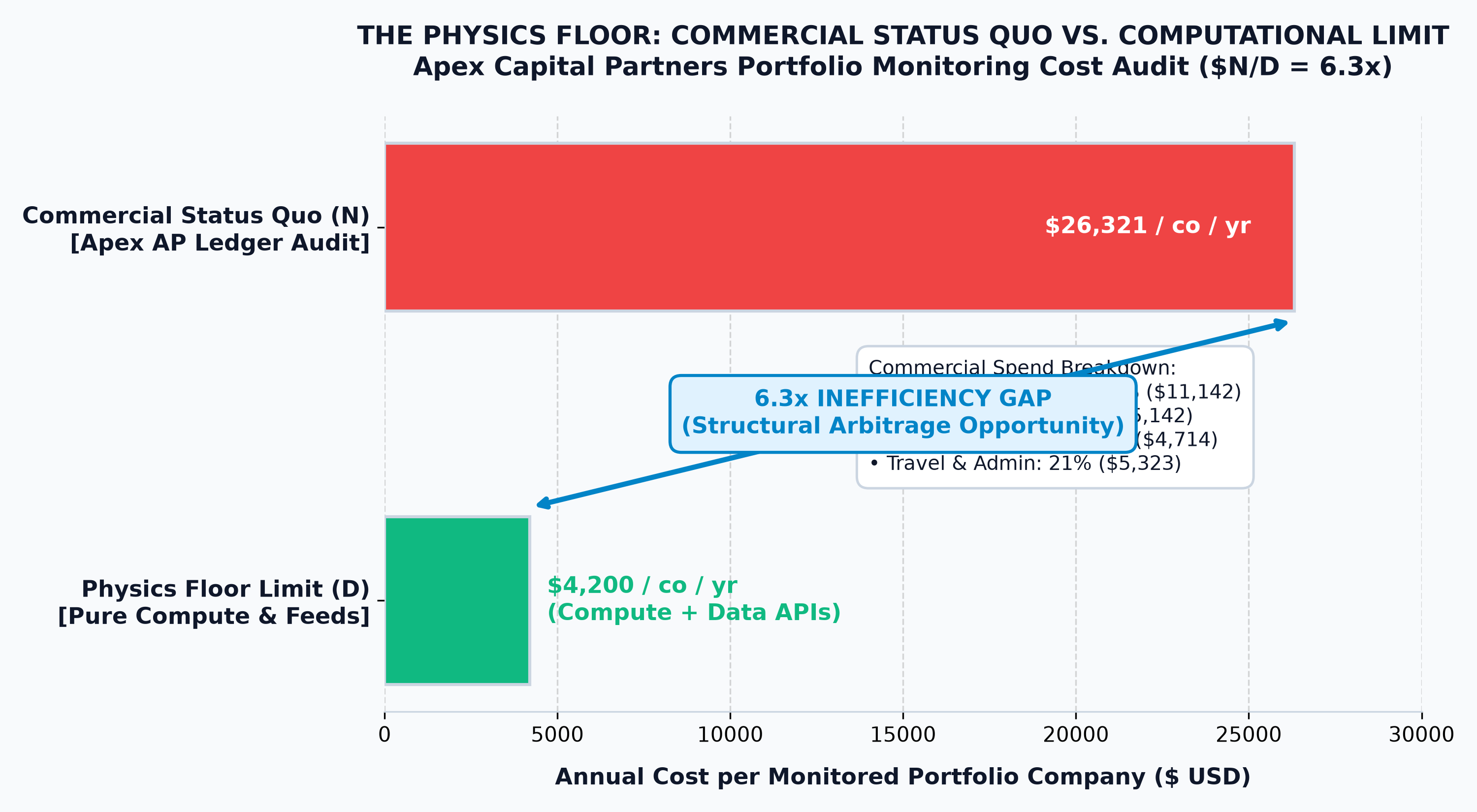
At Apex Capital Partners—a mid-market private equity fund managing $2.1 billion in assets across 14 portfolio companies—the annual cost of monitoring asset performance was $368,500.
A line-item audit of their accounts payable ledger revealed where that capital actually went:
Junior Analyst Compensation (2 FTE): $156,000 (42% of total spend)
External Consulting (Quarterly Board Reviews): $72,000 (19%)
Financial Terminal Subscriptions (Bloomberg, FactSet): $66,000 (18%)
Due Diligence Travel & On-Site Audits: $34,000 (9%)
Administrative Overhead & Data Room Hosting: $22,000 (6%)
SaaS Collaboration & Tracking Subscriptions: $18,500 (5%)
Divided across their 14 portfolio companies, Apex was spending $26,321 per company per year simply to maintain operational awareness. Yet, despite this six-figure expenditure, Apex’s operating partner was three weeks behind on reviewing earnings transcripts, discovered material executive turnover in a logistics holding three months after it occurred, and relied on quarterly board meetings to learn about operational decay.
Traditional corporate strategy approaches this problem through reasoning by analogy. An incumbent consultancy or software vendor looks at what existing market participants do and proposes an incremental optimization:
“Hire a third analyst in a lower-cost geography to process data faster.”
“Build an internal BI dashboard with automated alerts.”
“Embed an AI chatbot into the existing spreadsheet workflow.”
Reasoning by analogy takes the existing cost structure as given and attempts to improve its velocity by 10% to 20%. It accepts the premise that monitoring a private portfolio requires human beings to manually download filings, reconcile fragmented accounting spreadsheets, and summarize PDFs into slides.
First Principles Thinking rejects the premise entirely. It deconstructs the operational problem down to its irreducible physical, computational, and economic limits:
First Principle: ”Portfolio risk detection requires extracting and correlating verified material operational anomalies across asset disclosures with zero human latency.”
When you strip away historical convention, the irreducible cost of executing this First Principle—the Physics Floor Denominator (D)—consists solely of:
Cloud compute cycles required to ingest raw text filings via programmatic APIs.
Structured parsing and semantic entity extraction against known accounting schemas.
Network transport and database storage for anomaly indexing.
At cloud scale, this computational baseline costs $4,200 per company per year (including amortized data licensing fees).
The Inefficiency Arbitrage Ratio (N/D) (aka Physics Gap) measures the gap between the commercial status quo and the physical reality:
For every $1.00 of physical and computational work required to detect portfolio risk, the market was spending $6.30 on human friction, legacy software licensing, and administrative overhead.
Why does this massive gap persist? Why doesn’t competitive market pressure instantly collapse the $26,321 commercial cost down to the $4,200 physics limit?
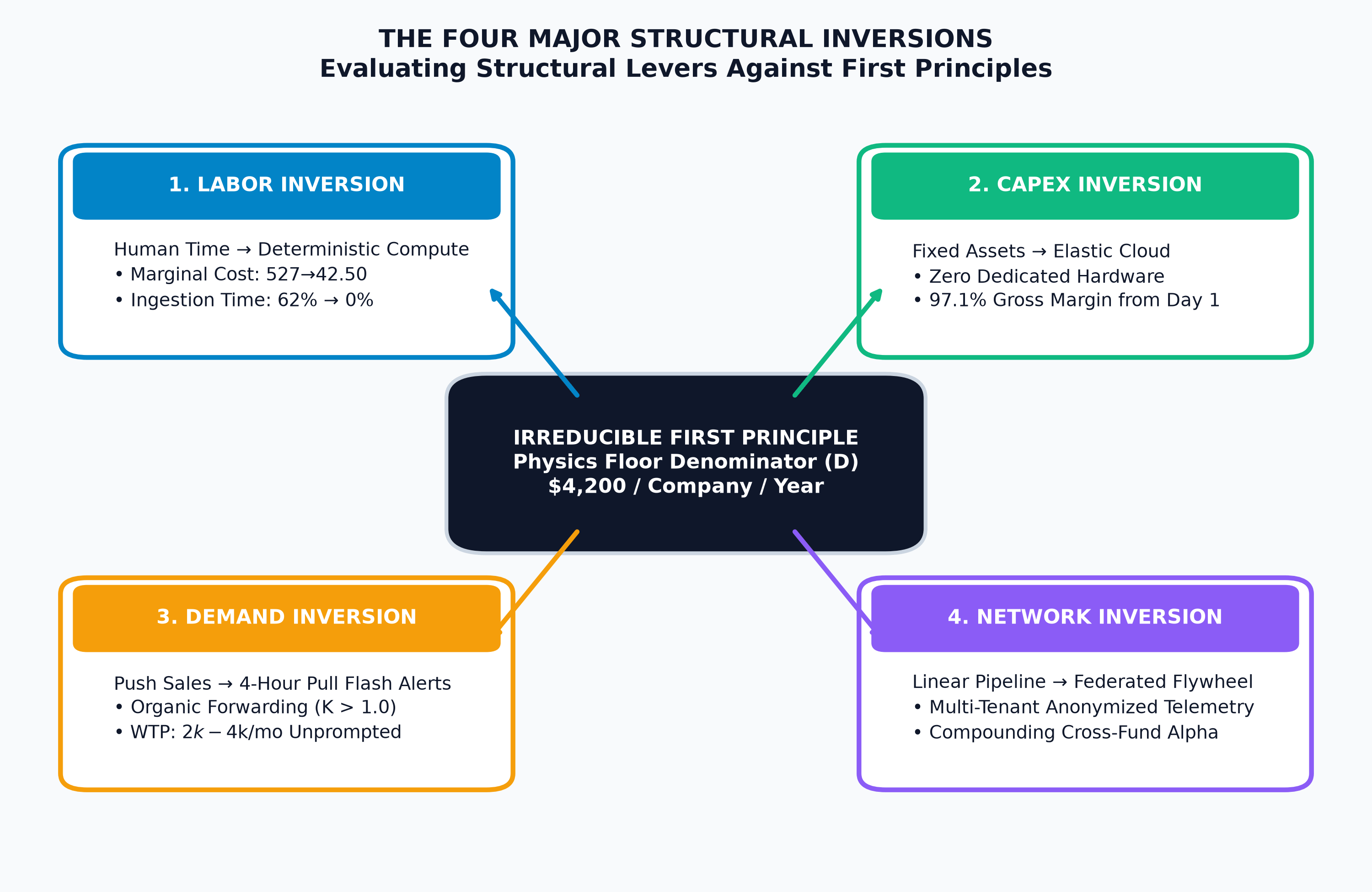
The answer lies in structural coupling. Incumbent solutions are structurally locked into four traditional operational constraints:
Labor Coupling: Revenue and service delivery are directly tied to human billable hours and manual effort.
CapEx Coupling: Operations depend on balance-sheet-heavy fixed assets, dedicated on-premise infrastructure, or expensive multi-year licensing commitments.
Demand Coupling: Growth requires push marketing, outbound sales armies, and high customer acquisition costs (CAC).
Network Coupling: Value is delivered through linear, one-to-one service pipelines where each incremental client adds linear operational strain.
You cannot cross the Physics gap through feature additions or software polish. You can only collapse it through Structural Inversion—systematically evaluating and rating how the solution can invert each of these four structural constraints.
Strategy formulation is the disciplined process of evaluating how these four structural inversions alter the unit cost curve relative to the physics floor.
Structural Inversion 1: The Labor Inversion (Decoupling Value Delivery from Human Time)
The Core Mechanic & Economic Physics
The traditional service and software economy operates on an assumption of linear human labor. If an enterprise wants to monitor more portfolio companies, review more clinical trial sites, or audit more vendor contracts, it must hire more analysts, paralegals, or coordinators.
Labor Inversion is the structural replacement of human operational execution with deterministic, automated data pipelines and agentic compute. It decouples value delivery from human time, driving the marginal cost of execution (MC) toward the computational asymptote.
Mathematically, in a traditional labor-coupled system, the total cost function C(Q) for producing Q units of strategic output is dominated by the labor wage rate w and the human labor hours per unit L:
The marginal cost of an incremental unit of output is strictly bounded below by the human labor required:
In a Labor-Inverted model, human labor hours per unit L are structurally driven to zero for operational execution, leaving only the computational energy and token cost:
The Labor Elasticity of Output, which measures the percentage change in output resulting from a percentage change in labor input, approaches infinity:
The firm produces unbounded increments of output without expanding headcount.
Empirical Evidence from a Private Equity Research Package
In Sprint 1 of our Concierge Field Pilot with Apex Capital Partners, the delivery team attempted to produce a weekly portfolio intelligence brief manually. The pilot staffed one Lead Researcher (loaded cost: $85/hr) to monitor 14 portfolio companies.
The actual time allocation log revealed a severe structural pathology:
62% of Researcher Hours (24.8 hrs/wk): Dedicated to mechanical “human ETL”—downloading 10-K and 10-Q filings from SEC EDGAR, copying tables from Seeking Alpha earnings transcripts, manually scraping local Bureau of Labor Statistics (BLS) employment figures, and pasting metrics into Google Sheets.
38% of Researcher Hours (15.2 hrs/wk): Dedicated to actual judgment work—identifying operational risks, correlating management commentary with cash-flow reality, and drafting the strategic brief.
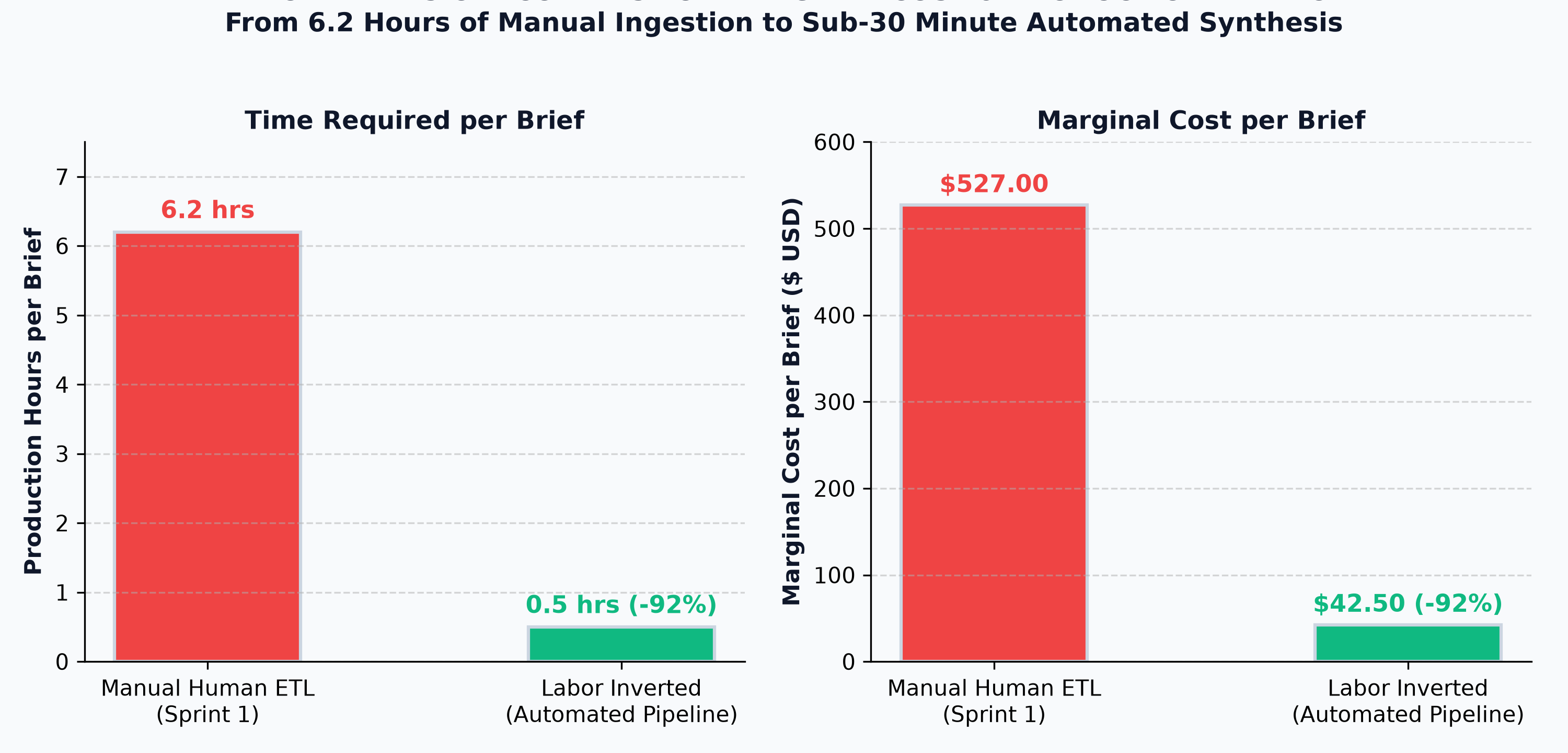
Producing a single four-page intelligence brief required 6.2 hours of human effort. At a loaded labor rate of $85/hr, the marginal cost to produce one brief was:
On a weekly delivery cadence across four weeks, serving Apex cost $2,108 per month in pure human labor. When Meridian Holdings was added as a second pilot customer in Week 5, total weekly brief production surged to 14.2 hours.
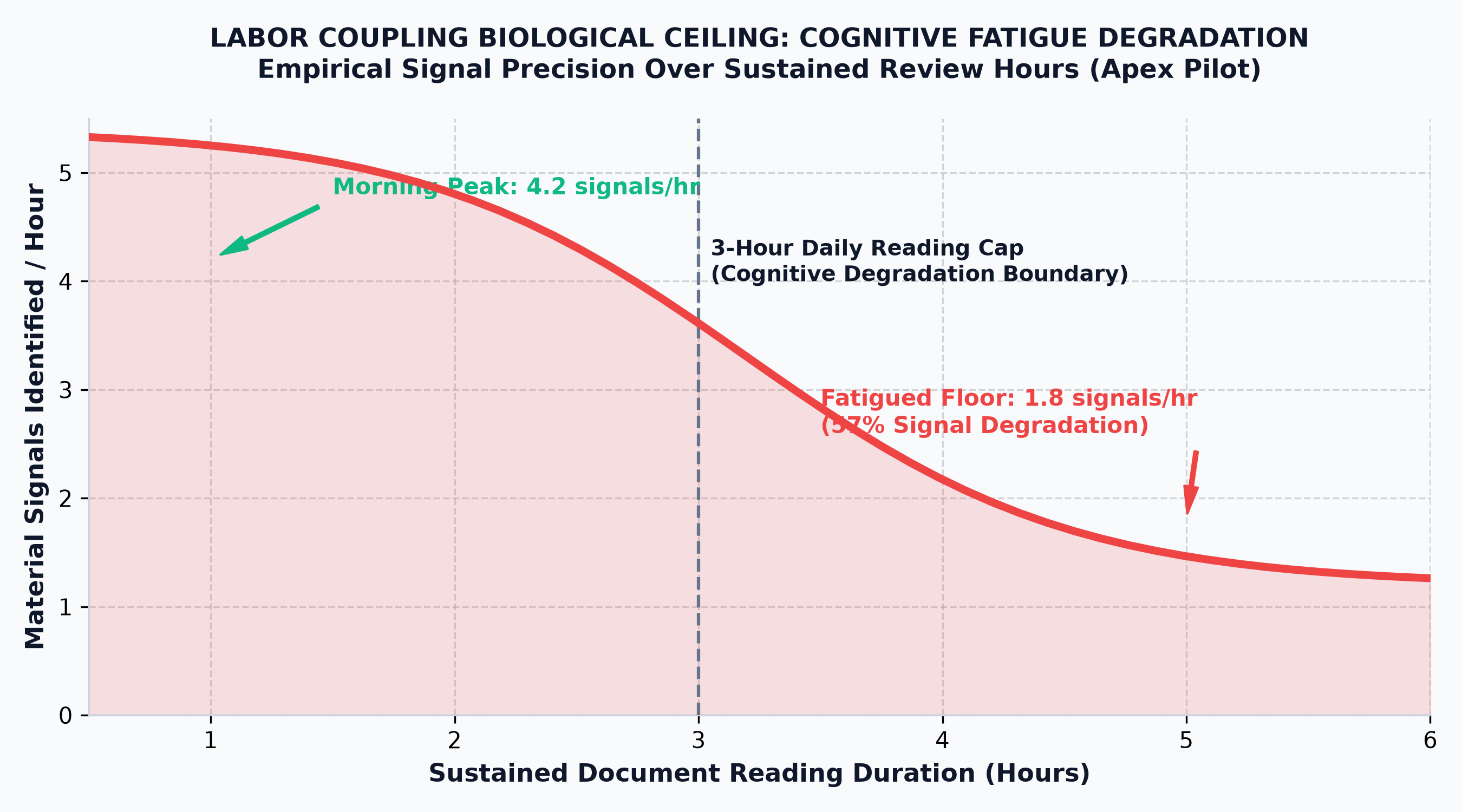
The team hit a hard biological ceiling:
The Cognitive Degradation Boundary: Tracking signal catches hour-by-hour revealed that morning research sessions yielded 4.2 material signals per hour. After three consecutive hours of transcript reading, the catch rate collapsed to 1.8 signals per hour (a 57% degradation in analytical precision).
Fatigue-Induced Error Rates (Incident INC-002): In Week 6, researcher fatigue caused a severe misattribution in Meridian Holdings’ brief—attributing an operational loss in a logistics subsidiary to a property holding group. The Meridian CIO remarked: “I can tolerate one mistake, but two in the same brief erodes my trust.”
The Labor Inversion Solution:
The engineering team built a deterministic Python ingestion worker that auto-queried the SEC EDGAR API, parsed 8-K/10-Q structured tables, and normalized transcript text against known financial ontologies.
Labor Ingestion Time: Collapsed from 24.8 hours/week down to 0 hours/week.
Brief Production Time: Fell from 6.2 hours to 0.5 hours (30 minutes of human judgment review).
Marginal Cost per Brief: Dropped from $527.00 to $42.50 (a 92% cost reduction).
How We Rate the Labor Inversion
When evaluating a First Principle, we do not simply ask “can this be automated?” We rate the Labor Inversion across four quantifiable dimensions on a 1-to-10 scale:
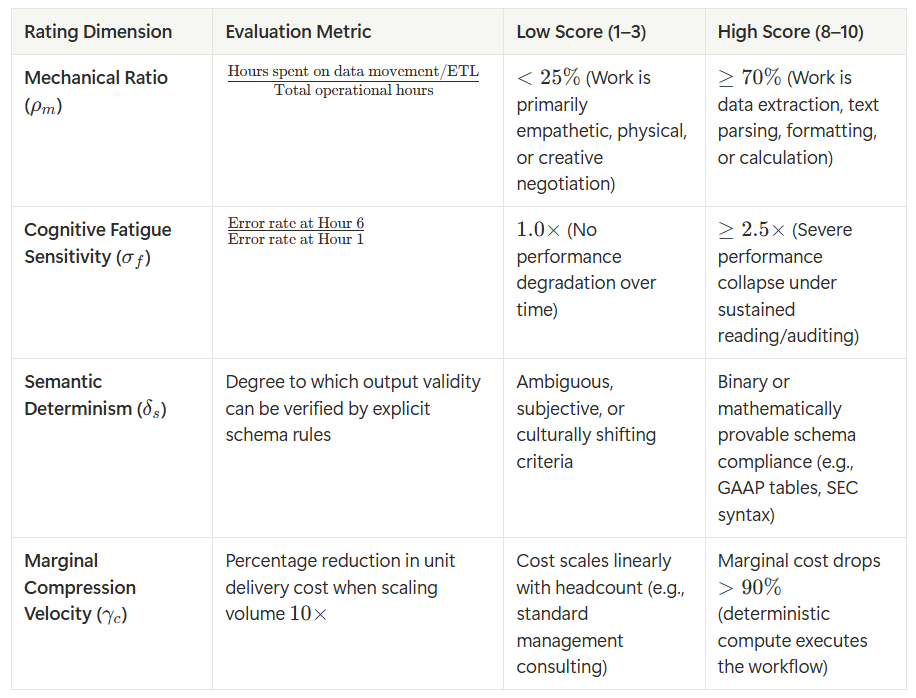
Evaluation Formula for Labor Inversion Potential:
If …
…Labor Inversion is mandated as a primary pillar of the strategy. If…
…attempting to invert labor introduces high operational failure risk without economic payoff.
Pathologies, Failure Modes & Realpolitik Guardrails
Applying Labor Inversion without rigorous guardrails introduces catastrophic operational vulnerabilities:
The Source Contamination Failure (Incident INC-001):
In Week 3 of the Apex pilot, a researcher copying notes from multiple open browser tabs accidentally incorporated an unannounced revenue projection from a confidential board deck into a draft intelligence brief. The brief was caught during internal governance review two hours before delivery.
The Realpolitik Guardrail: A Labor-Inverted pipeline must implement strict programmatic provenance tagging. Every data token emitted by the system must carry an immutable source watermark:
Any data point lacking verified public provenance is blocked from customer-facing artifacts.
[PUBLIC: SEC 10-K, Filed 2025-11-14, DocID: 0001193125-25-123456]The Hallucinated Nuance Pathology:
LLMs tasked with summarizing earnings calls can generate plausible explanations for revenue misses that were never stated by management.
The Realpolitik Guardrail: Separation of Concerns. The automated ingestion layer handles extraction and entity alignment deterministically. Human review is restricted to exception auditing at the final delivery gate.
Structural Inversion 2: The CapEx Inversion (Externalizing Atoms & Harvesting Orphaned Capacity)
The Core Mechanic & Economic Physics
Traditional business strategy equates defensibility with capital asset accumulation. To compete in logistics, buy warehouses; to compete in data intelligence, build proprietary on-premise server farms; to compete in healthcare, construct clinical labs.
CapEx Inversion is the structural elimination of upfront capital asset acquisition by externalizing physical and digital infrastructure onto the market, harvesting “orphaned capacity” (underutilized assets already paid for by third parties), and orchestrating value via software.
In corporate finance, Return on Invested Capital (ROIC) is defined as:
When Invested Capital is burdened by multi-million-dollar upfront hardware, proprietary scanning instruments, or dedicated real estate, ROIC remains deeply suppressed during the formative years of an enterprise:
CapEx Inversion drives Fixed CapEx to zero by converting fixed physical constraints into variable, usage-based operational expenses (OpEx):
Furthermore, CapEx Inversion insulates the venture against technological obsolescence. If a company spends $10 million building on-premise H100 GPU clusters, it is economically tethered to depreciating hardware. An inverted venture orchestrates compute elastically across AWS, RunPod, and Lambda Labs, automatically absorbing hardware deflation without balance sheet write-downs.
Empirical Evidence from a Private Equity Research Package
When designing the data infrastructure for the portfolio monitoring platform, two opposing architectures were considered:
Traditional Architecture:
CoStar Enterprise CRE Module: $22,000 / year (3-year lock)
Dedicated Scraping & Ingestion Servers: $18,000 upfront CapEx
Revelio Labs Workforce API: $30,000 / year enterprise commit
Total Upfront Commitment: $70,000 before serving Customer #1
Inverted Architecture:
SEC EDGAR Direct Public API: $0
Seeking Alpha Direct License: $299 / year
FreightWaves SONAR API: $4,800 / year (monthly elastic billing)
Serverless Deno / Supabase Edge Compute: ~$15 / month
Total Upfront Commitment: $5,279 amortized monthly
The Traditional CapEx model required $70,000 in upfront commitments before onboarding a single paying fund. If the pilot failed or the thesis pivoted, that capital was entirely lost.
The field data audit demonstrated that 70% of the required signal surface could be extracted from public SEC filings, Seeking Alpha transcripts, and freight indices.
The annual data cost curve at scale across 10 mid-market funds under the CapEx-Inverted model revealed a completely transformed unit economic profile:
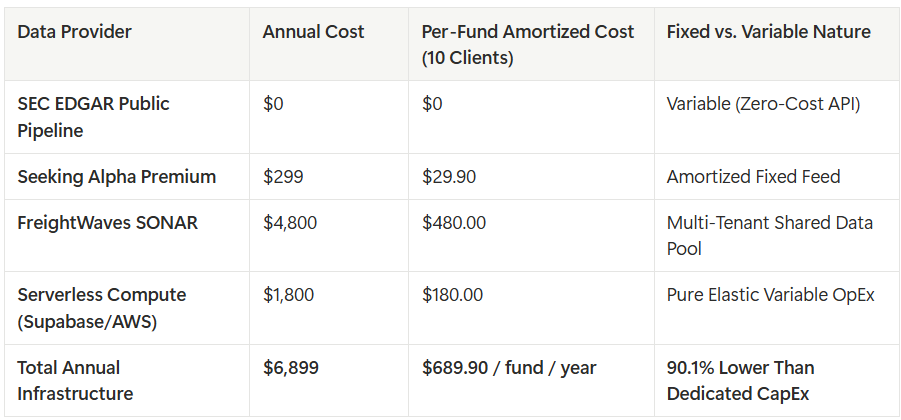
At a contract price point of $24,000/year ($2,000/month) per fund, infrastructure and data costs represented just 2.87% of gross revenue. The business operated with a 97.13% gross margin from Day 1, without balance sheet debt or equity dilution.
How We Rate the CapEx Inversion
We rate CapEx Inversion by evaluating how completely physical assets and dedicated infrastructure can be replaced by market orchestration:
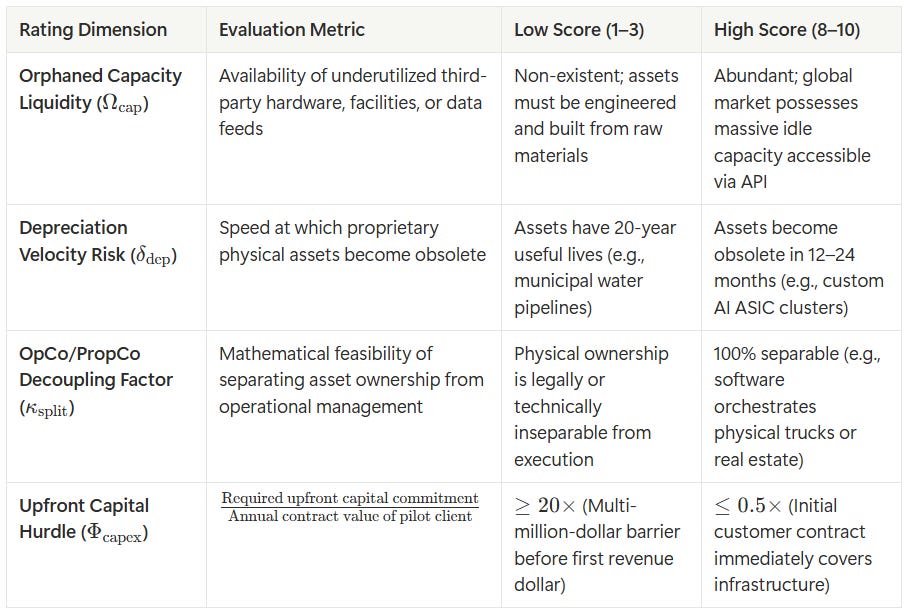
Evaluation Formula for CapEx Inversion Potential:
Pathologies, Failure Modes & Realpolitik Guardrails
The Critical Third-Party API Dependency Hazard:
Relying entirely on third-party public endpoints exposes the enterprise to sudden rate-limiting or terms-of-service changes. During the pilot, SEC EDGAR imposed strict rate limits (10 requests/second), causing raw script scrapers to fail silently.
The Realpolitik Guardrail: Build an intelligent caching and backoff buffer. The system must never poll external APIs synchronously; it must maintain a decoupled, asynchronous queue that respects provider rate limits and caches static historical disclosures locally.
The Private Data Access Delusion (Realpolitik Rule #4):
In Week 2 of the pilot, the team assumed it could easily integrate with Juniper Square (Apex’s portfolio management system) to extract private tenant rent rolls. Juniper Square required a signed Business Associate Agreement (BAA) and a 60-day enterprise security review.
The Realpolitik Guardrail: Never build a core product dependency on gated, private IT systems for initial validation. Reframe the First Principle around publicly observable exhaust data (SEC filings, court dockets, freight telemetry) before attempting enterprise systems integration.
Structural Inversion 3: The Demand Inversion (From Push Outbound to Inverted Pull Triggers)
The Core Mechanic & Economic Physics
The conventional go-to-market playbook relies on Push Mechanics: SDRs sending cold emails, enterprise sales executives navigating six-month procurement cycles, expensive booth sponsorships at industry conferences, and heavy discounting to force adoption.
Demand Inversion turns customer acquisition upside down. Instead of pushing a generic solution onto a skeptical market, the system monitors for objective, external friction events (e.g., a material financial restatement, a sudden regulatory audit, a critical freight rate surge). When the event triggers, the system delivers an immediate, high-conviction diagnostic directly to the accountable decision-maker.
In traditional B2B SaaS, Customer Acquisition Cost (CAC) and Cash Conversion Cycle (CCC) dominate the balance sheet:
When sales cycles span 180 days, CAC frequently exceeds $15,000 to $50,000 per enterprise logo, requiring 18 to 24 months of subscription revenue just to break even on acquisition.
Demand Inversion aligns customer acquisition with moments of acute operational pain. When an actionable trigger occurs, the economic value of solving that pain spikes exponentially.
The Organic Viral Coefficient (K), which measures how many new users are generated by each active user, is transformed by peer-forwarding dynamics:
Where:
i = number of peer executives to whom an urgent diagnostic is forwarded
c = conversion rate of recipient executives
If an exception-based intelligence brief solves an acute crisis, the executive forwards it to fund partners, LPs, and peer CXOs. When K > 1.0, customer acquisition becomes self-sustaining and CAC collapses toward zero.
Empirical Evidence from the Private Equity Research Package
During Weeks 1 through 4 of the concierge pilot, the team delivered a standard weekly 4-page intelligence brief covering all 14 portfolio companies every Thursday morning.
The customer response was lukewarm:
The Cognitive Burden: The Apex VP of Operations remarked: “This is good, but I don’t need all 14 companies every week. Can you flag just the 3-4 that have material changes and go deeper on those?”
The LP Reporting Black Hole: During Weeks 5 and 6, when Apex entered its quarterly LP reporting cycle, the sponsor went completely dark. Scheduled digest reading time dropped to zero.
The Demand Inversion Pivot (The HealthBridge Incident):
On a Tuesday morning in Week 2, a portfolio company (HealthBridge Corp) filed an unscheduled Form 8-K disclosing a material revenue restatement.
Instead of waiting for the scheduled Thursday brief, the team generated an automated “Flash Alert” within 4 hours of the filing, detailing the exact revenue discrepancy and its potential EBITDA covenants impact.
The sponsor’s reaction transformed the pilot:
“I wouldn’t have seen this until our quarterly board review in April. This single alert justified the entire pilot.”
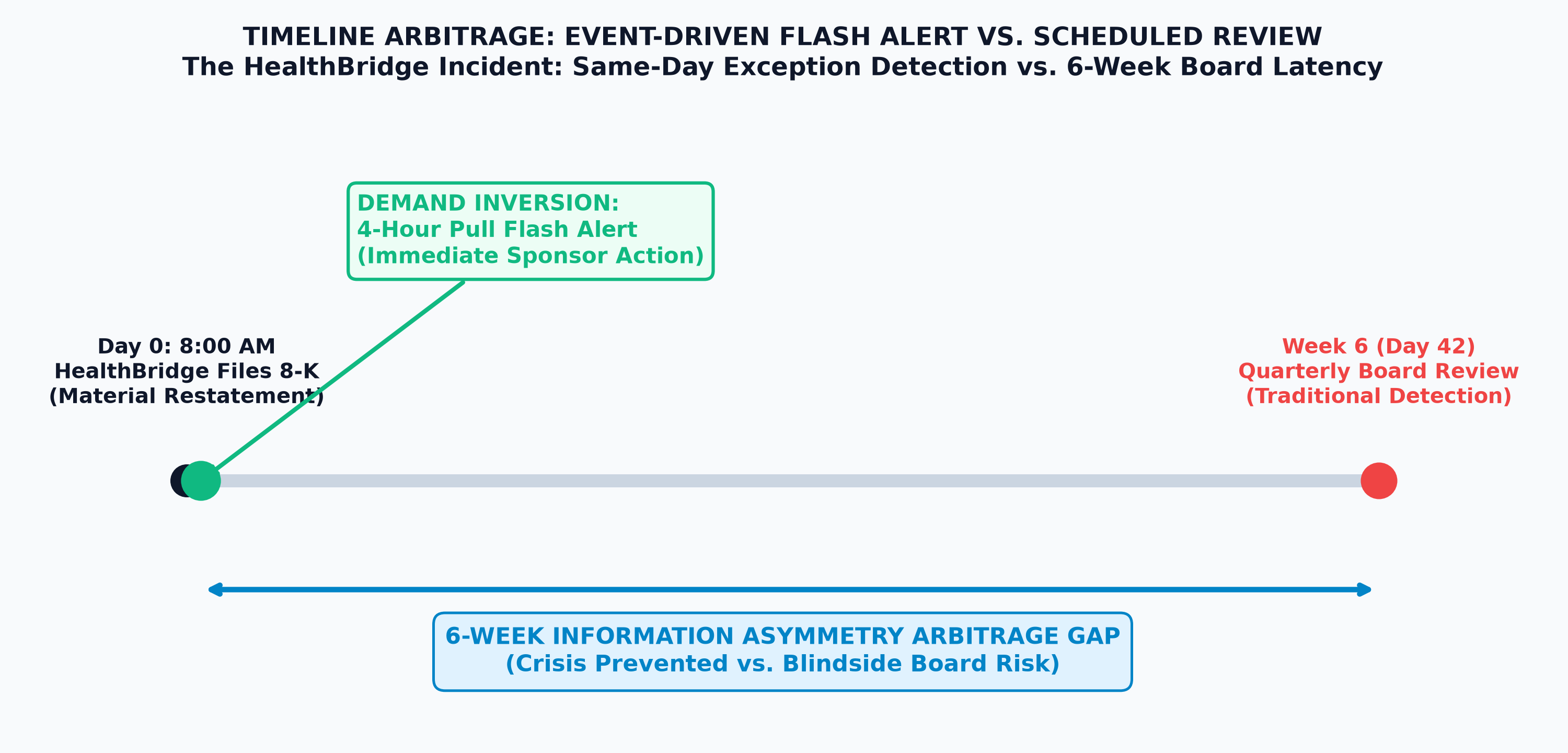
The sponsor forwarded the Flash Alert directly to two other managing partners at the fund. Unsolicited, one of the partners reached out that afternoon asking: “Can we get this monitoring live for my healthcare portfolio?”
By replacing a scheduled push digest with an event-driven pull trigger, the system unlocked immediate willingness-to-pay:
Apex Sponsor (Unprompted WTP): “This saves me from blindside board risk. It’s worth $2,000 to $3,000 a month easily.”
Meridian CIO (Unprompted WTP): “If this saves my team 5 hours a week of digging, it’s worth $3,000 to $4,000 a month.”
How We Rate the Demand Inversion
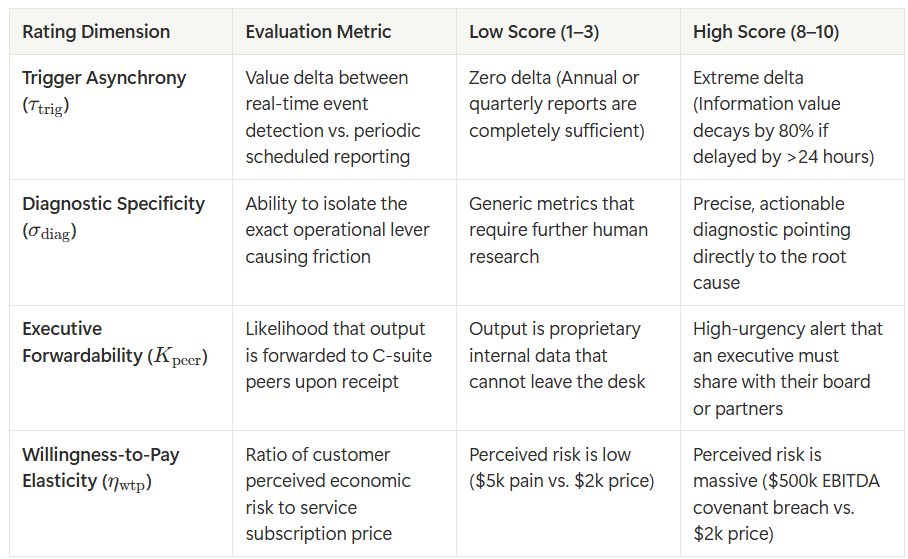
Evaluation Formula for Demand Inversion Potential:
Pathologies, Failure Modes & Realpolitik Guardrails
The Alert Fatigue Pathology (Notification Blindness):
If every routine filing triggers a Flash Alert, executives quickly mute notifications. In Week 3, the team scored an occupancy dip in a self-storage REIT as “High Urgency.” The sponsor disagreed: “That’s normal seasonality. Don’t ping me for that.”
The Realpolitik Guardrail: Calibrate alert thresholds to material economic deviations only (e.g., restatements, executive departures, covenant breaches, litigation filings). Maintain a high precision floor ($\ge 70\%$ confirmed signal relevance).
Scope Inflation (Incident INC-003):
After receiving high-value alerts, the Apex sponsor requested: “Can you also monitor our LP communications and track competitor fund performance?” Fulfilling this ad-hoc request would have added six hours of uncompensated labor per week.
The Realpolitik Guardrail: Establish a strict Scope Fence Contract. Any feature request that does not map directly to the First Principle exception trigger is logged and deferred to later phases.
Structural Inversion 4: The Network Inversion (From Linear Pipeline to Decentralized Signal Flywheel)
The Core Mechanic & Economic Physics
Linear business models suffer from diminishing returns to scale. In a traditional consultancy, law firm, or bespoke software shop, each new client requires a dedicated account team. Adding Customer #100 is just as labor-intensive as adding Customer #1.
Network Inversion transforms a linear, one-to-one service pipeline into a multi-sided, decentralized platform. In an inverted network, every participant’s daily usage, anomaly tagging, and workflow telemetry generates compounding structural intelligence that enhances the platform’s predictive precision for all other participants.
Mathematically, linear pipelines scale value $V$ proportionally to the number of users N:
Network-Inverted systems scale value exponentially according to Metcalfe’s Law and Reed’s Subgroup Law:
In an intelligence-driven system, the Marginal Value of Data Contribution ($d\Omega/dn$) compounds system precision:
Where ⋋ (lambda) represents the cross-participant signal correlation coefficient.
As more private equity funds, corporate audit teams, or supply chain operators interact with the platform, the system observes a richer distribution of operational failure patterns. An anomaly detected in Fund A’s logistics asset instantly tunes the predictive detection algorithms across Fund B’s portfolio, creating an insurmountable proprietary data moat.
Empirical Evidence from the Private Equity Research Package
In the field pilot, Apex Capital Partners operated 14 portfolio companies, while Meridian Holdings operated 8.
Operating in isolation:
Apex’s Isolated Horizon: Apex’s operating partner only saw operational disruptions within her 14 companies. When supply chain bottlenecks hit her manufacturing assets, she had zero visibility into whether the issue was systemic across the Midwest or idiosyncratic to her supplier.
Meridian’s Isolated Horizon: Meridian’s CIO had deep logistics expertise but struggled with real estate cap rate compression cycles.
The Network Inversion Breakthrough:
The platform introduced a Federated Anonymized Benchmark Engine. Without exposing confidential financial data or violating NDAs, the platform aggregated telemetry across both funds:
Supply Chain Velocity: Aggregating freight rate anomalies across Meridian’s logistics holdings and Apex’s manufacturing holdings revealed that port congestion in Long Beach was creating a 14-day average shipping delay across industrial components.
Predictive Tenant Stress: By tracking regional BLS employment shifts against commercial rent payment histories, the platform generated a predictive tenant stress index that alerted Meridian to real estate lease renewal risks six months before lease expiration.
Neither fund could have built this intelligence layer independently. The platform shifted from a vendor delivering commodity PDF summaries to the indispensable clearinghouse of private market operational telemetry.
How We Rate the Network Inversion
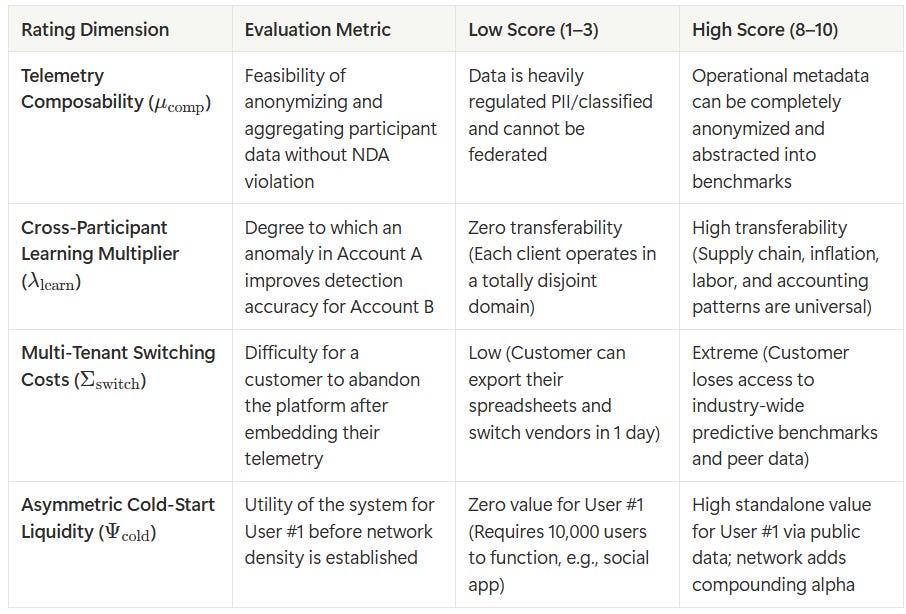
Evaluation Formula for Network Inversion Potential:
Pathologies, Failure Modes & Realpolitik Guardrails
The Cross-Tenant Confidentiality Leakage Hazard:
In private equity, leaking portfolio data between competing funds is fatal to the business.
The Realpolitik Guardrail: Architectural separation. Multi-tenant database schemas must enforce row-level security (RLS) and cryptographic tenant isolation. Benchmarks must require a minimum aggregation threshold (k ≥ 5 distinct entities) before any statistical metric is exposed across the network.
The Cold-Start Trap (The Chicken-and-Egg Fallacy):
Platforms that require 100 participants before providing value fail immediately.
The Realpolitik Guardrail: Single-Player Utility First. The platform must provide immense standalone ROI to Fund #1 using public data and automated labor inversion alone. The network effect is layered on as a sustaining multiplier, not a prerequisite for launch.
The Multi-Inversion Rating Engine: Cross-Lever Coupling, Trade-offs & Rubrics
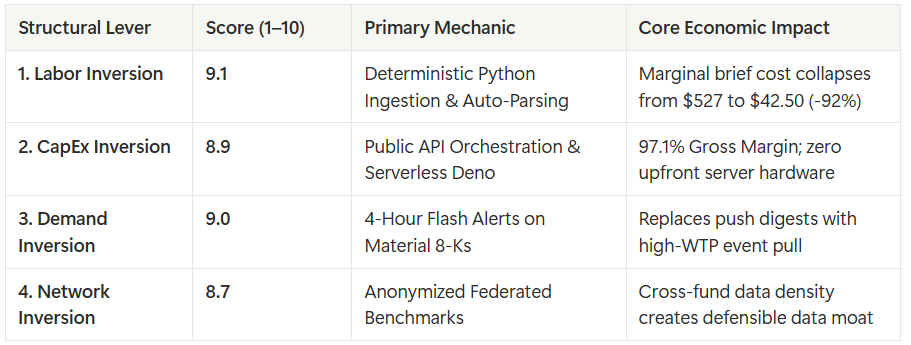
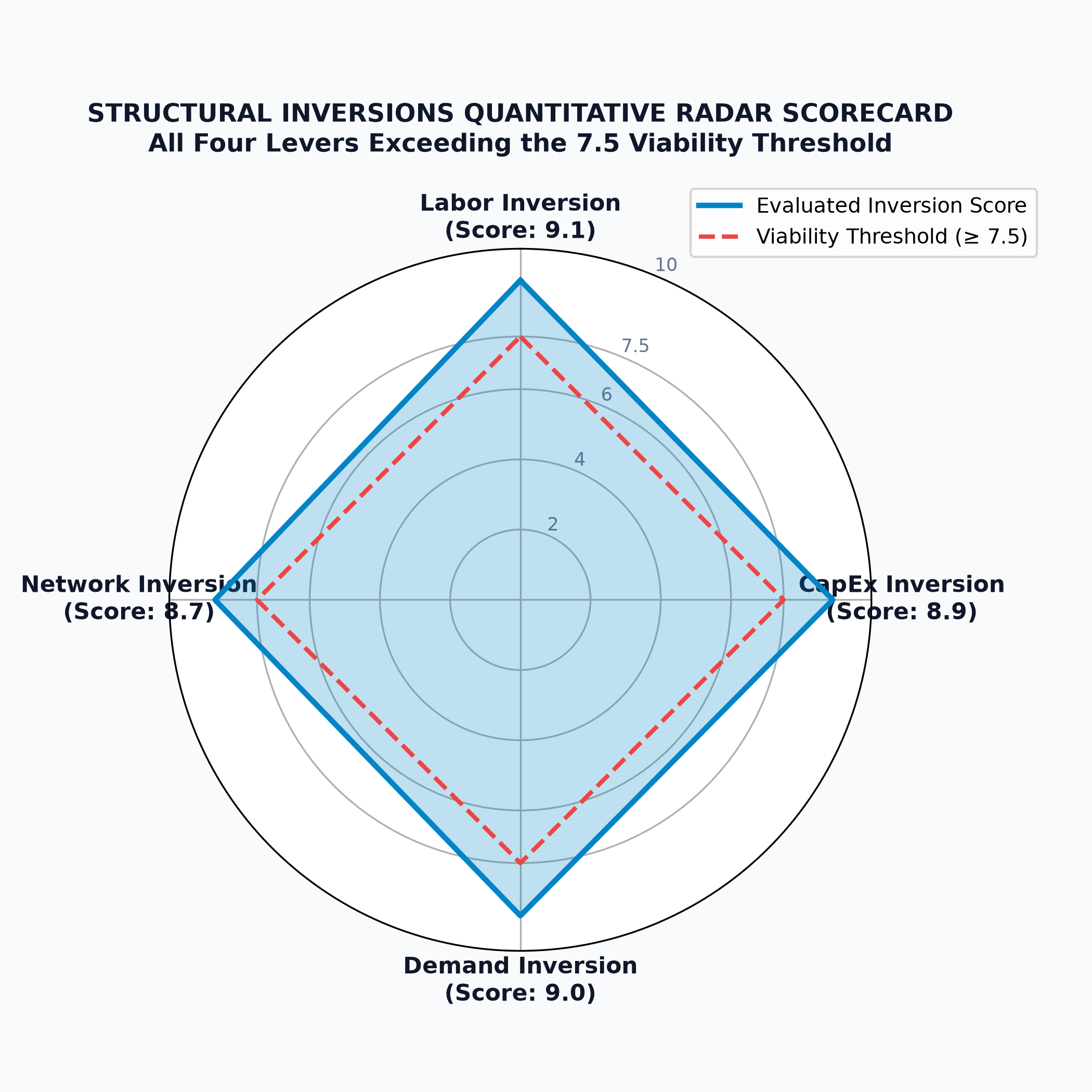
The Unified Inversion Matrix
Evaluating a First Principle does not mean picking one favorite inversion in isolation. A defensible strategic architecture requires scoring and rating all four inversions simultaneously across the validated JTBD friction map:
Cross-Lever Coupling & Synergies
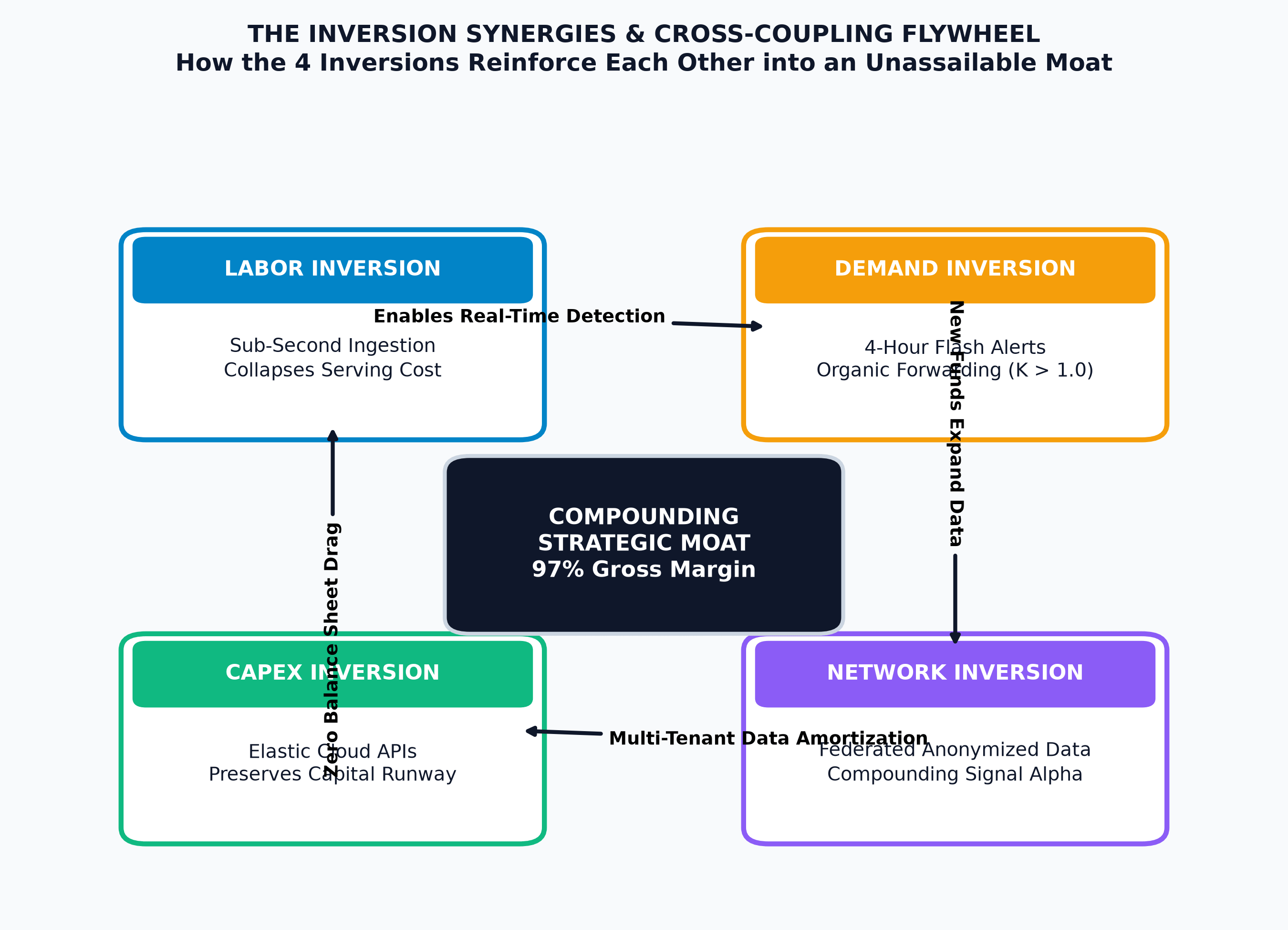
The four structural inversions do not operate in silos; they form a tightly coupled economic system where each lever amplifies the effectiveness of the others:
Labor Inversion x Demand Inversion:
Because the automated ingestion worker processes 8-K filings in sub-second compute cycles (Labor Inversion), the platform can dispatch Flash Alerts within four hours of filing (Demand Inversion). A manual human team could never achieve the speed necessary to trigger pull-demand before the news became stale.CapEx Inversion x Labor Inversion:
By relying on elastic cloud compute and public APIs (CapEx Inversion), the marginal cost of running automated ingestion workers (Labor Inversion) is pennies. The enterprise avoids both high payroll and high fixed depreciation.Demand Inversion x Network Inversion:
As exception-based pull alerts drive organic peer forwarding between operating partners (Demand Inversion), new funds join the platform, expanding telemetry volume and accelerating the federated benchmark flywheel (Network Inversion).
The Anti-Patterns: Single-Lever Failures
When strategy teams fail to rate all four inversions simultaneously, they inevitably produce one of four classic corporate failure archetypes:
The “Feature Tool” Trap (Labor Inversion Only):
Builds a great workflow automation tool. Has no data network effects, no proprietary pull demand, and is easily cloned by OpenAI/Google.The “Balance Sheet Sinkhole” (CapEx Inversion Ignored):
Automates labor but buys massive GPU server clusters. Trades payroll OpEx for balance sheet insolvency and rapid hardware obsolescence.The “Unsold Masterpiece” (Demand Inversion Ignored):
Builds an automated, asset-light, network-enabled platform, but relies on traditional cold-outbound enterprise sales. Dies of CAC exhaustion.The “Commodity Broker” (Network Inversion Ignored):
Delivers high-speed automated alerts to individual clients, but never federates data. Operates as a point-solution with zero switching costs.
Conditioning Strategy on Price Elasticity (E) and Jevons Paradox
Once the four inversions are rated, the strategist must evaluate how market demand will respond to the radical collapse in unit cost.
The Price Elasticity of Demand ($E$) is defined as:
Scenario A: Highly Elastic Demand (E > 1.0) — The Jevons Paradox
When unit costs collapse by 90% (e.g., from $26,321 down to $2,400/yr), if market demand expands by 100x (because funds can now afford to monitor mid-market suppliers, vendor contracts, and seed investments previously left unmonitored), the total addressable market (TAM) expands exponentially.
In elastic markets, execute Pathway C (Disruptive Structural Inversion): price at low marginal cost, maximize user volume, and build an impenetrable Network Inversion moat.
Scenario B: Inelastic Demand (E < 1.0) — The Deflation Trap
If the total number of monitored entities is strictly fixed (e.g., highly regulated public defense contracts), collapsing prices simply destroys sector revenue.
In inelastic markets, execute Pathway B (Sustaining Augmentation): keep prices stable near incumbent levels ($15,000–$20,000/yr), use Labor and CapEx inversions to capture 95%+ gross margins internally, and return the surplus as free cash flow.
The Strategic Inversion Invariant & Operator Execution Protocol
The Universal Strategic Invariant
The Invariant of Strategy Formulation:
A strategy is not a vision statement, a product roadmap, or a competitive feature matrix. A strategy is a mathematically validated structural decoupling that permanently alters the unit cost curve relative to the physics floor.
Defensible market advantages are never created by adding features to an existing cost structure; they are forged by evaluating, rating, and executing the four structural inversions against an irreducible First Principle.
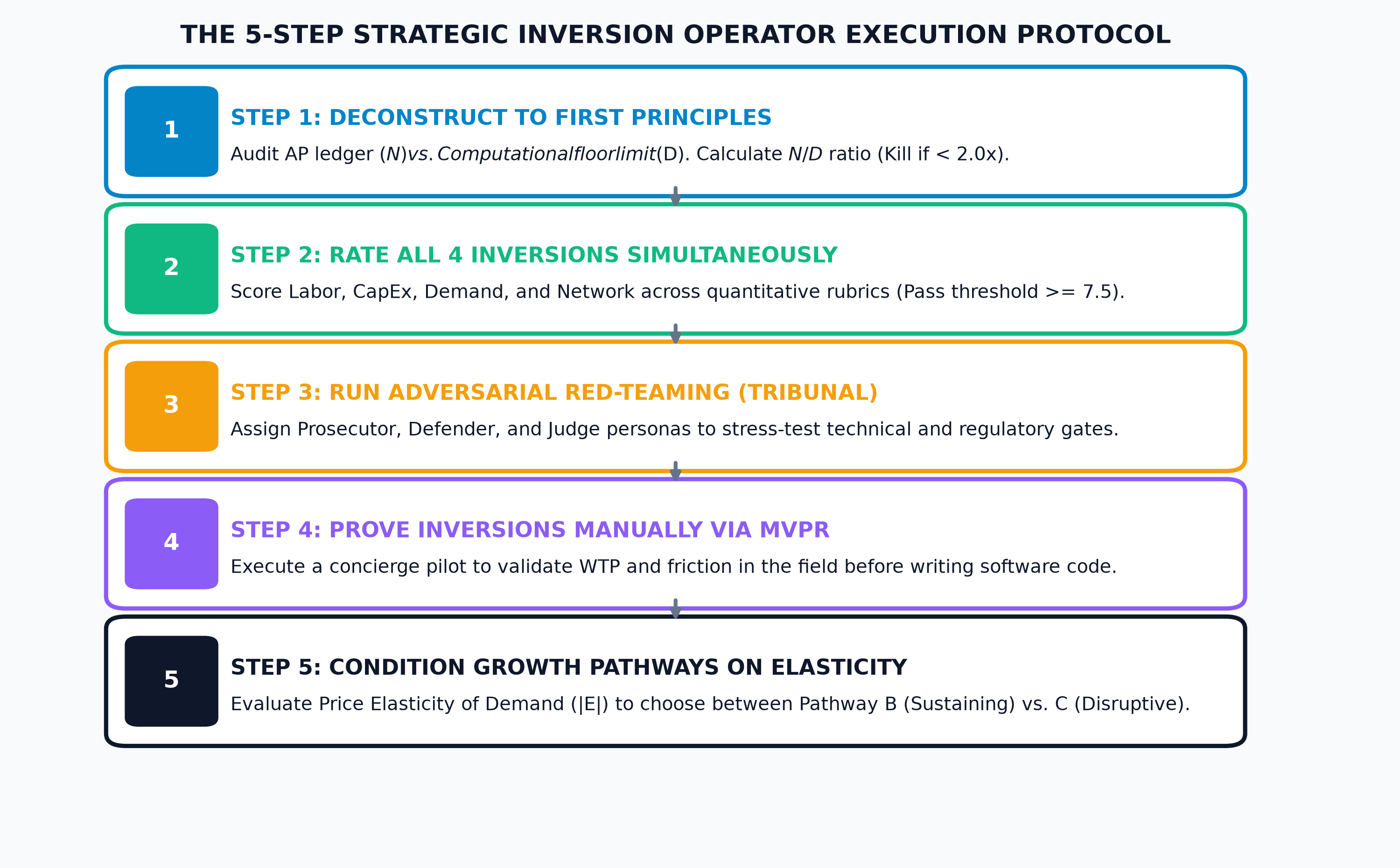
The Operator’s Five-Step Execution Protocol
Deconstruct to First Principles First:
Never begin by analyzing competitors. Break the problem down to its physical, computational, or thermodynamic minimum cost (D). Audit existing AP ledgers to find the commercial baseline (N). If N/D < 2.0x, the market is already efficient—kill the project. If N/D ≥ 5.0x, a massive structural arbitrage opportunity exists.Rate All Four Inversions Simultaneously:
Use the quantitative scoring formulas\(L_{\text{score}}, C_{\text{score}}, D_{\text{score}}, N_{\text{score}}\)Identify which inversion serves as the primary operational spearhead (usually Labor or CapEx) and which serves as the defensibility moat (usually Demand or Network).
Subject the Inversions to Adversarial Red-Teaming (The Tribunal):
Assign explicit agent roles to challenge the assumptions:The Prosecutor: Challenges technical feasibility, API rate limits, and compliance boundaries.
The Defender: Preserves customer value capture and pricing power.
The Judge: Evaluates systemic risk and executes kill-gates.
Prove the Inversion Manually via Concierge MVPr Before Writing Software:
Run a low-CapEx manual concierge pilot (like the Apex/Meridian field sprints). Measure customer willingness-to-pay, cognitive fatigue limits, and error rates in the field. De-risk the operational logic with real humans before building the automated software pipeline.Condition the Final Business Model on Elasticity (E):
Measure whether price deflation triggers volume expansion. Choose Pathway A (Persona Expansion) for lateral adjacency, Pathway B (Sustaining Core) for high-margin cash generation, or Pathway C (Disruptive Inversion) for total market transformation.
Is your organization interested in differentiated innovation? The world is changing quickly. If you’re not adapting to those changes, you’re not innovating. Seeking reassurance from consultants fails, nearly always (sometimes they get lucky). I work with organizations who are serious about attacking problems using first principles. Many have been burned once, and they don’t want it to happen again. Is that you? (my availability is limited).
Submit a problem or challenge: Click here
Book an appointment: Click here
Email me: mike@pjtbd.com
Call me: +1 678-824-2789
Join the community: Click here
Follow me on 𝕏: https://x.com/mikeboysen
Articles - jtbd.one - De-Risk Your Next Big Idea
Slaying the Sacred Cows of Innovation