

THE EPISTEMOLOGICAL PROBLEM: THE “CAC” TRAP
For decades, enterprise growth has been paralyzed by a monolithic assumption: To sell a product, you must build or buy your own audience. We map “Top of Funnel” metrics, obsess over SEO, and pour millions into programmatic advertising. We build massive internal apparatuses of Marketing Managers, Media Buyers, and Content Strategists (The Executors) whose sole job is to shout into the void.
This is the CAC (Customer Acquisition Cost) Trap. We spend years and millions trying to build trust from scratch, much like the Project Apex team spending $500,000 on a dashboard to solve a symptom rather than the root cause.
The Customer Perspective: Marketing is Friction. We must fundamentally recognize that customers don’t buy “nurture sequences,” “programmatic ad impressions,” or “brand awareness campaigns”—they buy outcomes. From the perspective of the Beneficiary, traditional marketing is not a value-add; it is a tax on their attention and time. The Selection Journey and Learning Journey are pure friction. Customers do not want to research you; they want the problem solved.
Traditional go-to-market strategies ignore this reality. We build Experience Moats around the Executor (the marketing agency or internal media buyer), creating a bloated Idiot Index (ID10T) where the commercial cost of acquiring a customer (Numerator) massively outpaces the theoretical floor of simply sharing revenue with someone they already trust (Denominator).
The Antidote is the Agentic O.P.A. Approach. We must deploy First Principles Thinking to smash “audience building” down to its indivisible truth: A transaction requires trust. By deploying the Socratic Scalpel, we invert the demand: What if the customer already trusts someone else for this exact Job-to-be-Done? We apply Musk’s Algorithm:
Step 1: Question every requirement (Why do we need our own audience?).
Step 2: Delete any part or process you can (Delete the ad spend and the media buyer).
The goal is Network Inversion: decoupling acquisition from human OPEX, shifting to scalable AI affiliate networks, and collapsing the journey entirely around the Beneficiary.
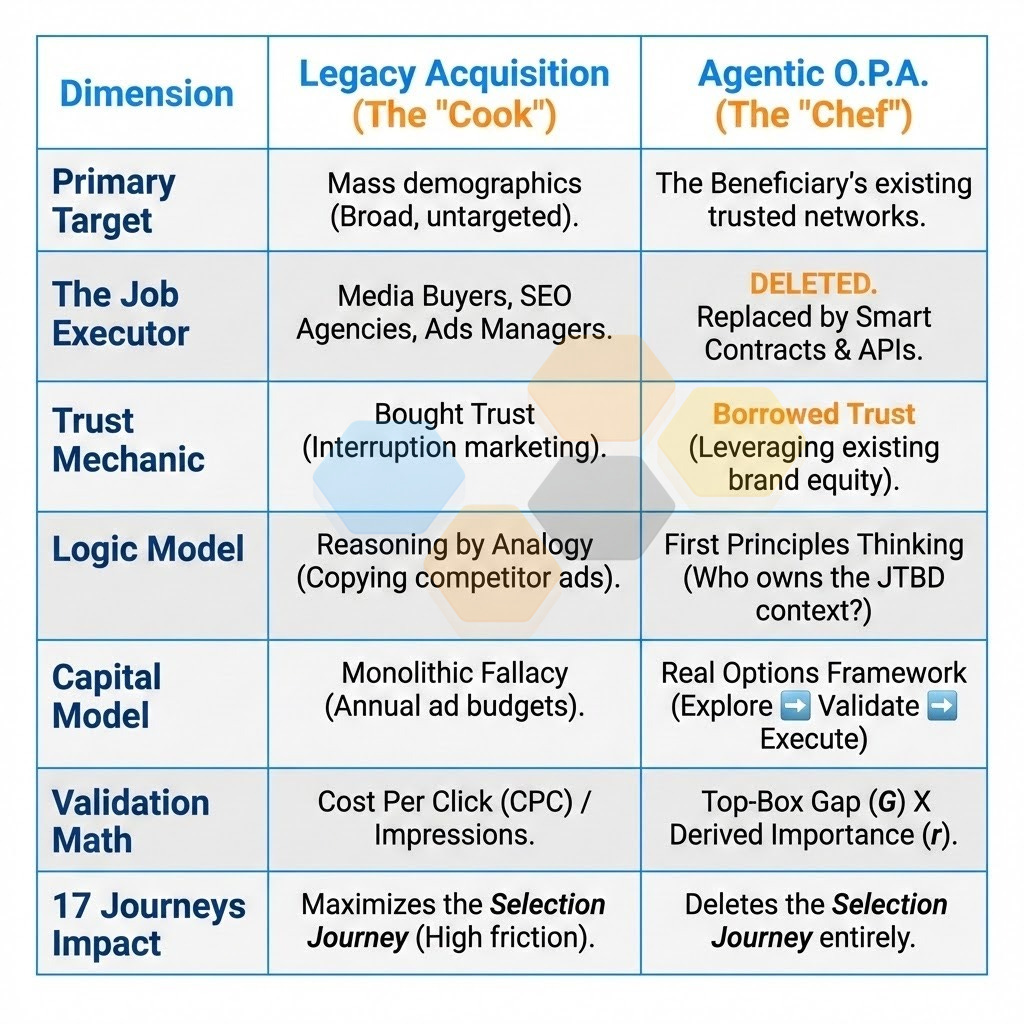
COMPARATIVE ANALYSIS: LEGACY ACQUISITION VS. AGENTIC O.P.A.
To cross the chasm from incremental growth to defensible monopolies, we must abandon the old metrics of audience building and shift from Doblin’s Offering innovations to Configuration (Profit Model & Network) innovations.
THE AGENTIC O.P.A. PIPELINE: A 6-NODE DECONSTRUCTION
To execute this strategy, we must run audience acquisition through my Innovation Lattice, stripping away human bias and enforcing mathematical rigor.
Step 1: Socratic Deconstruction & The Idiot Index (Nodes 1 & 2)
The Action: Intercept the demand for “more lead gen.” Reject analogical reasoning (e.g., “Our competitors are on TikTok, so we must be on TikTok”).
The Calculation: Calculate the ID10T Index. Compare the fully loaded CAC (ad spend + human marketing OPEX) against the theoretical floor: a 10% revenue split executed via a zero-marginal-cost smart contract. If the index is > 50, trigger the Delete Mandate: Eliminate the internal ad-buying process.
Step 2: JTBD Mapping & The Verb Lexicon (Node 3)
The Action: Map the 9-step struggle of the Beneficiary. Use strict JTBD syntax (e.g., Minimize the time it takes to verify financial compliance). Forbidden Verbs like “empower” or “engage” are banned.
The Identification: Identify the non-competitive entities that are already assisting the Beneficiary with the Locate, Prepare, or Execute phases of this exact job. This is your O.P.A. target.
Step 3: The Unified Validation Engine (Node 4)
The Action: You can’t guess if an O.P.A. partnership will work (State 1 Hunch). You must validate it using State 3 Empirical Data.
The Math: Survey the partner’s audience. Do not use 1-5 Likert averages. Calculate Urgency via the Top-Box Gap (
G = %I - %S) and Impact via Derived Importance (r). If the ObjectiveNeedScore (r x G) is high, the partner’s audience is a statistically validated match for your solution.
Step 4: Structural Inversion Strategist (Node 5)
The Action: Execute a Network Inversion. Transition from a linear pipeline to a decentralized network.
The Marketing Innovation Matrix: Apply the Borrow / Leverage trigger. Substitute brand copy for User-Generated Content from the partner’s audience. Piggyback on their trending cultural topics.
Step 5: Real Options Execution (Node 6)
The Action: Do not build a massive, automated integration immediately (The Monolithic Fallacy). Issue a Real Option to Build & Test.
The MVPr (Minimum Viable Prototype): Launch a manual, “Wizard of Oz” concierge test with the partner to prove the unit economics. Only once the conversion mechanic is de-risked do you execute Musk’s Step 5: Automate—deploying agentic AI to manage the rev-share and API syncing seamlessly.
CONCLUSION: THE REAL OPTION TO BORROW
The modern enterprise is addicted to “solution-jumping”—treating low website traffic as a sign to build a better blog, rather than realizing the root cause is a lack of embedded trust.
By applying the Marketing Innovation Matrix and utilizing Network Inversion to bypass the Marketing Executor, we stop building better megaphones (incrementalism) and start borrowing the microphone (disruption).
We don’t treat audiences as a CapEx investment; we treat them as a Real Option. We buy the right to explore adjacencies, validate them with Top-Box metrics, and execute them via partner ecosystems. The future of growth belongs not to those who can buy the most attention, but to those who possess the strategic clarity to borrow it.
If you find my writing thought-provoking, please give it a thumbs up and/or share it. If you think I might be interesting to work with, here’s my contact information (my availability is limited):
Book an appointment: https://pjtbd.com/book-mike
Email me: mike@pjtbd.com
Call me: +1 678-824-2789
Join the community: https://pjtbd.com/join
Follow me on 𝕏: https://x.com/mikeboysen
Articles - jtbd.one - De-Risk Your Next Big Idea
Q: Does your innovation advisor provide a 6-figure pre-analysis before delivering the 6-figure proposal?