

Customer complaints and support tickets are soaring, and you’re scratching your heads trying to figure out why. The knee-jerk reaction is to dive into user pain points and negative experiences. AI makes that synthesis easier than ever. But let's be honest, trying to fix the problem through the lens of customer service is like the tail wagging the dog.
I've always said:
"It's not the customer service, it's the service itself."
Do your customer support or complaint teams have any real visibility into the service itself? Probably not.
Pain points are like eruptions on your skin. You can guess the underlying cause, but a casual surface observation provides no real clues about what's happening underneath. An Enterprise is no different from the human body in that regard.
So, let's stop playing games and wasting resources.
You can't workshop the root cause of an acceleration in support tickets unless the problems are extremely obvious, like a glaring product defect. Defects can be less obvious in a service. But is that the problem we're talking about here? Defects? Or are we really talking about issues that have to do with the outcomes that your customers believe they should be experiencing from your service, but are not?
A Different Lens - Focusing on the Service Itself
This takes us all the way back to the front end of innovation. Yes, I realize everyone along the value-creation chain thinks they're an innovator. But please, suspend your misguided belief system for just a moment.
Let's pretend there's a dedicated group within the Enterprise, using the proper tools and methods, that is responsible for identifying market opportunities that align with actual value gaps in the market. This group would provide the insights needed to build the right product or service and the granular detail necessary to develop effective strategies and design concepts.
Without this, your strategy, design, product, and service teams are just guessing... and likely not on the same page. They might design great concepts or build great products, but the definition of "great" becomes about how well they execute, not how well they're aligned to customer needs.
This is a HUGE problem in most Enterprises!
When the mantra is "Go! Go! GO!" you simply won't see anyone taking the time to plan effectively (although they would disagree). I blame this on the type of leader most Enterprises choose and the KPIs they are enslaved by.
What if, instead, there was always a clear picture of the customer's problem space? Or the provider's problem space? Or both?
What if everything built by an Enterprise had to pass a sniff test:
Is this idea adding value? Can we measure the value being added?
Is this idea adding cost? Can we measure the cost being added?
Is this idea adding complexity? Can we measure the complexity being added?
Are we completely missing the mark? Can we quantify that?
Are your leaders receptive to this kind of certainty?
Be honest, this isn't how it works. I'm not just talking about product launches, I'm talking about over time as products become more adopted. What do you do?
You tend to destroy value because it seemed like the right thing to do... to make the experience better. Whose experience?
If you ever maximized #1, you are now reducing it. If you built an inexpensive service, you've now made it more costly. If you built a simple service, somehow you were convinced that complexity equated to value. And at some point, as the customer's problem elevates up the hierarchy of jobs, your service simply begins to miss the bigger mark.
Don't get all up in arms. You know this is true. Only the worst of the narcissists would argue with me. So, if you start arguing... 🤣
Let's Pretend We're Focused on the Customer
The Chief Operating Officer (for lack of a better focus) is charged with designing and running a service that delivers customer-desired outcomes. Does he or she go to customer service for the necessary insights? Certainly not upfront since the service doesn't yet exist. But even after, the dependence on customer service or support should be minimal if you've listened to customers upfront.
What are customers trying to achieve, and how do you proceed to understand how best to help them? Let's look at one possible, high-fidelity job-to-be-done map. This sort of problem is multi-sided (customer and provider). This is a related provider job that happens before the service is actually designed and launched.
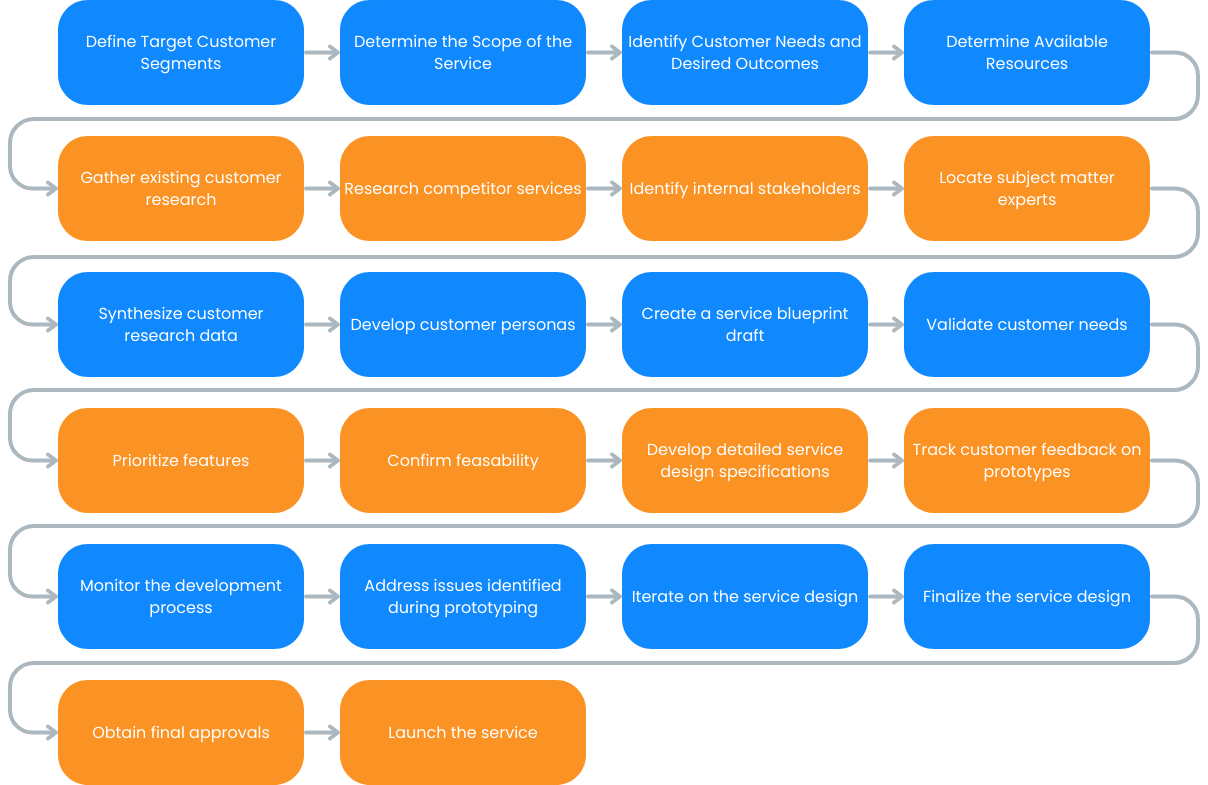
If you do all these things perfectly, or at least really well, you should never have serious customer service problems. Am I right?
"But, Mike, these are just a bunch of words!"
They're directionally correct words, though. And I'm happy to go deeper...
Let's Pretend We Know How Customers Measure Success
...not just what they say they want, in whatever language they want to use.
Let's take the step "Validate Customer Needs." This step focuses on confirming that the identified needs are accurate, complete, and truly reflect what the customer is trying to achieve. Validation is crucial to ensure the service is built on a solid foundation of understanding. So, what kind of stuff can we measure in the market that will provide us the insights that help us to...
...KNOW instead of Guess?
Let's establish some themes for categorizing success at this step:
Accuracy and Completeness of Validation: Ensuring all customer needs are identified and verified.
Direct Customer and Stakeholder Confirmation: Getting explicit agreement from customers and internal teams.
Evidence-Based and Actionable Insights: Using data to support and prioritize needs.
Efficiency and Documentation: Completing validation on time and documenting the process.
Avoidance of Negative Outcomes: Preventing design based on unvalidated assumptions and uncovering hidden needs.
Next, let's figure out what we can measure (within those themes) that will provide some forward-looking insights to the team. In this case, we can poll our internal teams or survey COOs across many companies if we're pitching a service design methodology.
Question: How important is it to..., how much effort does it take to..., and even how frequently do you...
Confirm the accuracy of each identified customer need with primary research. (e.g., Conduct interviews, surveys, focus groups)
Cross-reference needs identified through different data sources. (e.g., Compare interview data with survey data, analyze CRM data)
Obtain explicit confirmation from customers on the prioritized list of needs. (e.g., Present the list to customers for review and approval, conduct workshops, secure sign-off)
Gain internal stakeholder agreement on the validated customer needs. (e.g., Share needs with relevant teams, hold meetings to reach consensus)
Support each validated need with evidence from customer data. (e.g., Link needs to specific data points, create a database of evidence)
Prioritize validated needs based on their impact on customer business outcomes. (e.g., Rank needs by importance to customer goals, assess impact on satisfaction and retention)
Document the validation process and results for future reference. (e.g., Maintain a record of activities, create summary reports, store documentation centrally)
Complete the validation process within the defined project timeline. (e.g., Allocate time in the project plan, track progress, adjust as needed)
Avoid proceeding with service design based on unvalidated assumptions. (e.g., Require evidence for each assumption, treat unvalidated assumptions as hypotheses)
Avoid overlooking needs that are not explicitly stated by the customer. (e.g., Use empathy mapping and jobs-to-be-done analysis, analyze customer behavior)
If you're struggling with any of these metrics, then that could ultimately be reflected in your end product or service.
Okay, This Is Getting Too Long
Here's my point: Customer Service is something you must have after a product or service is out in the market. Inevitably, there will be some customers who struggle with the consumption of the service — whether that's purchasing, learning, or whatever. Of course, the same thinking applies to those consumption jobs as well (customer journeys), so your lens should take them into consideration as part of the entire package. However, nothing is ever perfect...
...especially the current state of journey analysis.
But to suggest that you can manhandle customer satisfaction at the customer service level (not the service, the reaction team) is misaligned with logical thinking. The tail does not wag the dog, no matter how many times you try.
This is a complex subject, and I've only addressed one small part of it. At the end of the day, however, I find the emphasis on fixing customer service to be an ineffective lens for customer satisfaction. How about you?
Mike Boysen - www.pjtbd.com
Why fail fast when you can succeed the first time?
Book an appointment: https://pjtbd.com/book-mike
Grab my JTBD Masterclass: https://mc.zeropivot.us/s/mc-1
Get the whole customer management thing done on a single platform:
https://pjtbd.com/tech-stack