

The term Empathy is bandied about by many people who don’t really know what it means, or what it should mean. It has become a proxy for not being able to articulate customer needs completely, and reliably.
Design Thinking is possibly the most visible process that starts with a stage called Empathy…

The Design Thinking Process
As a problem solving, and solution designing method, it must overcome the challenge we all face — commonly known as the fuzzy-front-end of innovation. Few are getting this right; yet understanding which needs of a target customer group are unmet is arguably the most important step in designing winning solutions that are actually based on winning market concepts. Why aren’t we focusing on fixing this weakness?
“Develop a deep understanding of the challenge”
We’re only improving what we’re good at…
If we can’t develop a deep understanding of the customer challenge before executing the subsequent steps in the Design Thinking (or any problem solving) process, we will not have predictable (and repeated) success. There is no evidence to suggest that Design Thinking has solved this problem. We still hear that product failure rates are as high as 95%. Yet, we keep focusing our attention on the things we do well; such as designing and building quality products.
Unfortunately, building the wrong product with high quality does not assure our success in the market. We cannot enter mature markets just because we create a quality product; nor can we invent markets because we developed a cool product. There must be demand, and finding that demand takes much more than ideation sessions, voice of the customer research, or filling in job story templates with our assumptions.
As innovators, we should be thinking about how we might do the right thing with high predictability, so we can take our expertise in building quality products and align that capability to our emerging capability of selecting the right markets to attack, and right products, services and business models to take to those markets.
Sounds simple, right?
How is Empathy defined today?
I like this definition because it demonstrates how misaligned concepts contribute to poor results…
“Empathy is the ability to experience the feelings of another person. It goes beyond sympathy, which is caring and understanding for the suffering of others. Both words are used similarly and often interchangeably (incorrectly so) but differ subtly in their emotional meaning”
What you just read is why the jobs of designers and innovators should be considered completely separate capabilities. While they must be highly collaborative as we move forward along the innovation timeline, we need to recognize that…
there is a difference between designing winning solution concepts, and designing winning market concepts that they enable.
Customers hire products and services that help them with functional challenges; such as maintaining clean and healthy teeth. How a product also addresses an emotional job is helpful when messaging to the customer on that last mile to a purchase decision. There are anywhere from 50–150 miles leading up to that last mile; and we’re ignoring them.
Think of each mile as a customer need. And yes, there are many more customer needs than we’ve been led to believe.
Should we replace Empathy with something else?
I view empathy as a proxy for understanding customer needs. A poor proxy. Understanding the feelings of a customer is not going to inform designers with information that will lead to successful products and services in the market. The data simply doesn’t support that thinking.
Unfortunately, methods like Design Thinking have not moved the ball forward with regard to a more complete and precise understanding of what a customers need really is. In fact, if we polled designers, and asked them to describe a customer need, we would get a different answer from each of them.
It’s a simple fact: customer needs are where the problem will be defined, since the unmet needs of today are what drive the successful solutions of tomorrow.
By glossing over the problem-space with imprecise and solely qualitative approaches — which focus only on the customer — we’re still just guessing at the problem. Ideation continues to be an effort that aligns to a squishy understanding of the problem as it relates to a customer’s feelings, emotions or pains.
In essence, ideas are not aligned to consistently formatted, specific, concrete and statistically quantifiable needs which are unmet in the market, and/or for a specific segment in the market.
Better than Empathy
A better way to deal with the necessary capabilities for working in the problem-space is to separate them out from capabilities necessary to be successful in the solution-space. They are completely different capabilities; and understanding the problem is something that cannot be rushed through in a few qualitative workshops. That approach is a proven failure.
Don’t focus on the customer…What?!?
Focusing on the customer is also proven to be the wrong approach. Customer-centric does not really mean putting the customer at the center. When we do that we tend let them control the language. This requires a great deal of synthesis; which is muddled by our own biases. Voice of the Customer (VoC) has been a miserable failure over the years for this very reason.
A better approach is to focus on the core jobs that customers are trying to get done. This theory is called Jobs-to-be-Done, and it is put into practice using Outcome-Driven Innovation (ODI); an innovation method with an 86% success rate that has been developed and fine-tuned over the past 25 years. This also breaks us free from the dated thinking that a market is defined by solutions; when in fact, it is actually defined by a group of people trying to get a job done (see link for more on that).
Replacing Empathize and Define within the Design Thinking process with ODI does not diminish the value of Design Thinking. In fact, they are highly complementary. Providing tangible and quantifiable inputs into the Ideation and Prototyping stages only makes them better…because the there is no guessing or ambiguity about the customers needs. This makes it faster and more reliable to test ideas and also provides a clear roadmap for product development over time.
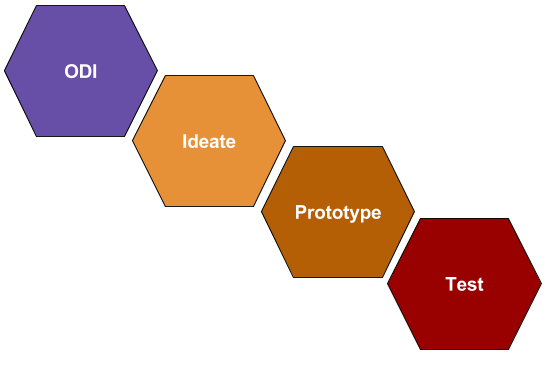
A New Design Thinking Process
To learn more about Outcome-driven Innovation, I’ve included some supplemental reading below:
What Is Jobs-to-be-Done?
Is Jobs-to-be-Done a theory? A lens? A process? A framework? A practice? Let’s start with a practical definition:jobs-to-be-done.com
Outcome-Driven Innovation: JTBD Theory in Practice
Outcome-Driven Innovation® (ODI) is a strategy and innovation process that ties customer-defined metrics (desired…jobs-to-be-done.com
Inventing the Perfect Customer Need Statement
Innovation is the process of devising a solution that addresses unmet customer needs. To win at innovation, a company…jobs-to-be-done.com
Quantify Your Customer’s Unmet Needs
Innovation is transformed from an art to a science when you have the ability to quantify your customer’s unmet needs.jobs-to-be-done.com