

The Governing Law of Genuine Innovation:
Perfection is achieved not when there is nothing more to add, but when there is nothing left to subtract. The ultimate product is no product; the ultimate part is no part; the ultimate process is no process. It costs nothing, weighs nothing, consumes zero energy, requires zero maintenance, and cannot fail.
Executive Summary & Epistemic Triage
The Strategic Thesis
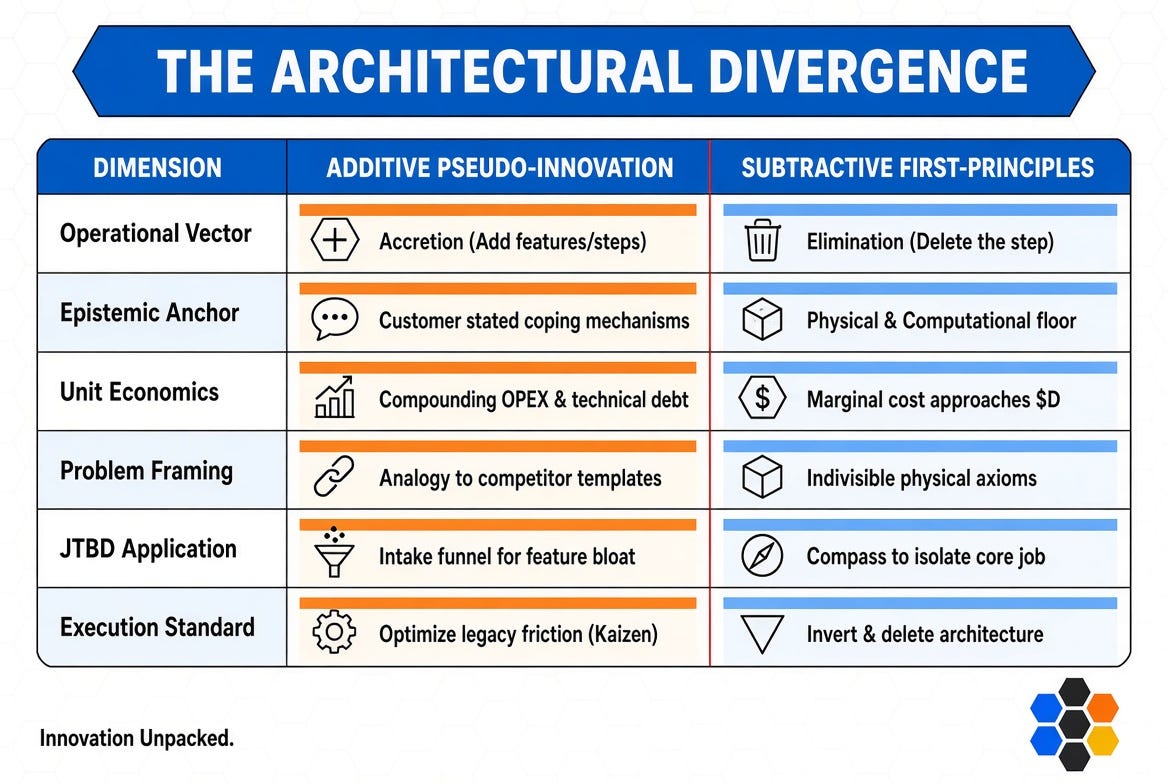
The default trajectory of enterprise product development is additive accretion. Organizations reflexively interpret customer struggle as a demand for more: more features, more configuration toggles, more middleware integrations, and more analytical dashboards. This additive reflex is frequently legitimized under the banner of customer-centricity or the misapplication of Jobs-to-be-Done (JTBD) theory.
This thesis asserts an uncompromising counter-principle: Addition is not innovation; it is the codification of architectural failure. True innovation is deterministic, structural, and strictly subtractive. A system reaches operational perfection not when there is nothing left to add, but when the underlying job is accomplished with no intermediate process, zero redundant mass, and zero human labor overhead. The ideal mechanism is no mechanism: it costs nothing, consumes zero energy, requires no maintenance, and possesses zero failure modes.
When product organizations employ JTBD merely as a qualitative intake funnel to catalog customer complaints, they inevitably fall victim to the Passenger Fallacy. They map customer coping mechanisms within an incumbent architecture rather than deconstructing the physical, computational, and economic floors of the underlying problem space. By adding features to address these coping mechanisms, organizations build expensive, prettier interfaces over fundamentally broken workflows.
Disruptive market advantage is achieved only by coupling JTBD abstraction to First Principles physics: establishing the theoretical floor (D), calculating the Inefficiency Delta (N/D), and executing ruthless architectural subtraction through the Musk 5-Step Algorithm and Structural Inversion.
Epistemic Triage of Industry Assumptions
To engineer an architectural breakthrough, incoming strategic inputs must be triaged through a strict Epistemic Hierarchy. Vague corporate mandates, competitor analogies, and unverified assumptions must be isolated and discarded before capital allocation occurs.
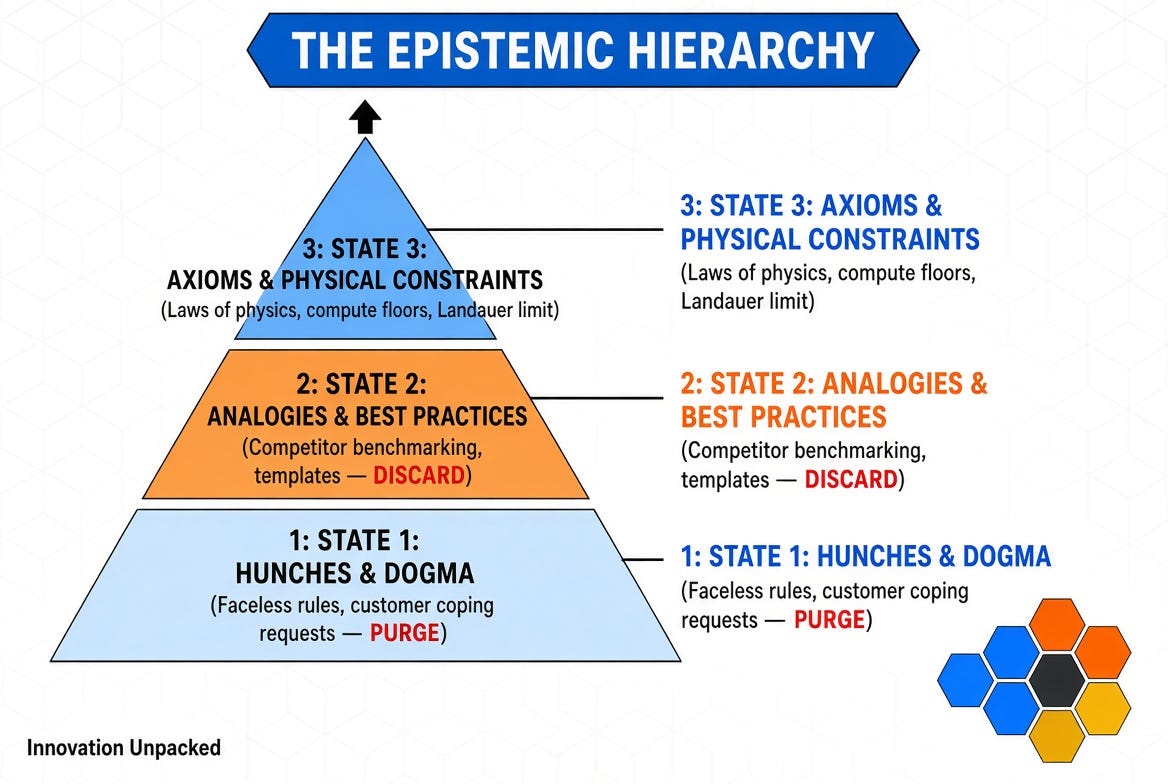
State 1: Hunches & Dogma (Untested Assumptions & Faceless Constraints)
The “Visibility” Dogma: The assumption that knowledge workers require “better single-pane-of-glass visibility” to perform reconciliations. This is an ungrounded hunch that treats manual human monitoring as an unchangeable operational constant.
Faceless Departmental Mandates: Requirements generated by organizational abstractions (e.g., “The Compliance Department requires a 7-step approval trail” or “Legal mandates manual sign-off on invoice variances”). Because these requirements are detached from a named human accountable author, they resist challenge and perpetuate additive verification layers.
The Feature Parity Hunch: The belief that losing a deal to a competitor requires adding the specific feature checkbox that the competitor’s sales team highlighted during procurement.
State 2: Analogies & Best Practices (The “Cook” Mindset Slated for Discard)
Industry Process Benchmarking: Adopting the standard enterprise resource planning (ERP) workflow because SAP, Oracle, or legacy market leaders enforce it. This is reasoning by analogy; it guarantees that the innovator inherits the incumbent’s cost curve, latency profile, and operational bloat.
The SaaS Middleware Template: Responding to data synchronization delays by buying or building an integration layer (e.g., an iPaaS connector). This is an analogy that accepts data silos as permanent architecture rather than deleting the fragmented data stores entirely.
Additive JTBD Roadmapping: Deconstructing a customer journey into dozens of micro-tasks and systematically creating a software module for every step. This treats the incumbent process map as an immovable law rather than an accidental historical artifact.
State 3: Axioms & Physical Constraints (Undeniable Foundations)
Thermodynamic & Computational Limits: The irreducible physical energy required to switch a transistor bit Emin = k T ln(2), (Landauer’s Principle) and the speed-of-light propagation latency of photons through optical fiber (v ≈ 2 × 10⁸ m/s).
The Retinal Labor Floor: Unless a statute explicitly mandates a human ocular inspection backed by criminal perjury penalties, the physical and economic floor for reading, routing, comparing, and transforming digital bits is mathematically:
Labor FloorBits=$0.00
The Direct Transmission Axiom: If Node A generates information and Node B requires it, any intermediate human node, inspection checkpoint, translation schema, or manual synchronization script is operational waste (Muda) that violates physical necessity.
The “Passenger Fallacy”: Coping Mechanisms vs. Architectural Reality
The fatal flaw of modern product organizations is mistaking the user’s coping mechanism for the customer’s Job-to-be-Done.
Consider an airline passenger. If surveyed or interviewed about their journey, the passenger will articulate clear, visceral frustrations:
The economy cabin is freezing or dry.
The seat pitch is three inches too short.
The chicken meal is desiccated and tasteless.
The boarding process creates overhead bin congestion.
An additive product manager, claiming to practice customer-centricity, immediately generates a roadmap of additions: install multi-zone seat heating, add automated tray-table storage sensors, formulate chemically enhanced moist poultry, and develop a smartphone boarding reservation app.
This is the Passenger Fallacy. The passenger experiences the symptoms of flight, but they are entirely blind to the underlying physics and engineering of aviation. They cannot calculate the lift-to-drag ratio (CL / CD), optimize the bypass ratio of a geared turbofan engine, calculate specific fuel consumption, or determine the aero-elastic flutter limits of a carbon-fiber composite wing.
If an aerospace engineer built what the passenger requested, the aircraft would be weighed down by hundreds of pounds of heating coils, seat servos, and warming ovens. The plane’s fuel burn would surge, ticket prices would escalate, and the core functional job—transporting the passenger between two geographic coordinates safely and rapidly—would be compromised.
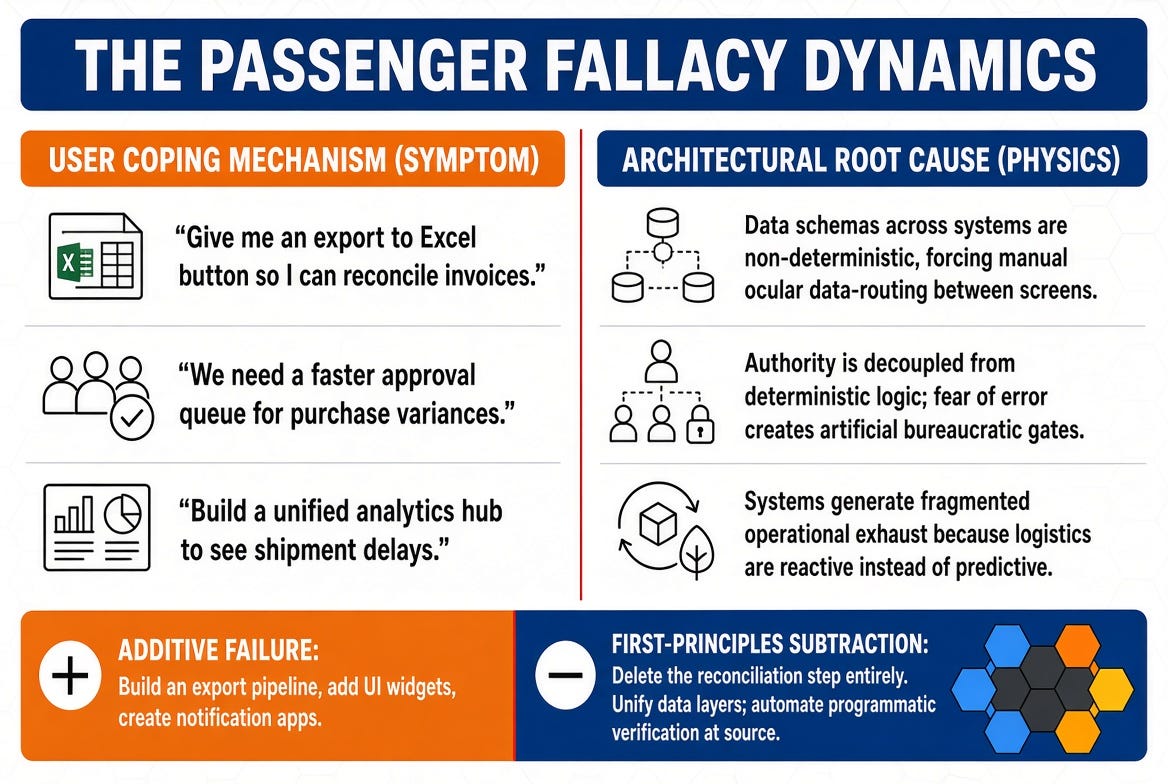
In enterprise software and operations, users operate entirely inside legacy architectures. When a user asks for “an easier way to export data to CSV,” “a status-tracking dashboard,” or “a notification system for approval bottlenecks,” they are describing how they survive inside an inefficient system.
When you build what they ask for, you are not innovating. You are codifying the competitor’s broken architecture. You are building a slightly faster treadmill inside a burning building. True innovation ignores the coping mechanism and executes a subtractive deletion of the step that forced the human to cope in the first place.
Problem Deconstruction & The Physics Gap
The Socratic Scalpel and Five Whys
To expose the failure of additive innovation, we deploy the Socratic Scalpel against an enterprise case study: an operations software team attempting to build an AI-driven dashboard to accelerate invoice reconciliation and dispute resolution.
THE SOCRATIC INTERROGATION
Requirement: “Build an automated dashboard to route billing variances to human analysts.”
Author: Vice President of Shared Services [David Vance]
Clarification: What is the precise functional outcome this feature is attempting to achieve?
Response: To reduce the resolution time of purchase order (PO) to invoice mismatches from 14 days to 48 hours.
Why 1: Why do PO-to-invoice mismatches take 14 days to resolve?
Finding: Because accounts payable clerks must pull data from the enterprise ERP, pull shipping manifests from the 3PL portal, and cross-reference them manually in an Excel spreadsheet.
Why 2: Why must clerks manually cross-reference these systems in an Excel spreadsheet?
Finding: Because the 3PL’s delivery receipt schema does not match the ERP’s item master catalog, causing line-item discrepancies that trigger automated system locks.
Why 3: Why are system locks placed on line-item discrepancies?
Finding: Because a policy written in 2018 states that any variance over $50.00 must be manually inspected to prevent vendor fraud.
Why 4 (The Scalpel Inversion): Who explicitly wrote that requirement, and what empirical evidence proves that vendor fraud occurs at the $50.00 threshold?
Finding: The policy was authored by an interim procurement manager [Sarah Jenkins, 2018] after a single $12,000 duplicate payment incident.The $50.00 threshold was an arbitrary safety margin chosen without statistical validation.
Why 5 (Bedrock Axiom): What is the net physical and computational cost of reconciling two structured, cryptographic transaction records across the network?
Finding: The computational cost of matching two signed data payloads is < $0.00001. The enterprise spends $18.50 in human labor and $4.20 in software overhead per invoice to prevent a mathematical error distribution that averages $0.32 per transaction.
The entire additive feature—the “variance management dashboard”—is an expensive optimization of a process that should not exist. The requirement was authored by a specific person to patch an edge case. The architectural solution is not to build a better dashboard; it is to delete the human inspection queue, enforce cryptographic matching at the boundary, and absorb variances below the true statistical threshold.
The Singular Job Executor
To strip away proxy metrics and demographic ambiguity, the Job Executor must be isolated at the individual operational role level.
Singular Job Executor: The Enterprise Operations Controller (not “The Accounting Department,” “Finance,” or “The Enterprise”).
Core Job-to-be-Done: Neutralize operational expenditure liabilities against verifiable vendor commitments.
Systemic Failure of Additive Roadmaps: Product managers routinely provide this executor with reporting layers, export engines, and communication channels. Each addition introduces maintenance overhead, synchronicity requirements, and human cognitive load, directly degrading the executor’s ability to settle the liability accurately and instantly.
Mathematical Formulation of the Inefficiency Delta (N/D)
We model the structural waste of the additive status quo by calculating the ratio between the Current Commercial Cost (N) and the absolute Theoretical Minimum Floor (D).
Derivation of the Numerator (N): Current Commercial Delivery Cost
In our target domain of enterprise financial liability neutralization:
Human cognitive labor: 0.45 hours of L3/L4 analyst time per transaction × $65.00/hr loaded = $29.25
SaaS enterprise seat licensing (ERP, ticketing system, reporting overlays): $4.80 per unit
Operational latency cost: Average capital float stall of 14 days at an operational weighted average cost of capital (Float Cost = V̄invoice × (0.085 / 365) × 14 = $1,200 × 0.00326 = $3.91
Total Current Commercial Cost (N):
N=$29.25+$4.80+$3.91=$37.96 per transaction
Derivation of the Denominator (D): The Theoretical Minimum Floor
The theoretical minimum is dictated by the absolute limits of compute, network transmission, and statutory constraints:
Computational Floor: Ingestion, cryptographic signature verification, cryptographic hashing, and database write of two 12 KB JSON payloads. On modern infrastructure (4nm server architecture at $0.04 per million instructions):
Dcompute ≈ 2.4×10⁻⁶ dollars
Network Transmission Floor: Transmission of 24 KB across dedicated IP transit:
Dnetwork ≈ 1.2×10⁻⁷ dollars
Statutory Human Floor: In this domain, no statutory law mandates a sworn wet signature or manual visual inspection for business-to-business transactions under $100,000. Therefore, by the Retinal Floor Principle:
Retinal Floor=$0.00
Total Theoretical Minimum Floor (D): D ≈ $0.00000252 per transaction
Calculating the Physics Gap Ratio
ND=$37.96 / $0.00000252 ≈ 15,063,492:1
Even if we conservatively calibrate the denominator to include high-availability database redundancy, distributed consensus logs, and statutory cold-storage archival costs over a 7-year regulatory hold (Dconservative ≈ $0.001):
(ND)conservative = $37.96 / $0.001 = 37,960:1
Domain Classification & The $100\times$ Real Options Gate
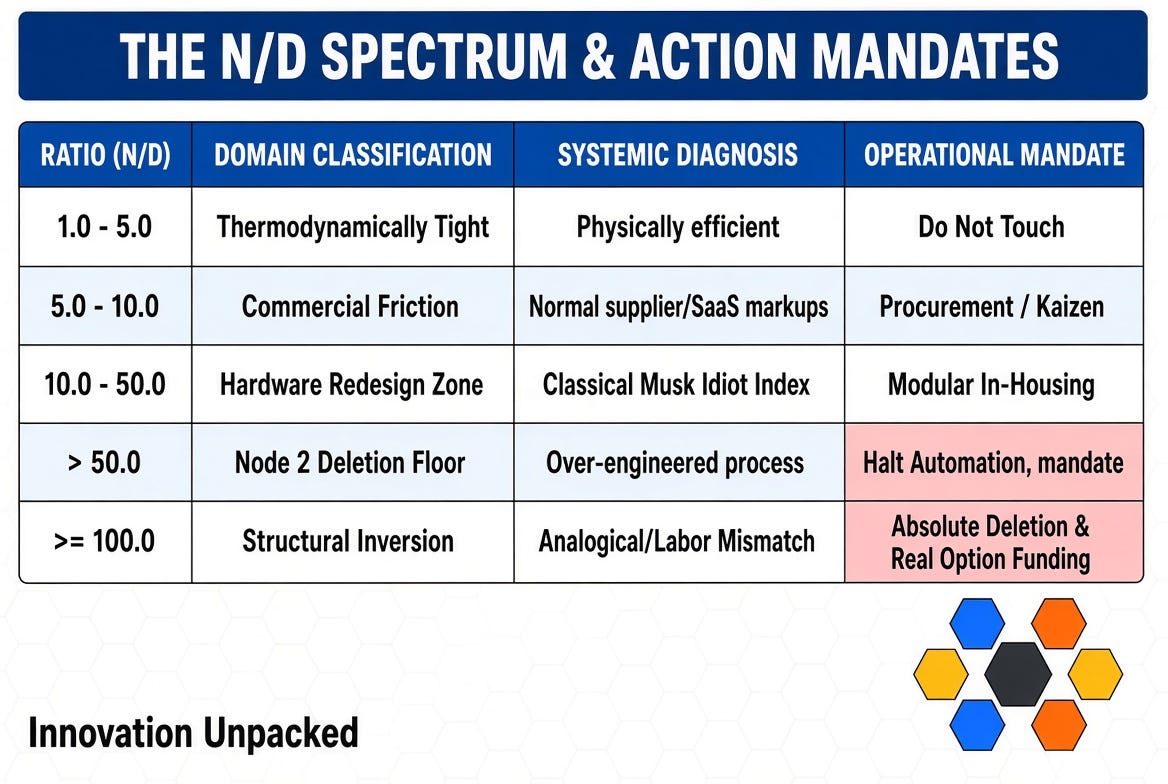
The calculated ratio of $37,960 : 1 falls into the Structural Inversion Gate (≥ 100.0) in the Bits & Labor domain.
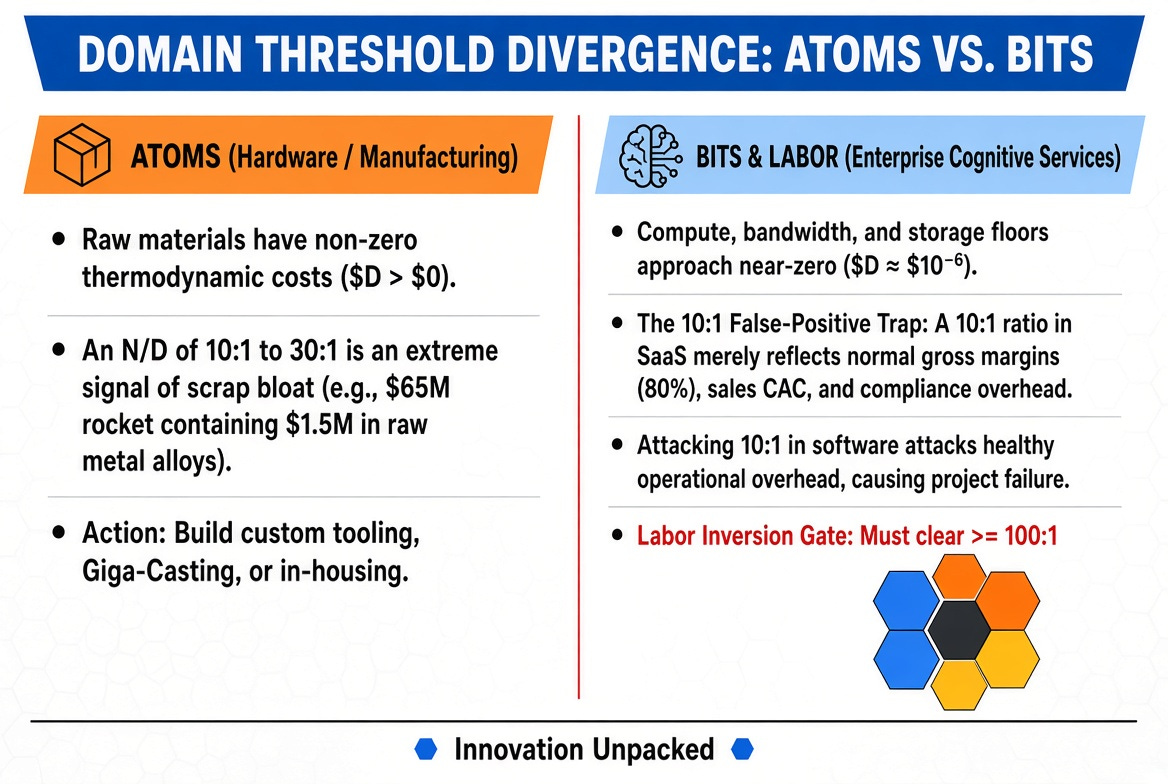
The Dissipation Buffer & The 100x Mathematical Necessity
A theoretical improvement calculated on paper is never captured cleanly in enterprise reality. In operational execution, theoretical efficiency is heavily degraded by three real-world dissipation vectors (η_capture ≈ 0.10)
The Musk 10% Add-Back Calibration: Subtractive execution requires deleting processes until edge-case failures force you to add back at least 10%.
The Statutory Tax: Irreducible regulatory governance (audit retention, SOC2/ISO compliance logging, anti-money laundering checks) that cannot be deleted.
Organizational Edge Cases: Incomplete vendor schemas, missing banking routing tokens, and physical exception handling.
The realized performance leap experienced by the enterprise is governed by:
Δrealized = 1 + ηcapture ⋅ (ND−1)
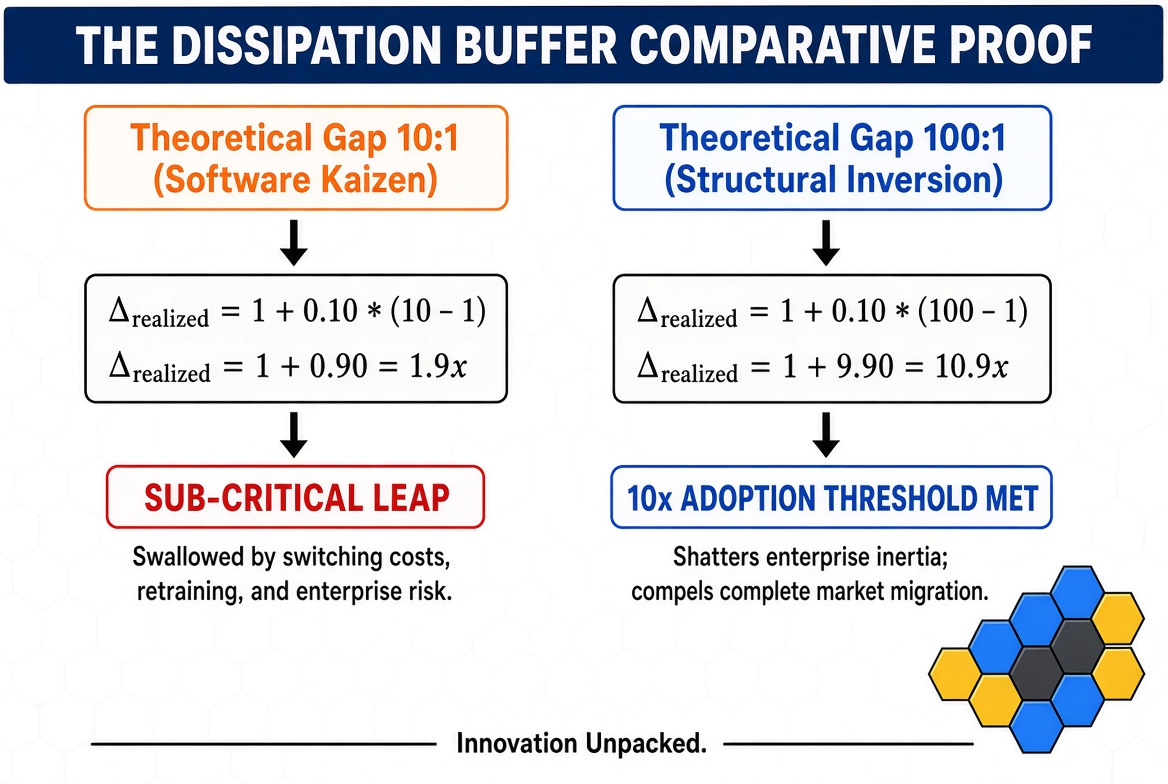
At 37,960 : 1, our conservative realized gain after absorbing 90% operational dissipation is:
Δrealized = 1 + 0.10 ⋅ (37,960−1) = 3,796.9×
This massive realized efficiency obliterates switching inertia. Attempting to deploy an additive software dashboard against this process is a fatal strategic mistake: it optimizes a process operating past the Node 2 Deletion Floor (> 50.0), burning >99% of its resources routing data through human retinas. The operational mandate is unconditional process deletion.
Structural Strategy & Innovation Lattice Integration
The Solution-Agnostic 9-Step Process Map
To locate the exact points of friction and structural waste, the Enterprise Operations Controller’s job must be deconstructed chronologically across the 9 universal JTBD stages, completely independent of existing software products or additive procedures.
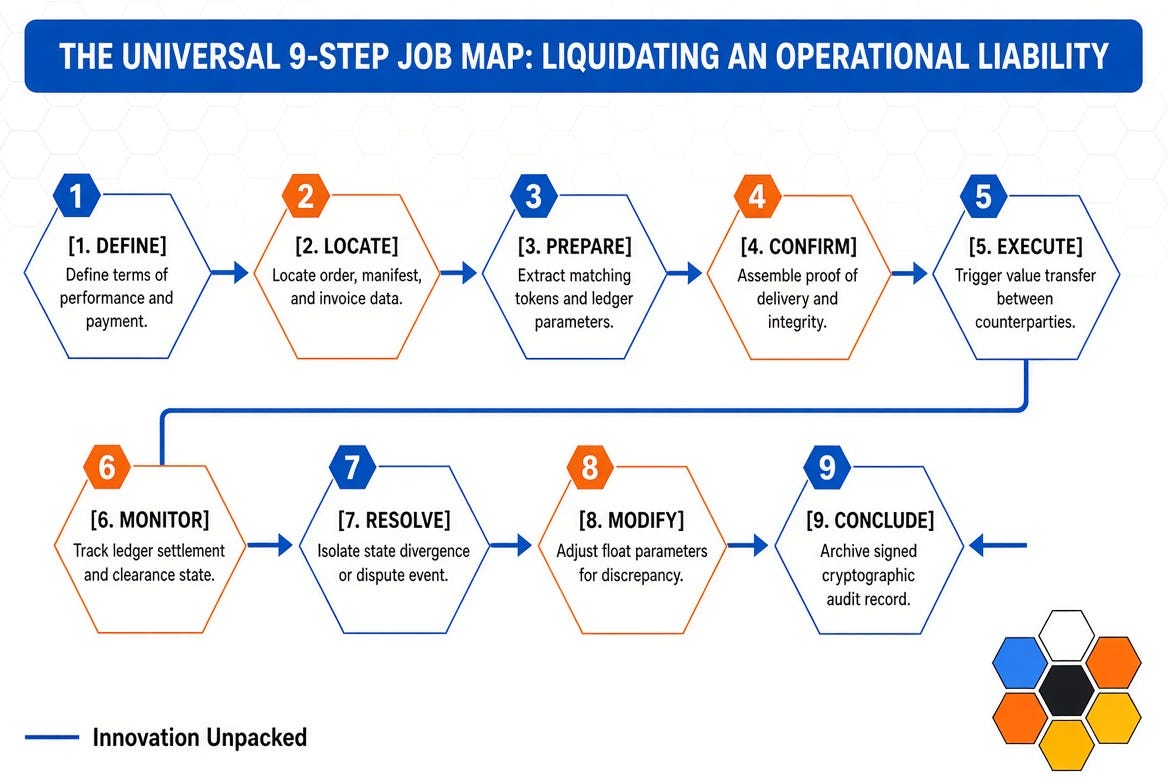
Friction Hotspots & Customer Success Statements (CSS)
By analyzing the job map through the lens of operational waste ($\text{Muda}$), latency, and the Inefficiency Delta, we formulate rigorous, MECE Customer Success Statements. All statements strictly obey the syntax:
[Direction: Minimize / Increase] + [Metric: Time, Likelihood, Cost] + [Object of Control] + [Contextual Clarifier]
Forbidden syntax—including vague verbs (manage, optimize, facilitate), subjective modifiers (better, easier), and solution-specific mechanics (click, download, dashboard)—is entirely excluded.
1. Step 2 (Locate) — Data Ingestion Latency Hotspot
CSS-01: Minimize the time it takes to retrieve matching transactional records across decoupled counterparty ledgers.
Legacy Additive Failure: Introducing an API aggregator screen that still requires an analyst to search and link foreign keys manually.
Subtractive Truth: The retrieval step is waste caused by database bifurcation.
2. Step 4 (Confirm) — Verification Friction Hotspot
CSS-02: Minimize the likelihood of false-positive state divergences when confirming goods receipt against contracted fulfillment terms.
Legacy Additive Failure: Adding an AI-assisted text-matching engine to parse unstructured PDF packing slips.
Subtractive Truth: Parsing unstructured PDFs is an additive coping mechanism for the failure to mandate structured, cryptographically signed data interchange at the physical receiving dock.
3. Step 5 (Execute) — Human Labor Gate Hotspot
CSS-03: Minimize the time it takes to clear the authorized value transfer once fulfillment conditions are cryptographically satisfied.
Legacy Additive Failure: Creating a multi-tier human approval workflow with automated Slack and email alerts.
Subtractive Truth: Human approval queues represent zero value creation; they exist solely because downstream execution lacks deterministic rule verification.
4. Step 7 (Resolve) — Arbitrary Exception Threshold Hotspot
CSS-04: Minimize the operational cost incurred to resolve settlement discrepancies that fall below the statistical expected loss threshold.
Legacy Additive Failure: Building a dedicated “dispute management ticketing workspace” for vendor negotiation.
Subtractive Truth: Spending 29.00$oflabortonegotiatea12.00$ shipping variance is pure economic loss. Delete the negotiation; programmatically absorb or settle variances algorithmically based on vendor credit ratings.
Application of the Musk 5-Step Deletion Protocol
The fundamental error of additive innovation is executing optimization or automation on processes that should be eliminated. The Innovation Lattice enforces the 5-Step Algorithm strictly in sequence:
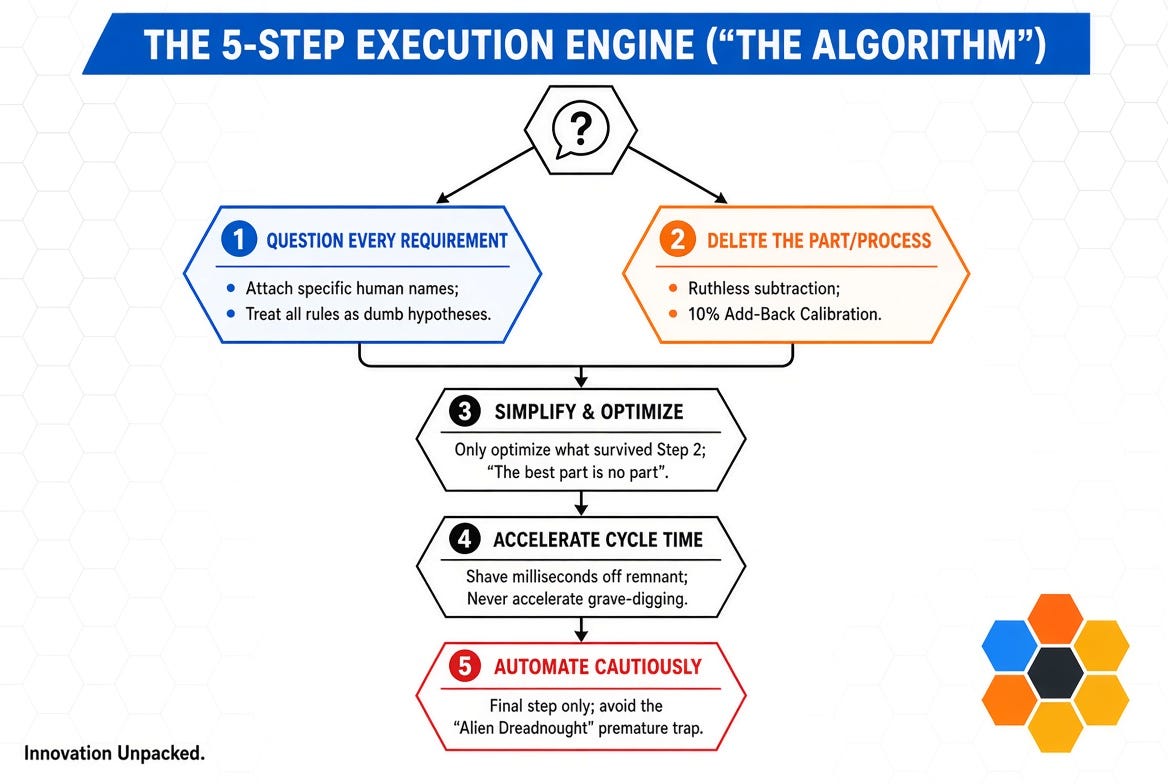
Step 1: Make the Requirements Less Dumb (Attach Names)
Requirement: “All discrepancies between invoice and receiving ticket exceeding $50.00 must be manually reviewed and countersigned by an L4 Operations Controller.”
Interrogation: Who authored this? Sarah Jenkins (Procurement, 2018).
Epistemic Audit: The rule was authored under the assumption of uncalibrated supplier risk. We interrogate the author: What is the empirical fraud rate for approved Tier-1 suppliers over the past 36 months? Result: 0.0004%. The requirement is invalid. The threshold is systematically raised to $1,500.00, instantly deleting 84% of human review queues.
Step 2: Delete Any Part or Process You Can (The 10% Add-Back Mandate)
Action: Delete the entire Invoice Generation and Transmission process.
Architectural Logic: An invoice is a secondary, retrospective human claim that work was performed. In a connected system, the delivery event itself (e.g., IoT dock scanner confirmation, cryptographic carrier signature) is the state-change event.
Subtractive Deletion: By deleting the invoice, we delete invoice parsing, OCR scanning, variance matching, approval workflows, and dispute ticketing.
The 10% Rule Check: If we are not forced to restore manual interventions for complex, un-metered service deliveries (e.g., custom consulting or variable utility billing), we have not deleted enough. We add back a specialized exception pipeline strictly for non-standard, physical service contracts (accounting for 8% of volume), preserving the deletion of the remaining 92%.
Step 3: Simplify and Optimize the Remnant
Action: For the remaining state changes, eliminate complex multi-field relational database schemas. Reduce the transaction payload to a singular cryptographic token:
Payload={Contract ID, Delivery Token, Counterparty Public Key, Value}
Never optimize the software interface of a legacy human review queue; optimize the deterministic evaluation speed of the cryptographic payload.
Step 4: Accelerate Cycle Time
Action: Collapse the operational batch settlement cycle from an end-of-month or weekly batch run down to synchronous, event-driven execution. The moment the confirmation event registers, execution occurs within 250 milliseconds.
Step 5: Automate
Action: Now—and only now—deploy automated programmatic smart-contract execution or direct API clearinghouse payment triggers. Because the underlying process was deleted and simplified, automation requires a simple serverless script rather than a fragile, multi-million-dollar “enterprise workflow engine.”
Deployment of the Four Structural Inversion Levers
To break the additive trap, we apply the Innovation Lattice’s Four Structural Inversion Levers, operationalized through the 154 Subtractive Levers.
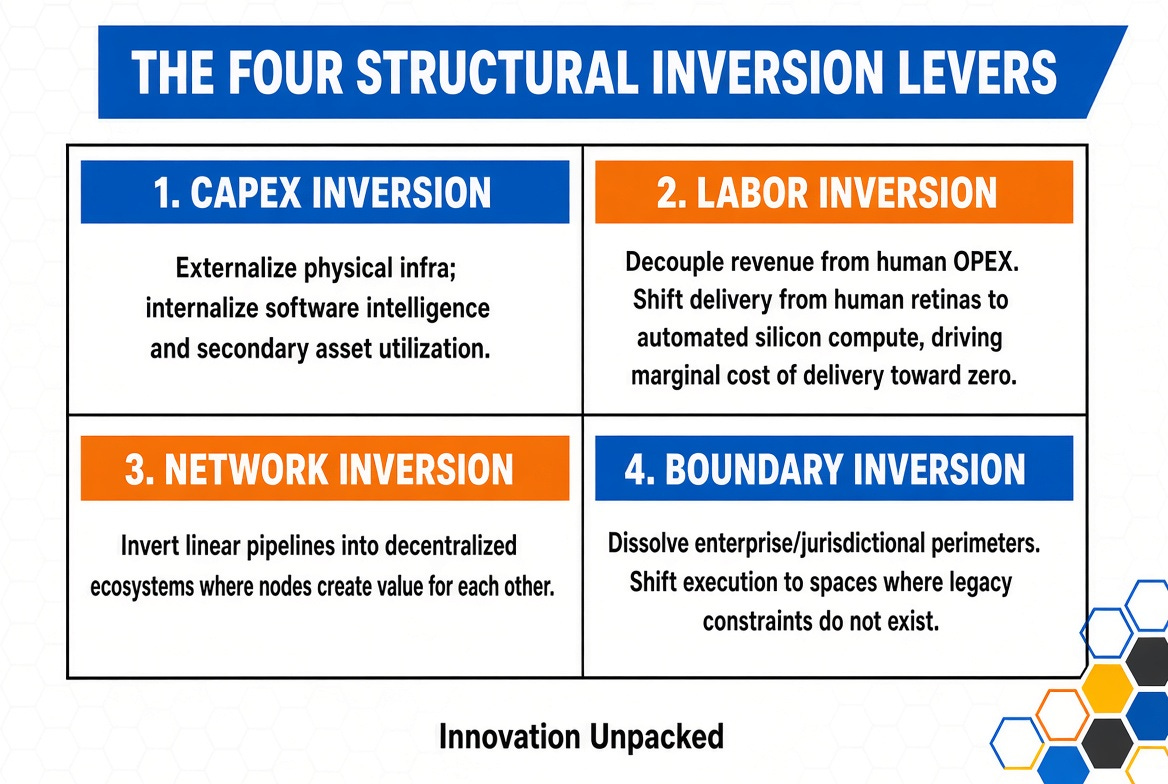
Lever 1: Labor Inversion (Shift from L3/L4 Retinas to Silicon Compute)
Execution: Decouple operational scale from accounting headcount. Eliminate the paradigm of adding operations headcount as transaction volume expands.
154-Matrix Mapping: Category 08, Lever 50 (Timing: Automatic vs. Manual) — Replace manual human verification with vision-based and cryptographically verified event triggers. The human labor unit cost drops from 29.25 to 0.00.
Lever 2: Boundary Inversion (Dissolving Enterprise Perimeters)
Execution: Shift the transaction verification out of the enterprise ERP and embed it into the physical handover boundary between the supplier and the transit carrier.
154-Matrix Mapping: Category 04, Lever 22 (Timing: Earlier vs. Later) — Test quality and reconcile contract terms before the transaction enters the enterprise boundary. If the cryptographic parameters do not align at the physical dock, the goods are not received; settlement failure is prevented at zero cost rather than resolved downstream at high cost.
Lever 3: CapEx Inversion (Externalizing Verification Infrastructure)
Execution: Rather than the enterprise maintaining custom, expensive on-premise EDI servers and bespoke ERP instances, utilize distributed neutral ledgers or zero-knowledge validation nodes maintained across the supplier ecosystem.
154-Matrix Mapping: Category 04, Lever 23 (Operation: Supplier vs. Customer Inversion) — Turn the supplier’s fulfillment infrastructure into the execution engine of the buyer.
Lever 4: Network Inversion (Decentralized Value Verification)
Execution: Convert the linear buyer-to-supplier pipeline into a multi-sided network where Tier-1 carriers and secondary logistics providers validate counterparty integrity for each other.
154-Matrix Mapping: Category 22, Lever 138 (Operation: Proprietary vs. Open Standard) — Establish open verification protocols that allow counterparties to settle micro-variances peer-to-peer without central enterprise mediation.
Real Options Architecture: Staged Asymmetrical Bets
Disruptive architectures cannot be funded through monolithic, 5-year ROI forecasts. Demanding five-year budget projections for an unproven architecture forces managers to invent numbers, systematically favoring low-risk, additive feature bloat over radical structural change.
We replace the Monolithic Fallacy with a three-stage Real Options engine.
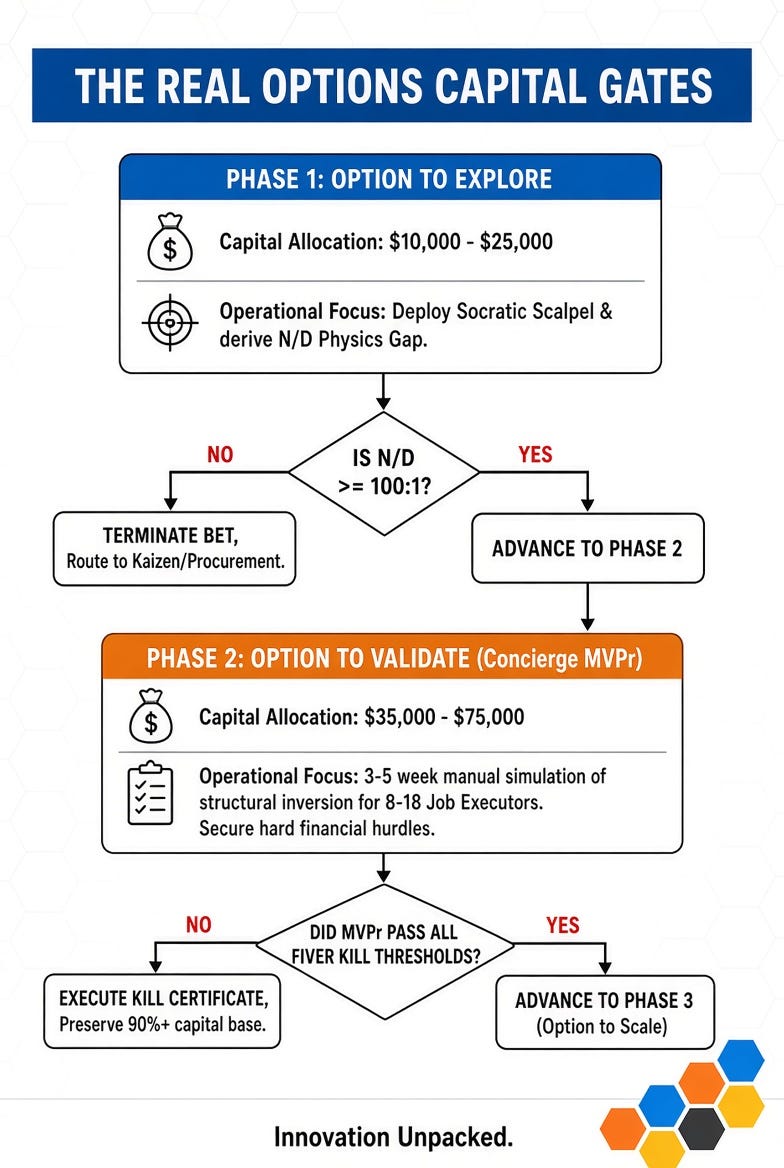
Phase 1: The Option to Explore
Objective: Determine whether the problem exhibits a true structural anomaly.
Activities: Run Axiom Audits, identify the singular Job Executor, interrogate requirement authors, and calculate the N/D ratio.
Tollgate Condition: If N/D < 100:1 in digital/labor workflows, the opportunity lacks structural disruption potential. The bet is immediately terminated or routed to operational Kaizen. If N/D ≥ 100:1, the Phase 2 Option is automatically unlocked.
Phase 2: The Option to Validate (The Concierge MVPr)
Objective: Validate the structural inversion mechanic and customer willingness-to-commit in the real world before developing production software.
Activities: Deploy an 8- to 18-executor manual concierge simulation over 3–5 weeks.
Tollgate Condition: Hard operational hurdle rates and binding financial commitments (LOIs or upfront pilot deposits). If hurdles fail, execute the Kill Certificate.
Phase 3: The Option to Execute (Scale)
Objective: Codify the validated mechanic into production-grade, highly automated infrastructure.
Activities: Build scalable software/hardware that automates the remnant of the deleted process. Capital is deployed into a thoroughly de-risked system.
Validation & Falsifiability Mechanics
Rejection of Narrative-Based Validation and Customer Surveys
Traditional innovation practice relies heavily on qualitative surveys, focus groups, and customer self-reported scores. In the Innovation Lattice, these methodologies are epistemically forbidden.
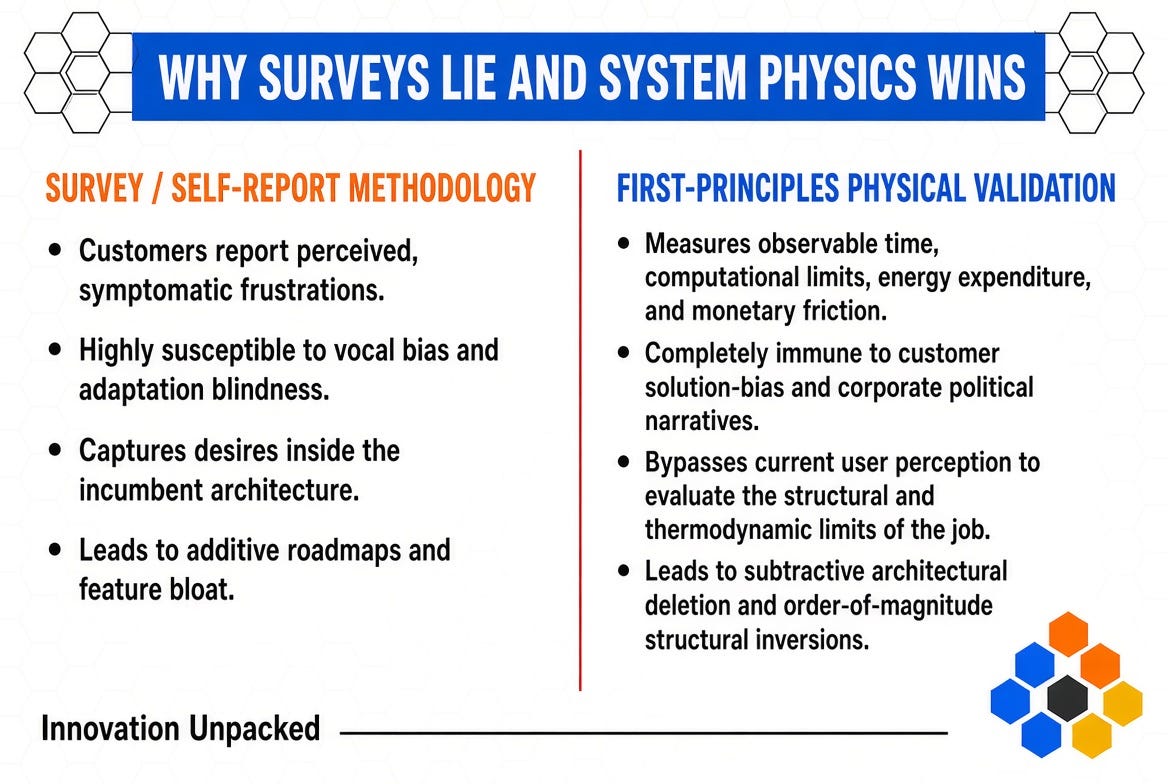
Surveys capture how people adapt to legacy dysfunction; they do not measure engineering boundaries. When customers fill out questionnaires, they evaluate existing solutions against their personal cognitive coping strategies. Relying on self-reported preference ensures that you build what the passenger asked for—an in-flight tray table warmer—rather than engineering the jet engine.
We replace narrative customer surveys with deterministic, falsifiable behavioral hurdles:
Direct Capital Allocation (Skin in the Game): Customers must sign binding Letters of Intent (LOIs) with procurement authority or deposit real capital.
Telemetry & Chronometric Observation: Measuring exact transaction latency, error counts, and process abort frequencies directly in the operational line.
The Concierge Minimum Viable Proof (MVPr)
An MVPr is fundamentally different from a traditional “Minimum Viable Product” (MVP). An MVP typically involves writing early, un-optimized code to deploy a software application. An MVPr (Minimum Viable Proof) is a manual, low-overhead operational simulation designed to test the structural inversion mechanic without writing production code.
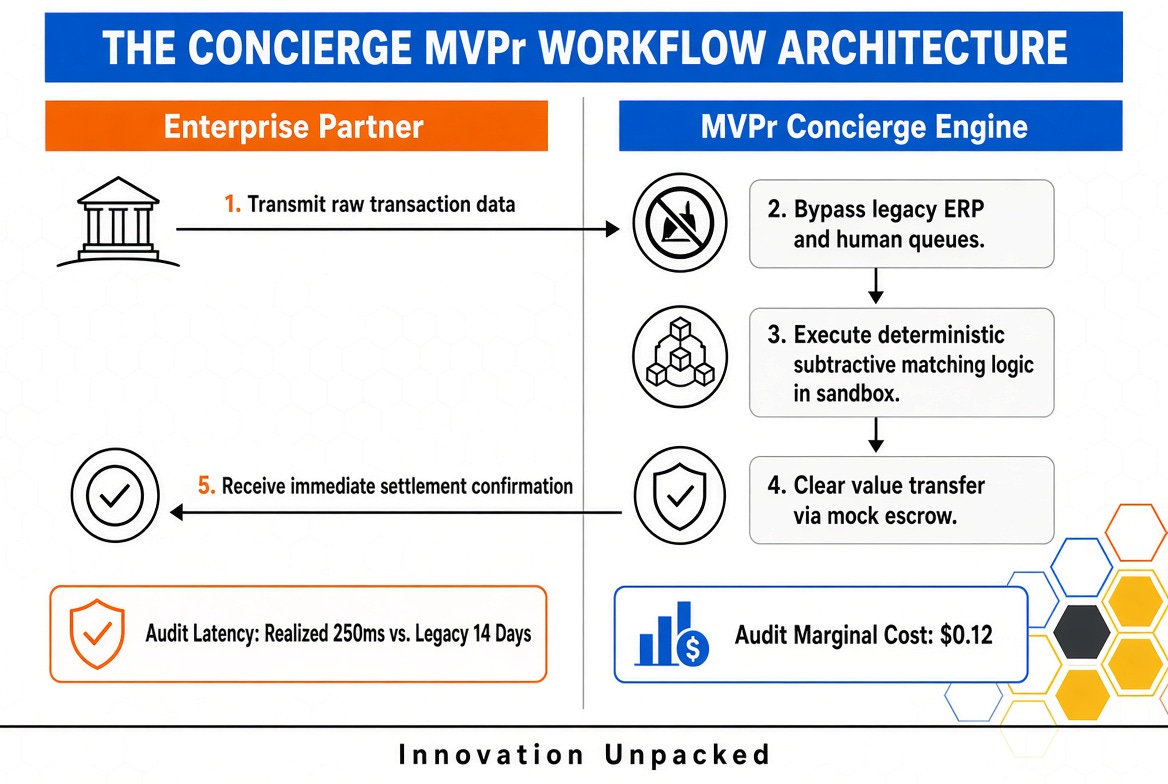
Protocol & Parameters of the Pilot
Cohort Size: Exactly 8 to 18 enterprise Job Executors (e.g., Controllers at mid-market distribution firms).
Duration: Exactly 21 to 35 business days (3–5 weeks).
Operational Mechanism: The Concierge Lead intercepts transactional state data at the enterprise boundary via lightweight, read-only flat files (or webhook listeners). The concierge team manually executes the proposed subtractive rules engine (deleting the invoice, matching raw fulfillment telemetry, and triggering payments programmatically via an escrow clearing account).
Objective: Prove that the counterparty ecosystem accepts settlement without the existence of the legacy invoice and dispute dashboard, and confirm that unit operating costs collapse toward the theoretical floor.
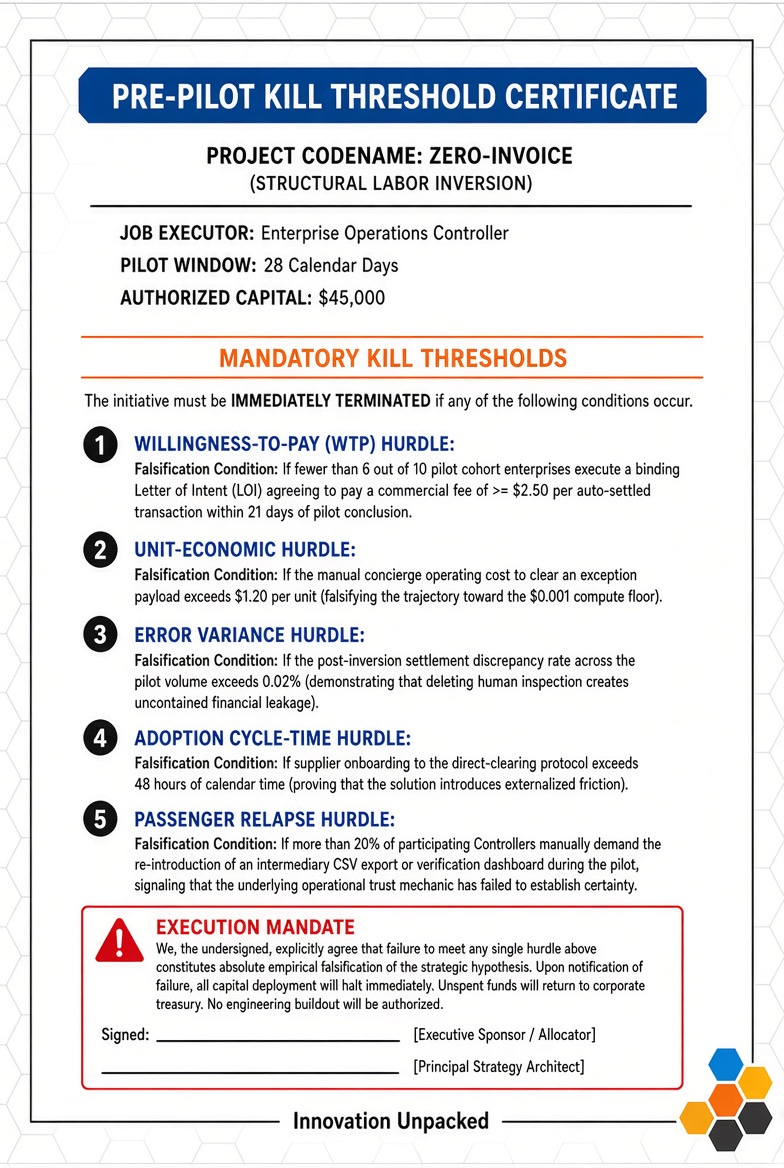
Falsification Criteria & Pre-Pilot Kill Threshold Certificate
A strategy that cannot be proven false is not an engineering discipline; it is corporate dogma. Prior to launching the Concierge MVPr, executive sponsors and the strategy team must sign a legally binding, non-negotiable Kill Threshold Certificate.
If any empirical metric fails to cross its designated hurdle rate within the pilot window, the project is terminated instantly. No executive appeals, no narrative reframing, and no roadmap extensions are permitted.
Strategic Conclusion: The Subtractive Imperative
The prevailing paradigm of product management treats innovation as an additive discipline. When companies struggle to grow, they add products. When software fails to convert, they add features. When customers express frustration, they add dashboards.
This approach is an economic dead end. Adding complexity to solve the symptoms of complexity merely accelerates organizational entropy. It increases lines of code, inflates headcount, compounds failure modes, and preserves the competitor’s broken architecture.
True innovation is the violent, disciplined act of subtraction.
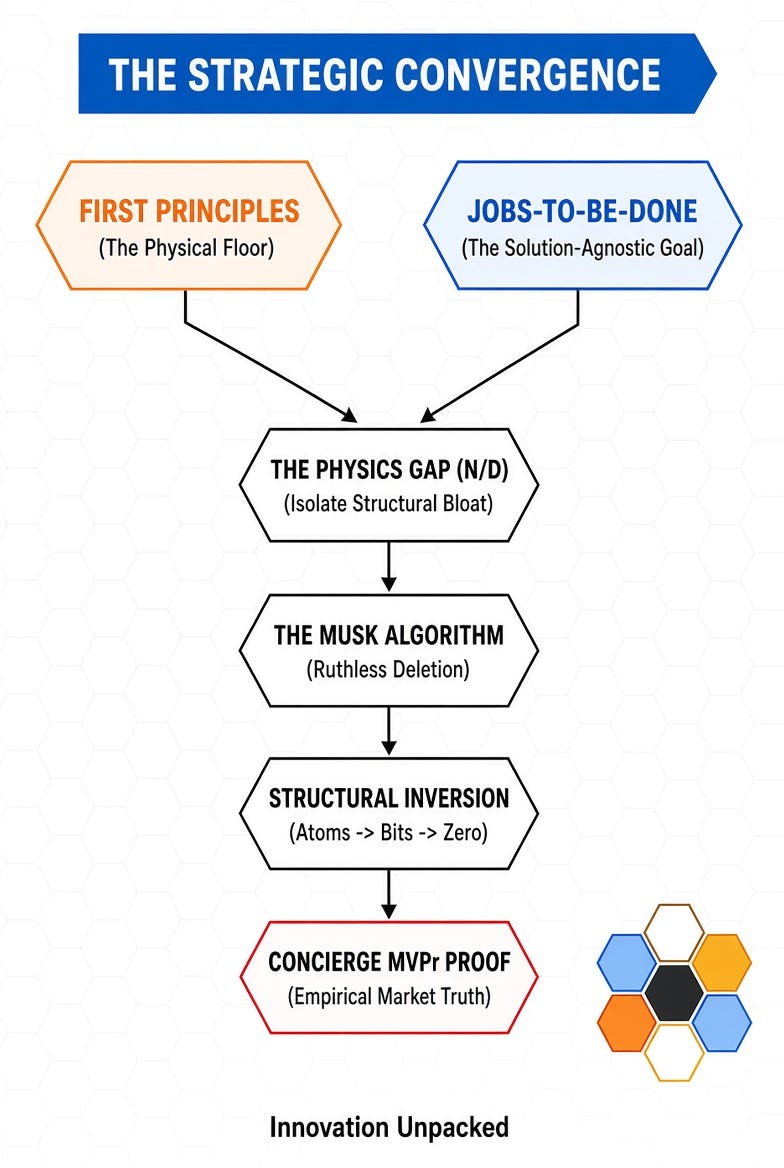
By anchoring strategy in the indomitable bedrock of physical and computational floors, decoupling Jobs-to-be-Done from the customer’s vocalized coping mechanisms, and deploying the five steps of the Musk Algorithm, organizations escape the additive treadmill.
They do not build what the passenger asks for. They deconstruct the problem to its raw materials, delete the intermediate processes, invert the unit economics, and deliver the only outcome the market ultimately values: an order-of-magnitude leap in speed, accuracy, and structural cost efficiency.
Book an appointment: Click here
Email me: mike@pjtbd.com
Call me: +1 678-824-2789
Follow me on 𝕏: https://x.com/mikeboysen
Articles - jtbd.one - De-Risk Your Next Big Idea
Research - studio.jtbd.one/research
Slaying the Sacred Cows of Innovation


