

Executive Summary & Epistemic Triage
Strategic Thesis
The primary pathology of corporate capital allocation is the optimization of waste. Organizations routinely expend hundreds of millions of dollars automating, accelerating, and refining processes that have no physical, computational, or statutory right to exist. Incremental methodologies—whether disguised as Kaizen, Six Sigma, Design Thinking, or Agile Digital Transformation—suffer from systemic myopia: they benchmark against competitor precedent, treat legacy workflows as immovable constraints, and solicit customer coping mechanisms as product roadmaps.
The Physics Gap (methodologically formulated as the Inefficiency Delta or Idiot Index) cuts through analogical consensus by establishing the deterministic ratio between the current commercial cost or latency to deliver an outcome (Numerator, N) and the irreducible physical, computational, or statutory floor required by fundamental natural law (Denominator, D):
Physics Gap Ratio=N/D
The strategic thesis of this treatise is absolute: The magnitude and domain classification of the Physics Gap dictate whether an enterprise must halt capital deployment, pursue vendor Kaizen, in-house physical tooling, or execute structural architectural inversion.
Capital allocation is not a narrative exercise governed by executive charisma or consensus polling. It is a mathematical tollgate:
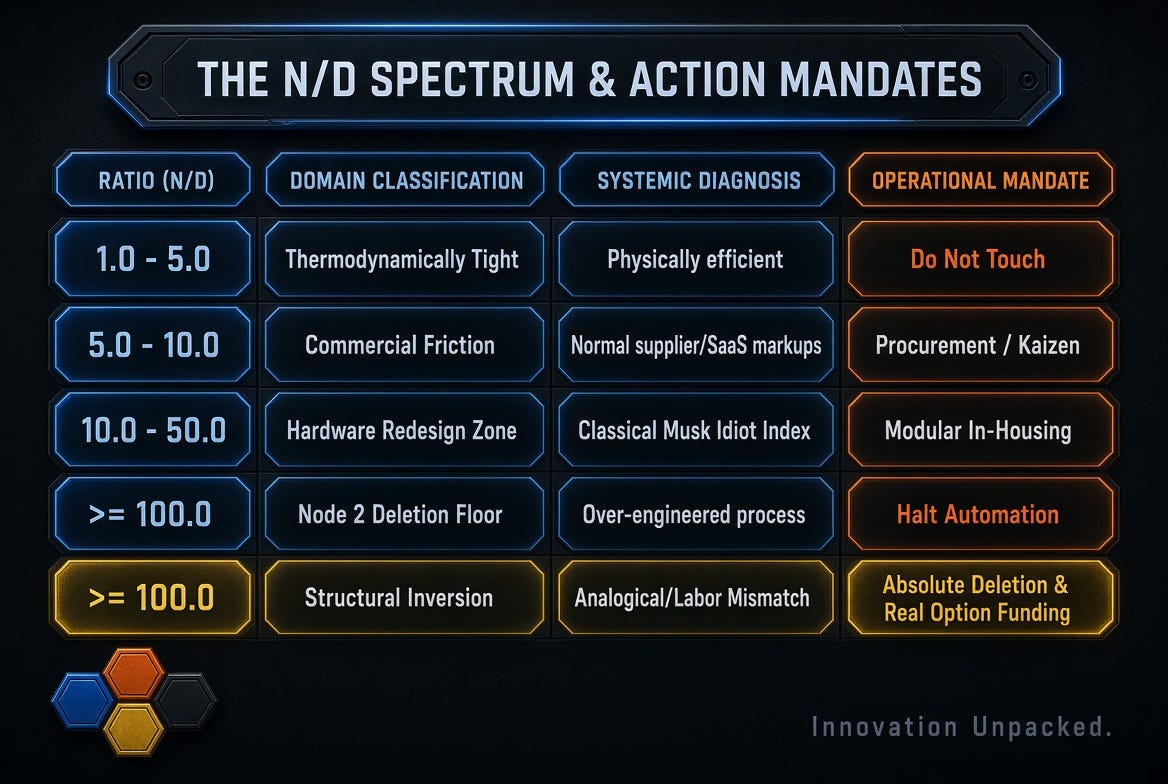
When N/D ≈ 1.0, the process has reached its thermodynamic asymptote; stop all R&D investment.
When 5.0 ≤ N/D < 10.0 in digital or enterprise systems, the delta represents standard operational gross margins; halt internal software development and apply standard procurement pressure.
When 10.0 ≤ N/D ≤ 50.0 in physical hardware, excessive scrap and supplier markups justify in-housing and modular tooling (e.g., Giga-Casting).
When N/D > 50.0, the process is burning over 98% of its resources on coordination overhead; strictly halt all automation and mandate ruthless deletion.
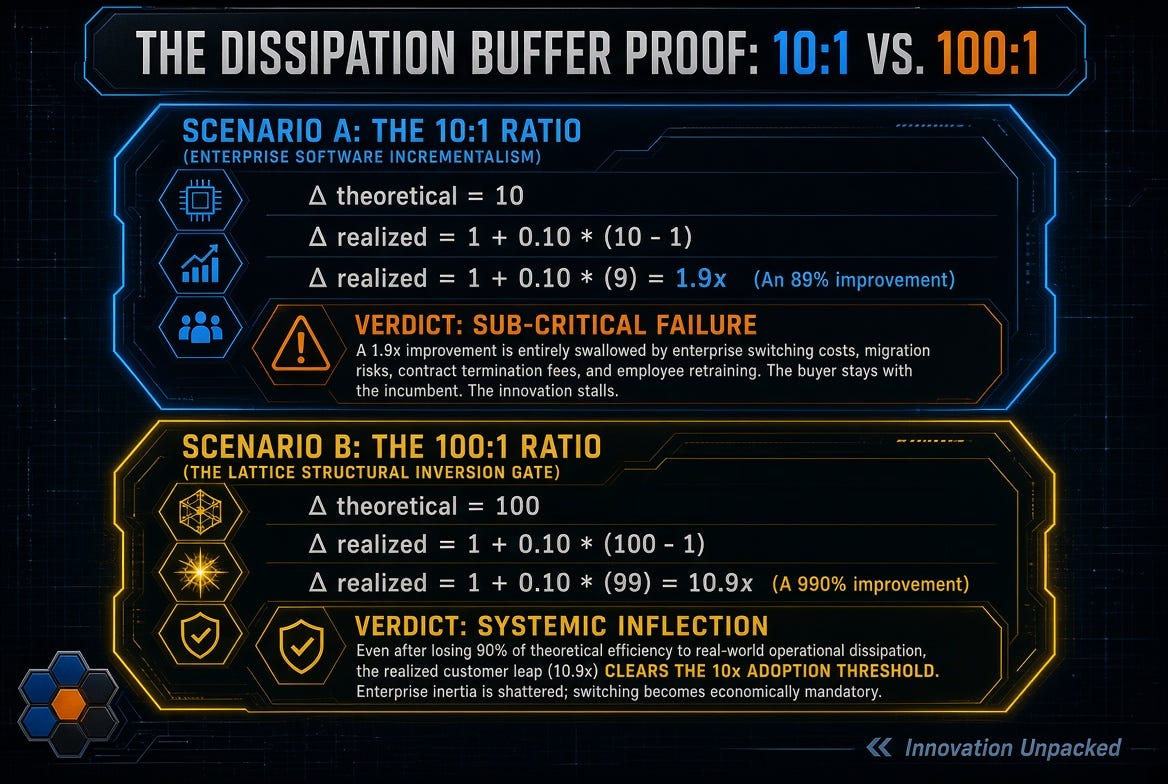
When N/D ≥ 100.0 in digital, cognitive, or labor-intermediated workflows, the presence of the Dissipation Buffer (η_capture ≈ 0.10) proves that a 100x theoretical gap is the mathematical prerequisite to yield an undeniable > 10x realized customer adoption leap; authorize capital exclusively for a Stage 2 Real Option to Validate via a Concierge MVPr, completely deleting legacy operational architecture.
Epistemic Triage of Industry Assumptions
To evaluate an enterprise initiative through the Innovation Lattice, all strategic assumptions must be categorized into the three states of the Epistemic Hierarchy:
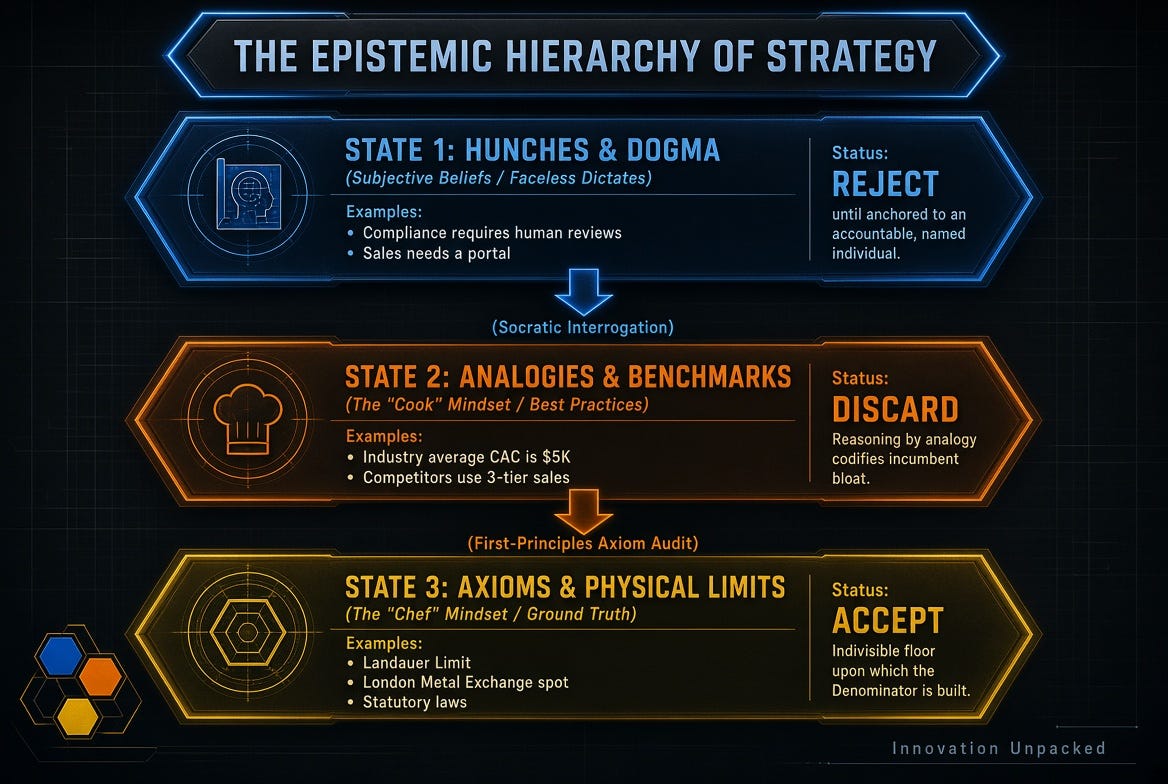
Hunches & Dogma (Untested Hypotheses):
These represent organizational lore, unbacked assertions, and faceless mandates (e.g., “Our risk department won’t allow algorithmic execution,” or “Customers expect a human account manager”). In the Innovation Lattice, any requirement lacking a specific, named human author is treated as non-existent. Stakeholders of high status who author requirements are subjected to the highest epistemic friction; their assertions are treated as unverified hypotheses until proven against physical limits.Analogies & Best Practices (The “Cook” Mindset):
These consist of competitor benchmarks, Gartner Magic Quadrants, operating models, and legacy templates. Reasoning by analogy assumes that because the industry currently delivers a service with 50 analysts, 4 software platforms, and a 6-week turnaround, the underlying architecture is correct and merely requires an “automated workflow” or “AI copilot.” Analogy-driven assumptions are slated for immediate discard. They codify the competitor’s structural waste.Axioms & Physical Constraints (The “Chef” Mindset):
The bedrock of empirical reality. These are non-negotiable physical, chemical, computational, and statutory laws:Thermodynamic/Material Axioms: The raw spot price of commodity bauxite, titanium billet, copper cathode, or lithium carbonate (kg).
Computational/Information Axioms: The Landauer Limit (Emin = k · T · ln(2)), speed-of-light photonic network latency (~5 ms per 1,000 km in vacuum), and raw CPU/GPU floating-point operations per watt.
Statutory Baselines: Hard statutory mandates enacted by formal legislation (e.g., specific SEC, FINRA, or FDA statutes explicitly requiring a licensed wet signature or ocular review). Everything outside formal legislative text is dogma, not law.
If it feels like I’m being repetitive, I am. These are all new concepts to most innovation, product, and design professionals. My expectation is that transformation professionals should already know this. Unfortunately, I’ve met a few that do. Several years back, I was right there with them.
The “Passenger Fallacy”
Traditional corporate innovation fails because it relies on customer sentiment, user feedback sessions, and vocalized preferences. This methodology suffers from the Passenger Fallacy:
An airline passenger can accurately report that the cabin is dry, the legroom is cramped, or the chicken is cold. They cannot, however, articulate bypass ratios, compute aerodynamic lift-to-drag coefficients, optimize the thermodynamic cycle of a high-bypass turbofan, or calculate the wing-spar load distribution. They experience the downstream symptoms of flight, but they are entirely blind to the physics and structural engineering of aviation.
When enterprise operators query users about business workflows, the users describe their coping mechanisms inside legacy architectures:
They ask for better spreadsheet export buttons.
They ask for unified dashboards to see disparate database errors.
They ask for faster turnarounds on manual review tickets.
Building what the user asks for codifies the broken architecture. It generates “faster horses,” optimizes manual coordination, and creates incremental software bloat. First-principles strategy ignores vocalized feature requests and examines the underlying physics: What is the raw data payload? What is the physical transformation? What is the statutory minimum threshold of trust? Disruption bypasses customer coping mechanisms entirely to engineer the foundational physics of the problem space.
Problem Deconstruction & The Physics Gap
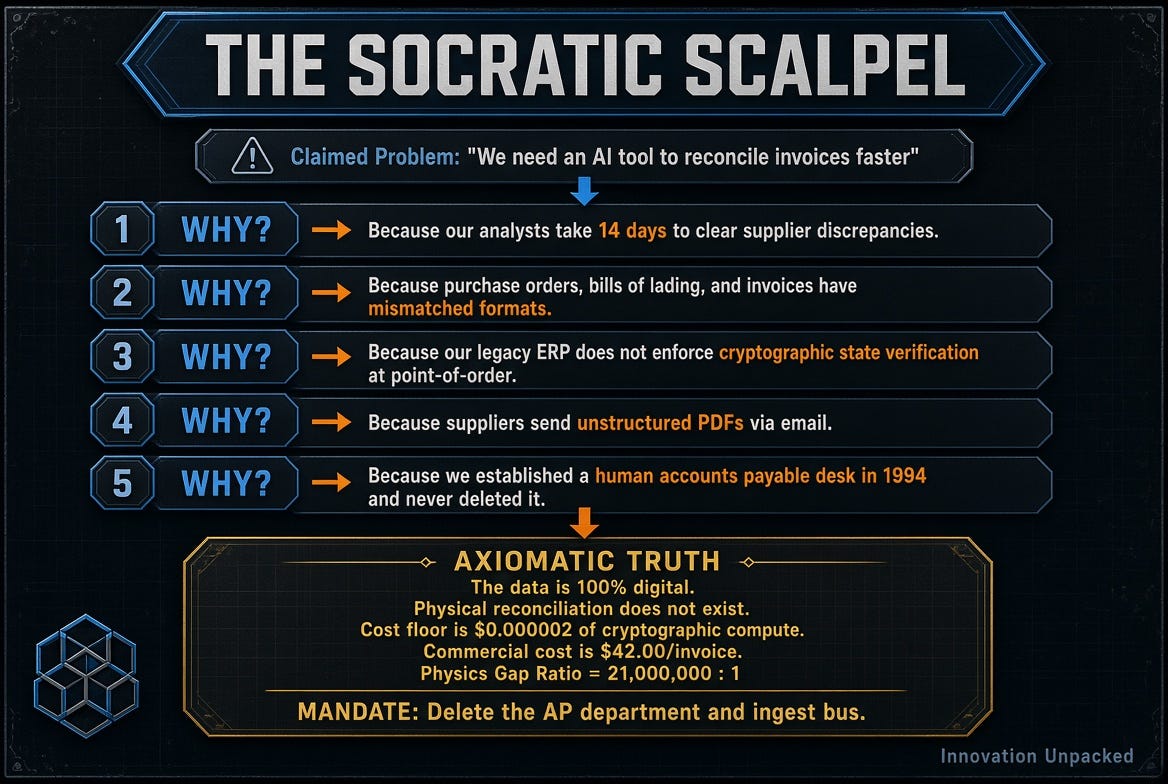
The Socratic Scalpel & The Five Whys
To establish the true Physics Gap, the strategist applies the Socratic Scalpel to deconstruct the operational chain. Rather than accepting industry jargon, the problem is systematically reduced to its indivisible atomic or computational units:
Identification of the Singular Human Job Executor
Disruption cannot be designed for a faceless enterprise, a vague “market,” or an abstract department. It must be calibrated around the singular human Job Executor—the specific individual whose cognitive focus, capital, or manual labor is consumed to force the job to conclusion.
Wrong: “Our customer is the Health System.” (Faceless corporate entity).
Wrong: “Our user is the Radiologist.” (Role conflation; radiologists analyze scans, but they do not manage diagnostic routing economics).
Right: The Hospital Chief Medical Officer (CMO) struggling to minimize the cycle time and diagnostic error rate of emergency triage without exceeding statutory labor caps.
Mathematical Formulation of the Inefficiency Delta
The Physics Gap mathematically quantifies the distance between commercial reality and physical law:
The Numerator (N): Current Commercial Cost
N is the fully loaded enterprise cost to achieve a unit of outcome. This includes:
Direct human labor (wages, benefits, physical facilities, workstation overhead).
Software vendor licensing, middleware taxes, and SaaS markups.
Tier-1 supplier scrap, logistics margins, and tooling amortizations.
Operational friction (error rework, manual handoff delays, latency costs).
The Denominator (D): The Theoretical Floor
D is derived strictly from bedrock axioms. It represents the absolute minimum cost or time required if the operation were conducted using ideal thermodynamic paths, raw materials, and photonic/silicon computation:
In Physical Atoms: The weight of the final assembly multiplied by the raw commodity spot price on global exchanges (e.g., London Metal Exchange), plus the theoretical thermodynamic minimum energy (kWh) required to melt, shape, or bind those atoms.
In Digital Bits & Workflows: The energy required to flip the requisite number of semiconductor gates according to Landauer’s Principle (E = k · T · ln(2)), transmitted across optical fiber at the speed of light, plus the statutory cost of non-negotiable human legal signatures (which is $0.00 unless specified by formal legislative text).
Domain-Adaptive Threshold Architecture: Why Atoms and Bits Diverge
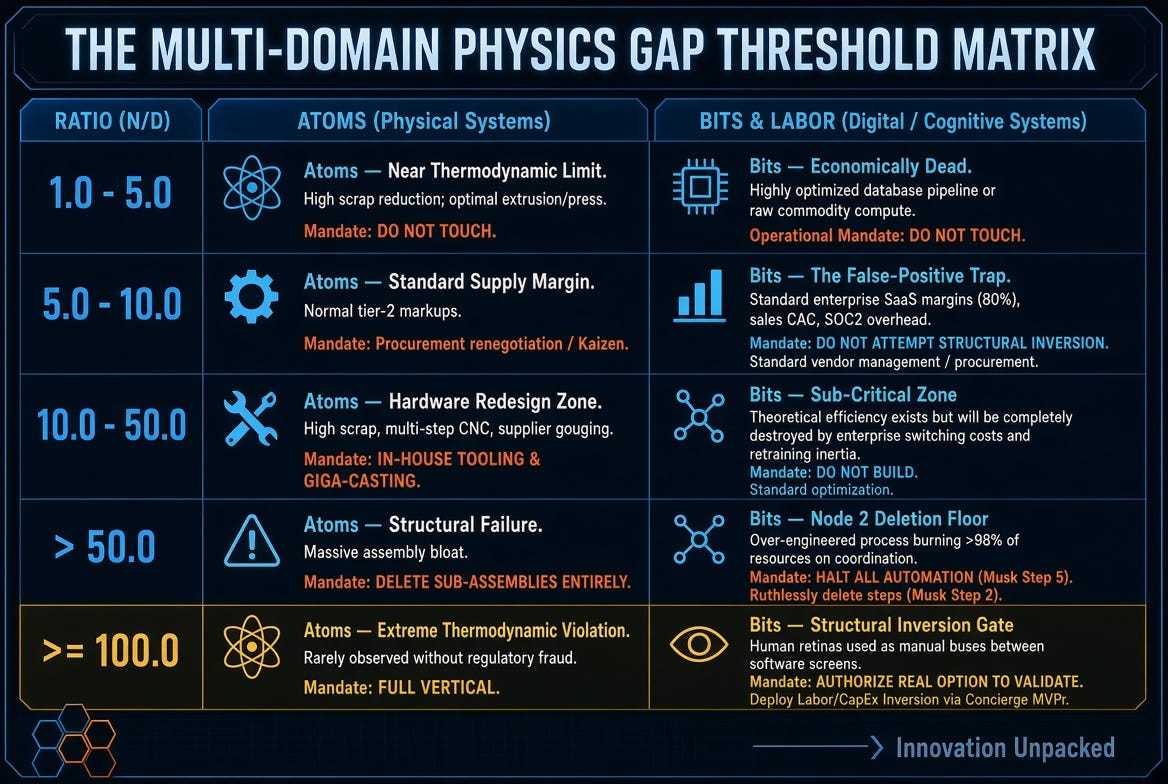
A critical failure mode in strategic execution is applying physical manufacturing thresholds to digital workflows, or vice versa. The exact same numerical ratio carries completely different strategic mandates depending on whether the medium is Atoms or Bits/Labor.
The Physical Realm (Atoms & Metallurgy)
In physical manufacturing, raw commodities (aluminum, steel, copper, lithium) have an immutable, non-zero commodity cost (D > $0.00).
A machined billet aluminum bracket costing $1,000 that contains $100 of raw aluminum has an N/D of 10:1.
An expendable launch vehicle costing $65M that contains $1.5M of raw metals exhibits an N/D of approximately 43:1.
In atoms, a ratio of 10:1 to 50:1 represents massive structural waste, high scrap rates, and supplier margin stacking. Because D is large, an N/D of 20:1 provides hundreds of millions of dollars in gross capital to justify designing custom stamping dies, gantry mills, and vertical manufacturing plants.
The Digital & Labor Realm: The 10:1 False-Positive Trap
In enterprise software, cognitive workflows, and professional services, direct computational cost is near zero (D ≈ $0.000001 to $0.01).
If an enterprise software platform charges $50 per seat per month, and the raw underlying database compute/storage costs $5 per seat, the ratio is 10:1.
The Trap: An inexperienced strategist evaluates N/D = 10:1 in software and attempts to disrupt it. This is a catastrophic failure. A 10:1 ratio in enterprise SaaS simply reflects healthy 80% gross margins, enterprise sales commissions (CAC), SOC2 compliance, ISO certifications, legal contracting, and tier-1 support.
Attempting to “structurally invert” a 10:1 software system attacks standard operational overhead. It expends capital to build tools that fail to achieve market velocity.
The Dissipation Buffer & The Mathematical Derivation of the 100x Gate
Why must the Innovation Lattice enforce an absolute gate of N/D ≥ 100:1 for digital, labor, and workflow structural inversions?
The derivation is rooted in market switching dynamics and execution dissipation. According to Andy Grove’s 10x Force rule and Peter Thiel’s monopoly imperative (Zero to One), a new architecture cannot displace an entrenched incumbent with an incremental 20% or 2x performance increase. An enterprise will not rip out systems of record, retrain thousands of employees, endure contract termination penalties, and absorb implementation risks for anything less than a realized order-of-magnitude (> 10x) economic leap.
However, theoretical efficiency is heavily dissipated during real-world operational execution.
Let:
Δ_theoretical = N / D (The theoretical Physics Gap calculated against the absolute computational/physical floor).
η_capture = The operational capture coefficient (0 < ηcapture ≤ 1.0).
Δ_realized = The actual performance or cost advantage captured by the customer.
Δrealized=1+ηcapture⋅(ND−1)
Empirically, in enterprise, industrial, and regulated workflows, execution dissipates roughly 90% of theoretical efficiency:
ηcapture≈0.10
This dissipation is driven by three inescapable operational realities:
The Add-Back Calibration: The rule of subtraction dictates that if you do not add back at least 10% of what you deleted, you did not delete enough. Re-introducing necessary safety buffers, regulatory edge-case logic, and architectural redundancies reclaims a portion of the raw physical gap.
Statutory Governance Tax: Even if a serverless script executes a contract verification in 5 ms, real-world statutory governance demands immutable audit logging, compliance review windows, and legal dispute holds.
Data Schema Entropy & Edge Cases: Real-world enterprise inputs contain malformed data, schema variations, corrupted payloads, and operational noise that consume compute and manual triage bandwidth.
The Retinal Floor Principle
The most extreme Physics Gaps in modern economies exist where human sensory organs are inserted into digital data pathways.
When an enterprise employs Level-3 or Level-4 knowledge workers (paralegals, underwriting analysts, claims processors, Tier-2 support engineers) at $50 to $250/hour to look at pixels on Screen A, evaluate them against a policy rubric, and re-type or click approvals on Screen B, they are using the human brain as a manual bus between disconnected databases.
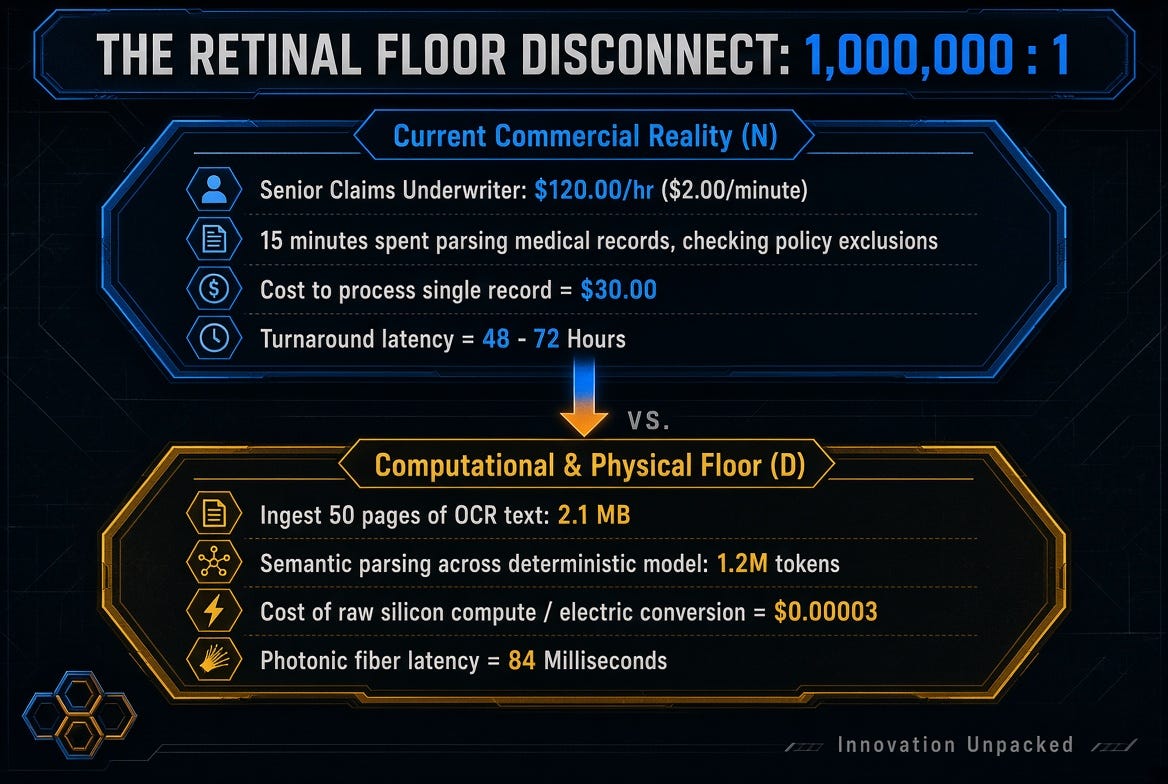
Workflows exhibiting Physics Gaps of 10,000:1 to 1,000,000:1 are non-negotiable targets for complete Labor Inversion. Attempting to build an “AI assistant” to help that underwriter read the screen faster is a catastrophic violation of first principles. The entire desk must be deleted from the system architecture.
Structural Strategy & Innovation Lattice Integration
The Chronological Process Map
Every workflow, across any industry, can be mapped into nine solution-agnostic, chronological process stages. To eliminate solution bias, the map isolates the universal operational steps required to deliver the core job:
Define⟶Locate⟶Prepare⟶Confirm⟶Execute⟶Monitor⟶Resolve⟶Modify⟶Conclude
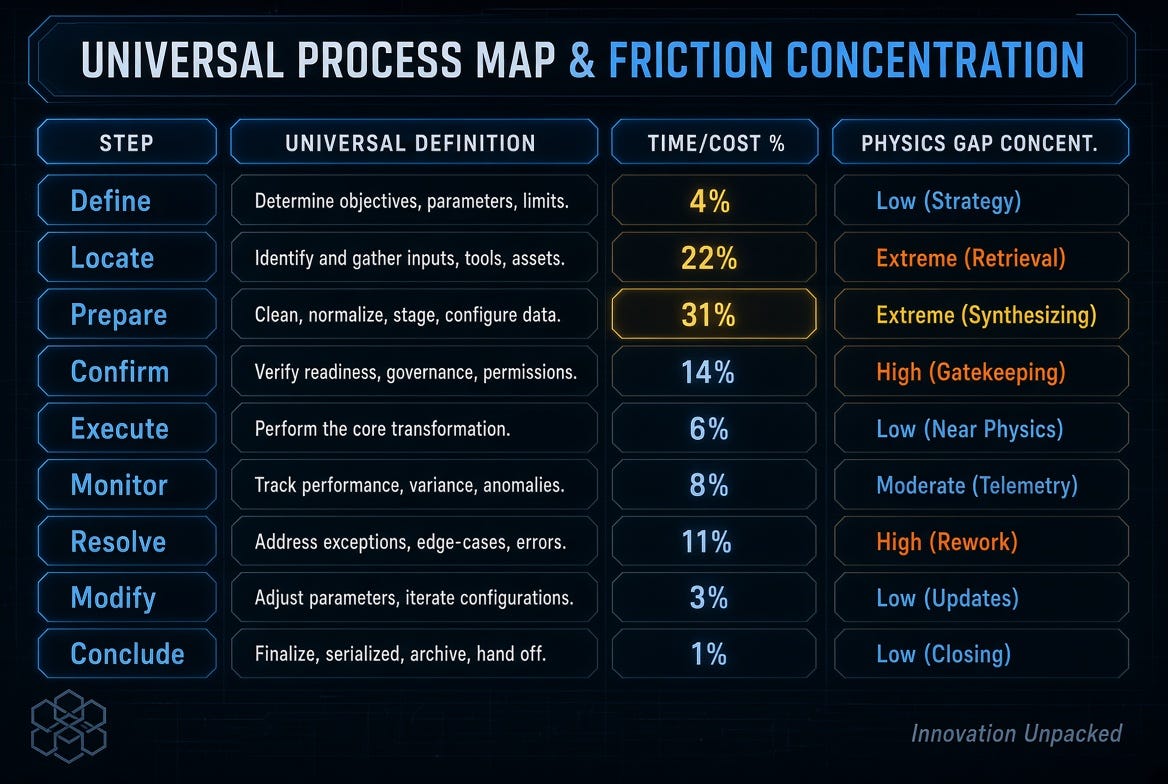
Notice the central irony of enterprise operations: Step Execute—the actual creation of value—typically accounts for less than 10% of total cycle time and cost. Over 65% of enterprise capital is wasted across Locate, Prepare, and Confirm: finding, staging, and verifying bits and atoms.
Formulation of Customer Success Statements (CSS)
In the Innovation Lattice, qualitative customer pain is stripped of emotional prose and codified into deterministic, MECE (Mutually Exclusive, Collectively Exhaustive) statements:
Prohibited Verbs: Manage, handle, facilitate, optimize, streamline, improve.
Prohibited Solutions: Dashboard, AI, portal, Excel, button, screen.
Exemplar CSS Suite (Enterprise Invoice & Settlement Space)
Locate Hotspot: Minimize the time required to locate disparate line-item charge records across non-standardized vendor fulfillment manifests.
Prepare Hotspot: Minimize the likelihood of schema serialization errors when converting unstructured optical shipment manifests into balance-sheet ledger inputs.
Confirm Hotspot: Minimize the operational labor cost required to confirm regulatory tax jurisdictional compliance across cross-border freight deliveries.
Resolve Hotspot: Minimize the latency required to resolve transaction value variances exceeding contractual tolerance limits between counterparty billing ledgers.
The Deletion Protocol
When an N/D ratio clears the deletion or structural inversion thresholds, the organization executes the subtractive protocol strictly in sequence. Executing out of sequence guarantees the optimization of waste.
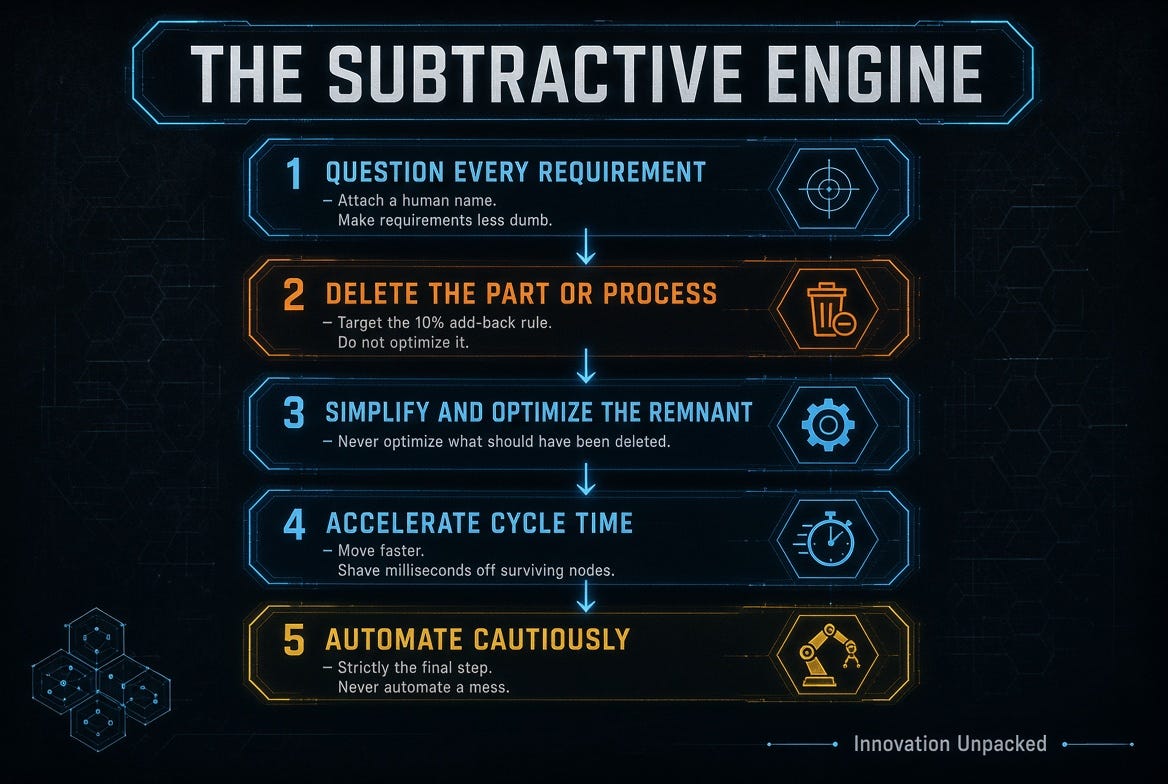
Question Every Requirement:
Reject all requirements originating from faceless entities (e.g., “Legal,” “HR,” “Industry Standards”).
Require a specific, named human author. Challenge requirements authored by high-status stakeholders with the highest skepticism. Every incoming requirement is assumed to be fundamentally wrong.
Delete the Part or Process:
If a process has an N/D > 50.0, optimization is banned. Delete the entire step.
The Add-Back Metric: If the organization is not forced to add back at least 10% of what was deleted, it did not delete enough. “Defensive engineering” and “just-in-case compliance” must be purged.
Simplify and Optimize the Remnant:
Only after the bloat is excised can optimization occur. The fatal sin of capable engineers is spending intellectual capital optimizing a component or database sync that should not exist.
Accelerate Cycle Time:
Accelerate the cadence of the simplified remnant. But obey the governing maxim: “If you are digging your grave, do not dig faster.” Accelerating an un-deleted process merely scales structural defects.
Automate Cautiously:
Automation is strictly the final step. Automating prematurely creates the “Alien Dreadnought” disaster—millions of dollars wasted on complex automation that jams on edge cases and must ultimately be physically ripped out.
Unfortunately, this is where most transformation begins
Structural Inversion Levers
To break free from legacy cost curves and collapse the Physics Gap, the strategist deploys the Four Structural Inversion Levers, mapped directly to the 154 Subtractive and Socioeconomic Levers:
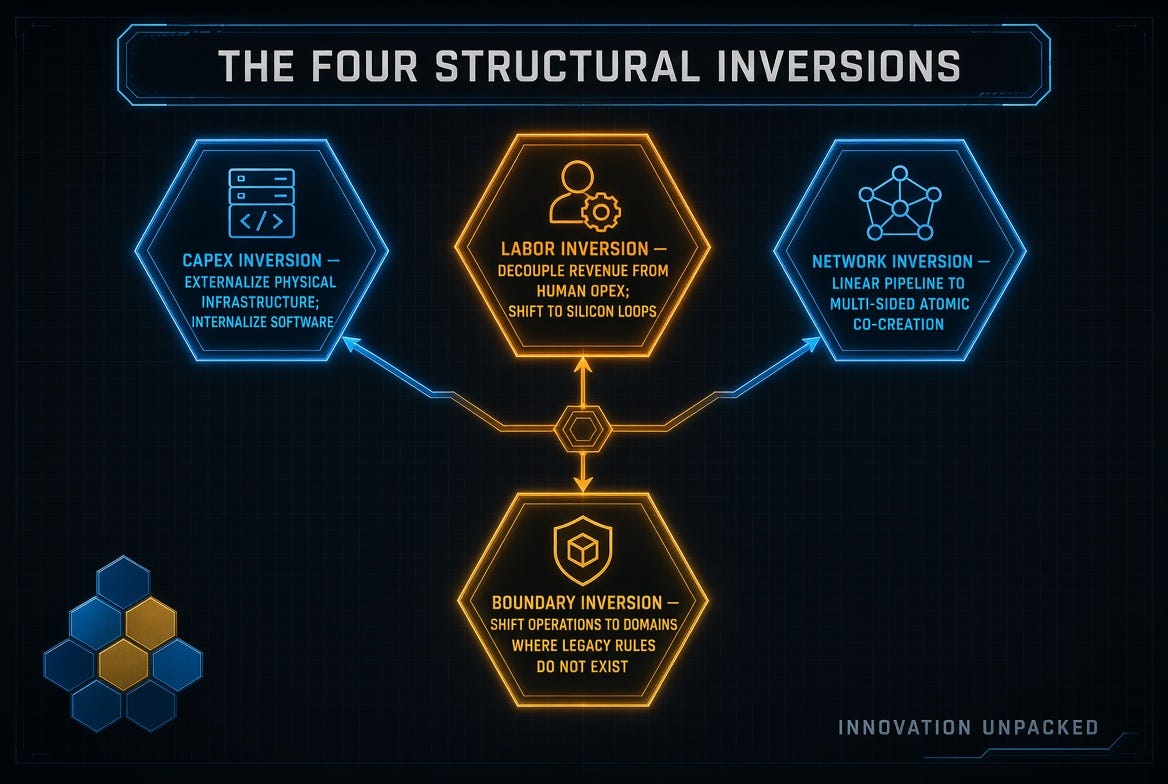
CapEx Inversion (Externalize Atoms / Internalize Intelligence)
The Mechanics: The incumbent owns, finances, and maintains massive physical infrastructure (server farms, retail real estate, vehicle fleets, heavy machinery), passing maintenance depreciation down to the customer. CapEx Inversion externalizes physical asset ownership to the market while internalizing software orchestration, routing intelligence, and secondary utilization.
Subtractive Matrix Alignment:
Supplier versus Customer Inversion: Monetize Orphaned Capacity. When an optimized operation creates massive excess capacity, invert the commercial model (e.g., SpaceX launching Starlink to consume its own excess reusable-rocket capacity; Amazon building AWS to consume internal compute overhead).
Input/Output Substitution: Substitute third-party supplier markups with radical vertical in-housing of the core intellectual node.
Labor Inversion (Decouple Revenue from Human OPEX)
The Mechanics: Incumbents scale revenue linearly with headcount (billable hours, operational analysts, triage desks). Labor Inversion replaces intermediate human cognitive routing with deterministic code, cryptographic verification, and agentic compute loops, driving the marginal cost of execution to the Landauer/silicon floor.
Subtractive Matrix Alignment:
Continuous Synchronous Flow: Replace asynchronous batch-processing delays with continuous synchronous algorithmic flow.
Hierarchical Bypass Flow: Eliminate managerial relay hierarchies; route raw system telemetry directly to autonomous execution nodes.
Pixel Consolidation: Solid-state physical buttons and manual screen data entry dissolve into background automated micro-computations.
Network Inversion (Decentralized Multi-Sided Atomic Value)
The Mechanics: Inverts linear pipeline dynamics (Company designs → Company builds → Customer consumes) into decentralized systems where market participants generate atomic value for one another.
Subtractive Matrix Alignment:
Shared Capacity Commons: Convert underutilized, individual assets into shared network capacity (e.g., Virtual Power Plants using distributed battery storage).
Ecosystem Platform Architecture: Establish open system architectures that incentivize external third parties to build atomic value onto the core OS.
Boundary Inversion (Dissolving Operational Perimeters)
The Mechanics: When optimization reaches an asymptotic limit inside a given legal, organizational, or technological domain, Boundary Inversion shifts the execution boundary outside the reach of legacy constraints.
Subtractive Matrix Alignment:
Direct Programmatic Bypass: Bypass franchise dealer legislation, clearinghouses, or distribution middlemen through direct programmatic customer relationships.
Asset Operator Elevation: Invert the customer relationship from a depreciating consumer into a cash-flowing infrastructure partner (e.g., vehicle owners transitioning into autonomous fleet operators).
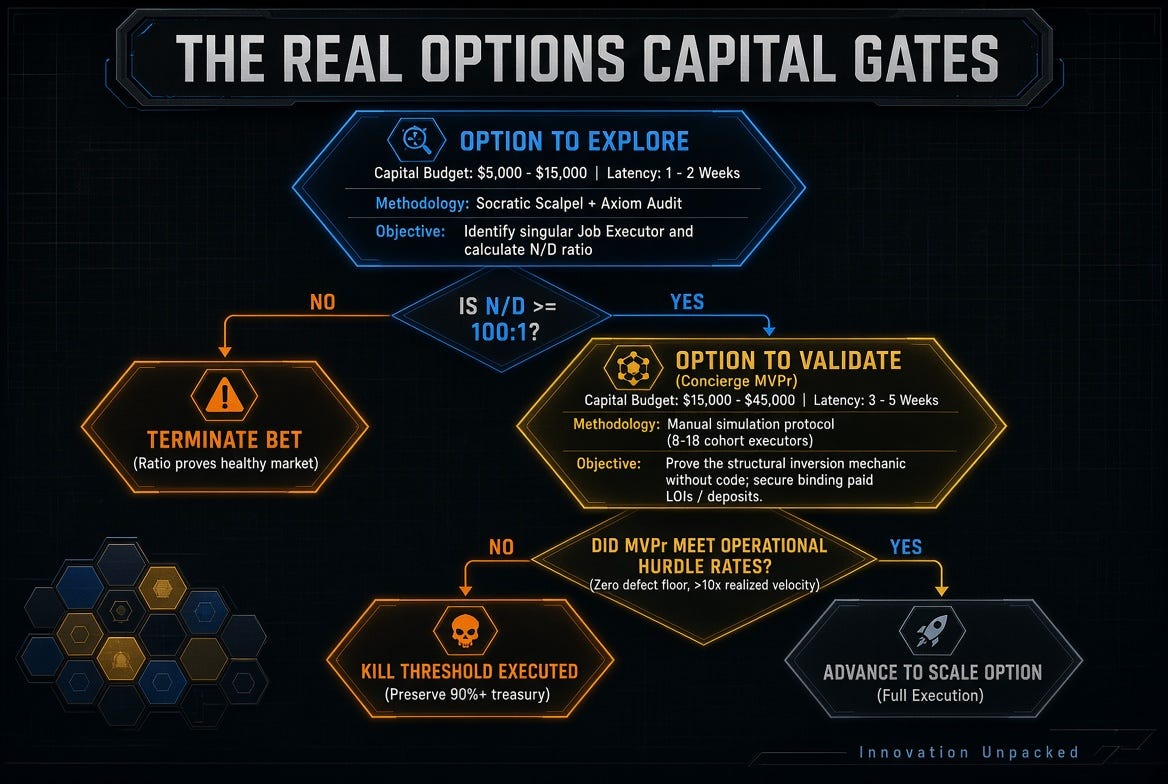
Real Options Architecture: Staged Capital Allocation
In the Innovation Lattice, strategic capital is never allocated via five-year ROI forecasts (The Monolithic Fallacy). Long-term forecasts for non-existent products force teams to invent numbers, resulting in the funding of safe, incremental bloat.
Capital is deployed through Real Options Analysis (ROA), treating R&D expenditure as a calculated “option premium” paid to purchase operational certainty and kill flawed hypotheses early.
Application Across Different Business Models
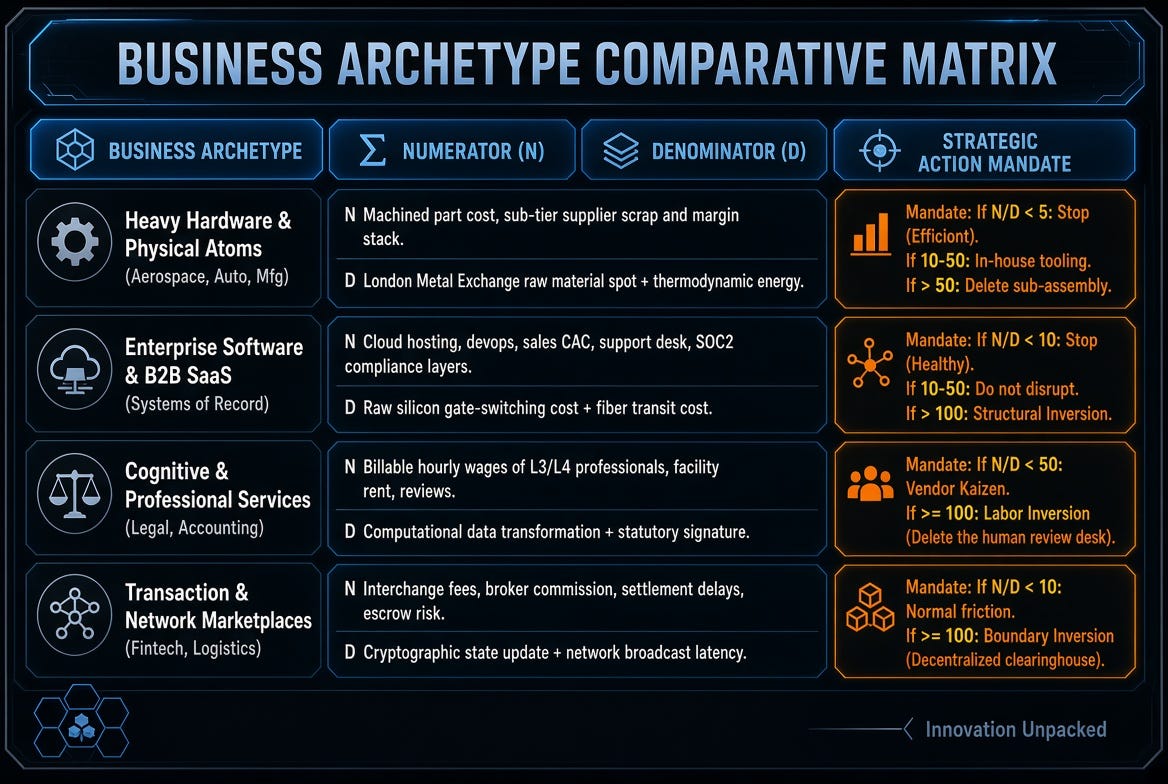
The operational breakdown demonstrates where to stop, where to proceed, and how to execute across four core commercial archetypes:
Heavy Physical Manufacturing (Atoms)
The Environment: Stamping plants, aerospace structures, industrial tooling, automotive powertrain.
The Numerator (N): Commercial supplier quotes for finished components. For example, an exhaust manifold quoted at $1,200, or a rocket fuel dome quoted at $85,000.
The Denominator (D): Finished dry weight multiplied by the spot price of titanium, inconel, or aluminum billet, plus the thermodynamic induction melting energy (kWh).
Decision Framework:
N/D ≤ 5.0 (STOP): The process is thermodynamically optimized. Do not waste engineering cycles redesigning the component.
10.0 ≤ N/D ≤ 50.0 (MOVE FORWARD - In-House Tooling): Supplier markups and multi-step CNC chips represent major gross profit leaks. Re-engineer the production method:
Apply scale consolidation: Replace 120 stamped, spot-welded sub-parts with a single 9,000-ton Giga-Casting.
Apply reusability architectures: Delete expendable stages; engineer rapid reusability.
N/D > 50.0 (MOVE FORWARD - Delete): The component is an artifact of legacy over-engineering. Question the requirement and delete the entire sub-assembly.
Enterprise Software & B2B SaaS (Bits)
The Environment: Enterprise workflow tools, ERP add-ons, customer portals, business intelligence.
The Numerator (N): Fully loaded cost of delivering the software outcome, including cloud server instances, continuous integration overhead, sales commissions, support tickets, and licensing costs (e.g., $120/user/month).
The Denominator (D): Landauer computation floor—the raw cost of database read/writes on commodity cloud infrastructure (~$0.001/user/month).
Decision Framework:
N/D ≤ 10.0 (STOP - The False Positive Trap): The company is simply capturing standard software gross margins and covering sales/compliance overhead. Do not attempt to “disrupt” this with internal development.
10.0 < N/D < 100.0 (STOP): Sub-critical zone. While there is theoretical bloat, any realized gain from a new tool will be less than 10x and will fail to overcome enterprise switching costs. Retain legacy tools; negotiate pricing via standard enterprise procurement.
N/D ≥ 100.0 (MOVE FORWARD - Architecture Deletion): The software exists merely to route data between disjointed systems. Delete the UI; replace the entire application layer with a direct programmatic event loop.
Cognitive Services & Professional Labor (Workflows)
The Environment: Contract analysis, commercial loan underwriting, regulatory filings, claims processing, medical billing.
The Numerator (N): Billable human labor hours ($150 - $500/hr) combined with process latency (3 to 14 business days).
The Denominator (D): Photonic data transmission latency (< 100 ms) and raw API token/compute transformation costs (< $0.01). Statutory Retinal Floor is $0.00.
Decision Framework:
N/D < 50.0 (STOP): Highly specialized domain with mandated human legal liability (e.g., sworn courtroom testimony). Incremental tooling only; do not attempt labor inversion.
N/D ≥ 100.0 (MOVE FORWARD - Labor Inversion): The process uses human retinas as intermediate buses.
Authorize the Option to Validate.
Collapse multi-week asynchronous email tag into real-time cryptographic validation.
Deploy Labor Inversion: Drive marginal delivery cost to zero by substituting human analysis with deterministic compute.
Transaction & Network Marketplaces (Platforms)
The Environment: B2B freight brokerage, insurance settlement, cross-border payment clearing, procurement exchanges.
The Numerator (N): Brokerage fees, interchange commissions (1.5% - 4%), escrow margins, and multi-day clearing float.
The Denominator (D): Cryptographic verification and distributed database synchronization latency (< 500 ms) and electricity costs (< $0.0001).
Decision Framework:
N/D < 10.0 (STOP): Standard financial processing margins covering legitimate credit risk, fraud loss reserves, and banking liquidity.
N/D ≥ 100.0 (MOVE FORWARD - Boundary & Network Inversion):
Dissolve legacy clearinghouse boundaries: Replace broker coordination with programmatic escrow and automated matching engines.
Convert proprietary exchange tollgates into an open protocol, monetizing secondary liquidity services.
Validation & Falsifiability Mechanics
Rejection of Survey Methodologies & Subjective Scoring
In the Innovation Lattice, qualitative customer preference surveys, Likert-scale questionnaires, Net Promoter Scores, and focus groups are epistemologically banned.
Surveys measure what customers think they want based on the legacy systems they currently inhabit. They capture adaptations to existing friction, yielding incremental feature requests. Furthermore, mathematical operations performed on ordinal survey data generate fictitious statistical means that distort the underlying distribution of operational reality.
Fact: All of my former colleagues know — deep down — that I’m right 👆
Strategic validation must be deterministic, behavioral, and physically falsifiable. Capital is allocated based on hard operational hurdles, cash commitments, and measurable unit economics.
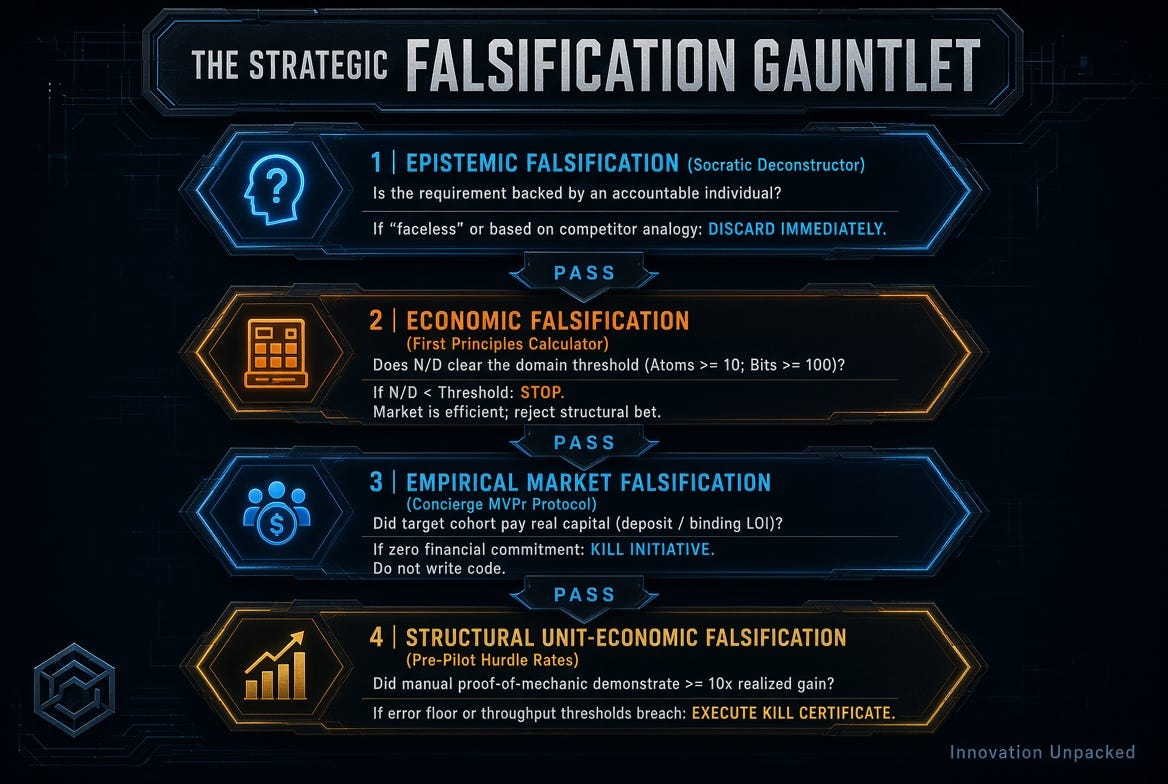
The Concierge Minimum Viable Proof (MVPr) Protocol
Before authorizing an engineering team to write scalable software or procure physical manufacturing tooling, the enterprise must execute a Concierge Minimum Viable Proof (MVPr).
The MVPr is a rapid, manual, low-overhead simulation of the inverted operating mechanic run directly on a live target cohort:
Cohort Scale: 8 to 18 verified Job Executors.
Duration: 3 to 5 weeks strictly.
Capital Cap: $15,000 - $45,000 (funded entirely via the Phase 2 Real Option premium).
Architecture: Zero production code. The structural inversion is executed manually behind the scenes by the strategic engineering team (”Wizard of Oz” architecture) to measure true edge-case friction, verify the Retinal Floor, and calculate actual unit economics.
Empirical Hurdle Criteria
Binding Willingness-to-Pay (WTP): The cohort must commit real commercial capital. This requires a non-refundable cash deposit (e.g., $2,500 - $10,000) or a binding Letter of Intent (LOI) signed by an executive possessing explicit commercial budget authority. Verbal enthusiasm or “intent to pilot” is logged as a negative signal (0).
True Operating Delivery Cost (D_realized): The manual execution cost is logged down to the exact second. This proves whether the projected post-inversion unit economics survive real-world edge cases.
Operational Latency Collapse: The turnaround time must demonstrate a realized > 10x collapse during the manual run (e.g., compressing an 8-day manual loan review cycle to under 30 minutes).
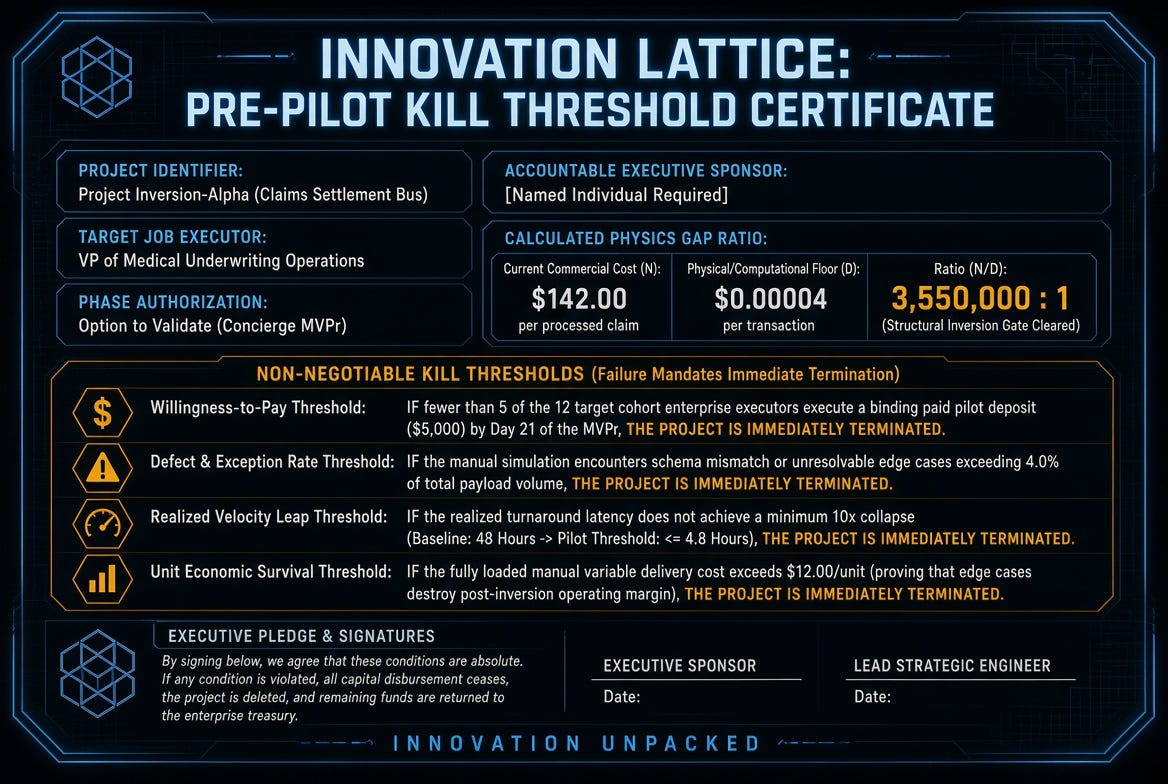
The Pre-Pilot Kill Threshold Certificate
The ultimate governance mechanism of the Innovation Lattice is the Pre-Pilot Kill Threshold Certificate. Traditional corporate projects suffer from the sunk-cost fallacy: once funded, milestones are perpetually extended, narratives are spun, and zombie projects burn capital for years.
To eliminate this pathology, the Kill Threshold Certificate is a legally binding internal governance document executed before a single dollar of pilot capital is disbursed. It defines unambiguous, quantitative failure metrics. If any threshold is breached, project funding is instantly and irreversibly terminated, preserving over 90% of enterprise treasury capital.
Synthesis: The Physics Gap Axiom
The Physics Gap is the definitive boundary separating futile operational optimization from asymmetric structural disruption:
Optimization optimizes within legacy friction.
Innovation deletes the architecture that generated the friction.
Epistemic Discipline: Stop reasoning by analogy. Stop building dashboards for customer coping mechanisms. Interrogate every requirement, reject faceless mandates, and anchor the denominator strictly in the physical laws of chemistry, metallurgy, thermodynamics, and silicon compute.
Domain Rigor: Enforce the Multi-Domain Threshold Architecture. Treat 10:1 in physical atoms as an immediate call for in-housing and modular tooling. Avoid the False-Positive Trap in enterprise software: never mistake healthy 80% gross margins for disruptive inefficiency.
The Dissipation Reality: Demand N/D ≥ 100:1 in digital and labor workflows. Because operational reality, statutory governance, and edge cases dissipate 90% of theoretical efficiency (η_capture ≈ 0.10), an initial 100x Physics Gap is the absolute mathematical minimum required to deliver an undeniable > 10x realized leap that shatters enterprise switching inertia.
Governance via Real Options: Replace monolithic five-year business cases with staged Real Options. Validate the structural inversion mechanic using a manual Concierge MVPr before writing code, and enforce written Kill Threshold Certificates to preserve capital when hypotheses fail.
By anchoring strategy strictly in the Inefficiency Delta, the enterprise ceases to be a passive victim of corporate entropy. It becomes a deterministic execution engine, methodically dismantling legacy bloat and engineering the foundational physics of the market.
What one study found
A large company asked if a faster way to get its work approved and launched was worth building.
Today, each time they do this job, it costs about $2,700.
If a machine did only the steps that must be done, it would cost about $6.
That means they pay about 466 times more than they need to.
For office work, we want that number to be at least 100 before we say go. This one is far past it.
Why so high? Savings always look bigger on paper than in real life. A big gap leaves room for that.
Our call: Go, but start small. Test it with a few real users before spending big money.
Book an appointment: Click here
Email me: mike@pjtbd.com
Call me: +1 678-824-2789
Follow me on 𝕏: https://x.com/mikeboysen
Articles - jtbd.one - De-Risk Your Next Big Idea
Research - studio.jtbd.one/research
Slaying the Sacred Cows of Innovation


