

A lot of Tesla owners have had the same strange moment. They paid thousands of dollars for Full Self-Driving, often years ago, because they were told the price was going up. Then, a few years later, a new owner got to try the same software for free. After that, the new owner could keep it for a monthly fee.
In the video, I walked through why that happened and what it teaches. Here I want to go deeper. You’ll get the full price history with sources, the psychology behind urgency pricing, how it backfires, what Tesla got right, and a checklist you can use before you set your own deadline.
I’ll be fair to Tesla throughout. Each pricing move made business sense when it happened. The lesson isn’t that Tesla is bad at pricing. It’s that urgency pricing locks you in more than it looks like it does.
The lever: urgent, not nurture
This comes from the set of subtractive levers I use in Venture Proof. Venture Proof is a powerful, disruptive strategy-as-code engine I built. It builds and tests your strategy with code, so every step runs the same way and can be checked. It tests business ideas, and then makes them better.
A subtractive lever is a way to improve something by taking something away. Lever #92 sits in the category “Change Timing / Frequency.” It’s called Objective (Urgent vs. Nurture), and in the catalog it reads like this:
Violation: Nurturing leads for 12 months.
Scalpel: How to force a decision?
Target State: “FSD price increases by $1,000 next week.”
In plain words: lots of companies spend a year gently warming up possible buyers. There are emails, check-ins, webinars, and more emails. The buyer never says no. They just say “later,” over and over. The lever asks what you can remove so the buyer has to decide. The answer is the long, slow wait. Put a real deadline in its place.
The catalog’s own example is Tesla. That’s no accident. Tesla used this lever about as well as any company ever has.
The full price timeline
Here’s the verified history of the upfront price for Full Self-Driving in the US, plus the subscription and trial changes.
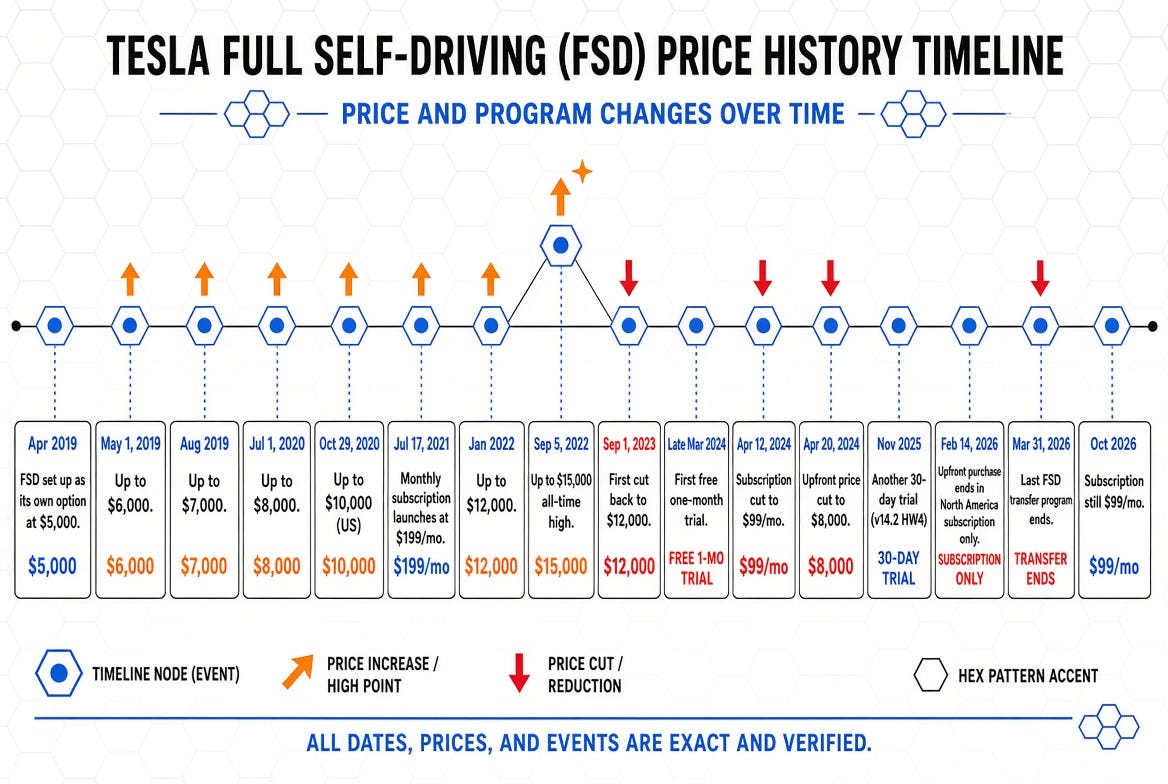
The climb from $5,000 to $15,000 took about three and a half years. The fall from $15,000 to “you can’t buy it anymore” took about the same.
Along the way, the message was clear. In May 2020, Musk wrote that “the FSD price will continue to rise as the software gets closer to full self-driving capability with regulatory approval”. In 2019, he said Teslas with it would be “appreciating assets”. If you believed that, buying early was the smart move.
Why urgency pricing works
Urgency pricing isn’t a trick. It works because of how people actually make decisions. Here are the three big reasons.
1. Missing out hurts more than winning feels good. Losing a deal stings more than getting one feels good. When the price goes up next week, waiting stops feeling free. It starts to feel like losing money.
2. A deadline ends “later.” Most buyers don’t say no. They put it off. Every week of “let me think about it” is a week the buyer can drift away. A real deadline takes “later” off the table. That’s exactly what lever #92 is after.
3. It rewards your first believers. Your earliest buyers are usually your biggest fans. Urgency gives them a better price for trusting you first. That feels fair, and it is fair, as long as the story holds.
For Tesla, it worked. Early buyers paid up, some as much as $15,000, to lock in the price. That brought in cash early. It also built a big group of loyal owners who wanted the product to succeed and talked about it everywhere.
Compare that to the slow route. If Tesla had nudged people gently for a year, many would still be “thinking about it.” Many would never have bought at all.
Then the plan changed
Starting in 2021, Tesla moved step by step toward a different model.
First came the monthly plan. Then, in September 2023, the first upfront cut. In spring 2024, everything happened at once. Tesla gave a free month to every capable US car, cut the subscription in half to $99 a month, and cut the upfront price by about a third to $8,000. Free trials kept coming with major new versions, roughly every year or so. Then, in February 2026, Tesla stopped selling it outright in North America.
Musk has said the $99 monthly price will rise as the software improves. As of October 2026, it’s still $99.
Each of these steps had a sound business reason. Not many buyers were choosing the big upfront option. Tesla’s CFO said in October 2025 that only about 12% of customers had paid for FSD. A cheaper monthly plan and free trials let far more people try it. More drivers can also mean more real-world data for the software. If I were running a business with a low take rate, I’d look hard at the same moves.
How it backfires
Now look at it from the owner who bought at the top.
They did exactly what they were asked to do. They acted fast. They trusted the story. A few years later, the person next to them got a free month and could keep it for $99 a month. Fred Lambert at Electrek put it plainly: “you have to feel for the people who paid $15,000 for this package in 2022. They paid the equivalent of 12 years of subscriptions.” The math checks out. $15,000 divided by $99 is about 150 months.
Some owners pushed back. After the 2024 cuts, Torque News reported that some buyers who paid $12,000 or $15,000 wanted refunds, and that early Cybertruck buyers were especially unhappy. When some inventory cars later showed FSD at lower prices, a $15,000 buyer suggested store credit as a fair fix. When the first free trial came, owners who’d paid in full got no credit, while monthly subscribers got a free month.
There’s one more wrinkle. On the Q1 2026 earnings call, Musk said older cars with its HW3 computer can’t run the unsupervised version. Those cars get a supervised “Lite” version instead. Tesla has talked about retrofits or trade-in deals, but there’s no firm date or price yet.
Here’s the part that matters for any business. These weren’t random buyers. They were the biggest fans. The people who trusted you first are the ones who end up feeling the worst.
And it spreads. Early fans talk the most. When they feel let down, the next buyer hears about it. Your next deadline works less well, because people have learned to wait. Why buy now if it might get cheaper, or free, later? That’s the real cost. You don’t just upset one group. You teach your whole market to wait.
What Tesla did right
It would be unfair to stop there. Tesla did several things well.
The purchase stays with the car. FSD bought outright stays with that car, including when it’s sold.
Transfer windows. For a while, Tesla let owners move FSD to a new Tesla. That was a real gesture to early buyers. The last program ended March 31, 2026.
Honesty about price changes. Musk has said openly that “Tesla prices must change frequently to match production with demand.” Most companies change prices. That alone isn’t wrong.
More people can try it. Free trials and a $99 plan opened the product to millions of drivers who’d never pay $15,000 up front. That’s good for customers too.
So the takeaway isn’t “Tesla got it wrong.” It’s that a deadline built around “the price only goes up” is a promise about the future. And the future is hard to promise.
The one question to ask first
Before you use a deadline to get people to buy, ask one question:
Will your fastest buyers still feel smart a year later?
Not next week. A year from now. Picture your most eager customer. They bought on day one at full price. Now picture everything you might do over the next year:
A discount to hit a sales target.
A free trial to grow your user base.
A cheaper plan for a new market.
A move from one-time pricing to monthly.
Would your first buyer look at any of those and feel like they got a bad deal? If yes, you have two honest choices. Skip the deadline. Or plan right now for how you’ll take care of those early buyers when things change.
A checklist for urgency without the regret
Use this before you announce any “price goes up next week” offer.
Write down your likely moves for the next 12 to 24 months. Discounts, trials, new plans, a switch to monthly. If any of them would undercut your early buyers, fix the offer now.
Make the early deal something later buyers never get. Lifetime access, a founder badge, extra features or early access. Don’t make it only a lower price, because prices change.
Promise only what you can keep. “This price ends Friday” is a promise you control. “The price will only go up from here” is a bet on the future.
Decide the make-good in advance. If you ever cut the price or give it away, what do early buyers get first? Credit, an upgrade, or the right to move it to a new purchase? Write it down before you need it.
Make upfront beat monthly, and say by how much. If you might add a monthly plan someday, set the upfront price so it’s clearly better than a few years of monthly payments, and tell buyers how many years.
Tell early buyers first. When something changes, they should hear it from you before they see it online.
Watch your fans, not just your sales. Track what early buyers say after each change. If they go quiet or angry, your next deadline is already weaker.
Wrapping up
Urgency works. It gets people to decide, and it rewards the people who believe in you first. That’s why lever #92 is so strong. But a deadline is also a promise, and your best customers are the ones holding it. Before you set one, ask if your fastest buyers will still feel smart a year later.
If this was useful, subscribe so you don’t miss the next one. And for more on this kind of thinking, head over to jtbd.one.
Mike Boysen
Book an appointment: Click here
Email me: mike@pjtbd.com
Call me: +1 678-824-2789
Follow me on 𝕏: https://x.com/mikeboysen
Articles - jtbd.one - De-Risk Your Next Big Idea
Website - pjtbd.com
Slaying the Sacred Cows of Innovation


