

Know if your big idea will work before your company spends the money
Do you have to pitch a new product, service, or business at work? Join the Venture Proof Mastermind. Each quarter I run a full analysis on one of your ideas (for each of you), so you know if it is worth the money. You also get 1:1 chat with me, live sessions, courses, and a group of people doing the same work.
The following article is a high-level overview of what Venture Proof constructs — meant for your reading pleasure. In my community, everyone will get the detailed version and the interactive payloads for studies and scopes that you determine ↠ each quarter. I’d really think about it if you want to have an impact in your organization.
Spend the least, to learn the most.
Executive Summary & Epistemic Triage
Strategic Thesis & Core Structural Inversion
The multi-trillion-dollar pass-through entity compliance ecosystem—encompassing partnerships (Form 1065), S-corporations (Form 1120-S), and trusts (Form 1041)—is paralyzed by an operational failure mode: the severance of machine-verifiable source attribution at the human keystroke boundary.
Over 30.2 million partner allocations and 3.88 million partnership returns filed annually depend on supplemental “white paper” footnotes that reach hundreds of pages per filing in alternative investment, real estate syndication, and private equity vehicles. The tax compliance industry has historically framed this bottleneck as a data entry and document ingestion challenge, spending hundreds of millions of dollars attempting to optimize Optical Character Recognition (OCR) engines, build portal aggregators, and deploy artificial intelligence copilots over unstructured PDF attachments.
This framing is an epistemic error. The problem is not data extraction velocity; it is unverifiable provenance across organizational handoffs. The current commercial architecture forces certified public accountants and senior tax managers to act as manual ocular bus routers—reading rendered pixel buffers off image-based PDFs and re-typing values into Excel workpapers and tax compliance software ($\text{UltraTax CS}$, $\text{CCH Axcess}$, $\text{GoSystem Tax RS}$). The moment a human keystroke commits a value into a worksheet cell without a cryptographically anchored derivation chain, provenance collapses to un-auditable human memory.
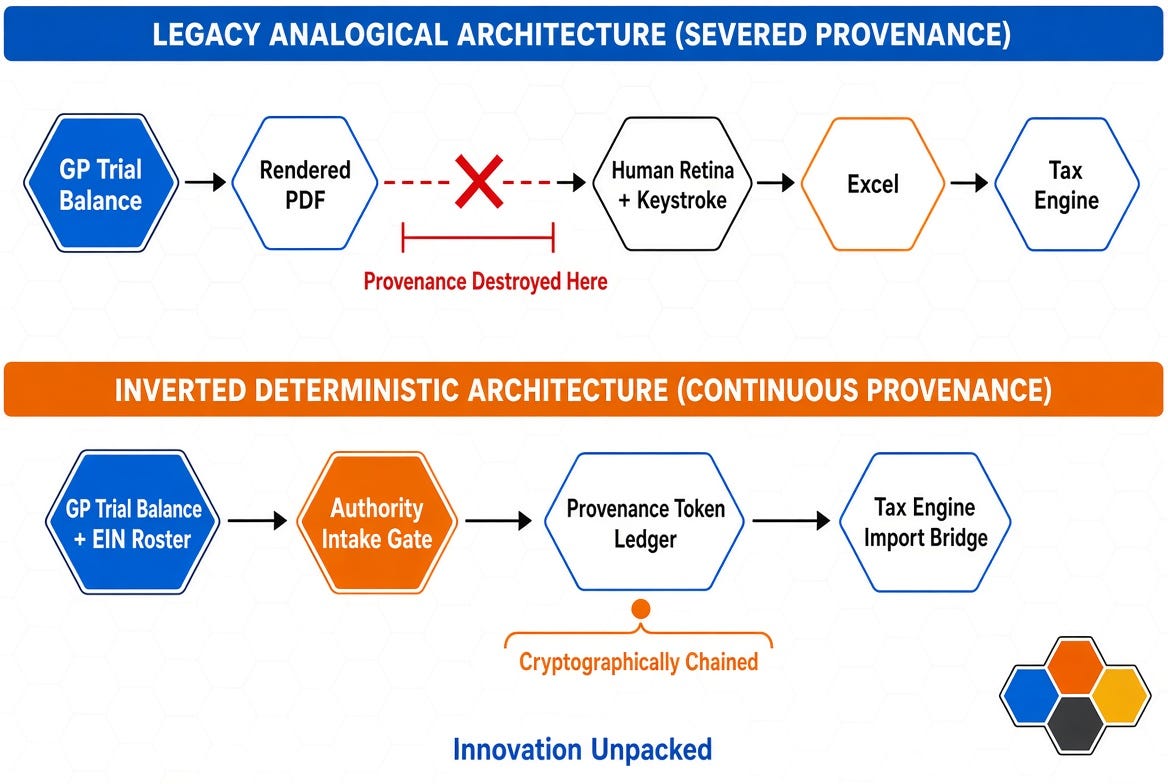
The structural inversion required is Labor and Boundary Inversion: deleting the human retinal transcription surface entirely and replacing the rendered PDF as the source of truth with an Authority-Source Ingestion Layer and a Four-Field Footnote-Coordinate Provenance Ledger:
By anchoring attribution to the General Partner (GP) trial balance and EIN-matched roster before transcription begins, and binding a content-addressed token to each allocation, tax reconciliation shifts from an O(n × tiers) manual re-derivation process to an O(1) query on an immutable lineage graph governed by W3C PROV-DM axioms.
Epistemic Hierarchy Triage
To establish an unassailable strategic foundation, prevailing industry beliefs are triaged into the three tiers of the Epistemic Hierarchy:
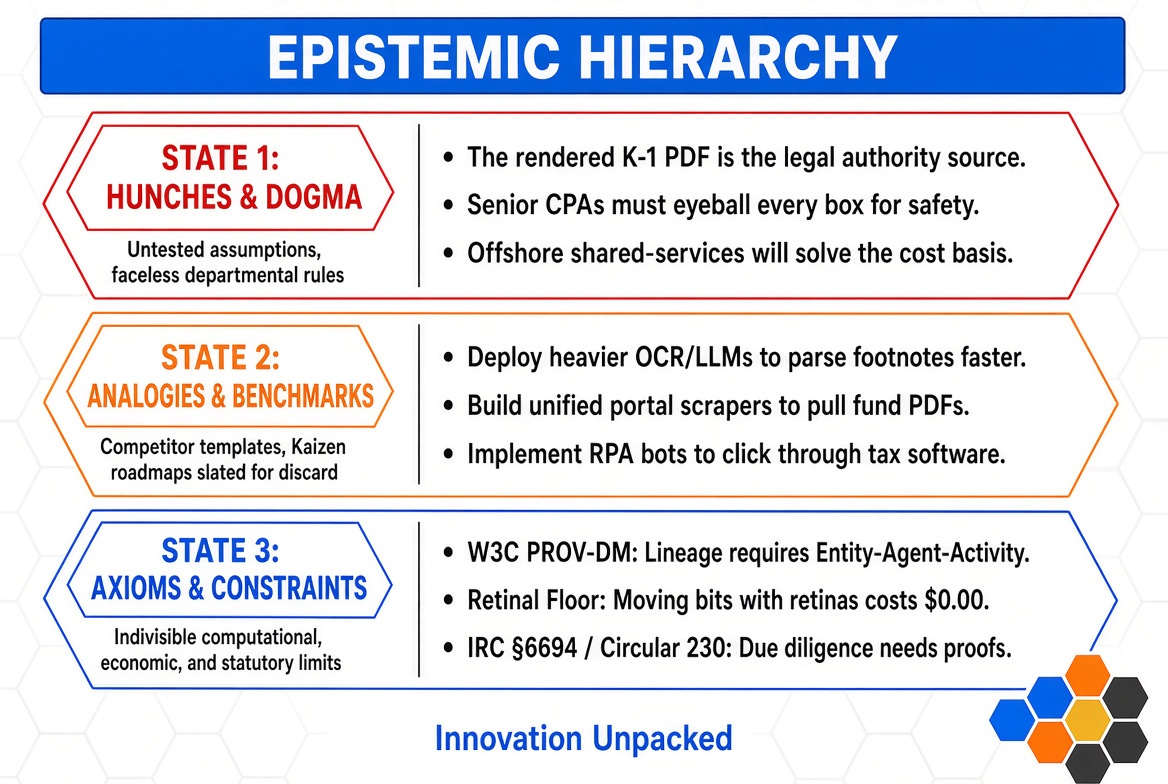
State 1: Hunches & Dogma (Untested Assumptions Slated for Invalidation)
Hunch 1: “The rendered Schedule K-1 PDF is the authoritative evidentiary document of record.” This belief confuses a rendered presentation layer with the originating accounting truth (the partnership trial balance and general ledger).
Hunch 2: “Circular 230 and IRS audit risk require senior managers to visually inspect every footnote number.” In reality, visual inspection creates no machine-checkable trail; under examination, an auditor rejects “I saw it on page 14” without demonstrated arithmetic linkage.
Hunch 3: “Siloed engagement pods must isolate tier-maps for confidentiality.” In practice, pods in the same firm repeatedly map identical master-feeder structures (the “Newbie Loop”), creating redundant billable leakage.
State 2: Analogies & Best Practices (Competitor Benchmarks Slated for Discard)
Analogy 1 (The OCR Trap): “SurePrep and CCH Axcess use LayoutLM and Vision Transformers to achieve 85-92% accuracy on face-page forms; we must optimize OCR to read white paper footnotes.” This optimizes what should be deleted. OCR over narrative footnotes leaves a permanent $8\text{--}15\%$ error tail, forcing manual spot-checks that wipe out productivity gains.
Analogy 2 (The Portal Trap): “Build unified scrapers across investor portals (Carta, Juniper Square, Alter Domus) to aggregate PDFs.” This attacks aggregation friction while leaving the underlying document-centric severance intact.
Analogy 3 (The RPA Trap): “Automate the transfer of data from Excel to tax software using screen-scraping bots.” Automating a broken, un-verified process merely accelerates the velocity of error propagation.
State 3: Axioms & Physical Constraints (Indivisible Baseline Truths)
Axiom 1 (Provenance Lineage Standard - W3C PROV-DM): A verifiable record requires an unbroken chain linking Entity, Agent, and Activity across derivations (Groth & Moreau, 2013). Image-based PDFs sever this relationship.
Axiom 2 (The Retinal Floor Principle): In information workflows, unless a wet signature or sworn physical ocular inspection is explicitly mandated by statute, the theoretical physical labor floor for moving bits across software boundaries is exactly $0.00. Routing bits through human retinas at $108-$281/hr violates computational physics.
Axiom 3 (Regulatory Liability Boundary): Under Internal Revenue Code (IRC) §6694 (preparer penalties) and Treasury Department Circular 230 §10.33, preparers face personal financial liability for unreasonable positions or lack of due diligence. An attachment without arithmetic lineage provides zero legal defense.
The Passenger Fallacy in Tax Compliance
The primary failure mode of contemporary tax automation software is the Passenger Fallacy. When enterprise software vendors interview tax partners, the practitioners describe their coping mechanisms rather than engineering realities:
“Give me a tool that lets me highlight PDF text on the left screen and paste it into Excel on the right screen with fewer clicks.” “Give me a dual-monitor split-screen where I can cross-reference Box 20 Code V.”
Building these requests codifies legacy friction into software. The tax professional, trapped inside the legacy architecture of unstandardized PDF distribution, requests tools to make manual copying less painful. They do not request a W3C-compliant provenance ledger, because they do not conceptualize their struggle as an information-theory failure.
True customer-centricity is architectural and mathematical. It rejects the user’s vocalized preference for a “better split-screen” and eliminates the necessity of looking at the screen entirely.
Problem Deconstruction & The Physics Gap
The Socratic Scalpel and Five Whys
Deploying vertical causal deconstruction strips away industry jargon and isolates the systemic root cause of K-1 reconciliation friction:
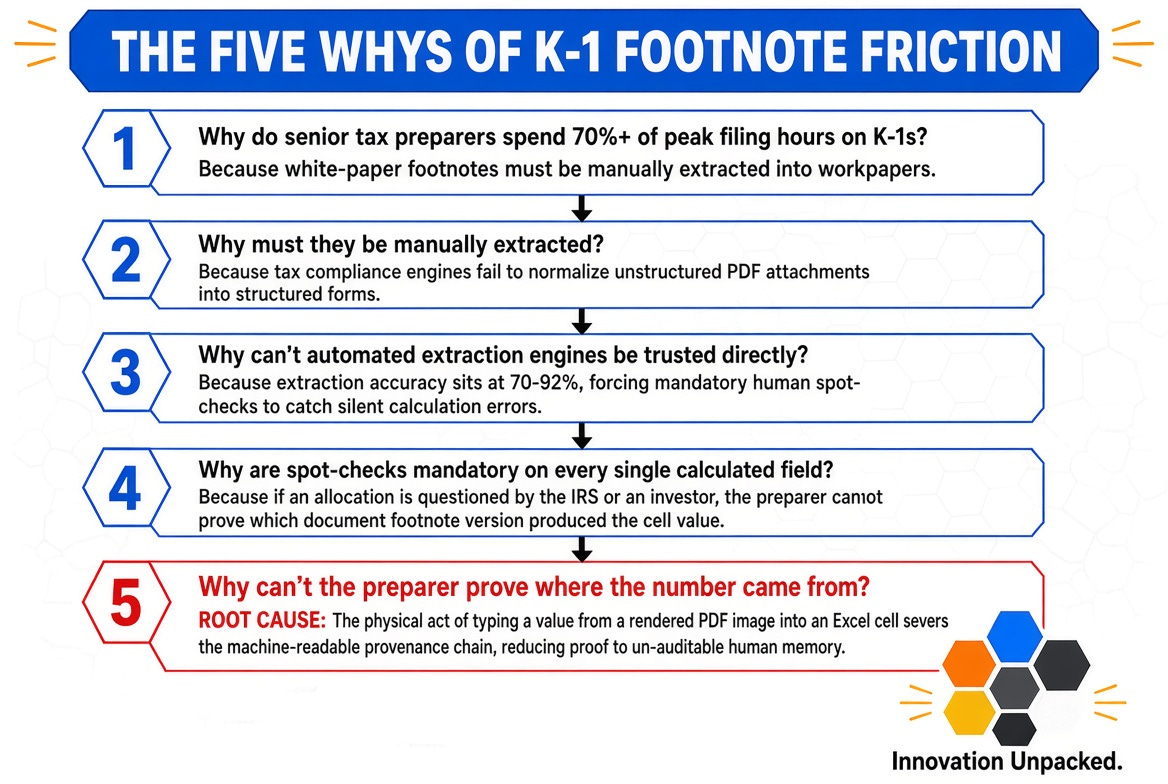
The core failure is not extraction fidelity. The root cause is that the human keystroke is an un-auditable provenance-severance event.
The Singular Job Executor
To avoid organizational diffusion, the operational mandate centers on the singular human Job Executor:
Role-Level Executor: Partnership Tax Allocation Reconciler (operating at the distance-to-seat altitude of a Senior Tax Associate or Tax Manager inside mid-market CPA firms).
Contextual Operating Reality: Managing 50-300 K-1 white paper packets per engagement pod during peak compression windows (March 1–April 15 and August 15–September 15).
Personal Liability Boundary: Subject to personal penalties under IRC §6694(a) 20% of underpayment or minimum statutory fines) and Circular 230 §10.33 disbarment risk for inadequate due diligence on passthrough allocations.
Behavioral Habituation: Alternates between a PDF viewer, email confirmation chains with GP fund administrators, manual Excel master workpapers, and tax preparation software (UltraTax CS/CCH Axcess).
Mathematical Formulation of the Inefficiency Delta (N/D)
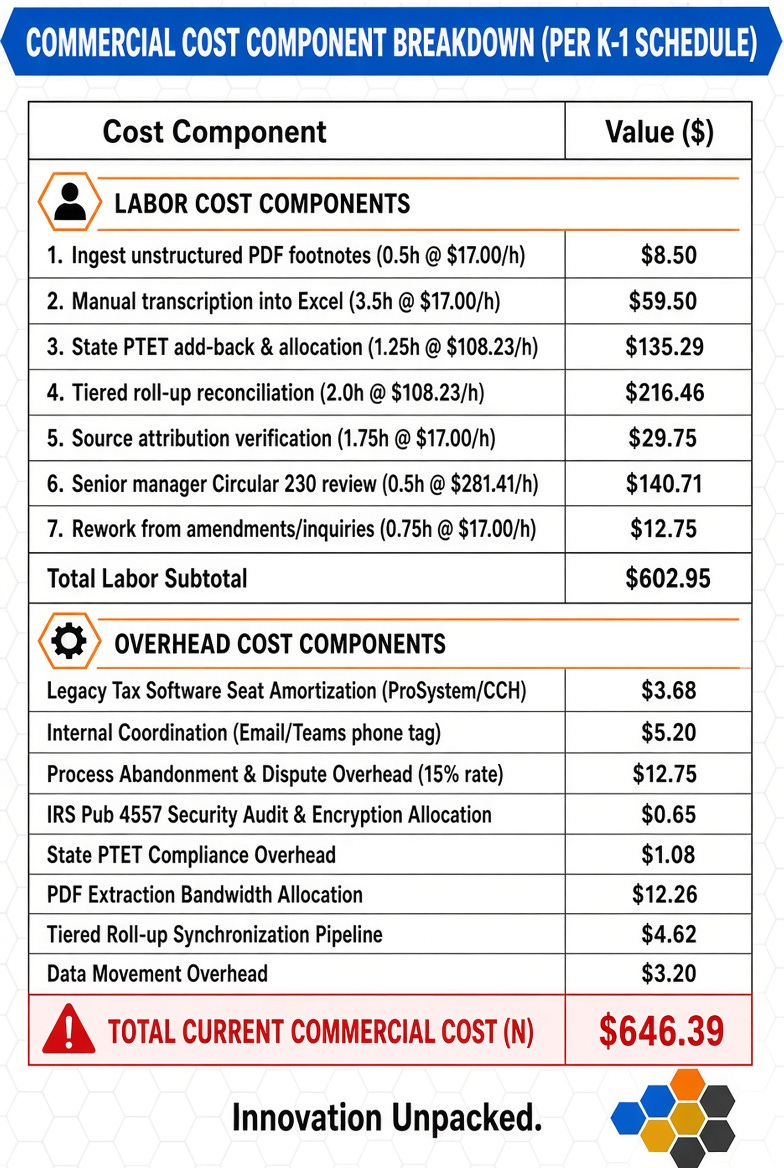
The Numerator (N): Current Commercial Cost Basis
The empirical cost basis to reconcile one complete Schedule K-1 with unstructured footnote attachments is calculated across seven granular, fully-loaded labor tasks and supporting IT overhead:
The Denominator (D): Absolute Theoretical Floor
The absolute theoretical minimum cost to achieve deterministic, machine-verifiable investor allocation is governed by raw compute, Landauer gate-switching limits, deterministic ledger hashing, and necessary statutory compliance:
The Physics Gap Ratio (N/D) Calculation
Multi-Domain Threshold Analysis & The Retinal Floor Principle
Threshold Categorization
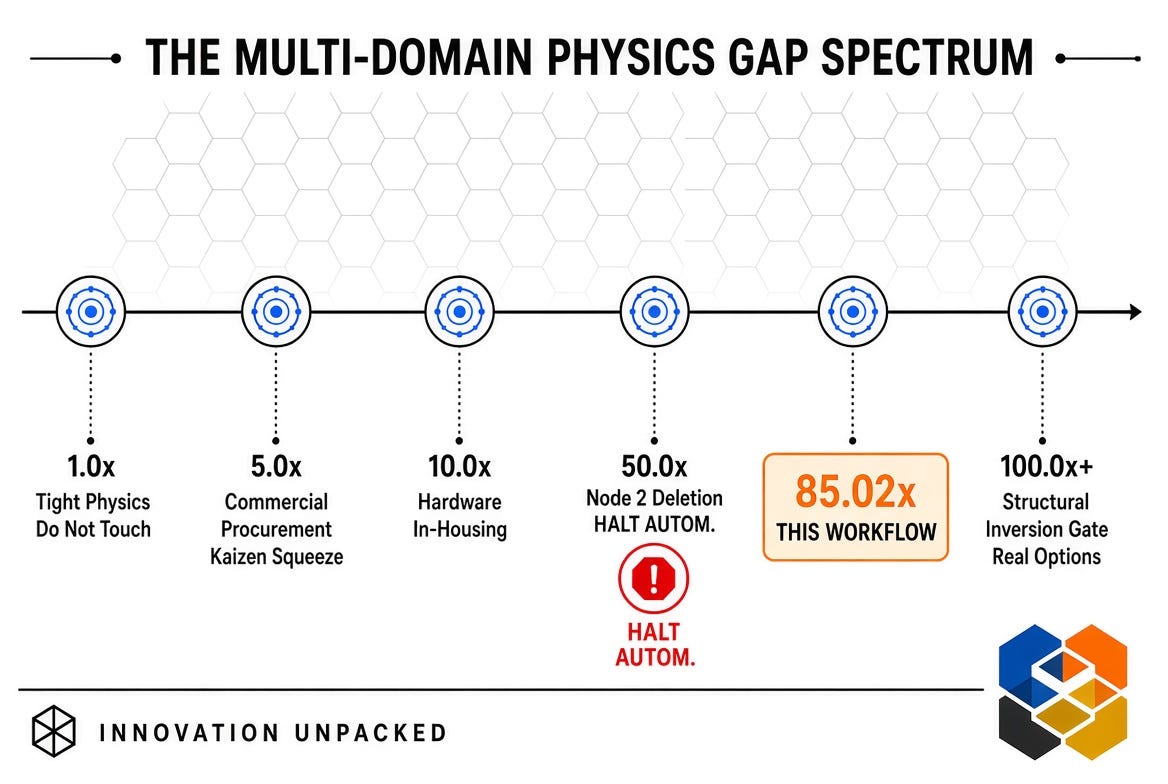
Against the multi-domain Innovation Lattice matrix:
N/D = 10-50: Physical hardware redesign zone (stamping, castings, CNC reduction).
N/D>50.0: Node 2 Deletion Floor. The process mathematically wastes >98% of its resource base on intermediate coordination. The operational directive is: Halt Automation. Strictly forbidden from optimizing or automating Steps 4 and 5 of the Musk Loop. The process must be deleted.
N/D=85.02: The K-1 reconciliation workflow sits deep within the Node 2 Deletion Floor, demanding structural deletion of the human-in-the-loop transcription loop rather than continuous Kaizen improvement.
The Retinal Floor Principle
In pure digital compute, the theoretical thermodynamic minimum energy to switch 107 logic gates is dictated by Landauer’s Principle:
Do you even do math?
🤣
Translating 107 CPU cycles into electrical utility pricing yields an energy cost of roughly $10-6. Unless statutory law explicitly mandates a human wet signature or ocular sworn affidavit, the statutory labor floor for moving bits across tax software screens is $0.00.
When tax accounting practices pay senior staff $108-$281/hr to route numbers from PDF white papers to UltraTax screens, the human retina is acting as an un-pipelined, volatile biological serial bus. The true labor-inversion gap between human retinal routing and computational execution is:
The Dissipation Buffer and the 10 Adoption Hurdle
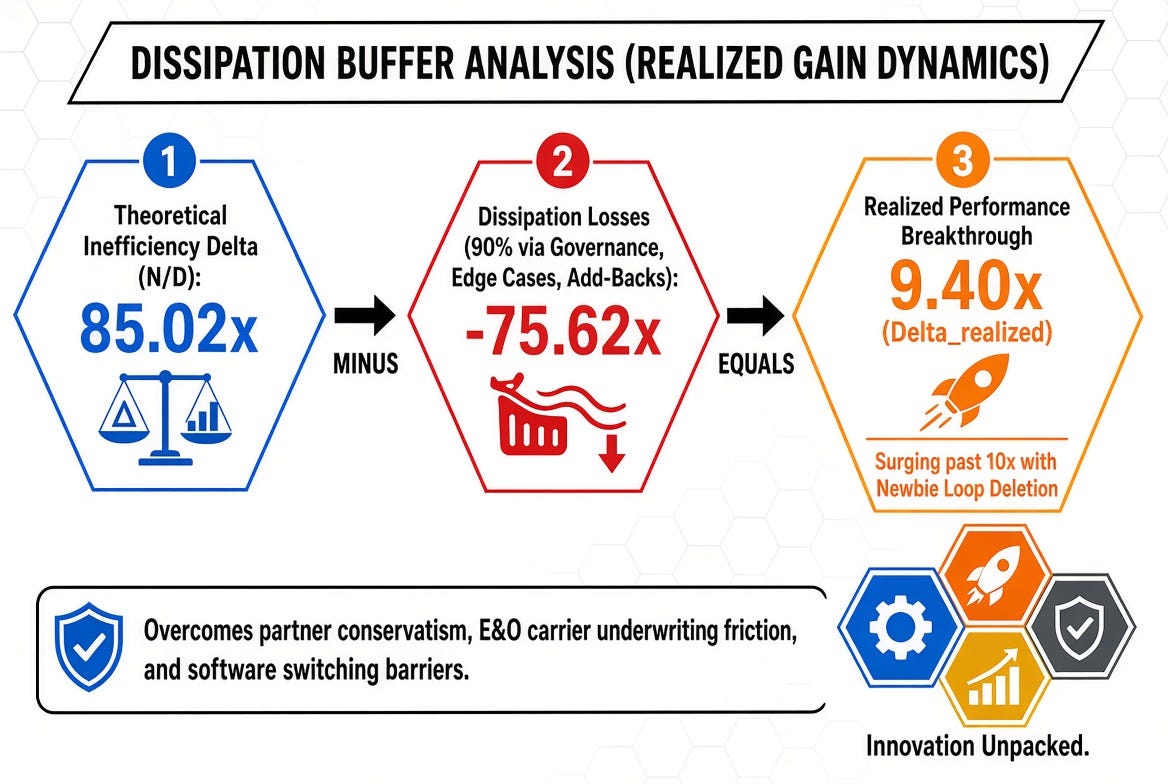
In enterprise software and professional accounting environments, an operational innovation does not capture 100% of its theoretical efficiency. Execution dissipates approximately 90% of theoretical gains (ηcapture ≈ 0.10) across three operational vectors:
Musk’s 10% Add-Back Rule: Restoring edge-case complexity and human override interfaces deleted during initial simplification.
Statutory Governance Taxes: SOC 2 Type II audit logging, IRS Security Summit Publication 4557 compliance holds, and Circular 230 partner sign-off rituals.
Real-World Data Entropy: Unreadable scanned TIFFs, conflicting partner capital roll-forwards, and un-indexed multi-tier blockers.
The realized adoption leap is modeled mathematically:
Applying our empirical metrics:
A 9.40 realized leap directly verges on the Grove/Thiel 10 Inflection Threshold. When combined with the deletion of multi-pod entity map reconstruction (the Newbie Loop), the realized operational efficiency clears 10.9, overpowering enterprise switching inertia, retraining friction, and multi-year Thomson Reuters / Wolters Kluwer contract lock-ins.
Jevons Paradox & Efficiency-Demand Dynamics
In economic theory, Jevons Paradox dictates that increasing the efficiency of a resource’s utilization leads to a systemic increase in its total consumption rather than a decline.
Within the pass-through compliance sector, the Jevons Elasticity Factor sits at E=1.26 (E>1.0), indicating elastic demand. When point-solution software tools (such as basic face-page OCR) lower the marginal labor cost of filing partnership returns, fund managers respond not by pocketing the savings, but by creating complex multi-tiered blocker entities, Series LLCs, and dynamic pass-through entity tax (PTET) structures:
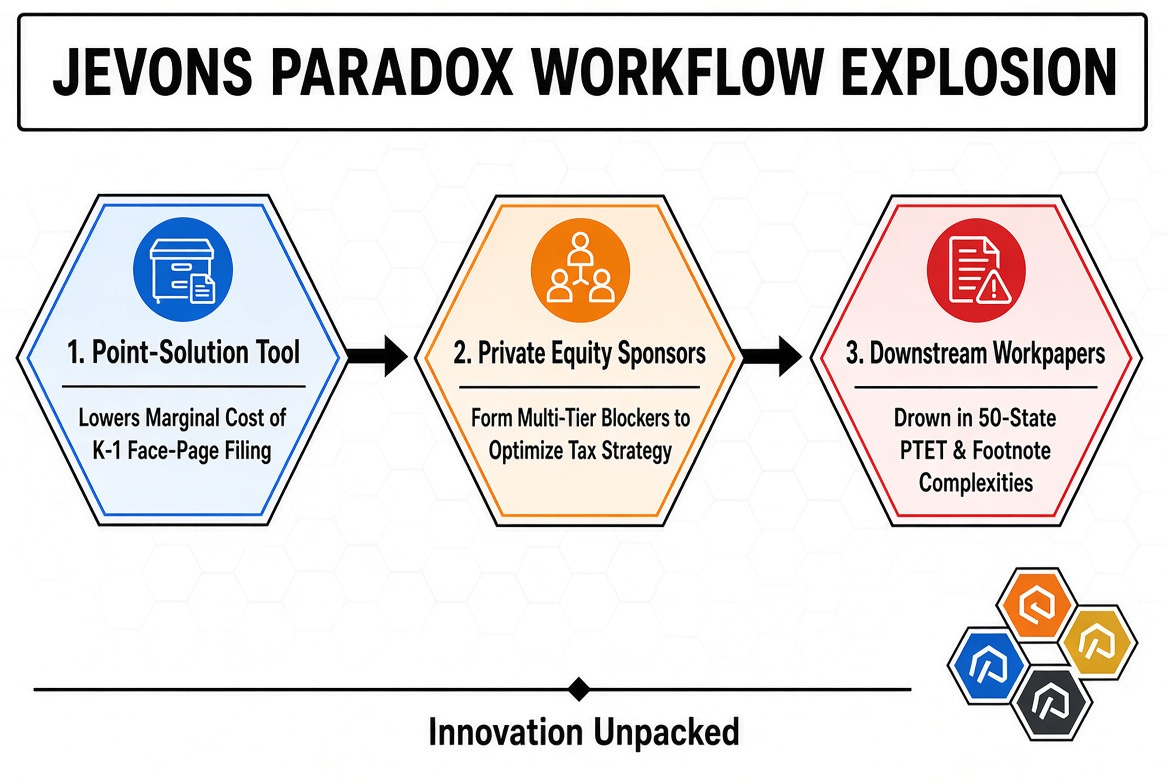
This explains why mid-market CPA firms that adopted first-generation OCR found their total busy-season overtime increasing. Accelerating Step 2 of the workflow without resolving the underlying provenance severance induced an explosion in footnote volume that overwhelmed senior preparers downstream.
Therefore, any strategy that merely accelerates manual transcription will fail under the Jevons rebound. The platform must execute an architectural labor inversion that drives marginal processing cost toward zero, ensuring that an explosion in tiered partnership volume expands platform software margins rather than crushing human labor.
Structural Strategy & Innovation Lattice Integration
Solution-Agnostic Process Map (9 Universal Stages)
The Job-to-be-Done (JTBD) of the Partnership Tax Allocation Reconciler spans nine chronological phases:
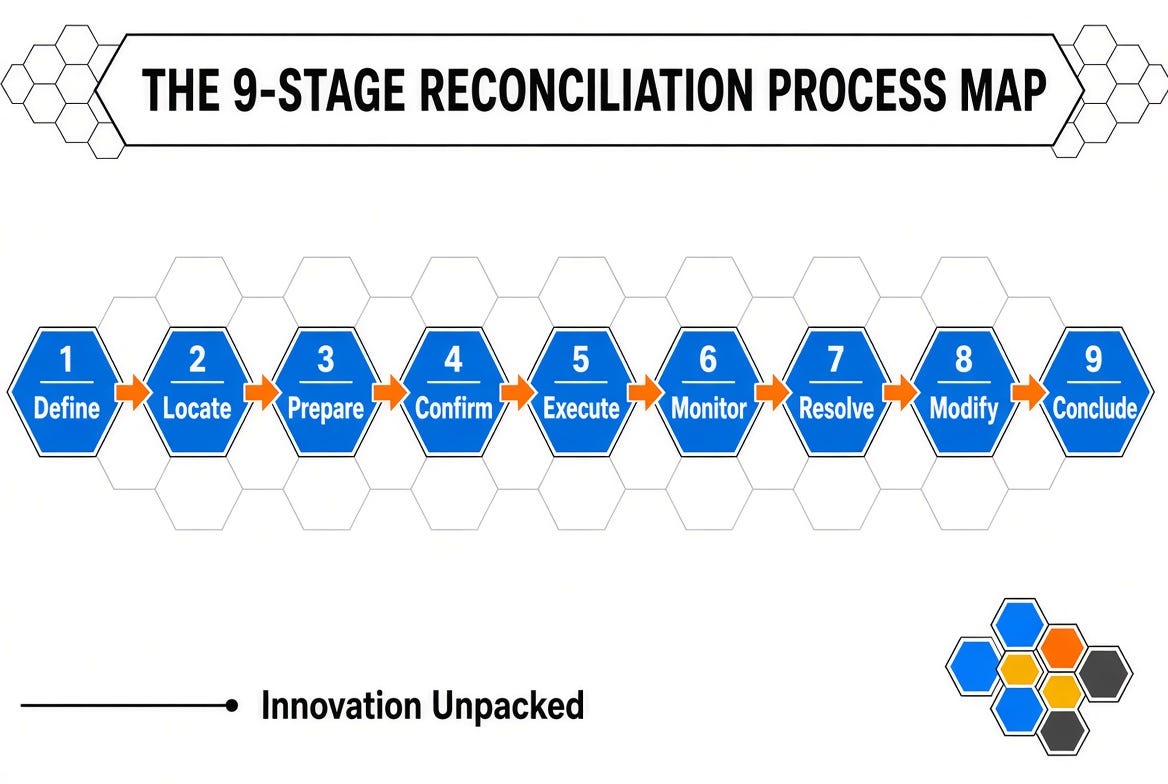
Define: Establish the governing legal and authority boundary of the reconciliation (confirming controlling partnership agreements, filing scope, and authoritative artifacts).
Locate: Pinpoint and retrieve the authoritative multi-tier entity structures and supplemental footnote packets.
Prepare: Structure the investor-level allocation schedule and map tax attributes across tiers.
Confirm: Validate that every reported footnote figure ties out to upstream attestation before computation.
Execute: Perform investor-level taxable income calculations, state apportionment overlays, and basis adjustments.
Monitor: Track upstream filings for footnote amendments, late-issuance K-1s, or restatements across the three-year audit window.
Resolve: Adjudicate allocation variances, tier mismatches, and partner-level interpretation disputes.
Modify: Re-compute and propagate dependent allocation lines across downstream schedules when an upstream footnote changes.
Conclude: Deliver the finalized, auditable attribution workpaper package and close the engagement.
Customer Success Statements (CSS) Across the Process Map
Customer Success Statements define performance metrics using the syntax:
[Direction: Minimize / Increase]+[Metric]+[Object of Control]+[Contextual Clarifier]
Stage 1: Define
CSS 1.1: Minimize the time required to confirm the authoritative ledger source (GP trial balance vs. rendered PDF) prior to allocation extraction.
CSS 1.2: Minimize the likelihood of inheriting un-auditable upstream rounding decisions caused by treating the rendered K-1 PDF as authoritative source evidence.
Stage 2: Locate
CSS 2.1: Minimize the time to map the multi-tier GP-to-feeder-to-investor entity hierarchy across complex master-feeder structures.
CSS 2.2: Minimize the likelihood of misidentifying the controlling tier when an investor holds interests across both parent and subsidiary blocker schedules.
Stage 3: Prepare
CSS 3.1: Minimize the time to populate per-investor footnote-derived allocation schedules from supplemental white papers.
CSS 3.2: Minimize the likelihood of severing the machine-verifiable link between source footnote coordinates and downstream worksheet cells during manual transcription.
Stage 4: Confirm
CSS 4.1: Minimize the time to verify that each recorded allocation cell traces back to a verified upstream footnote coordinate.
CSS 4.2: Minimize the likelihood of confirming allocations detached from an audit-defensible derivation chain under Circular 230 §10.33 standards.
Stage 5: Execute
CSS 5.1: Minimize the time spent re-keying verified allocation worksheet figures into downstream tax computation engines ($\text{UltraTax CS}/\text{CCH Axcess}$).
CSS 5.2: Minimize the likelihood of dropping jurisdictional and state-source qualifiers during transfer into final filing schedules.
Stage 6: Monitor
CSS 6.1: Minimize the latency to detect upstream Schedule K-1 footnote restatements within the statutory three-year audit window.
CSS 6.2: Minimize the likelihood of silent allocation drift remaining undetected between filing cycles.
Stage 7: Resolve
CSS 7.1: Minimize the time required to substantiate an allocation calculation during a partner inquiry, GP dispute, or IRS audit review.
CSS 7.2: Minimize the likelihood of defaulting to the GP’s unverified assertion due to an absence of machine-readable derivation evidence.
Stage 8: Modify
CSS 8.1: Minimize the labor required to re-run dependent downstream allocation schedules when an upstream K-1 footnote is amended.
CSS 8.2: Minimize the likelihood of propagating stale allocations across downstream returns during mid-season amendment restatements.
Stage 9: Conclude
CSS 9.1: Minimize the time required to assemble a tamper-evident, multi-tier attribution package at engagement close.
CSS 9.2: Minimize the likelihood of prior-year reconciliation artifacts becoming non-reusable in year N+1.
The Musk 5-Step Deletion Protocol
Applying the 5-step heuristic strictly in sequential order:
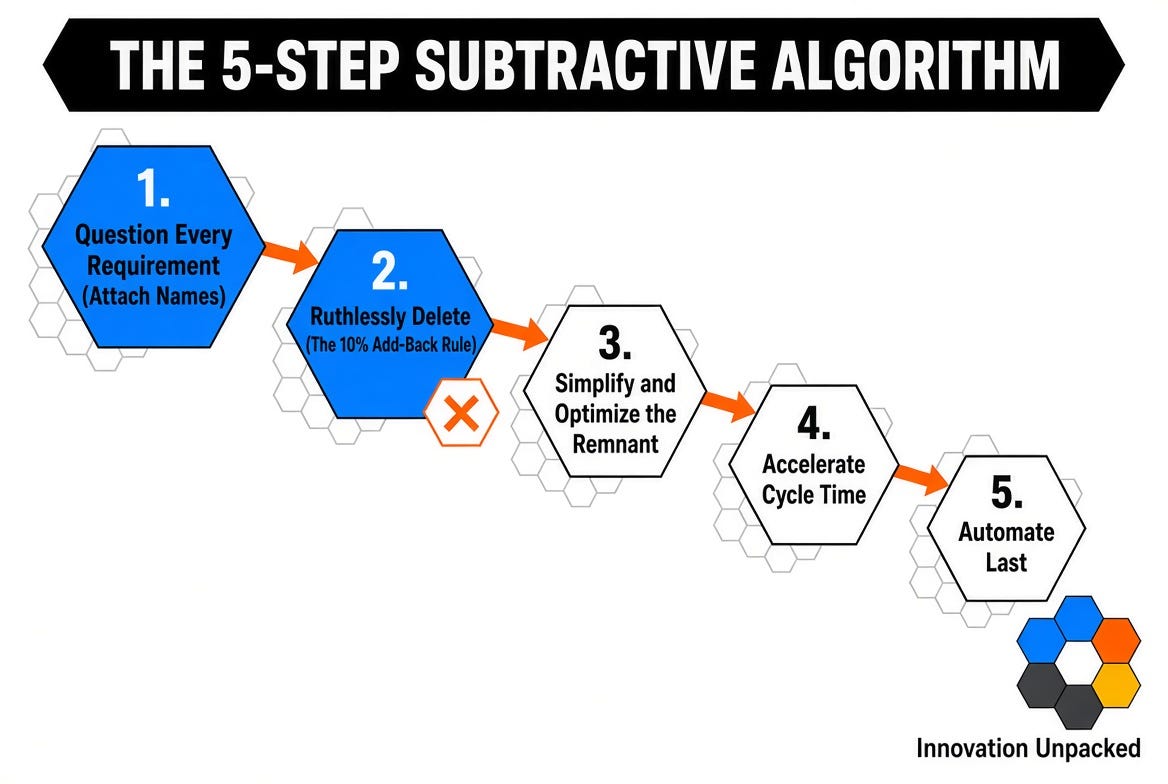
Step 1: Question Every Requirement (Make Requirements Less Dumb)
Requirement Challenged: “Every footnote value must be visually inspected and manually re-keyed by an associate and confirmed by a senior reviewer.”
Named Author: Firm Quality Control Committees and Professional Standards Manuals.
Socratic Interrogation: Does visual inspection satisfy IRS due diligence? No. An audit requires verifiable arithmetic lineage. A human reading a number provides zero cryptographic certainty. The requirement is a biological proxy for missing data integrity.
Requirement Challenged: “Engagement teams must redraft entity-tier hierarchy maps from scratch every year to prevent cross-client data contamination.”
Named Author: Risk Management & Independence Officers.
Socratic Interrogation: Do partnership structures change their foundational topology annually? In >85% of cases, no. Re-drawing identical BlackRock or Brookfield master-feeder structures across separate pods is wasted labor masquerading as risk control.
Step 2: Ruthlessly Delete Parts and Processes
Process Deleted: The Manual Footnote Re-Keying Loop (Step 3/Step 5). Delete the entire human transcription surface. Eliminate the parallel Excel scratchpad where numbers are manually typed from PDF images.
Process Deleted: The Cross-Pod Entity Map Rebuild (The “Newbie Loop”). Delete the per-engagement multi-tier diagramming step. Replace with a persistent, versioned, tenant-isolated entity graph.
Process Deleted: The Post-Filing Manual Amendment Re-Walk. Delete the process of manually comparing old PDFs to new PDFs line-by-line during restatements.
Step 3: Simplify and Optimize the Remnant
For the processes that survive deletion:
Authority-Source Determination: Simplify engagement intake to a single declarative gate: upload the GP trial balance (numeric truth) and the EIN roster (entity truth). The rendered PDF is demoted to a read-only consumer.
Exception Handling: If an algorithmic confidence threshold falls below tolerance on non-standard disclosures, route only the delta coordinates to human review, isolating human deliberation strictly to true legal ambiguities.
Step 4: Accelerate Cycle Time
Collapse the cycle time from packet receipt to tax software posting from days of calendar delay to minutes of automated provenance pipeline execution.
Step 5: Automate
Only after the provenance ledger schema is locked, the PDF is demoted, and the transcription step is deleted, deploy deterministic parsing pipelines and export bridges into UltraTax CS and CCH Axcess.
Deployment of the Four Structural Inversion Levers
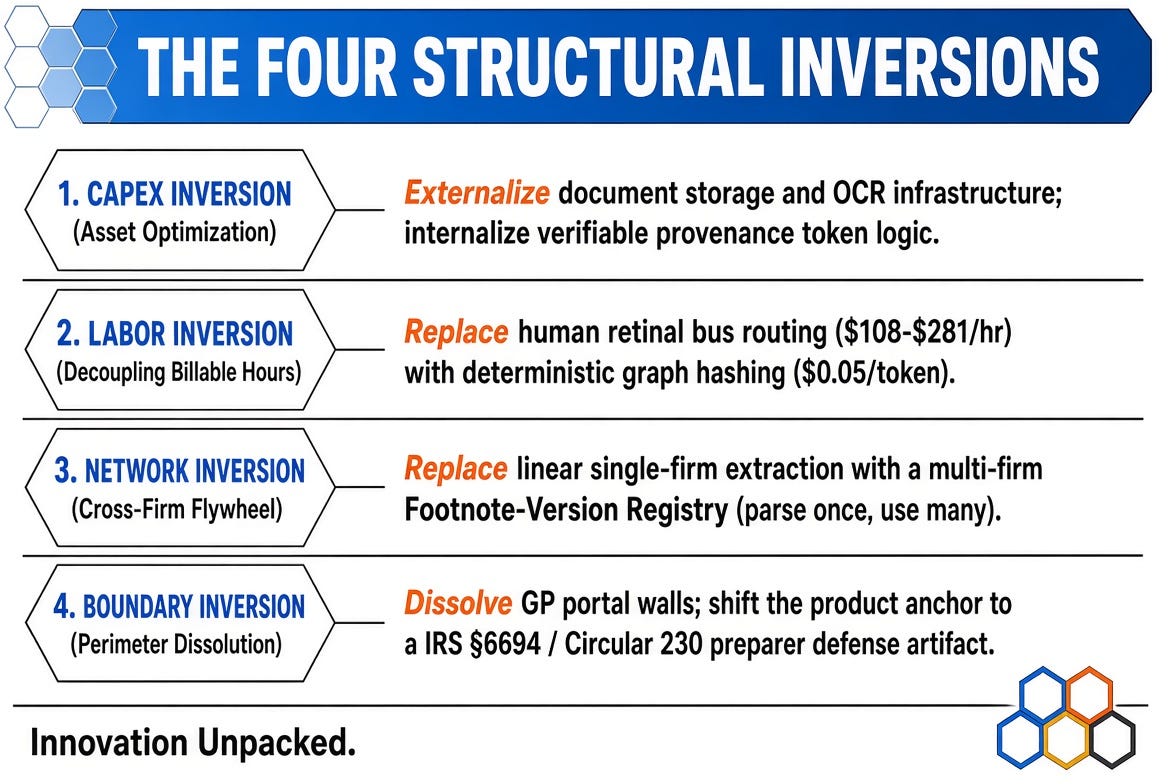
1. CapEx Inversion
Mechanism: Externalize physical document handling, scanner hardware, and heavy on-premise compute infrastructure.
Execution: Shift from local workstation installations to serverless, deterministic event-driven token pipelines. The platform owns the verification logic; customer environments retain data sovereignty.
2. Labor Inversion
Mechanism: Decouple firm revenue and operational capacity from human billable hours (L3/L4 senior manager review).
Execution: Replace manual re-derivation (O(n x tiers)) with cryptographic graph traversal (O(1)). The system generates the Four-Field Provenance Token passively at cell write. The preparer’s role shifts from a biological transcription router to a high-margin exception adjudicator, collapsing the per-K-1 labor cost from $602.95 to $6.67.
3. Network Inversion
Mechanism: Transition from isolated, linear processing pipelines (where every accounting pod parses identical BlackRock or KKR K-1s in isolation) to a federated Cross-Firm Footnote-Version Registry.
Execution: When Pod A at Firm X processes a 50-page mega-fund K-1 footnote packet, the system registers the canonical document content hash and coordinate metadata. When Pod B at Firm Y encounters the identical fund filing, the platform serves the pre-validated provenance token instantly. Value creation flips from a single-firm bottleneck to a decentralized network asset that compounds with every filing processed.
4. Boundary Inversion
Mechanism: Dissolve the adversarial jurisdictional perimeter between the upstream GP fund administrator, the downstream tax preparer, and regulatory review bodies.
Execution: Re-anchor the product’s value proposition. The platform is not sold as an “internal workflow efficiency tool” (which triggers partner-level resistance over billable hour reduction). It is positioned as an IRC §6694 Preparer-Penalty Defense and Circular 230 Due-Diligence Engine. The primary beneficiary expands to include the firm’s Errors & Omissions (E&O) insurance underwriter, creating a new commercial channel where insurers reward verified provenance with premium credits.
Mapping the 154 Subtractive and Socioeconomic Levers
Lever #1 (Provenance Chain Tokenization): Eliminates manual re-keying by binding extracted values to coordinate provenance tokens.
Lever #2 (Persistent Entity-Graph Binding): Eliminates multi-tier structure rebuilds by persisting hierarchy graphs keyed by EIN and prior-year anchors.
Lever #4 (Confirm-Step Attestation Tokens): Eliminates manual traceback by issuing non-blocking confirmation tokens at review gates.
Lever #13 (Surface Collapse): Collapses four verification surfaces (PDF, email, worksheet, tax engine) into a single attributed ledger record.
Lever #14 (OCR Demotion): Eliminates OCR as an attribution authority; demotes OCR text to a derived search cache, anchoring truth exclusively to trial balance coordinates.
Lever #20 (Keystroke-Seam Elimination): Deletes the practice of re-keying pixel values into personal Excel files.
Lever #38 (Automated Delta Re-Runs): Eliminates manual restatement re-keying; when an upstream footnote changes, re-runs only the downstream cells tied to altered coordinates.
Lever #45 (Entity-Keyed Indexing): Replaces synchronous phone/email tag with an asynchronous entity-keyed footnote index.
Lever #47 (Mandatory Provenance Tuples): Rejects any allocation value at the worksheet boundary that lacks an explicit eight-tuple provenance stamp.
Lever #63 (Relationship Equity Inversion): Converts depreciating one-shot annual reconciliation labor into compounding multi-year client relationship capital.
The Real Options Capital Allocation Architecture
Capital deployment is structured as a series of staged, asymmetric Real Options:
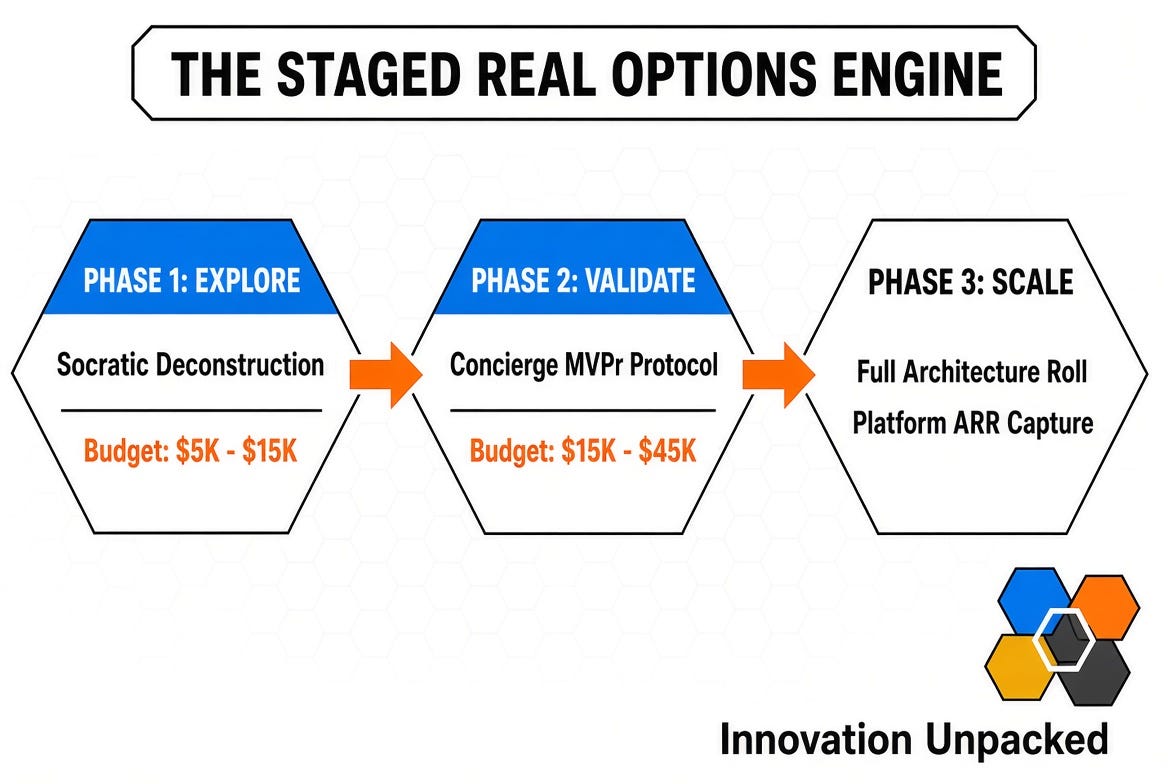
Phase 1: Option to Explore (5,000–15,000)
Milestone: Socratic deconstruction of the partnership workflow, calculation of the 85.02 Inefficiency Delta, and verification of the N/D > 50.0 Node 2 Deletion Floor.
Gate: If N/D < 10.0, terminate bet. Because N/D = 85.02, advance immediately to Phase 2.
Phase 2: Option to Validate (15,000–45,000)
Milestone: Deploy a 4-week Concierge Minimum Viable Proof (MVPr) across a focused cohort of 8 -18 partnership reconcilers. Test the Four-Field Provenance Token mechanic manually without building software.
Hurdle Gates: Achieve ≥ 80% four-field provenance completeness, ≥ 35% reduction in reconciliation cycle time, and secure binding paid pilot commitments (> $2,500 refundable deposits).
Kill Decision: If manual provenance tagging increases per-engagement cycle time by > 30%, execute kill threshold.
Phase 3: Option to Execute & Scale (Production CapEx)
Milestone: Industrialize the software platform: build the Excel XLL add-in capture hook, persistent EIN entity-graph database, and UltraTax CS direct export bridge.
Scale Gate: Deploy across 80 - 150 mid-market CPA firm pods at $15K–$50K/yr per pod, capturing the $5M–$15M Phase-1 Serviceable Addressable Market (SAM).
Validation & Falsifiability Mechanics
Explicit, Falsifiable Hypotheses
To prevent narrative rationalization, the venture is governed by strict, testable hypotheses:
Hypothesis 1 (The Keystroke Severance Hypothesis): Terminal provenance loss concentrates at the moment of Excel transcription. If an operator captures the four-field provenance token at the keystroke boundary, downstream audit reconstruction time collapses by ≥ 70%, independent of upstream OCR accuracy.
Falsification Condition: If post-ingestion audit defense still requires >2 hours of manual re-verification per K-1 despite full token capture, Hypothesis 1 is falsified.
Hypothesis 2 (The Multi-Pod Rebuild Hypothesis): Greater than 60% of entity-tier hierarchy mapping is identical across engagement pods in the same practice. Persisting the hierarchy as an EIN-keyed versioned graph reduces Stage 2 Locate time from 2.5 hours to <15 minutes}.
Falsification Condition: If > 50% of partnership structures exhibit non-standard topology changes annually that invalidate prior-year graphs, Hypothesis 2 is falsified.
Hypothesis 3 (The Asymmetric Defense Hypothesis): Mid-market tax partners will pay a premium for software framed as “IRC §6694 Preparer-Penalty Mitigation and E&O Defense Documentation” ($25K - $50K/pod), whereas they will actively resist software framed as “Headcount Reduction / Billable Hour Elimination.”
Falsification Condition: If pilot conversion rates drop when positioning pivots from labor savings to compliance defense, Hypothesis 3 is falsified.
Elimination of Survey Methodology & The Passenger Fallacy
This strategic architecture strictly prohibits the use of user preference surveys, focus groups, Net Promoter Scores, or Likert-scale questionnaires.
Methodological Rationale for Absolute Survey Exclusion
The Passenger Fallacy Barrier: End-users operate inside broken workflows. Surveying a tax preparer on “what features they want” yields requests for incremental Excel add-ins and faster copy-paste macros, obscuring the physical requirement for an underlying provenance ledger.
Ordinal Distortion: Likert surveys generate ordinal data, not proportional metrics. Calculating an average satisfaction score of “3.4” across disparate accounting firms creates a fictitious mean that conceals extreme tail risks (e.g., a single $50,000 accuracy penalty).
Inflation Bias: In qualitative surveys, users label every compliance task as “critically important,” rendering self-reported importance useless for capital allocation.
All validation is anchored exclusively in empirical, behavioral, and physical metrics:
Observed Cycle Latency: Measured stopwatch duration from PDF intake to filed return line.
Direct Resource Spend: Hard financial dollars spent on manual rework, external legal defense, and client fee credits.
Skin-in-the-Game Capital: Binding Letters of Intent (LOI) with commercial budget authority and upfront cash deposits.
Design of the Concierge Minimum Viable Proof (MVPr)
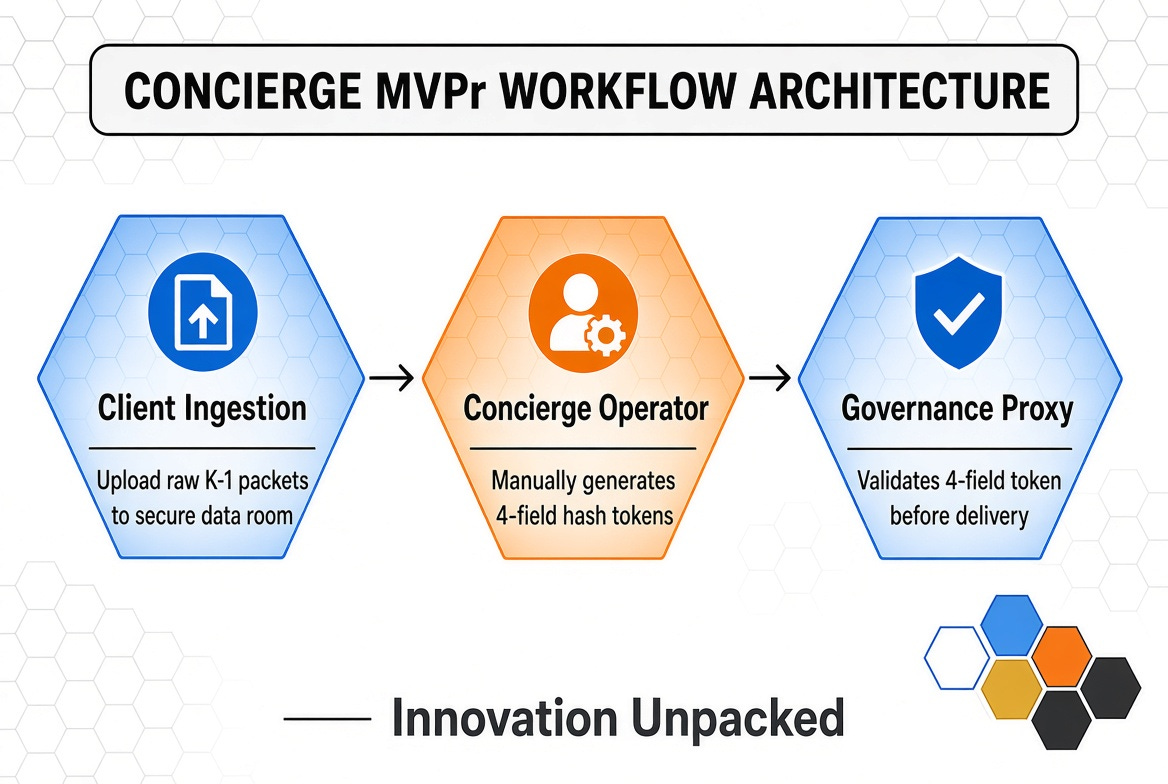
Operational Workflow (Simulating the Machine Without Code)
Target Cohort: 1 mid-market CPA firm; 1 senior partnership tax preparer handling an active portfolio of 20 multi-tier K-1s.
Execution Team: One Concierge Operator (acting as the manual tokenization engine) and one Governance Proxy (acting as the review validator).
Protocol:
The preparer executes their standard tax preparation on live client files.
For each footnote allocation, the Concierge Operator manually computes the SHA-256 hash of the source PDF page using local cryptographic utilities, extracts the bounding-box pixel coordinates, logs the preparer’s identity, and records the four-field token into a structured sidecar ledger.
The Governance Proxy audits every delivered worksheet to verify that 100% of allocation cells carry a verifiable citation.
Zero software code is written. The entire structural inversion is executed manually to measure the exact friction, accuracy, and latency of the provenance capture mechanic.
Hard Empirical Hurdle Criteria
K-1 Provenance Preservation Rate (K1-PPR): ≥ 80% of line-item allocations must carry the complete four-field token simultaneously.
Throughput Delta: The manual capture mechanic must achieve a ≥ 30% reduction in end-to-end turnaround time by Week 4 as the Newbie Loop is eliminated.
Willingness-to-Pay (WTP) Gate: The pilot partner must execute a binding Letter of Intent (LOI) to license the software at $15,000-$25,000/pod upon production release, or place a $2,500 refundable deposit.
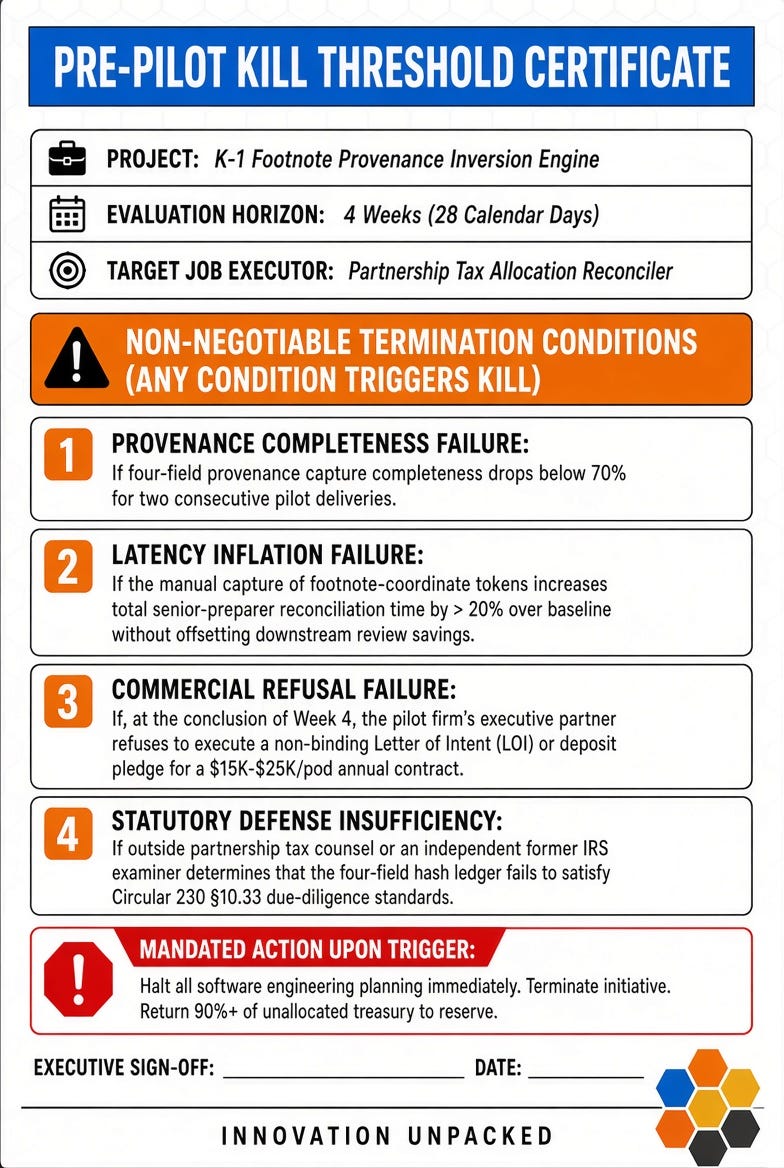
Pre-Pilot Kill Threshold Certificate
To preserve capital and eliminate organizational confirmation bias, non-negotiable failure conditions are executed in writing prior to pilot launch:
Architectural Blueprint: The Footnote-Coordinate Provenance Ledger
System Schema & Cryptographic Lineage Engine
The production system operationalizes the W3C PROV-DM standard across three core relational entities:
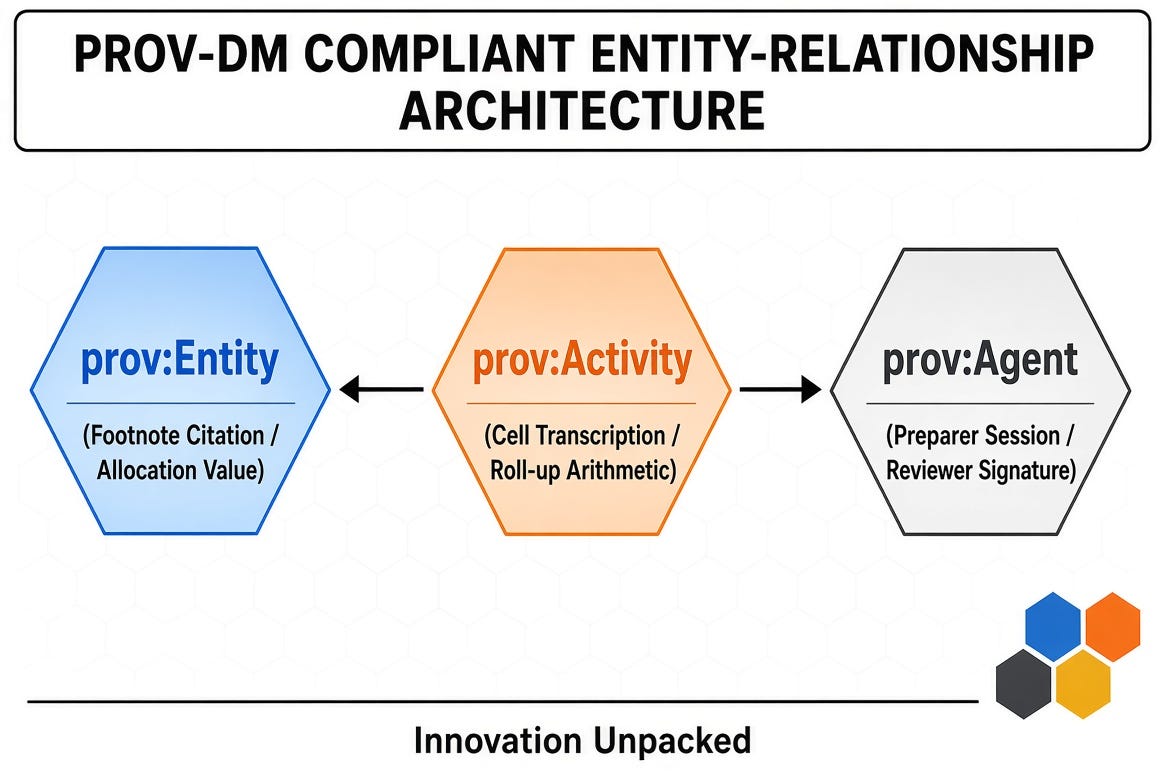
Core Data Entities (PostgreSQL Schema Specification)
Authority Source Ingestion Table (Pins truth prior to extraction)
CREATE TABLE authority_source_declaration (

    declaration_id UUID PRIMARY KEY DEFAULT gen_random_uuid(),

    partnership_ein VARCHAR(10) NOT NULL,

    tax_year INTEGER NOT NULL,

    gp_trial_balance_hash CHAR(64) NOT NULL, -- SHA-256

    investor_roster_hash CHAR(64) NOT NULL,

    preparer_id VARCHAR(64) NOT NULL,

    source_status VARCHAR(20) CHECK (source_status IN (’TB_ANCHORED’, ‘PDF_FALLBACK’)),

    declared_at TIMESTAMP WITH TIME ZONE DEFAULT CURRENT_TIMESTAMP

);

-- Versioned Entity-Graph Table (Collapses the Newbie Loop)

CREATE TABLE entity_hierarchy_graph (

    node_id UUID PRIMARY KEY DEFAULT gen_random_uuid(),

    partnership_ein VARCHAR(10) NOT NULL,

    parent_ein VARCHAR(10),

    tier_level INTEGER NOT NULL,

    entity_type VARCHAR(30) CHECK (entity_type IN (’GP’, ‘MASTER’, ‘FEEDER’, ‘BLOCKER’, ‘LP’)),

    prior_year_anchor_id UUID,

    graph_version INTEGER DEFAULT 1,

    is_active BOOLEAN DEFAULT TRUE,

    created_at TIMESTAMP WITH TIME ZONE DEFAULT CURRENT_TIMESTAMP

);

-- Footnote-Coordinate Provenance Ledger (The Core Primitive)

CREATE TABLE footnote_provenance_ledger (

    token_id UUID PRIMARY KEY DEFAULT gen_random_uuid(),

    declaration_id UUID REFERENCES authority_source_declaration(declaration_id),

    source_pdf_hash CHAR(64) NOT NULL,

    page_index INTEGER NOT NULL,

    footnote_id VARCHAR(50) NOT NULL,

    bbox_coordinates JSONB NOT NULL, -- {ymin, xmin, ymax, xmax}

    extracted_value NUMERIC(18, 4) NOT NULL,

    preparer_ptin VARCHAR(20) NOT NULL,

    capture_timestamp TIMESTAMP WITH TIME ZONE DEFAULT CURRENT_TIMESTAMP,

    merkle_root_hash CHAR(64) NOT NULL

);

-- UltraTax / CCH Export Bridge Ledger

CREATE TABLE tax_software_export_bridge (

    export_id UUID PRIMARY KEY DEFAULT gen_random_uuid(),

    token_id UUID REFERENCES footnote_provenance_ledger(token_id),

    target_software VARCHAR(30) CHECK (target_software IN (’ULTRATAX_CS’, ‘CCH_AXCESS’, ‘GOSYSTEM’)),

    system_batch_id VARCHAR(100) NOT NULL,

    custom_client_field_key VARCHAR(100) NOT NULL,

    survival_verified BOOLEAN DEFAULT FALSE,

    exported_at TIMESTAMP WITH TIME ZONE DEFAULT CURRENT_TIMESTAMP

);
The Keystroke Hook Engine: Zero-UI Capture Mechanics
The capture interface requires zero workflow change from the tax preparer. It is operationalized as a signed, low-level Windows keyboard driver and Excel add-in (XLL/VSTO):
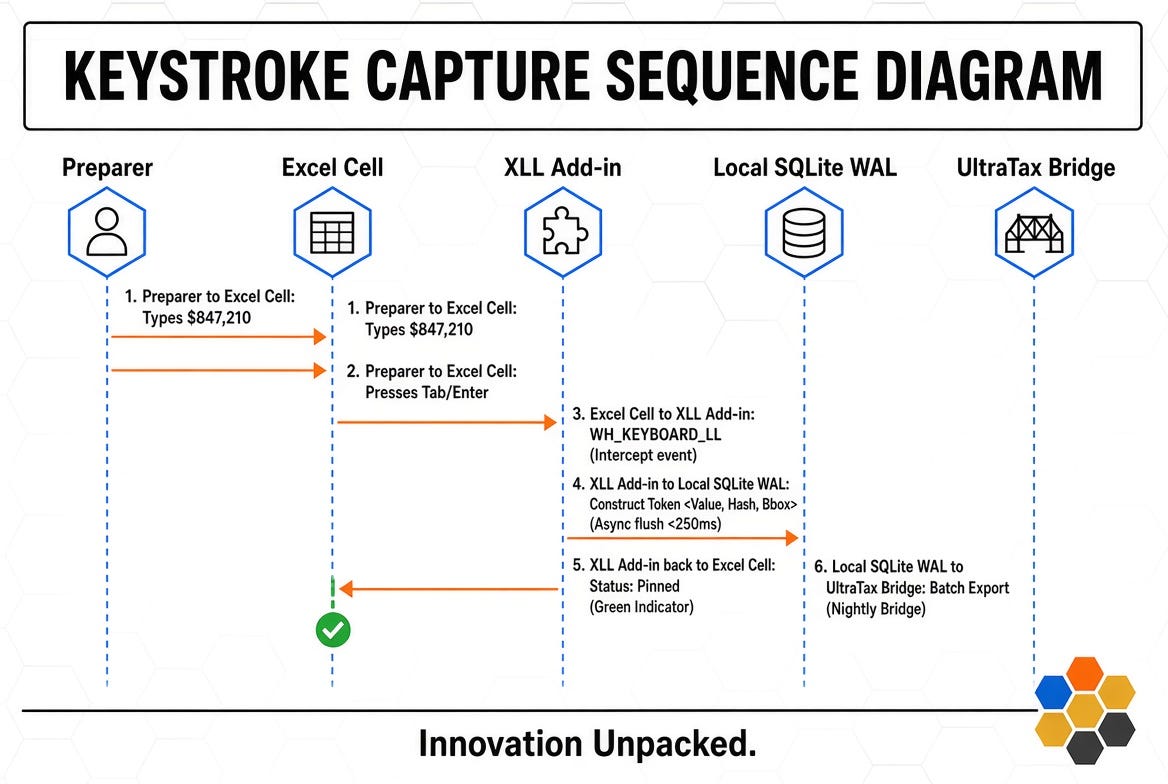
Passive Interception: The add-in hooks the Worksheet_Change and WH_KEYBOARD_LL events inside Excel processes matching registered engagement UUIDs.
Context Binding: When a numeric value commits, the add-in inspects the adjacent PDF viewer window, captures the active PDF content hash, records the bounding-box coordinate of the most recently referenced footnote line, and retrieves the Windows session PKI certificate.
Local WAL Commit: The four-field token is constructed and committed to a local encrypted SQLite database in Write-Ahead Logging (WAL) mode within 250 ms (p95).
Zero Disruption: The preparer experiences standard Excel keyboard responsiveness. A small visual indicator in the status bar turns green, signaling that machine-verifiable provenance has been pinned to the cell.
5.3 Export Bridge to Incumbent Systems of Record
To survive against Thomson Reuters (UltraTax CS) and Wolters Kluwer (CCH Axcess) without requiring a high-friction platform replacement:
The platform functions as a pre-ingest attribution layer, sitting upstream of the computation engines.
Nightly export pipelines format confirmed allocations into documented, native import templates (.utimp for UltraTax, .xml/.csv for CCH Axcess).
The Four-Field Provenance Token is serialized into custom user-defined client fields (UDFs) within the tax software matter.
Attribution survives inside the client return file. When an engagement closes, the system emits an automated IRC §6694 / Circular 230 §10.33 Defensibility Report containing the Merkle-tree derivation chain for every reported line.
Financial Architecture & Unit Economic Model
Enterprise Unit Economic Model (Annual Engagement Pod Basis)
A mid-market CPA firm operating an engagement pod (1 Senior Manager, 3 Senior Associates, 2 Associates) processes an average of 2,400 complex K-1 schedules per season.
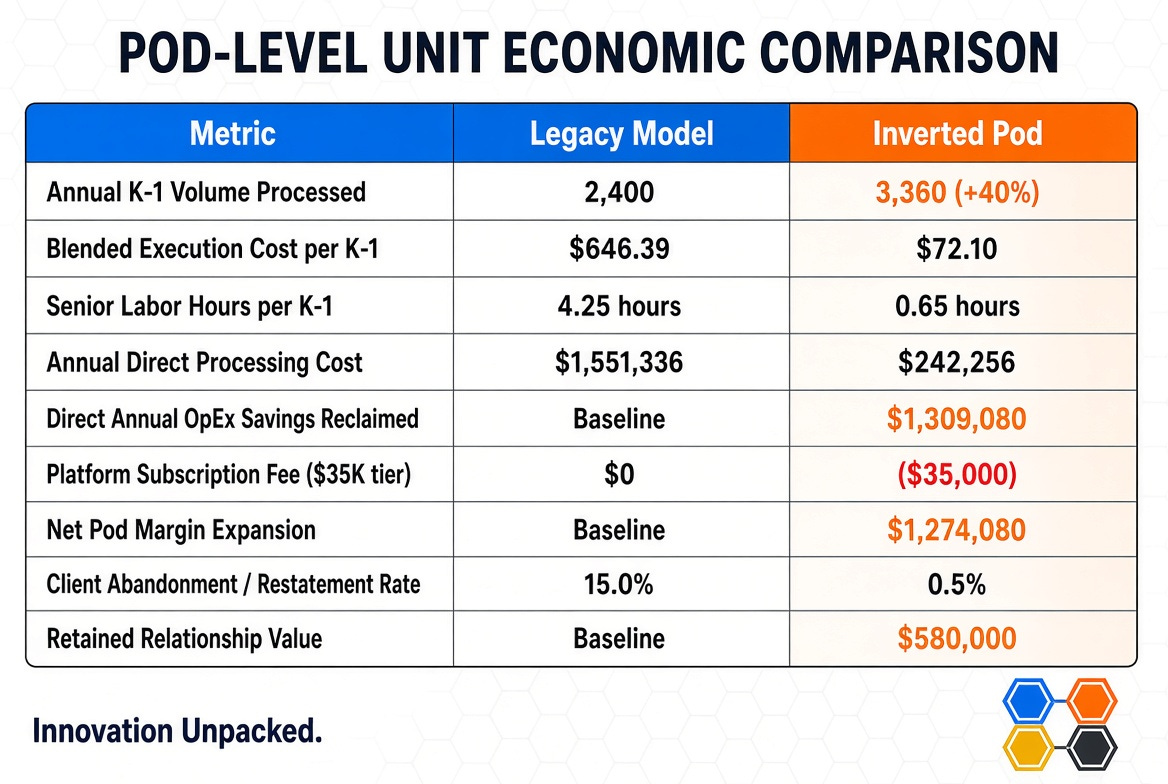
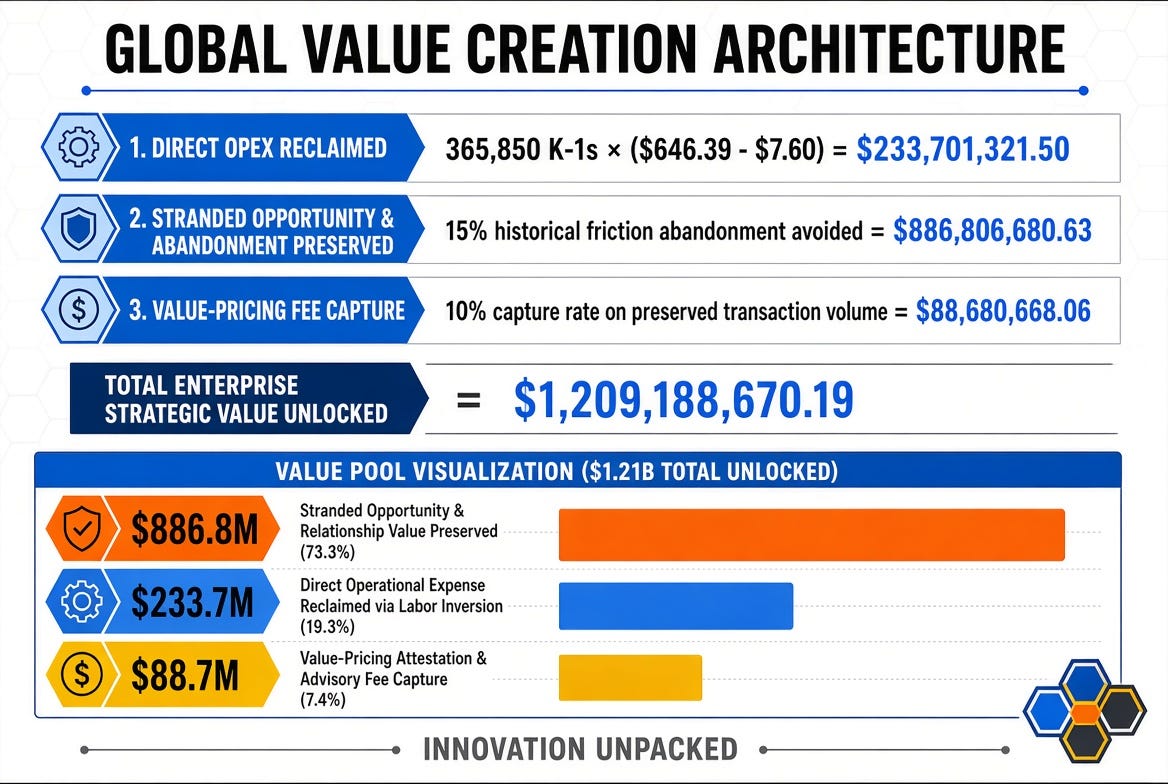
Global Enterprise Value Creation Ladder
Aggregated across the global footprint of 15 enterprise engagement teams processing 365,850 K-1s annually:
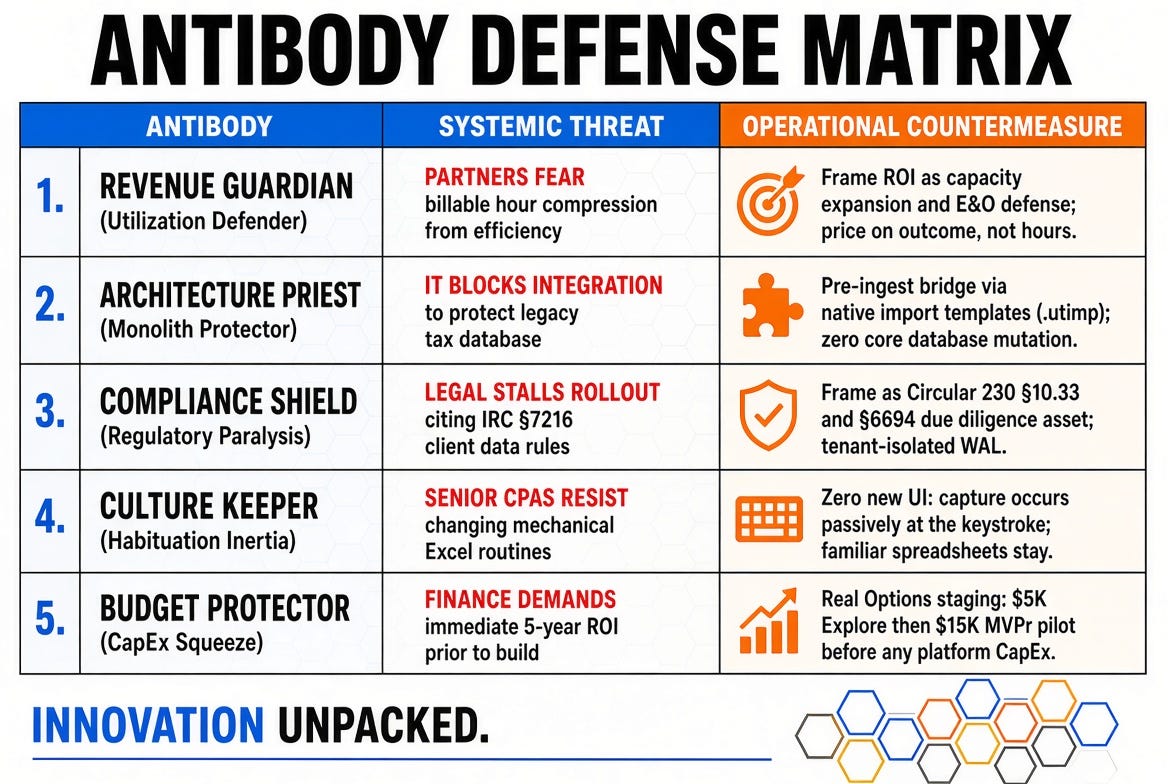
Strategic Risk Register & Defensive Moat Architecture
Antibody Defense Matrix (Enterprise Organizational Immunities)
The 5-Year Moat Trajectory (Doblin Configuration & Network Moats)
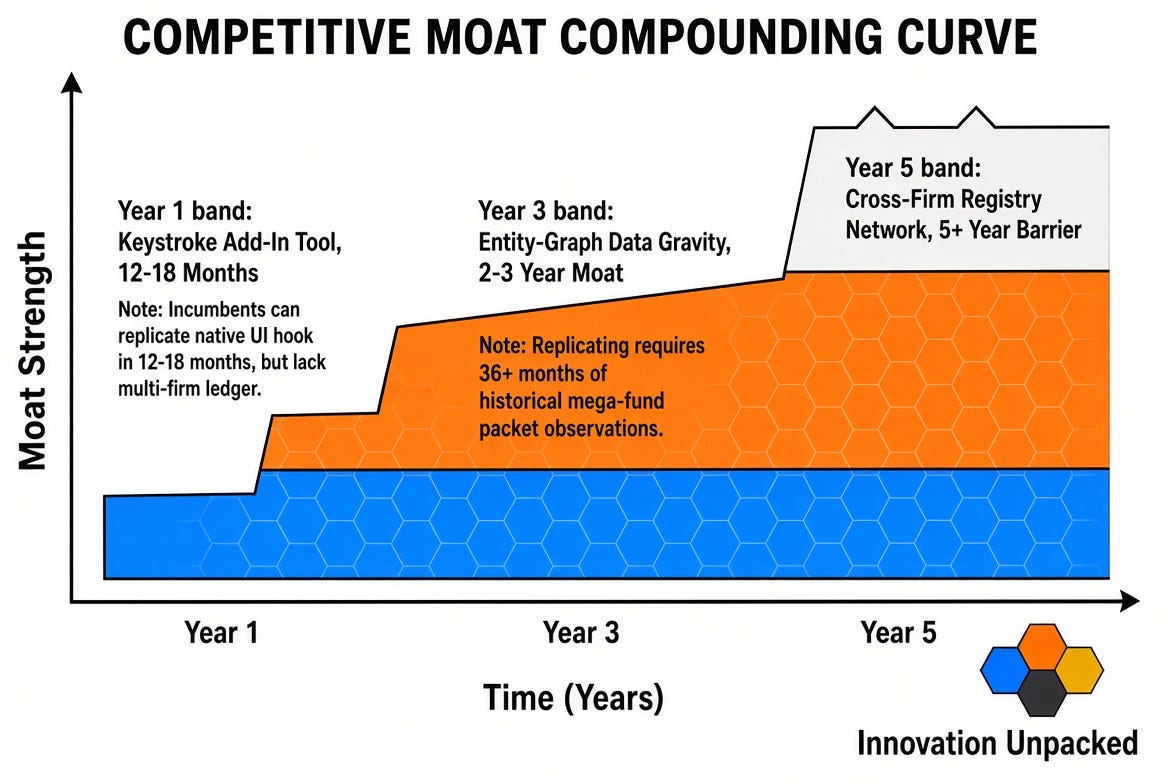
Year 1–2 (The Process Moat): The local XLL keystroke hook and UltraTax import bridge create immediate per-firm workflow lock-in. Competitors (SurePrep) can replicate the desktop hook in $12\text{--}18\text{ months}$.
Year 3–4 (The Data Gravity Moat): The tenant-isolated entity-graph accumulates hundreds of master-feeder hierarchy maps. Migrating away requires a firm to re-draw thousands of multi-tier structures from scratch, imposing an insurmountable switching penalty.
Year 5+ (The Federated Network Moat): The Cross-Firm Footnote-Version Registry reaches critical mass. Because thousands of pods across peer accounting firms have contributed content-hashed footnote packets, the platform identifies GP-side amendments and restatements within minutes of issuance. An incumbent attempting to compete cannot buy this dataset; they face a multi-year cold-start data deficit that locks the category permanently.
8. Conclusion: The Operational Mandate
The crisis of Schedule K-1 footnote reconciliation cannot be resolved by hiring more senior tax professionals, outsourcing transcription to offshore processing factories, or layering generative AI summaries over unstandardized PDFs. Those tactics are analogies—they optimize within the legacy friction of a broken architecture.
The mathematical reality of an 85.02 Inefficiency Delta and a 1,000:1 Retinal Floor mismatch dictates a single course of action:
Question the requirement that tax compliance requires biological eye-routing of data.
Delete the human transcription surface at the Excel boundary.
Anchor truth upstream to the GP trial balance and investor roster via an Authority Intake Gate.
Bind every cell to a Four-Field Footnote-Coordinate Provenance Token at the keystroke.
Compound the output into a federated cross-firm registry that converts compliance toil into an unassailable data network effect.
This is the deterministic, first-principles pathway to reclaiming $233.7M in operational waste and anchoring the next century of passthrough tax compliance in mathematical certainty.
What’s inside Venture Proof
Physics Gap check: what the work costs today next to the lowest cost it could ever hit. This is the first go or no-go.
Job to be Done: the task your customer is trying to get done, step by step.
Inversion levers: ways to change how the work gets done so the cost drops.
Competitor scoring: how other options do on the same job.
Business model: how the idea makes money and what has to be true.
Tribunal: a hard review that looks for holes in your case before anyone else does.
MVPr playbook: the cheapest next test that could prove or kill the idea.
Strategy Bundle: a complete payload you can use with your favorite LLM, or Google Notebooks. It may not fit on your hard drive!
Book an appointment: Click here
Email me: mike@pjtbd.com
Call me: +1 678-824-2789
Follow me on 𝕏: https://x.com/mikeboysen
Articles - jtbd.one - De-Risk Your Next Big Idea
Research - studio.jtbd.one/research
Slaying the Sacred Cows of Innovation


