

Some of you followed me for Jobs-to-be-Done. If you’ve noticed fewer posts about it, that’s on purpose.
I still use JTBD every day. But I spent years at strategy consultancies, including one known for its Jobs-to-be-Done method. Client work kept showing me the same gap: it’s great at making today’s product a little better. It’s weak at seeing the competitor who makes your product pointless.
That’s the threat now. New players are building AI agents into business models that don’t look like yours, and they’re building moats you can’t cross. Asking customers what they want won’t warn you in time.
So I changed my approach. I start with an idea, break down the problem behind it from first principles, and test whether it holds up before anyone builds anything. The job still matters. It just isn’t step one anymore.
If you came for JTBD, I get it if this isn’t for you. But if you’re the kind of leader who’d rather find the disruption than get hit by it, you’re in the right place.
The following is the doorway to a new, more reliable, approach.
Your research bought you a better airline cabin. The outsiders who disrupted you changed the jet engine, and your customers could never have told you how.
Your Jobs to Be Done study was right, and that’s exactly why you lost. The interviews were done well, and the work was careful. So how could being right make you lose? What you got was a better cabin: smoother steps, fewer complaints, a nicer screen. Meanwhile someone from outside your industry changed the engine. More research won’t fix that, because the research didn’t fail. It started in the wrong place. So if you don’t start by asking customers, and you don’t start with the job, where do you start? I’ll get there. First, here’s why the research let you down.
An airline passenger can tell you the cabin is too cold, the seat is too tight, and the chicken is dry. They can’t design a jet engine or tell you what a flight should cost to run. They feel the trip. They can’t see what makes it possible. I call this the passenger fallacy. It’s the belief that because someone uses a service, they know how to improve it. I wrote about it here. Your customers are the passengers. They told you about the cabin — regardless of the questions you asked — because the cabin is all they can see.
Why JTBD research shines on CX
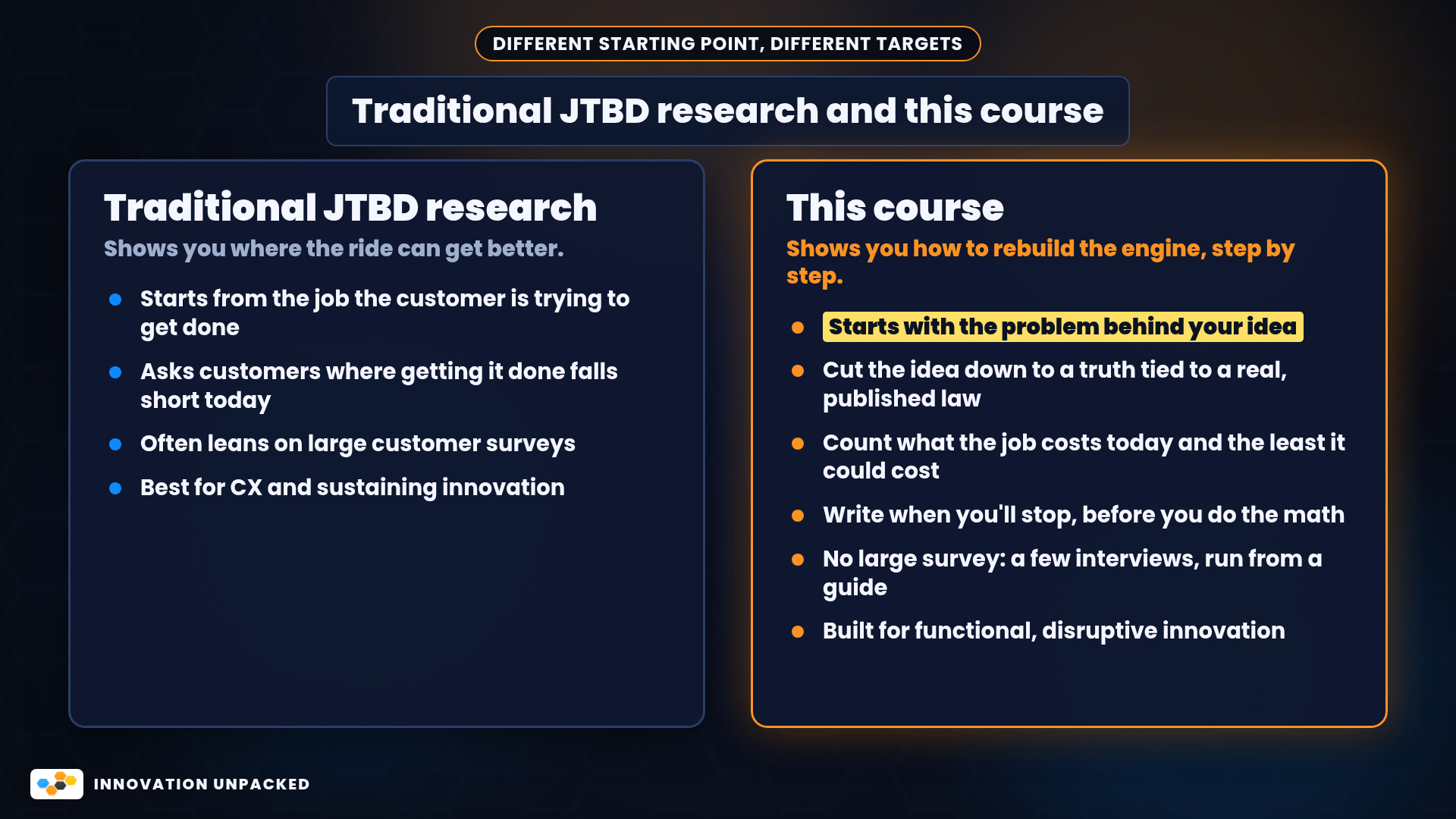
Traditional Jobs-to-be-Done research asks customers where getting a job done falls short. For the cabin, that works well. People know when a step is slow, confusing, or annoying. That makes it a strong tool for customer experience (CX) work and for sustaining innovation, which means making what you already sell a little better.
Disruption lives in the engine. How many people it takes to get the job done. What equipment you have to own. Who sits in the middle and takes a cut. What the job should cost if only the work that truly has to happen were left.
Customers live inside those choices every day, but they can’t see them. So when you ask what they want, they describe how they cope. They ask for a faster way to export a spreadsheet. They don’t ask why the spreadsheet exists at all.
Build what they ask for, and you get a nicer dashboard on top of the same manual process. Even careful JTBD research can land there, because the answers still come from passengers.
When the goal is functional, disruptive change, customers want what they’ve always wanted. Fast, cheap, and reliable. You don’t need a long survey to learn that. You need to understand the engine.
If you’re not thinking about real transformation or disruption, you’re in for a rude awakening. Outsiders aren’t standing still. They’re figuring out how to build agentic capabilities —AI that does the work on its own without piling up waste downstream — into new business models that can scale. And they’re building moats you won’t be able to cross.
No big survey needed
I created the Jobs-to-be-Done Masterclass almost 4 years ago. Hundreds of people grabbed it. But it was only Step 1 in a process that subsequently requires a far more expensive investment — a survey. This course skips the big customer survey. Surveys are slow and expensive. Worse, they ask the wrong people the wrong question. A survey asks passengers how to fix the plane. They ride it every day, but they can’t redesign it, any more than a passenger can design a jet engine.
So the course gets you to your first real go or stop call, Gate 1, a different way. First, you do the hard thinking a survey can’t do, starting from a place I’ll show you in a minute. Then you name the job, map how it gets done today, and work out what it costs today and the least it could honestly cost. Then, in Module 5, you check that model with a small number of real people who do the job, using an interview guide you write yourself. You’re not asking them to design the answer. You’re asking them to tell you where your model is right and where it’s wrong. That’s faster and cheaper, and it puts the hard thinking where it belongs.
You still talk to customers. You just don’t ask them to design the engine.
Where I learned this
I’ve worked at several strategy consultancies, including one known for its Jobs-to-be-Done method. That method starts with the job. I still use the job, and I still keep the product out of it. But I don’t start there anymore.
After working with clients over the years, I kept finding gaps that needed filling. The biggest one was true disruption and transformation. That’s why I moved to a first principles approach. You cannot transform anything without inverting the cost curve.
So if I don’t start with the job, and I don’t start by asking customers, where do I start? It’s the part most research skips, and it’s the part this course is built on.
Different starting point, different targets
Outcome-focused JTBD research is good at what it’s built for. It starts with the job and tells you what to aim for. If you want to make an existing product or experience better, that’s a solid place to start. In CX, there are only 17 Universal Jobs. There’s really nothing to figure out there. Frankly, it’s pretty obvious.
This course starts somewhere else: the problem. It often begins with an idea. You find the real problem behind it and break that problem down first. Only then does the job come in, followed by the steps you need when the goal is to change the engine, not the cabin.
That’s how being right made you lose. The research made the cabin better, but the outsiders changed the engine, and customers could never have told you how.
This is problem solving. First principles sets the stake in the ground. You find the real problem behind the idea and break it down until nothing more can come out. Then the job comes in as your compass, to point that change in the right direction. You don’t ask customers where to start. You work it out, then check it with them.
That’s what my new course teaches you to do, by hand. The full program has 13 Modules and 144 lessons. Module 1 is free.
Find the real problem behind your idea with the free Module 1
Here’s what it adds.
It starts with the problem, not the job. In Module 1, you take your idea and strike out the answer it came with. Usually that’s an app or a gadget. You keep cutting until nothing more can come out. What’s left is a plain truth, and you tie it to a real, published law. If you can’t find one, the idea isn’t ready. You also write down the problem as it was handed to you and the deeper one under it, and pick which one you’ll work on. Only then, in Module 2, do you name the job.
It counts the money before you fall in love. In Module 4, you ask what I call the rude question. What does this job cost today? And what’s the least it could honestly cost if only the work that truly has to happen were left? If those two are far apart, you’ve got a reason to keep going. If they’re close, you don’t.
It makes you decide when to stop, before you see the answer. You write one sentence that says what you’ll do if the numbers come up short. You date it. Then you do the math. That way you can’t move the line after you see where you landed.
It talks to people to check your work, not to find the idea. In Module 5, you sit down with real people who do the job. You log what they confirmed, what they contradicted, and what you never asked.
It puts every step on paper. Every lesson comes with a one-page sheet. You don’t need software, and you don’t need me there. You can check every number yourself, and so can your boss.
What you actually walk away with
Here’s what’s in your hands after each Module. It runs in problem solving order: the idea, the real problem, the problem broken down, and only then the job.
Module 1 (free): Your idea, with the answer it came with struck out. The real problem behind it, cut down until nothing more can be removed. A truth tied to a real law. And a plain principle you can build on, plus the analogy trap to watch for.
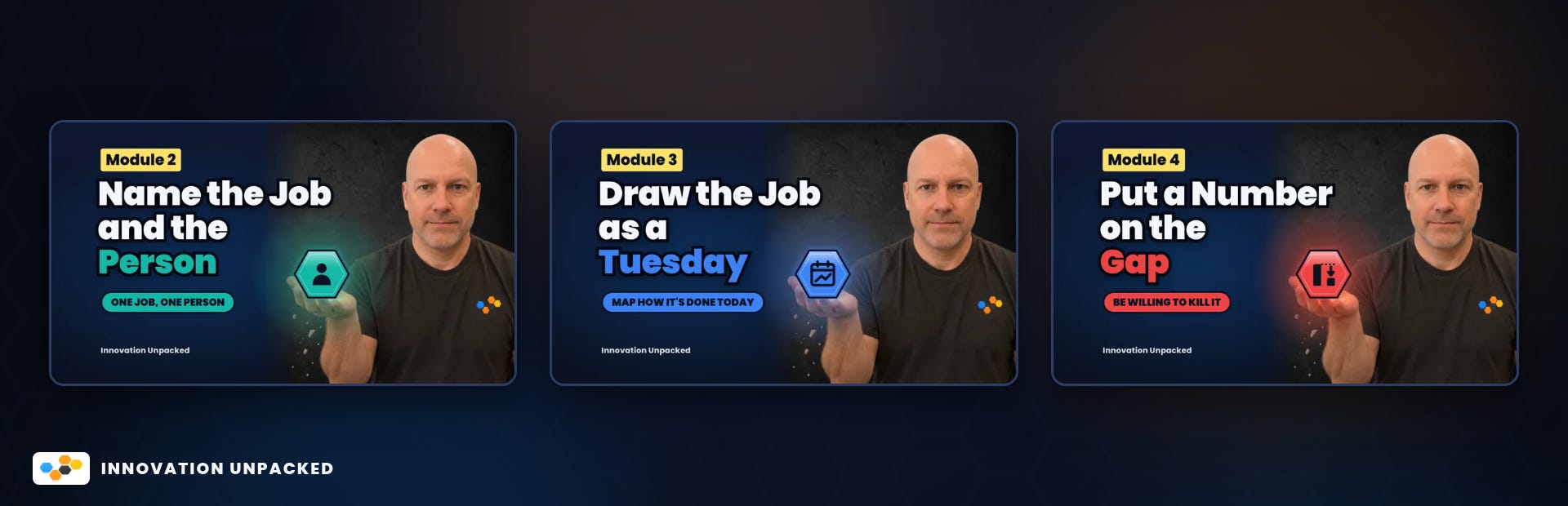
Module 2: Now that the problem is broken down, the job comes in. One job and one person who does it, written with no product in the sentence. You’ll know if it’s really a job with one test. If every tool for it vanished tomorrow, would it still need doing? You’ll score your job sentence on paper, the same way the engine does.
Module 3: A step by step map of how that person gets the job done today. Not how you wish they did it. How they do it on a normal Tuesday. Then you try to break your own map before anyone else can.
Module 4: About 10 measures for every step on your map. What one run of the job costs today, with a source for every rate. The least it could honestly cost. Your own math, done by hand. And a written decision: keep going, or stop now while stopping is cheap.
That last one is the result most people skip. Stopping early isn’t a loss. It’s weeks you won’t spend building the wrong thing.
Module 5: Notes from at least two real people who do the job. You’ll rate where the job is hardest, then log what they confirmed, what they contradicted, and what you never asked. You score that proof by hand.
Module 6: The four ways to change how a job’s costs grow: labor, equipment, boundaries, and networks. Plus a fifth that comes after, demand. You’ll be able to tell a real change from a feature dressed up as one.
Module 7: All 154 levers, one group at a time. For each one, you’ll know what it is, which habit of the industry it breaks, and which of the five changes it usually serves.
Module 8: One change aimed at a problem real people confirmed. You score all four ways on paper before you pick. You name the habit you’re throwing away, and you pick a path to grow.
Module 9: A business model on one page. Who pays, for what, how you charge, and what each unit costs you. Plus a plan for what keeps it yours, scored by you, with every line tied back to a fact you already logged.
Module 10: A ruling on your own model. You attack it against a real checklist and defend it with only the facts you have. Then you rule: endorse it, endorse it with conditions, or reject it.
Module 11: A test you run by hand with a few real buyers. It has pass lines and stop rules nobody can talk away. You run it, keep a record, and make the call: go, stop, or change.
Module 12: A story board for your first release. It covers every main activity, but only thinly, so you can ship it small and learn fast.
Module 13: A one-page brief for a skeptic. It answers their top questions and names the one thing the market could do that would make you stop.
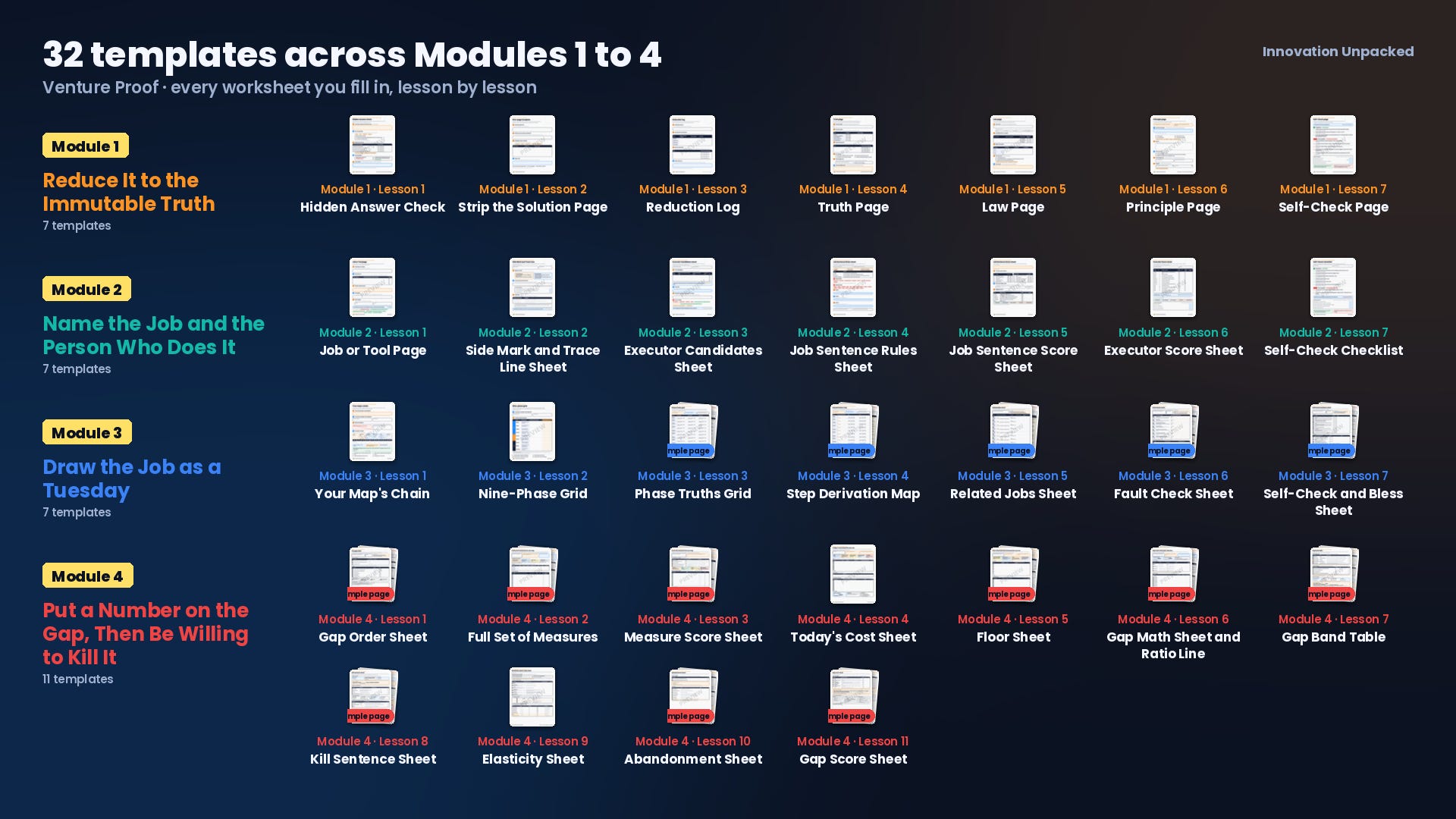
Modules 1 to 4 alone come with 32 fill-in templates (there will be sets for ever module). Here’s every one of them. You get the full templates with each Module.
The whole path
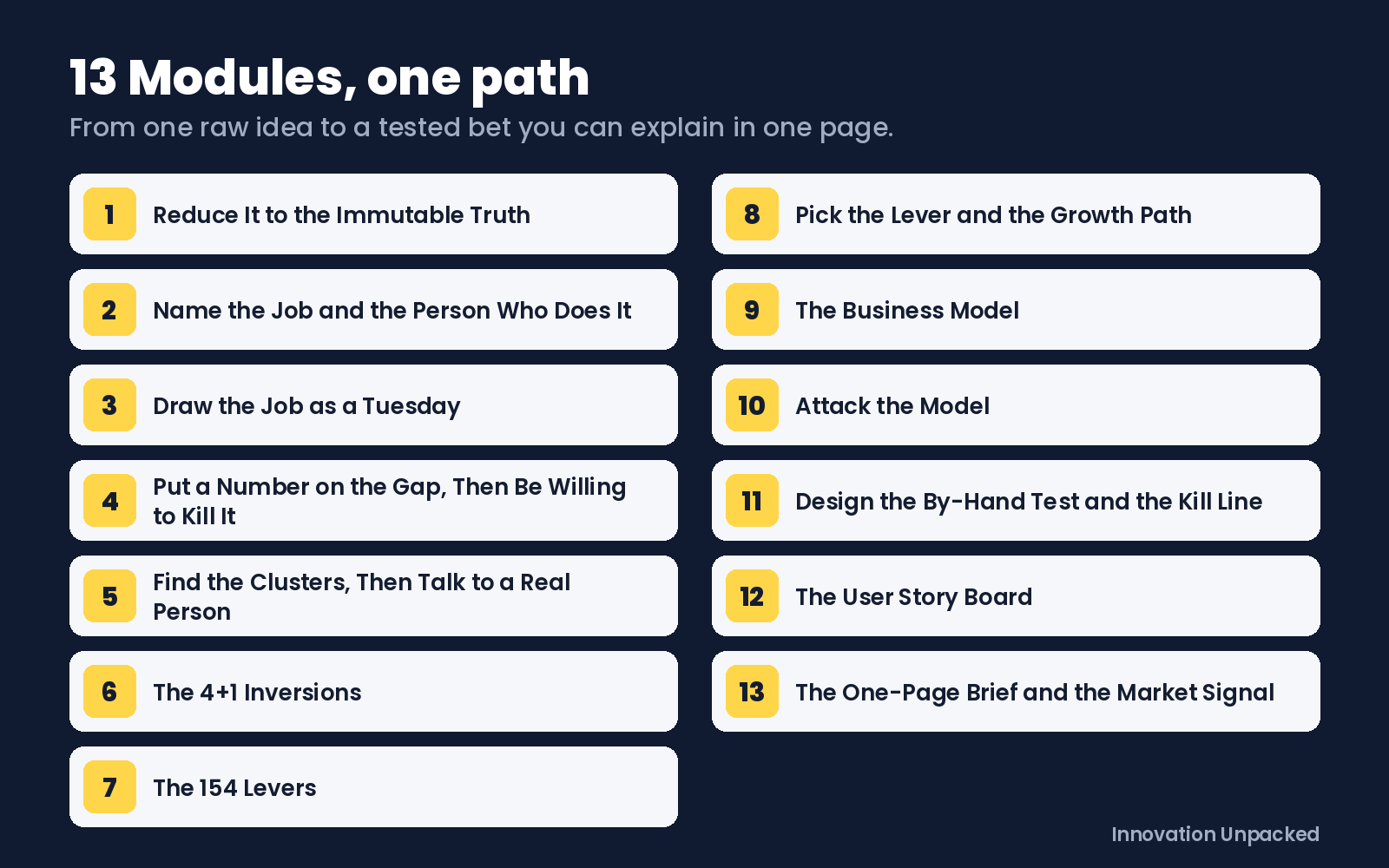
The path starts with the problem. Module 1 takes your idea down to the real problem and a truth you can build on. The job comes in at Module 2, and every Module after that builds on both.
Each Module also shows the engine’s output for one worked case, for that Module’s step only. The case looks at how decisions get made inside a large company. You’ll see what good output looks like before you make your own.
This is Venture Proof, done by hand
Venture Proof is my enterprise strategy app. It’s a strategy-as-code engine built for disruption. It builds and tests your strategy with code, so every step runs the same way and can be checked. Right now it’s in private Alpha, and it’s only available through my advisory work.
This course is a fully manual version of Venture Proof.
The steps are the same steps, in the same order. The rules, the weights, and the cut lines are the same ones the engine uses. The engine’s code is the source of truth for every sheet you fill in. If a person can act on it by hand, I teach it. The only things that stay inside the engine are the code, the prompts, and the parts that run on their own.
So why learn it by hand?
Because you’ll understand every call. You’ll know why an idea passed or failed. You’ll be able to explain it to a skeptic without saying “the system said so.” And it removes nearly all the bias you get when consultants (or even internal teams) do this work, because it’s a system, not chaos.
There’s no other program like this. It puts the whole system where anyone can work through it.
Built to fit a training budget
I designed this for people inside enterprises, not just founders. Each single Module fits a typical employee training/expense budget. So does the full program. That means you can likely run it through your company’s training or professional development funds, instead of paying out of your own pocket.
Start with one Module, or take the full program from Module 1 to Module 13.
Three ways to start
Bring an idea and find the real problem behind it, free. Module 1 is 7 lessons, self-paced, with a worksheet for every lesson. Find the real problem behind your idea with the free Module 1
Join other people (FREE) working on their own ideas. Join the Innovation Unpacked community
Have a big bet coming and need it tested fast? That’s what my advisory work is for. It’s where Venture Proof runs the whole system for you. Book a time to talk about your decision
You’ve already paid for a better cabin. Keep asking customers how to make the ride better. They’re good at that. But if you want to (or need to) change the engine, you’ll have to look at it yourself. Start with your idea, and find the real problem behind it. That’s Module 1.
Mike Boysen - Innovation Engineer
Book an appointment: Click here
Email me: mike@pjtbd.com
Call me: +1 678-824-2789
Follow me on 𝕏: https://x.com/mikeboysen
Articles - jtbd.one - De-Risk Your Next Big Idea
Website - pjtbd.com
Slaying the Sacred Cows of Innovation


