


The Empowerment Promise & The “Near Miss”
Let’s get straight to it. In the next few minutes, I’m going to show you exactly how to stop burning millions of dollars on post-meeting data debt. We’re going to deconstruct the actual job of a meeting, size the exact friction it causes, and build an automated workflow that does the heavy lifting for you.
If you manage a team of professionals, you need this blueprint. Because right now, your people are wasting their time. They’re performing administrative tasks that machines should be doing, and it is costing you an absolute fortune. We aren’t here to talk about generic productivity hacks. We’re here to talk about structural business transformation. Most companies are completely blind to the amount of capital they flush down the drain every single day just trying to remember what was said in a room. They’re drowning in unstructured audio data, and they do not even know it.
Let me tell you a story about Lumina Partners. The firm is an elite B2B consulting group. The consultants are brilliant. They’re highly paid experts who solve incredibly complex problems for enterprise clients. But if you look closely at their daily operations, you will see a massive crack in the foundation.
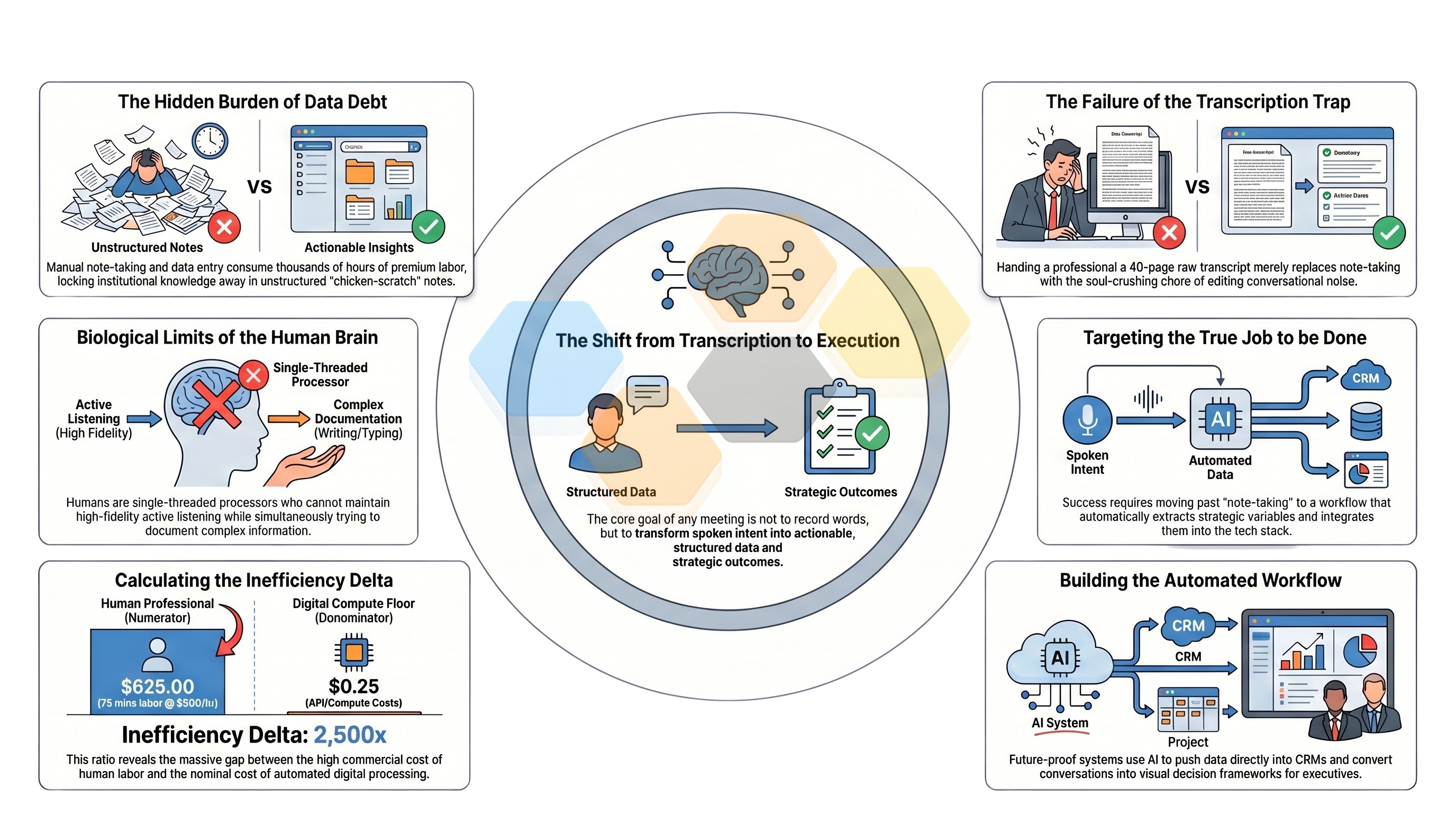
Every month, the consultants at Lumina Partners are burning 10,000 hours manually entering CRM data and drafting executive summaries from client discovery calls. Let that sink in. That’s 10,000 hours of premium, top-tier human labor wasted on basic data entry.
Picture a typical consultant at the firm. Let’s call him David. David gets on a high-stakes, 60-minute discovery call with a prospective client. During the call, he is scrambling. He’s trying to actively listen, ask insightful questions, and simultaneously scribble down notes. His attention is entirely split.
When the call ends, the real nightmare begins. David hangs up the phone and stares at his chicken-scratch notes. He opens Salesforce. He spends 30 minutes trying to parse out the core objectives, the budget, and the timeline, manually typing it all into the right fields. Then, he opens a Word document. He spends another 45 minutes synthesizing his notes into a polished executive summary to share with his internal team.
He’s just spent more time doing administrative data entry than he spent actually talking to the client. And he has to do this four more times today. The process is completely broken. It is a massive workflow bottleneck.
Data debt is the silent killer of the modern enterprise. Every time a meeting ends and the insights are locked inside someone’s head, or buried in a notepad, you’re accumulating debt. You’re losing institutional knowledge. The company is bleeding intellectual capital.
So, what do enterprise leaders do when they see this bleeding neck problem? They try to fix it. But they almost always miss the mark.
Here is the near miss. The executive team at Lumina Partners realized they had a massive efficiency problem. They decided to deploy a technology solution. They bought enterprise licenses for a popular AI transcription bot and threw it into every single client meeting.
They thought they solved the problem. They patted themselves on the back. But they didn’t. They failed miserably.
Why did it fail? Because a raw, 40-page transcript is not a solution. It’s just a different kind of noise.
The executives confused a feature with an outcome. They thought capturing the words was the goal. But the goal isn’t transcription. The goal is execution.
Let’s dive deeper into this near miss. Software vendors love to sell a promise. They’ll tell you that you will never have to take notes again. But the reality is much darker. Have you ever actually read a raw transcript of a one-hour conversation? It’s a total nightmare. Human speech is incredibly inefficient. We talk in circles. We use filler words. We jump between five different topics in the span of three minutes. We ask a question about pricing, pivot to a story about our weekend, and then finally give the budget number twenty minutes later.
When you hand a consultant a 40-page literal transcription of that mess, you aren’t doing them a favor. You’re giving them a chore. You’re asking a highly paid strategist to act like a data miner. They’re forced to pan for gold in a river of conversational mud.
This is the “Transcription Trap.” Companies invest heavily in capturing the audio, but they completely ignore the cognitive load required to make that audio useful. They build a bridge halfway across the river and wonder why no one is reaching the other side.
By introducing a raw transcript into the workflow, the leaders at Lumina Partners didn’t eliminate the bottleneck; they merely shifted it. Now, instead of trying to remember what the client said, David is staring at a massive wall of text. He has to read through 40 pages of tangents just to extract the three action items he actually needs.
You haven’t removed the human from the loop. You’ve just changed their job title from “note-taker” to “transcript editor.” And let me assure you, editing a raw transcript is soul-crushing work. It’s exhausting. It’s highly inefficient.
Think about the compounding cost of this failure. It’s not just David wasting an hour today. It’s two hundred consultants wasting an hour, every single day, for a year. The financial bleed is catastrophic. But the cultural bleed is even worse. You’re taking your best talent and forcing them into administrative drudgery. They burn out. They get frustrated. And ultimately, the quality of their consulting degrades because they’re too exhausted from doing data entry.
This is why the near miss is so dangerous. It provides the illusion of progress while actively harming the underlying operational mechanics. You buy the software, you check the box, and you assume the problem is handled. But under the surface, the structural bloat remains entirely intact.
The transcription bot looks like a perfect fix on paper, but it ignores the fundamental truth of how professionals actually work. The solution assumes that humans are good at parsing massive blocks of unstructured text. We aren’t. We’re terrible data-parsers. We’re built for synthesis, strategy, and empathy—not combing through endless paragraphs to find a budget number.
The executives at Lumina Partners fell into this trap because they were reasoning by analogy. They looked at the old analog process—a human writing down words—and they replaced it with a digital equivalent—a machine writing down words. They didn’t rethink the workflow. They just digitized the inefficiency.
To truly innovate, you have to break the entire process down. You have to ask yourself: What is the actual job we are trying to accomplish here? The client does not care if you have a verbatim record of their small talk. The internal team does not want to read a transcript. They want the deliverables. They want the CRM updated automatically. They want the strategic insights summarized perfectly. They want the friction completely removed.
When you simply throw a bot into a meeting, you aren’t innovating. You’re just creating digital clutter. You’re accumulating data debt at a staggering scale. The audio is captured, but the intent is lost.
I’ll show you how to actually fix this. We won’t just capture the words. We’re going to transform them into action. To do that, we have to stop jumping straight to the solution. We have to pause, step back, and architect the workflow. We’re going to aggressively interrogate the friction using first principles. We’re going to calculate the exact inefficiency delta. And then, we’re going to build a system that actually works.
Socratic Deconstruction (First Principles)
So, how do we actually fix this mess? We don’t start by brainstorming features. We start by tearing the problem down to the studs. I call this Socratic Deconstruction.
Most software teams look at a consultant scrambling on a call and say, “We need a better note-taking app.” Or they say, “We need a transcription bot.” They’re looking at the surface. They’re reasoning by analogy. If you do that, you’re guaranteed to build something incremental and useless. We’re going to ignore the analogy and hunt for the first principle. We have to strip away the assumptions until we hit a fundamental truth.
Let’s ask some uncomfortable questions. Why do we take notes in the first place? We take them to capture information. Why do we need that information? We need it to execute a workflow later. But what actually happens in the room when a human tries to capture that information manually?
Here is the axiomatic truth. The human brain is a single-threaded processor when it comes to language synthesis. You can’t actively listen to a complex problem, parse the strategic intent, and write down a coherent summary at the exact same time. When you split attention, knowledge fidelity degrades. It’s a biological limit.
If you demand that your experts take notes, you’re demanding that they stop listening. Every time David looks down to type a bullet point, he is missing the subtext of what the client is saying right now. The client is dropping subtle hints about timeline constraints, and he’s missing it completely because he’s too busy documenting what they said thirty seconds ago.
The problem is not that “note-taking is hard.” That is merely a symptom. The foundational problem is that manual capture destroys active engagement. If we want to solve this, we have to separate the act of listening from the act of documenting. The goal is not a literal transcript. The goal is achieving absolute cognitive presence during the conversation, followed by flawless data extraction.
We aren’t exploring for a problem. We’re testing a hypothesis. And the hypothesis is this:
if we completely remove the cognitive burden of data capture, our professionals will perform exponentially better.
Now that we have isolated the bedrock truth, we have to calculate exactly how much this friction is costing us.
Sizing the Friction (The Inefficiency Delta)
Now that we’ve torn the problem down to its biological limits, we can’t just sit around and guess how bad the damage is. We have to size the friction. And we’re going to do it with absolute, ruthless mathematical precision.
Most leaders try to measure inefficiency by comparing their team to a competitor. They’ll say, “Our consultants take an hour to write a brief, but the firm across the street does it in forty-five minutes. We need to get faster.” That’s reasoning by analogy. It’s a terrible way to run a business. If the firm across the street is doing it completely wrong, you’re just trying to be the best of the worst. You’re fighting for incremental gains in a broken system.
We don’t do that. We use a metric called the Inefficiency Delta.
The Inefficiency Delta is a brutal, unforgiving ratio. It strips away all your corporate excuses and lays bare the exact cost of your operational bloat. You calculate it by taking your current commercial cost to do a job—we call that the numerator—and you divide it by the absolute theoretical, physical, or digital floor—that’s your denominator.
Let’s look at Lumina Partners again. We need to find our numerator.
David finishes his 60-minute client call. As we established, he spends 30 minutes updating Salesforce and another 45 minutes synthesizing an executive summary. That’s 75 minutes of premium human labor. The firm bills David out to clients at $500 an hour. That means every single time David gets off a call, the firm is burning $625 in billable potential just to do administrative cleanup. If he does four calls a day, the firm is bleeding $2,500 a day, per consultant. Multiply that across a team of two hundred, and the numbers become genuinely terrifying.
That $625 per meeting is our numerator. It’s the harsh, undeniable reality of what the current analog process costs the business.
Now, we have to find the denominator. This is where most executives fail. They’ll look at the $30-a-month subscription they pay for a transcription bot and say, “There is our denominator!” But they’re wrong. That $30 software still requires David to read the 40-page transcript. It doesn’t complete the job.
What is the absolute digital floor to actually extract the intent from the audio and format it into a deliverable? We’re going to ignore how Lumina Partners currently operates. We only care about the absolute limits of compute power.
To run an hour of audio through an advanced LLM, extract the exact strategic insights, strip out the filler words, and push that structured data through an API directly into Salesforce and a polished Word document... what does that actually cost?
It costs pennies. It requires a few seconds of raw compute time. Let’s be incredibly generous to account for premium API routing and call the digital floor 25 cents.
That $0.25 is our denominator.
Now we do the math. You divide the $625 commercial cost by the $0.25 digital floor.
You get an Inefficiency Delta of 2,500.
I really want you to let that number sink in for a second. Your current process is two thousand, five hundred times more expensive than the theoretical floor.
What does an Inefficiency Delta of 2,500 tell you? It tells you that the structural bloat is completely out of control. It proves that you don’t need to optimize the existing system. You don’t hold a training seminar to teach David how to type his notes 10% faster. You don’t try to negotiate a small discount on your CRM licenses to save a few bucks.
When the delta is that massive, it’s a flashing red siren. It means you must completely delete the process and replace it. You’re forcing a brilliant human mind to do the work of a 25-cent API call. It’s absolute madness.
This is why the Inefficiency Delta is so powerful. It replaces directionless exploration with mathematical certainty. You aren’t guessing where to innovate. The math tells you exactly where the fire is burning.
We’ve successfully isolated the first principle. We’ve quantified the exact cost of the friction. Now, we have to map the actual job and use our innovation levers to build the automated workflow.
Axiom-Driven Job Mapping & Innovation Levers
So, the Inefficiency Delta is screaming at us. What is our next move? Most engineering teams will immediately start coding a Minimum Viable Product. They’ll build a shiny user interface and assume people will use it. They don’t map the job.
Let me stop you right there. We are testing a hypothesis. We are not exploring for a problem.
We know the exact problem. Now we have to map the Job-to-be-Done. Listen closely, because this is where almost every single company fails. If you ask a standard project manager what David is doing during that hour after his call, they’ll tell you, “He is taking notes.”
No, he isn’t. “Taking notes” is a product-centric illusion. It’s a clumsy, analog method. It is not the job.
The actual Job-to-be-Done is transferring spoken client intent into an actionable execution format.
Do you see the difference? The client doesn’t care about the notes. The partners don’t care about the notes. They only care about the actionable execution format. When you map that specific job step-by-step, you see exactly where the workflow breaks down. David has to execute the conversation, manually isolate the strategic variables, and then integrate those findings into your tech stack. That manual integration is the exact friction point we’re targeting.
To eliminate this friction, we don’t just hand David a cleaner text editor. We pull massive innovation levers.
First, we pull the ecosystem integration lever. We architect a system where the AI agent actively listens, extracts the defined intent, and pushes the structured data directly into Salesforce, Notion, and Slack. It’s automatic. Zero human copy-pasting is required. The system does the data entry, so David doesn’t have to.
Second, we pull the visual data synthesis lever. Let’s be honest. Executives don’t read 40-page transcripts. They don’t want to read five-page text summaries either. They are overwhelmed with information. They want visual decision frameworks. So, we build the workflow to automatically convert the conversational data into presentation-ready slides and strategic infographics.
By mapping the job strictly around intent and execution, we remove the human bottleneck entirely. We’re letting the machines do the heavy data parsing, and we’re letting the humans do the high-level strategic thinking.
In Conclusion
I’m not going to summarize what we just talked about. I’m here to tell you exactly what you possess right now that you didn’t have twenty minutes ago.
Before you read this, you thought note-taking was a necessary evil. You assumed your experts were just complaining about administrative work because nobody likes doing data entry. You looked at software vendors selling raw transcription bots, and you thought they held the answer.
They don’t.
Now, you possess a fundamentally different lens. I’ve given you the Socratic Deconstruction framework. You aren’t going to blindly accept symptoms anymore. You now recognize the biological reality that the human brain can’t synthesize strategy and document text at the exact same time. You know that forcing your people to do both destroys the fidelity of your most valuable conversations.
I’ve handed you the Inefficiency Delta. You aren’t guessing about the cost of this problem anymore. You have a ruthless, mathematical tool to prove that digitizing a bad process is a catastrophic waste of money. You can walk into any executive meeting tomorrow and demonstrate exactly how your operations are thousands of times more expensive than the absolute digital floor.
Finally, I’ve given you the true Job-to-be-Done. You’re never going to settle for a 40-page wall of text again. You possess the blueprint to architect a frictionless pipeline. You’re going to demand ecosystem integration that updates your CRM automatically. You’re going to demand visual data synthesis that your leaders can actually use.
You have the exact mechanics to completely eradicate organizational amnesia. It’s time to stop paying brilliant minds to do the work of a 25-cent API. Let the machines handle the mud. Let your people handle the strategy.
Are you interested in innovation, or do your prefer to look busy and just call it innovation. I like to work with people who are serious about the subject and are willing to challenge the current paradigm. Is that you? (my availability is limited)
Book an appointment: https://pjtbd.com/book-mike
Email me: mike@pjtbd.com
Call me: +1 678-824-2789
Join the community: https://pjtbd.com/join
Follow me on 𝕏: https://x.com/mikeboysen
Articles - jtbd.one - De-Risk Your Next Big Idea
Q: Does your innovation advisor provide a 6-figure pre-analysis before delivering the 6-figure proposal?


