


Introduction: Ditching the “Blank Canvas” BS
Let’s get one thing straight right out of the gate: staring at a blank whiteboard hoping for a lightbulb moment’s a complete waste of your time. We’ve all been in those agonizing corporate brainstorming sessions where someone slaps a sticky note on a wall and says, “Our UX sucks, how do we fix it?” It’s a lazy, useless diagnosis. It’ll get you absolutely nowhere.
Here’s the truth most teams miss: customer friction isn’t some invisible, random ghost haunting your product. It’s chronological. It happens at very specific, highly predictable points in a user’s timeline. You can’t just broadly declare that your “onboarding” needs work. You’ve got to isolate the exact micro-moment where the user wants to throw their laptop out the window.
That’s exactly why we’re bringing in the big guns today. We’re ditching the monolithic guesswork and mapping everything to the 17 Universal Customer Journeys. When you break a customer’s experience down chronologically—from the second they realize they have a problem to the day they throw your product in the trash—you start seeing exactly where the system’s bleeding value.
But identifying the problem’s only half the battle. To actually solve it, we’re combining Doblin’s 10 Types of Innovation (specifically focusing on Configuration, Offering, and Experience) with an Innovation Matrix. Those structural and marketing triggers we’ve got? They’re our secret weapon.
We aren’t doing any math to start. You can forget about the Validation Scorer, the Top-Box gaps, and the Pearson correlations for a minute (we’ll get to how to de-risk this at the end). Today’s all about raw, highly constrained ideation. We’re taking verified friction and aggressively applying rigid, counter-intuitive constraints to it. Why? Because the brain’s lazy. If you don’t force it into a corner, it’ll just spit out an incremental feature update. We’re going to use these triggers to force structural inversions and manufacture actual breakthroughs.
Let’s dive into Part 1: The Pre-Use Era. This is everything that happens before the customer actually extracts the core value of your product.
Part 1: The Pre-Use Era (Acquisition & Setup)
1. The Selection Journey
The Selection Journey’s where the whole game starts. Your buyer is sitting there, staring at a massive sea of identical competitors, trying to figure out who’s actually going to solve their problem. Historically, companies try to win this by shouting the loudest about their feature list. They’ll cram a million bullet points onto a pricing page hoping something sticks. It’s exhausting for the buyer.
The Pivot Strategy: We’re going to hit this with the “Reverse/Invert” marketing trigger and pair it directly with Doblin’s Brand (Experience) innovation type.
Instead of adding more noise to the pile by listing what you do, you’re going to aggressively isolate and highlight exactly what your product doesn’t do. You’re going to target the active detractors and lean heavily into anti-marketing. It builds immense, immediate trust because it proves you aren’t desperate for just any customer … you only want the right customer.
B2B Example:
Think about the traditional CRM market. It’s bloated. Everyone’s trying to be Salesforce. Now look at a company like Basecamp or certain boutique agency software tools. In the B2B space, applying this pivot means your homepage shouldn’t say “The all-in-one solution for everyone.” It should say, “If you’ve got a 500-person enterprise sales team, close this tab right now. We’ll break your workflow. We’re built exclusively for 5-person hit squads who hate data entry.” By inverting the target audience and pushing away the enterprise, you’ve instantly won the absolute loyalty of the SMB market. You’ve used brand inversion to make the selection process effortless for your actual target.
B2C Example:
Hinge is the absolute gold standard for this in the B2C world. The dating app market is flooded with platforms trying to keep you swiping endlessly. That’s their core metric: time in app. Hinge inverted the entire selection journey with their brand slogan: “Designed to be deleted.” They actively marketed the disposal of their own product. For a user burned out by Tinder’s endless gamification, choosing Hinge becomes a no-brainer. They reversed the objective from “stay here forever” to “get out of here quickly,” fundamentally altering how users selected them over the competition.
2. The Purchase Journey
Purchasing shouldn’t be a painful, high-friction event, but somehow, we’ve designed systems that make people jump through hoops just to give us their money. The Purchase Journey is all about the transactional action. If you’ve got friction here, you’re literally blocking revenue.
The Pivot Strategy:
We’re applying the “Automate/Manual” trigger and mapping it to Doblin’s Profit Model (Configuration) type.
We’re shifting the fundamental unit of value conversion. Instead of forcing the user to make a conscious, manual decision to hit “Buy Now” for a static product, we’re automating the value capture. We’re decoupling the revenue event from the human action.
B2B Example:
Look at how enterprise software used to be sold. You’d call a sales rep, negotiate a massive annual license, sign a wet contract, and wire a six-figure sum. It was incredibly manual. Then companies like Stripe and Twilio came along and completely blew up the profit model. You don’t “buy” Stripe. You literally just drop a few lines of code into your platform. The purchase journey is completely automated in the background based on API calls. They shifted from a manual, centralized purchasing motion to an automated, decentralized usage model. The friction is gone because the “purchase” happens seamlessly a fraction of a cent at a time.
B2C Example:
Amazon practically owns this pivot. Remember the Dash buttons? You stuck a physical button on your washing machine and pressed it when you needed detergent. But they took it further with “Subscribe & Save.” They realized that re-ordering toilet paper is a manual, low-value task. By automating the purchase journey, they locked in the profit model. The user doesn’t even think about the transaction anymore; a box just magically shows up on their porch every month. They automated the decision-making process right out of existence.
3. The Delivery Journey
Alright, so the customer is paid. Now they’re waiting. The Delivery Journey is all about the logistics of how your solution bridges the gap between your warehouse (or server) and the customer’s hands. Traditional delivery’s slow, error-prone, and frustrating.
The Pivot Strategy:
We’re grabbing the “Make Virtual/Physical” structural trigger and blending it with Doblin’s Channel (Experience) innovation type.
If you’re shipping atoms (physical goods), how can you make the delivery feel virtual or bypass the physical supply chain entirely? If you’re shipping bits (software), how can you ground it in the physical world to make the delivery feel premium? We’re flipping the channel delivery mechanism entirely.
B2B Example:
Let’s talk enterprise cybersecurity. Historically, if you bought a massive firewall solution, you’d wait three weeks for a pallet of heavy servers to arrive at your loading dock. Then you’d rack them. It was a purely physical channel. Modern providers applied the virtual pivot. Instead of shipping a box, they deliver a virtualized container or a cloud instance. The delivery journey went from three weeks of supply chain logistics to three minutes of provisioning a virtual environment. They removed the physical space entirely.
B2C Example:
Warby Parker and Casper mattresses executed brilliant physical/virtual channel inversions. But let’s look at the digital-to-physical flip. When the Apple Card launched, it lived entirely on your iPhone. It’s a purely digital financial product. But Apple didn’t just email you a welcome link. They shipped you a laser-etched, titanium physical card in premium packaging. They took a virtual product delivery and created a stunning physical channel experience. It gave the digital service an immense, tangible weight that competitors’ digital-only wallets couldn’t touch.
4. The Installation Journey
Installation’s historically been where user excitement goes to die. They’ve finally got the product, they open the box (or launch the app), and they’re immediately hit with a wall of technical labor. They’ve got to assemble things, connect wires, or set up databases. It’s pure friction.
The Pivot Strategy:
We’re using the “Nested Parts (within others)” or “Remove Motion” trigger, tied closely to Doblin’s Product System (Offering) type.
The goal here’s simple: the user shouldn’t have to install anything. We’re going to nest the complexity of the installation process back at the factory or deep inside the cloud ecosystem, completely removing the physical or mental motion required from the customer.
B2B Example:
Think about networking gear. Installing enterprise Wi-Fi used to require a certified network engineer manually configuring every single router via a command-line interface. Cisco Meraki changed the game by nesting the intelligence in the cloud. Now, the delivery and installation journeys are decoupled. An office manager can plug the Meraki hardware into the wall (removing the motion of complex routing), and the device automatically calls home to the cloud to download its entire configuration profile. The “Product System” handles the installation automatically. The complexity’s nested off-site.
B2C Example:
Apple’s device ecosystem’s unmatched here. Remember the old days of getting a new phone? You’d plug it into iTunes, back up your old phone, wait two hours, sync the new one, and pray it worked. Now? You just set your new iPhone down next to your old iPhone. That’s it. You’ve completely removed the motion. The product system recognizes the nested hardware proximity and transfers everything securely over a local peer-to-peer connection. Installation went from a two-hour technical headache to simply placing two objects near each other.
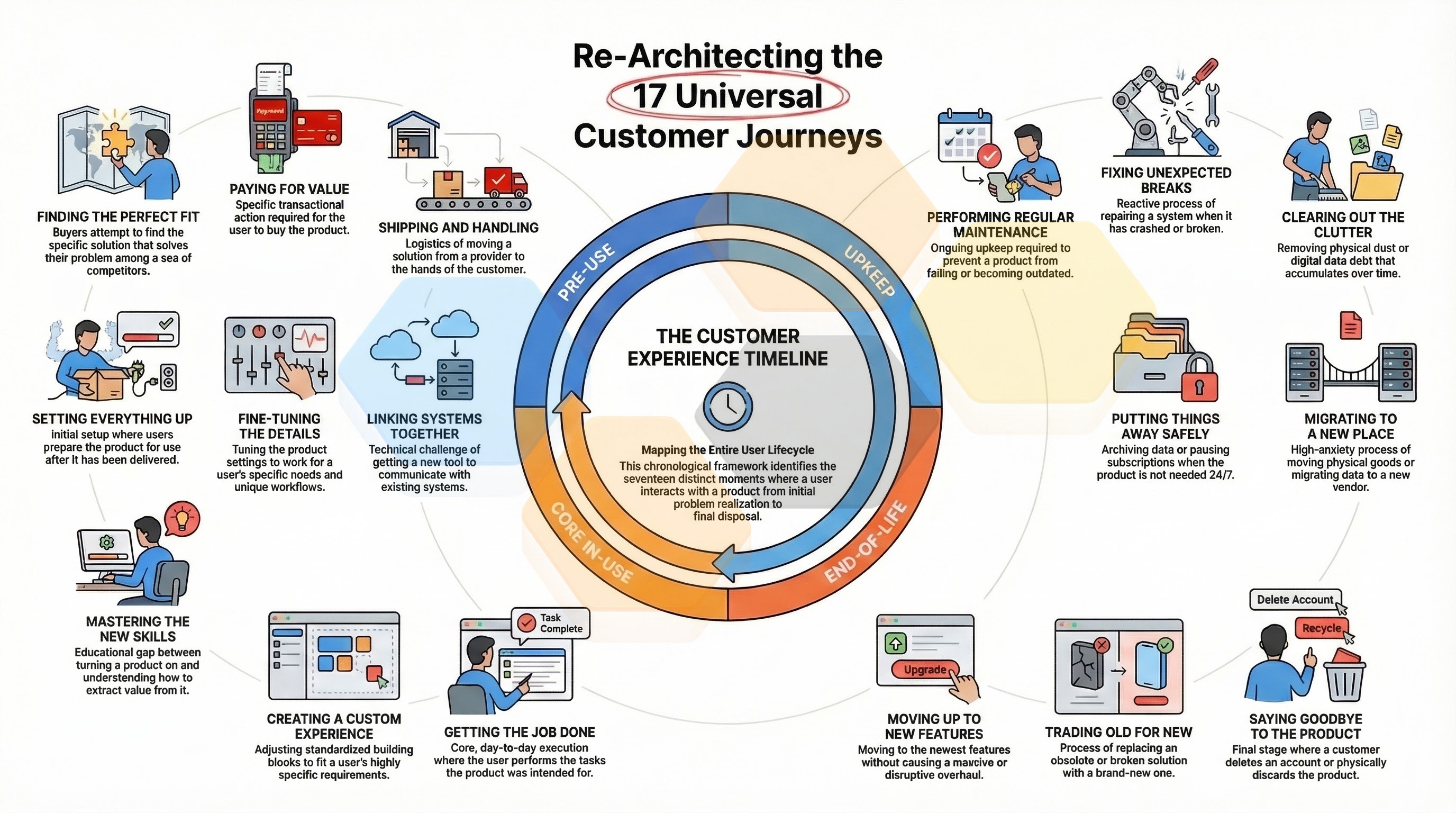
5. The Configuration Journey
If installation is getting the product plugged in, configuration is tuning it to actually work for your specific needs. This is where most SaaS platforms bleed churn. You log in, and you’re staring at 50 different toggles, dropdowns, and settings panels. It’s overwhelming.
The Pivot Strategy:
We’re deploying the “Distinct (Specialized) vs. Redundant” structural trigger, coupled with Doblin’s Service (Experience) type.
We’re going to eliminate the user’s configuration burden by shifting it from a self-serve, generalized software dashboard into a highly specialized, concierge service motion. We’ll do it for them.
B2B Example:
Superhuman, the premium email client, is famous for this. They didn’t just give users a download link and say, “Good luck setting up your hotkeys.” They knew configuration was the biggest barrier to experiencing their product’s magic. So, they made it a distinct service. Every single new user was required to do a 30-minute, 1-on-1 concierge onboarding call. A human expert literally sat on a Zoom call, asked about their workflow, and configured the software’s keyboard shortcuts for them in real-time. They shifted configuration from a redundant product feature into an elite, specialized service.
B2C Example:
Look at premium home audio, like Sonos. When you used to buy a surround sound system, you’d spend hours configuring the EQ, balancing the rear channels, and messing with an amp receiver. Sonos introduced “Trueplay.” You just walk around your living room waving your phone up and down for 60 seconds. The app listens to the acoustic reflections, calculates the room’s shape, and automatically tunes the speakers. They took a highly specialized audio engineering task and replaced it with a 60-second, distinct sensory feedback loop.
6. The Integration Journey
Nobody buys software in a vacuum anymore. Everything’s got to talk to everything else. The Integration Journey is the massive headache of trying to get your shiny new tool to play nice with your archaic legacy systems. Usually, it feels like slapping duct tape on a leaky pipe.
The Pivot Strategy:
We’ll hit this with the “Linked (Networked) vs. Unrelated” trigger and integrate it with Doblin’s Network (Configuration) innovation type.
Instead of forcing your customer to build custom bridges between unrelated silos, you create a network layer that seamlessly links them in the background. You want your product to become an invisible, unifying layer.
B2B Example:
Plaid is the ultimate B2B integration pivot. Fintech app developers used to spend millions trying to build custom, unrelated integrations into thousands of different banks—each with its own terrible, unique legacy codebase. Plaid stepped in and built the universal network. They handled the nightmare of linking the legacy systems. Now, if you’re building a finance app, you just integrate with Plaid once, and you’re instantly linked to every bank in the country. They innovated purely on the “Network” layer, solving the integration journey for an entire industry.
B2C Example:
Think about smart home automation. Getting your Philips Hue lights to talk to your generic smart blinds and your Google Nest used to require a computer science degree and a third-party hub like IFTTT. The introduction of the “Matter” protocol completely changed this. By creating a unified, linked network standard, tech giants agreed to make their previously unrelated hardware play nice natively. For the consumer, the integration journey vanished. You just scan a QR code, and your Apple HomeKit instantly links to a third-party smart lock.
7. The Learning Journey
Finally, we hit the Learning Journey. This is the educational gap between the user turning the product on and actually extracting value from it. The harsh reality? Nobody reads the damn manual. If your product requires a 40-page PDF to understand, you’ve already lost.
The Pivot Strategy:
We’re going to apply the “Introduce Feedback / Alter Sensory Elements” trigger and blend it directly into Doblin’s Customer Engagement (Experience) type.
You’ve got to stop trying to teach users upfront. Instead, you create a system that teaches them asynchronously while they’re utilizing the product. You gamify the living hell out of the learning curve, using real-time feedback to drive engagement.
B2B Example:
Slack and Notion are brilliant at this. When you join a new Slack workspace, you aren’t forced to watch a 20-minute training video on how channels work. Instead, Slackbot—an automated, interactive entity—sends you a direct message. It asks you to reply, to try an emoji reaction, or to create a channel. As you execute these micro-actions, it gives you immediate positive feedback. You’re learning the platform’s mechanics by actually doing the core jobs. They altered the feedback loop to make learning an interactive engagement rather than a static reading assignment.
B2C Example:
Duolingo is arguably the best learning journey architect on the planet. Learning a language is inherently difficult and boring. Duolingo completely threw out the textbook. They introduced constant, micro-sensory feedback loops. Every correct answer gets a satisfying “ding” and a visual celebration. They introduced streaks, leaderboards, and slightly unhinged owl notifications to keep you engaged. They took the traditional, slow learning journey and inverted it into a hyper-engaging, real-time feedback game. You aren’t “studying”; you’re just playing.
Part 2: The Core In-Use Era (Value Extraction)
Alright, the honeymoon’s officially over. The user bought your product, they set it up, and they’ve learned the ropes. Now they actually have to use the damn thing to get their job done. This is where you prove your worth. If they can’t extract value quickly and seamlessly, they’re gone.
8. The Customization Journey
Everyone wants things their way, but nobody actually wants to build it from scratch. The Customization Journey is that weird purgatory where a user needs your tool to fit their highly specific workflow, but if you just hand them a blank canvas and a bunch of developer tools, they’ll freeze. Customization shouldn’t feel like a second job.
The Pivot Strategy:
We’re going to deploy the “Customize/Standardize” marketing trigger and smash it together with Doblin’s Structure (Configuration) innovation type.
Instead of forcing your internal dev team to build a million niche features for every possible edge case, you standardize the underlying building blocks. Then, you open up your organizational structure to let a decentralized network of users do the heavy lifting for you.
B2B Example:
Look at Notion. If Notion just gave you a blank page, you’d never use it. It’s too overwhelming. But they didn’t try to build a custom project manager for every single industry themselves, either. They applied the structural pivot. They built a standardized set of Lego blocks (tables, databases, text blocks) and then structurally incentivized a massive creator community to build custom templates. You want a CRM for a boutique real estate firm? A Notion creator already built it. You just duplicate it. They achieved infinite customization by standardizing the core and decentralizing the structural effort.
B2C Example:
Roblox completely mastered this in the gaming space. They didn’t build a billion custom mini-games. They built a standardized physics engine and a set of structural creation tools, then handed them to the players. The users customize the entire experience for themselves and each other. The customization journey isn’t a feature; it’s the entire structural business model.
9. The Utilization Journey
This is it. The big one. The Utilization Journey is the core, day-to-day execution. It’s the exact moment the user tries to get the job done. If your utilization journey is clunky, slow, or bloated, your churn rate’s going to skyrocket.
The Pivot Strategy:
We’re grabbing the “Separated vs. Combined” structural trigger and injecting it into Doblin’s Product Performance (Offering) type.
You’ve got to look at the user’s workflow and ask: “Are we forcing them to combine things that should be separated? Or are they doing three separate things that we could combine into one single, god-tier button click?” You’re physically altering the product’s performance mechanics to fold time.
B2B Example:
Let’s talk about booking a meeting. Historically, you’d email back and forth, check your Outlook, type out availabilities, wait for a reply, and then manually create a calendar invite. It was a terribly combined, synchronous nightmare. Calendly came in and separated the booking interface from the calendar management entirely. They decoupled the process. They gave you a static link that performs asynchronously. You separated the negotiation from the execution, radically improving product performance.
B2C Example:
Uber is the ultimate “combined” product performance pivot. Before ridesharing, the utilization journey of getting a cab meant separating three tasks: calling a dispatcher, physically waving a hand on a street corner, and swiping a credit card at the end. Uber took those three entirely separated, high-friction steps and combined them into one single tap on a glass screen. They combined location tracking, dispatching, and payment into one unified product performance motion.
Part 3: The Grind (Upkeep & Friction)
Welcome to the messy middle. The Grind is where products break, data gets messy, and the reality of physical or digital entropy sets in. Companies hate focusing on these journeys because they aren’t “sexy,” but innovating here builds an incredibly deep moat.
10. The Maintenance Journey
Maintenance is a tax on the user’s time. It’s the ongoing upkeep required just to stop the product from failing. Whether it’s updating software versions or getting an oil change, users actively resent it.
The Pivot Strategy:
We’re bringing in the “Fixed vs. Mobile” structural trigger and pairing it with Doblin’s Process (Configuration) type.
If maintenance historically requires the user to go to a fixed location (a dealership, a specific IT terminal), make the maintenance mobile so it comes to them. Change the operational process so the upkeep happens invisibly in the background.
B2B Example:
Think about legacy enterprise software. Maintaining it meant scheduling “server downtime” at 2:00 AM on a Sunday while an IT guy manually installed a patch at a fixed terminal. It was a brutal process. Modern SaaS companies inverted this by making maintenance “mobile” via the cloud. They changed the underlying development process to Continuous Integration/Continuous Deployment (CI/CD). The updates roll out invisibly in the background while you’re working. The user doesn’t even know the maintenance journey happened.
B2C Example:
Tesla completely obliterated the traditional automotive maintenance journey. For a century, if your car had a recall or needed a system update, you had to drive it to a fixed location—the dealership. You’d sit in a waiting room drinking terrible coffee. Tesla made the maintenance mobile. You park your car in your garage, go to sleep, and it downloads an Over-The-Air (OTA) update via Wi-Fi. You wake up, and your brakes work better. They changed the entire operational process of vehicular upkeep.
11. The Repair Journey
Maintenance is preventative; Repair is reactive. The thing is broken. The system crashed. The user’s in acute pain and their blood pressure’s through the roof. Making them sit on hold for 45 minutes listening to elevator music is practically a crime.
The Pivot Strategy:
We’re going to hit this with the “Borrow/Leverage” marketing trigger and map it to Doblin’s Service (Experience) type.
Instead of routing every single broken thing through your own expensive, bottlenecked customer support team, how can you borrow an external asset or leverage a community to provide the service instantly?
B2B Example:
Open-source software companies and developer platforms like GitHub or Stack Overflow are brilliant at this. When a developer hits a bug, they don’t submit a support ticket to Microsoft and wait 48 hours. The company leverages the global community. The “service” is crowd-sourced. You search the error code, and you borrow the solution from another developer who fixed the exact same issue three years ago. The repair journey is instantly resolved by leveraging O.P.A. (Other People’s Answers).
Note: With the emergence of Large Language Models, Stack Overflow has seen its monthly peak of new questions of 200,000 per month to under 50,000; erasing 15 years of growth and returning to 2008 levels.
B2C Example:
Look at how modern smart appliances are shifting the service model. If your washing machine breaks, you used to call a repairman who’d charge you $100 just to diagnose it. Now, companies like LG are leveraging NFC and smartphone sensors. Your washer breaks, you hold your phone up to a blinking light on the console, and the app “listens” to an audio diagnostic code. It instantly tells you what’s wrong and orders the exact part. They borrowed the computing power in your pocket to radically upgrade their repair service.
12. The Cleaning Journey
Things get dirty. Physical products gather dust; digital products gather data-debt. A cluttered inbox or a disorganized hard drive creates massive cognitive friction. Users shouldn’t have to spend their Friday afternoons sanitizing your platform.
The Pivot Strategy:
We’re using the “Dissolve/Evaporate” structural trigger (a subset of removing motion) and embedding it into Doblin’s Product System (Offering).
We’re going to build a product system that literally cleans itself. The clutter should evaporate automatically after its useful life is over, removing the manual motion of cleaning entirely.
B2B Example:
Slack realized that enterprise communication creates an insane amount of data-debt. If you had to manually delete every irrelevant message to keep your workspace clean, you’d go crazy. So they built auto-archiving and retention policies right into the product system. You can set channels so that messages literally dissolve after 30 or 90 days. The clutter evaporates. The cleaning journey is fully automated by the system’s architecture.
B2C Example:
This is the entire premise of the iRobot Roomba. Vacuuming is a terrible cleaning journey. iRobot turned the vacuum from a dumb tool you have to push into an autonomous product system that patrols your house while you’re at work. But they didn’t stop there. The newest ones drive back to their base station and suck the dirt out of their own bins. The system cleans the cleaner. The manual motion of sanitizing your floors simply evaporated.
13. The Storage Journey
Users don’t always need your product active 24/7. Sometimes they need to archive data, pause a subscription, or put a physical item away. If you make it hard to store or pause, they won’t put it on a shelf—they’ll just cancel it completely.
The Pivot Strategy:
We’re applying the “Add vs. Remove Space” trigger and tying it directly to Doblin’s Profit Model (Configuration).
We’re going to change how we charge the customer based on the “space” (or accessibility) they’re currently occupying. If they don’t need immediate access, we alter the profit model to keep them in the ecosystem rather than losing them to churn.
B2B Example:
Amazon Web Services (AWS) completely revolutionized this with “Glacier” storage. Companies have petabytes of legal or compliance data they rarely need to access, but they can’t delete it. Storing it on active, high-speed servers is incredibly expensive. AWS added a “cold” space. They drastically dropped the price (changing the profit model) for data that takes a few hours to retrieve. They removed the immediate accessibility in exchange for cost, dominating the B2B storage journey.
B2C Example:
Think about boutique gym memberships or high-end subscription boxes. If someone gets injured or goes on a two-month vacation, their only option used to be a hard cancellation. That’s terrible for retention. Smart brands introduced a “pause” tier. You pay $5 a month just to “store” your account, keeping your grandfathered pricing and your data intact. They added a digital holding space and adjusted the profit model to capture a small amount of revenue while completely eliminating the churn event.
14. The Relocation Journey
Moving sucks. Whether it’s moving your physical couch to a new apartment or migrating 10 years of CRM data to a new software vendor, it’s a high-risk, high-anxiety journey. Customers will literally stay with a terrible product for years just because they’re terrified of the relocation process.
The Pivot Strategy:
We’ll attack this with the “Change Location” structural trigger and pair it with Doblin’s Channel (Experience) innovation type.
Instead of making the user manually haul their data or physical goods across the gap, you build a dedicated, frictionless channel that changes the location for them. You make the migration a competitive advantage instead of a barrier to entry.
B2B Example:
When a company wants to switch from a legacy on-premise server to the cloud, the data relocation journey is terrifying. AWS literally built a physical channel to solve this called the “Snowmobile.” It’s a massive, ruggedized shipping container packed with hard drives that they drive to your data center. You plug it in, securely transfer petabytes of data at local speeds, and they drive it back to their cloud facility. They changed the location of the data by building an audacious, physical migration channel, completely removing the internet bandwidth bottleneck.
B2C Example:
Switching music streaming services used to mean manually rebuilding hundreds of playlists track by track. Nobody wanted to do it. Then, third-party apps and native channels emerged (like SongShift) that automate the entire relocation journey. You log into Spotify, log into Apple Music, and hit a button. The digital channel perfectly mirrors your library in the new location in three minutes. By removing the friction of relocation, they destroyed the competitor’s lock-in effect.
Part 4: The End-of-Life Era (Evolve or Churn)
We’ve reached the final frontier. The End-of-Life Era is exactly what it sounds like. The customer’s extracted the value, and the current lifecycle of the product’s coming to a close. They’re either going to upgrade, replace you, or throw you in the trash. If you haven’t innovated here, you’re just handing your hard-earned customers directly to your competitors with a neat little bow on top.
15. The Upgrade Journey
Upgrades shouldn’t feel like pulling teeth, but they usually do. If you force a user to go through a massive, disruptive overhaul just to get the newest features, you’re creating a gigantic hurdle. You’re basically asking them to re-evaluate their entire purchase decision from scratch. And trust me, you don’t want them shopping around.
The Pivot Strategy:
We’re going to deploy the “Change Scale/Scope” marketing trigger and weave it perfectly into Doblin’s Customer Engagement (Experience) type.
Instead of treating an upgrade like a massive, once-a-year capital expenditure or a giant software migration, we’re changing the scale. We’re breaking the upgrade down into continuous, bite-sized micro-engagements that’re baked right into the user’s daily workflow.
Deep-Dive B2B Case Study: Adobe & Microsoft’s Cloud Pivot
Let’s look at legacy enterprise software. In the old days, upgrading from Adobe CS5 to CS6, or Windows Server 2008 to 2012, was a multi-month nightmare. You had to hire consultants, take systems offline, retrain everyone, and drop a massive chunk of CapEx budget. The scope was terrifying. Competitors loved this because it was the perfect window to steal clients.
Microsoft and Adobe completely changed the scale. They shifted to Office 365 and Creative Cloud. You don’t “upgrade” your Photoshop in a massive, disruptive event anymore. They just drop micro-updates into your app while you’re sleeping. If you want a new premium feature, you just click a padlock icon in your daily workspace, pay a tiny marginal fee, and it unlocks instantly. They altered the scope from a massive IT headache to a frictionless, continuous customer engagement moment. They made upgrading so small it practically vanished.
Deep-Dive B2C Case Study: The Apple iPhone Upgrade Program
This is the absolute holy grail of the scale/scope pivot. Asking a consumer to shell out $1,200 every two or three years for a new phone creates a huge psychological barrier. It forces them to look at Samsung or Google.
Apple changed the scale of the financial and psychological hurdle. Instead of a massive lump sum, you pay a small, manageable monthly fee. In exchange, every 12 months, they just hand you the newest iPhone. You don’t even think about it anymore. You don’t research alternatives. They turned a massive, anxiety-inducing upgrade journey into a standardized, continuous micro-engagement. They locked in the ecosystem by simply changing the frequency and scale of the transaction.
16. The Replacement Journey
Nothing lasts forever. Eventually, the user’s current solution is entirely obsolete or broken beyond repair, and they need a new one. If you wait until they’re actively shopping on Google to try and win their replacement business, you’ve already lost.
The Pivot Strategy:
We’re attacking this with the “Change Timing/Frequency” trigger and mapping it to Doblin’s Network (Configuration) innovation type.
We’re going to intercept the replacement journey before it happens. By partnering with adjacent players or even your direct competitors, you can leverage a network to handle the messy reality of swapping out old junk for your shiny new solution. You’re changing the timing to catch them right when their frustration peaks, but before they start hunting for alternatives.
Deep-Dive B2B Case Study: IT Device-as-a-Service (DaaS)
Think about the nightmare of replacing a fleet of 5,000 corporate laptops. It’s so expensive and logistically awful that companies will stick with failing gear for years, torturing their employees. Smart IT hardware vendors realized this and changed the timing. They partnered with corporate financing networks and e-waste recyclers to create “Device-as-a-Service.”
When a company’s three-year lease is up, the network automatically ships them brand new laptops and takes the old ones away to be securely wiped and recycled. They intercepted the replacement journey before the IT director ever had the chance to look at a competitor’s pricing. By leveraging a massive partner network, they absorbed all the friction of the replacement cycle.
Deep-Dive B2C Case Study: The Dealership Trade-In Model
Car dealerships and electronics retailers like Best Buy run this playbook flawlessly. When you’re tired of your clunky, dying Android phone, Best Buy doesn’t just run an ad trying to sell you a new iPhone. They leverage their massive retail network to offer an instant trade-in program. They’ll literally take the competitor’s dying product off your hands, give you a gift card, and use it to fund the replacement on the spot. They altered the timing of your churn and used their network to absorb the friction of dumping your old device. They solve the disposal and the replacement journey in one swift motion.
17. The Disposal Journey
We’re at the end of the line. The Disposal Journey is where the customer deletes their account or physically throws your product in a dumpster. Usually, this is a guilt-ridden, frustrating experience. Software companies usually make account deletion impossible to find, hoping you’ll just give up and keep paying. That’s toxic and burns your brand to the ground.
The Pivot Strategy:
We’re going to hit this with the “Reverse/Invert” structural trigger and pair it brilliantly with Doblin’s Brand or Process types.
We’re going to take the absolute most negative part of the customer lifecycle (throwing something away) and invert it. We’re going to turn the disposal process into a massive, loyalty-building brand asset.
Deep-Dive B2B Case Study: Elite IT Asset Disposal (ITAD)
Disposing of old enterprise hard drives is a massive legal and environmental liability. You can’t just toss servers in the trash; they’re full of sensitive customer data. Elite IT disposal firms completely inverted this journey. They don’t just act like garbage men. They come in with military-grade shredders, securely destroy the data on-site, recycle the raw atoms, and hand the CEO a beautiful “Green IT & Data Security” certificate.
They inverted the disposal process into a tangible asset the company can brag about in their annual ESG report. They turned corporate garbage into a brand-building victory, transforming a massive liability into a premium service.
Deep-Dive B2C Case Study: Patagonia & Nespresso
Patagonia’s “Worn Wear” program is a masterclass in brand inversion. When your $300 winter jacket gets ripped or worn out, the traditional disposal journey means tossing it in a landfill. It feels terrible. Patagonia completely inverted it. They tell you to send it back to them. They’ll patch it up, resell it as vintage gear, and give you store credit for your next purchase. They turned the literal disposal of their product into a sustainable, closed-loop process that skyrockets brand loyalty.
Nespresso did the exact same thing with their aluminum coffee pods. Tossing them felt wasteful, so Nespresso built a specialized Process to invert it. They give you a customized recycling bag. You fill it with used pods, and UPS picks it up from your porch for free. They smelt the aluminum down to make new pods and use the coffee grounds for compost. By completely owning the disposal journey, they removed the consumer’s guilt and built an incredibly sticky, premium brand moat.
Part 5: The De-Risking Playbook (Executing Governance)
Alright, so we’ve used our triggers and Doblin types to dream up some incredibly disruptive ideas. Now what?
This is where most innovation labs completely fail. They march into the CFO’s office with a slide deck, and the finance team demands a 5-year ROI projection for a product that doesn’t even exist yet. That’s called the “Monolithic Fallacy.” Teams are forced to invent fake revenue numbers, which usually leads to the company funding safe, boring, incremental ideas and killing the disruptive ones.
We’re throwing that out. We’re replacing it with Real Options Analysis (ROA) and the Unified Validation Engine. You aren’t funding a product launch; you’re buying staged options of information. You’re systematically de-risking the journey. Here’s exactly how you govern it.
Phase 1: The Option to Explore (State 1: The Hunch)
The Goal: Prove you aren’t solving a fake problem.
The Math: You’re dealing with “State 1” data here. It’s just a hunch. We use the Bivariate Risk/Impact Matrix. You score the risk of being wrong (1-10) against the potential impact (1-10). If your priority score is over 64, you’ve got permission to explore.
The Action: You deploy the Socratic Deconstructor and First Principles Calculator. You strip away the analogies, find the actual physics or digital floor of the problem, and figure out the ID10T Index (the inefficiency delta). You’re buying the right to go gather actual market data.
Phase 2: The Option to Validate (State 3: Empirical Data)
The Goal: Quantify the exact struggle using rigorous statistics. No more guessing.
The Math: We’re moving to “State 3” empirical proof. Listen to me closely: You cannot average 1-5 Likert scale survey responses. It’s a severe statistical violation. Ordinal data isn’t math. Instead, we use the Top-Box JTBD Formula: Objective Need Score = r * G.
Urgency (G): You take the percentage of people who rate the problem highly important (Top-Box 4 or 5) and subtract the percentage who are highly satisfied. That gives you your unfulfilled market gap.
Impact (r): Customers lie. They’ll tell you everything’s important. To cut through the BS, you use a Pearson correlation coefficient. You correlate their satisfaction with a specific step to their overall satisfaction with the job. If the correlation is high, fixing that step actually moves the needle.
The Action: You map the 9-step chronological job and generate the mathematical Heatmap. You’ve now bought the right to design a prototype.
Phase 3: The Option to Execute (The MVPr)
The Goal: Prove the unit economics work before you write a million lines of code.
The Action: You don’t build a massive, scalable software platform. You build a Minimum Viable Prototype (MVPr)—a “Wizard of Oz” manual concierge service. If you can’t solve the problem manually for ten customers, software won’t save you.
The Ultimate Check: The 3-Tier FAQ
Before you release a single dime of serious scaling capital, the team must draft a 3-Tier FAQ. This forces the transition from divergent dreaming to convergent execution.
The Customer FAQ: How much is it? How does it work? Why should I switch? (Tests adoption).
The Internal FAQ: What’s the biggest technical risk? What’s our CAC vs LTV? (Tests business viability without marketing fluff).
The Private Equity FAQ (Value Creation Plan): How do we scale this 3x without crushing our margins? What’s the 7-year exit optionality? (Tests long-term asset value).
Conclusion: The Option to Execute
Let’s wrap this up. Unstructured brainstorming is dead. If you’re just sitting in a room saying, “Hey, how do we make our software better?” you’re going to fail. You’ll end up building a slightly shinier version of a fundamentally broken process. You’ll be playing firefighter, putting out symptoms while the root cause burns your house down.
The 17 Universal Customer Journeys give you the exact chronological map of where your customer is bleeding out. Doblin’s 10 Types of Innovation and those rigid Creativity Triggers are your Socratic Scalpel.
By forcing your team to apply aggressive constraints—like “How do we completely remove the motion of this installation?” or “How do we invert this disposal journey into a brand win?”—you stop iterating and start innovating. You don’t just build a better feature; you re-architect the entire structural unit economics of the problem.
And most importantly, you don’t bet the farm on a guess. You use the Unified Validation Engine. You find the Top-Box gaps, you correlate the impact, and you run it through the PR/FAQ buzzsaw.
Innovation isn’t about blindly throwing darts at a whiteboard. It’s about systematically de-risking your vision. It’s about taking the Option to Explore, forcing it through the crucible of these constraints, and emerging with a bulletproof Option to Execute.
Stop tweaking the symptoms. Grab a trigger, map the journey, do the math, and go invert your industry.
If you find my writing thought-provoking, please give it a thumbs up and/or share it. If you think I might be interesting to work with, here’s my contact information (my availability is limited):
Book an appointment: https://pjtbd.com/book-mike
Email me: mike@pjtbd.com
Call me: +1 678-824-2789
Join the community: https://pjtbd.com/join
Follow me on 𝕏: https://x.com/mikeboysen
Articles - jtbd.one - De-Risk Your Next Big Ideaaudible
Q: Does your innovation advisor provide a 6-figure pre-analysis before delivering the 6-figure proposal?


