

New Masterclass: Principle to Priority
Part I: The Deconstruction
Introduction: The End of the “Yellow Pages” Era
The global freelance economy is currently valued at approximately $1.5 trillion, yet it operates on a digital architecture that hasn’t fundamentally evolved since 1999. Whether it is Upwork, Fiverr, or Toptal, the core mechanism remains identical to the physical Yellow Pages: a directory of humans that you must search, vet, and manage.
This model is a transitional artifact. It is based on the “Pre-AI” assumption that cognitive labor is inextricably linked to a biological human. In the post-LLM era, this assumption is false. We are witnessing the collapse of the “Talent Marketplace” (connecting humans to work) and the rise of the “Agentic Service Network” (encapsulating work as software).
The shift is not about “AI tools” making freelancers faster; it is about Service-as-Software (SaS) making the “freelance gig” economically obsolete. When the cost of executing a standard cognitive task drops from $300 (human rate) to $0.30 (compute cost), the friction of the marketplace model—posting a job, interviewing candidates, and managing invoices—becomes a “Transaction Tax” that exceeds the value of the work itself.
This guide deconstructs the physics of this transition. We will dismantle the current industry beliefs using Socratic inquiry, audit the efficiency gaps using the ID10T Index, and map the inevitable reconstruction of the service economy.
The “Yellow Pages” Fallacy
The Stuck Belief
The entire “Gig Economy” industry is built on a single, fragile premise: “The hardest part of getting work done is finding the right person to do it.”
This belief drives the feature roadmaps of every major platform. They build better search algorithms, “Talent Badges,” and “Pro” tiers, all designed to optimize the search for a human.
The Socratic Deconstruction
1. Clarification: What do we actually mean by “finding talent”?
When a business leader says they need a “Graphic Designer,” they are using a proxy term. They do not want a human with a specific job title; they want a specific Capability (the ability to manipulate pixels) to produce a specific Outcome (a high-conversion landing page). The “Person” is merely the container for the Capability.
2. Challenging Assumptions: Why do we assume the solution to a business problem must be a person?
The assumption is that “Reasoning” and “Execution” are biological traits. Therefore, to get reasoning, you must hire a human. But if an AI agent can execute the reasoning (e.g., “Analyze this SEO data”) and the execution (e.g., “Write the report”), the human container becomes redundant.
3. Evidence: The “Marketplace” fails at its primary job.
If marketplaces were truly the most efficient way to access talent, high-value work would concentrate there. It does not.
The Referral Anchor: According to industry data, 60-70% of high-value freelance work ($10k+ projects) happens off-platform via private referrals.
The Toll Booth Reality: Platforms charge a 15-30% take rate (combined buyer/seller fees) essentially for introductions. Once trust is established, rational actors move off-platform to avoid the tax. The platform is not a “value engine”; it is a “toll booth” on the road to trust.
The Implication
If the “Capability” can be decoupled from the “Person” via Agentic AI, the marketplace model collapses. You do not need to “search” for an API. You do not “interview” software. You simply subscribe to the outcome.
The future is not a better directory of writers; it is a Writer-Agent API that guarantees the outcome without the search friction.
The “Trust Tax” Deconstruction
The Stuck Belief
“We need humans to vet humans. Trust is a social capital that requires interviews, portfolios, and reviews.”
This belief creates the massive latency found in the current system. It takes an average of 3 days to hire a freelancer for a task that might only take 2 hours to complete.
The Socratic Deconstruction
1. Clarification: What is “Trust” in a digital transaction?
Trust is simply Predictability. It is the statistical confidence that Input A will result in Output B. In the current model, we use “Social Proxies” (reviews, headshots, university degrees) to guess at Predictability. This is a low-fidelity, high-latency verification method.
2. The Alternative Viewpoint: Trust should be Cryptographic and Performance-Based.
In a “Service-as-Software” model, trust is established through code, not conversation.
SLA vs. Resume: You don’t ask AWS for a resume to see if they can host your website. You look at their Service Level Agreement (SLA) (e.g., “99.9% Uptime”).
The Verification Shift: We are moving from “Social Trust” (I like this guy) to “Verifiable Trust” (The output passed the unit test).
The “Minimum Viable Gig” Floor
The reliance on “Social Trust” creates a hard economic floor for the Gig Economy.
The Friction Calculation: It takes approximately 2 hours of management time to define a job, post it, interview three candidates, and onboard the winner.
The Cost: At a manager’s L3 rate ($75/hr), the “Trust Tax” is $150.
The Consequence: It is economically irrational to hire a freelancer for any task worth less than ~$150. If the task is worth $50, the transaction cost exceeds the value.
The Implication
The “Trust Tax” makes micro-work impossible for humans to trade efficiently. However, AI Agents have zero transaction friction.
Agentic Trust: An agent doesn’t need an interview. It needs a prompt.
The result: The “Minimum Viable Gig” drops from $150 to $0.01. This opens up a massive new economy of “Nano-Services”—tiny, complex cognitive tasks (e.g., “Find the email of this CEO”) that were previously too expensive to outsource to a human, but are now trivial for an Agentic Service Network.
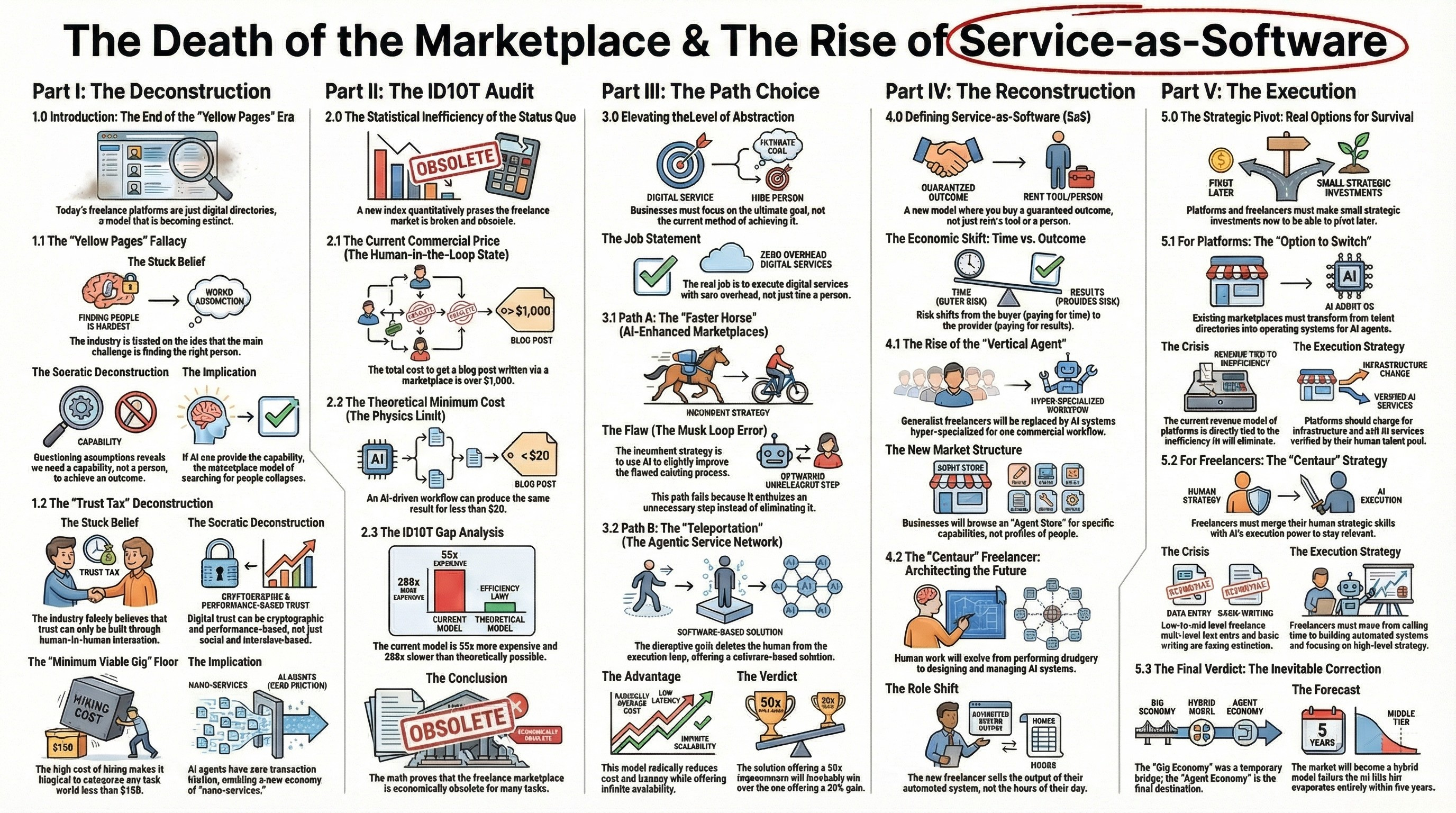
Part II: The ID10T Audit
The Statistical Inefficiency of the Status Quo
We must move beyond qualitative arguments and audit the “Freelance Marketplace” using the ID10T Index (Inefficiency Delta in Operational Transformation). This index calculates the gap between the Current Commercial Price (what you pay today) and the Theoretical Minimum Cost (the limit of physics and compute).
A healthy market has an ID10T gap of 2x-3x. The freelance market, as we will demonstrate, has a gap exceeding 25x, indicating imminent obsolescence.
The Current Commercial Price (The Human-in-the-Loop State)
The Scenario: A business needs a high-quality, 2,000-word SEO-optimized blog post on a technical topic.
The Labor Audit (L2 Skilled Trade):
To execute this via a marketplace (e.g., Upwork/Fiverr), the buyer pays for both execution time and “Trust Tax” latency. We utilize the L2 Skilled Trade Rate ($75/hr) from the standardized rate card, as this represents a competent professional copywriter.
Search & Vetting (The Trust Tax): 2 hours of Buyer time (L3 Manager @ $300/hr) to post, filter, and interview.
Execution (The Labor): 5 hours of Freelancer time (L2 Skilled @ $75/hr) to research, draft, and edit.
Platform Friction: 15% Platform Fee (Buyer + Seller side combined) on the labor.
Latency: 72 hours (3 days) from “Need” to “Delivery.”
The Invoice:
Buyer Admin Cost: $600 (2 hrs x $300)
Freelancer Labor Cost: $375 (5 hrs x $75)
Platform Fees: ~$56 (15% of Labor)
Total Commercial Price: $1,031
Total Latency: 72 Hours
Note: Even if we ignore the Buyer’s admin time (which businesses often fail to track), the direct cash cost is $431.
The Theoretical Minimum Cost (The Physics Limit)
The Scenario: The same 2,000-word outcome generated via an Agentic Workflow (e.g., an OpenAI/Claude wrapper with search capability).
The Physics Audit:
Search & Vetting: 0 hours. The Agent is an API endpoint.
Execution (The Bits Floor):
Input: ~3,000 tokens of context/research.
Output: ~2,500 tokens of finished text.
Compute Cost: At current GPT-4o pricing (~$5.00/1M tokens), this transaction costs approximately $0.03.
The Regulatory/Quality Floor: The “Human-in-the-Loop” must verify the output. We assign a “Quality Review” step.
Time: 15 minutes (0.25 hrs).
Rate: L2 Skilled Trade ($75/hr).
Cost: $18.75.
The Invoice:
Buyer Admin Cost: $0 (API call)
Agent Labor Cost: $0.03 (Compute)
Human Review Cost: $18.75
Total Theoretical Minimum: $18.78
Total Latency: 15 Minutes (Generation + Review)
The ID10T Gap Analysis
The ID10T Index is calculated by dividing the Current Commercial Price by the Theoretical Minimum.
The Efficiency Collapse
Cash Efficiency Gap: $1,031 / $18.78 = 54.9x
Latency Efficiency Gap: 72 Hours / 0.25 Hours = 288x
The Conclusion:
The current marketplace model is operating at 55x the cost and 288x the slowness of the theoretical minimum. In any efficient market, a delta of this magnitude triggers a rapid correction. The “arbitrage” of hiring cheap human labor is gone; the new arbitrage is replacing the human labor loop entirely.
The Freelance Marketplace is not just “inefficient”; it is economically totally obsolete for standardized cognitive tasks. We are not waiting for “better AI”; the math already dictates the death of the model.
Part III: The Path Choice
Elevating the Level of Abstraction
When an industry faces a 55x efficiency gap, it faces a strategic fork in the road. To navigate this, we must use the Jobs-to-be-Done (JTBD) framework to elevate our level of abstraction. We must identify what the customer is actually trying to achieve, independent of the current solution (hiring a person).
The Job Statement
Level 1 (The Current Task): “Hire a freelancer to write a blog post.” (Solution-Biased).
Level 2 (The Functional Goal): “Generate high-quality written content.” (Better).
Level 3 (The Ultimate Job): “Executing complex digital services with guaranteed quality and zero management overhead.”
When we optimize for Level 3, we realize that the “Freelancer” and the “Marketplace” are not essential components of the job. They are merely the current delivery mechanism.
Path A: The “Faster Horse” (AI-Enhanced Marketplaces)
The Strategy:
This is the path currently chosen by incumbents like Upwork (with “Uma”) and Fiverr (with “Neo”). The strategy is to use AI to optimize the search process. They are building tools to:
Auto-generate proposals for freelancers.
Use matching algorithms to find candidates faster.
Use chatbots to help clients define their scope.
The Flaw (The Musk Loop Error):
This strategy violates Step 1 of the RFPA Protocol: “Make the Requirements Less Dumb.” It accepts the requirement that a human must be hired and tries to optimize the process of finding them. It is “paving the cow path.”
The Outcome: You might reduce the “Search & Vetting” time from 2 hours to 30 minutes.
The Failure: You still have the 5-hour execution latency and the $375 labor cost. The ID10T gap remains massive. You are simply building a faster toll booth.
Path B: The “Teleportation” (The Agentic Service Network)
The Strategy:
This is the path of disruption. It involves deleting the human requirement entirely (Step 2 of the RFPA Protocol) for the execution phase. The platform stops selling “Access to Talent” and starts selling “Service-as-Software” (SaS).
The Mechanism:
Instead of a “Marketplace of Profiles,” the platform becomes an “App Store of Vertical Agents.”
The Product: You don’t hire “Steve the Writer.” You subscribe to “Content-Agent-v4” (tuned by Steve).
The Transaction: You send an API call (the brief) and receive the artifact (the blog post).
The Human Role: Steve moves from “Laborer” to “Architect.” He maintains the agent and verifies its output, but he is no longer the bottleneck.
The Advantage:
Latency: Drops from Days to Minutes.
Cost: Drops from $1,031 to ~$20 (Software margin).
Scalability: Infinite. An agent can write 1,000 posts simultaneously; Steve cannot.
The Verdict:
Path A offers a 20% efficiency gain. Path B offers a 5,000% efficiency gain. In the history of innovation, the solution that offers a 10x improvement (let alone 50x) always wins. The “Gig Economy” will inevitably transition into the “Agent Economy.”
Note: You just don’t need something like Outcome-Driven Innovation to figure this stuff out. That work comes later.
Part IV: The Reconstruction
Defining Service-as-Software (SaS)
We must strictly define the new economic unit. Service-as-Software (SaS) is distinct from Software-as-a-Service (SaaS).
SaaS (The Tool): You rent a hammer (Salesforce). You still need a carpenter (Sales Rep) to swing it.
SaS (The Outcome): You rent the carpentry (The AI Sales Agent). The tool is invisible; only the outcome (a booked meeting) is delivered.
The Economic Shift: Time vs. Outcome
The most profound shift is the movement of risk.
The Marketplace Model (Hourly): The buyer pays for time. If the freelancer is slow or incompetent, the Buyer pays the penalty. Incentives are misaligned; the freelancer is incentivized to take longer.
The SaS Model (Outcome): The buyer pays for result. If the Agent is inefficient or hallucinates, the Provider pays the penalty (in compute costs). Incentives are aligned; the provider is incentivized to maximize efficiency to increase margin.
The Rise of the “Vertical Agent”
The “Generalist Freelancer” (e.g., “I do data entry and web research”) is dead. They cannot compete with the Vertical Agent.
A Vertical Agent is an AI system fine-tuned for a specific, narrow commercial workflow. It does not try to “be human”; it tries to be the “Theoretical Minimum” of a specific process.
The New Market Structure
Instead of browsing profiles for “Graphic Designers,” businesses will browse the Agent Store for specific capabilities:
The “Thumbnail Agent”: Reads a YouTube video script -> Generates 5 high-CTR thumbnail variants -> A/B tests them.
Latency: 30 seconds.
Cost: $0.10.
The “Legal Discovery Agent”: Scans 10,000 PDF emails -> Flags privilege -> Summarizes timelines.
Latency: 10 minutes.
Cost: $5.00.
The “React Refactoring Agent”: Ingests legacy Class Components -> Rewrites as Functional Components -> Runs Unit Tests.
Latency: Instant.
Cost: $0.05 per component.
The “Centaur” Freelancer: Architecting the Future
This does not mean the end of human work. It means the end of human drudgery. The freelancer of 2026 is not a laborer; they are an Agent Architect.
The Role Shift
Old Role: “I write blog posts for $100.” (Limited by hours in the day).
New Role: “I build and tune ‘Blog-Agent-v9’ that writes blog posts.” (Unlimited scale).
The new “Freelancer” sells the Labor of their System, not the labor of their hands. They are the “Human-in-the-Loop” for the edge cases, the creative director for the strategy, and the engineer of the prompt chains.
Part V: The Execution
The Strategic Pivot: Real Options for Survival
The transition from the “Marketplace Era” to the “Agentic Era” is not a remote probability; it is an active market correction. To survive, both Platforms and Freelancers must exercise Real Options—investing small amounts of capital today to buy the right to pivot tomorrow.
For Platforms: The “Option to Switch”
The Crisis:
Upwork, Fiverr, and Toptal face an existential “Innovator’s Dilemma.” Their entire revenue model (listing fees + percentage of hourly billing) is tied to inefficiency. If they make the work instant and cheap (SaS), their Gross Merchandise Value (GMV) collapses.
The Execution Strategy:
They must purchase the Option to Switch from “Talent Marketplace” to “Work Management OS.”
Cannibalize the Listing Fee:
Stop charging for introductions. Start charging for infrastructure. They must become the OS where the Agents live.
Acquire the “Verticals”:
Instead of competing with the “Legal Discovery Agent,” they must acquire the tool and offer it as a “Managed Service.”
Old Model: “Here are 50 lawyers you can hire for $200/hr.”
New Model: “Use our Legal Discovery Cloud for $0.10/doc. (Powered by AI, verified by Elite Humans).”
The “Human-in-the-Loop” Premium:
Position their human talent pool not as “Laborers,” but as the “Quality Assurance Layer” for the AI. You pay the AI for the work, and you pay the Platform to have a human verify it.
For Freelancers: The “Centaur” Strategy
The Crisis:
The bottom 50% of the freelance market (L1/L2 tasks) is facing Value Extinction. Data entry, transcription, basic translation, and SEO writing are effectively worth $0.00. You cannot compete with free.
The Execution Strategy:
Freelancers must execute a “Centaur” pivot—merging human strategy with AI execution.
Abandon L1/L2 Work:
Stop selling “time” for standardized tasks. If an LLM can do it 80% as well as you, get out of that market immediately.
Become the “Agent Orchestrator” (L4 Role):
Sell the System, not the Key Strokes.
Instead of: “I will write your email campaign.”
Sell: “I will build you an automated Email Agent that monitors your CRM and writes personalized outreach.”
The “High-Context” Moat:
AI struggles with “High Context” (understanding the messy, unwritten political and emotional reality of a specific company).
The Pivot: Move upstream to Strategy, Consulting, and Complex Project Management. Use Agents to do the work; use your brain to manage the Agents.
The Final Verdict: The Inevitable Correction
The “Gig Economy” (2010–2024) was a temporary bridge. It connected the “Offline World” to the “Online World” via human labor.
The “Agent Economy” (2025–Beyond) connects the “Business Need” directly to the “Digital Outcome.”
The Forecast:
Next 2 Years: Hybrid Model. Marketplaces flood with “AI-Assisted” freelancers. Prices crash. Noise increases.
Next 5 Years: The “Middle” evaporates.
The Bottom: Replaced by Service-as-Software (SaS).
The Top: Becomes “Elite Boutique Consultancy.”
The Marketplace: Dies or becomes an “Agent App Store.”
The choice is binary: You can be the one building the Agents, or you can be the one replaced by them. There is no third option.
If you find my writing thought-provoking, please give it a thumbs up and/or share it. If you think I might be interesting to work with, here’s my contact information (my availability is limited):
Book an appointment: https://pjtbd.com/book-mike
Email me: mike@pjtbd.com
Call me: +1 678-824-2789
Join the community: https://pjtbd.com/join
Follow me on 𝕏: https://x.com/mikeboysen
Articles - jtbd.one - De-Risk Your Next Big Idea
New Masterclass: Principle to Priority


