


Free Access to Research Artifact
If you point an LLM at the public internet, you get pattern-matching and slide-deck filler—a race to the middle executed at lightspeed. In modern strategy, the model is not the moat; the proprietary data payload you query is. To prove this, I’m opening my research vault: every week, I compile a complete, industry-wide research payload (job maps, physics floors, and inversion plans) into a secure Google NotebookLM workspace. If you have a Gmail account, you can enter the workspace, query the raw math, and stress-test the data yourself. Today’s artifact is about Global Data Privacy 👈
If you’re an enterprise data architect, a Chief Privacy Officer, or a Chief Data Officer working at a global multinational today, you are likely trapped in a quiet, exhausting war. You are tasked with an impossible mandate: deliver hyper-personalized customer experiences across fragmented, heavily guarded regulatory jurisdictions—like Europe’s GDPR, China’s PIPL, and California’s CCPA—without centralizing your customer data.
You’re holding fifteen to twenty conflicting regulatory constraints in your head at any given moment. You’re desperately trying to map shadow data flows using static spreadsheets that drift out of accuracy the moment you hit “save”. And you’re watching millions of dollars vanish into compliance tooling that somehow still leaves you exposed to catastrophic fines.
We think we’ve solved the data sovereignty puzzle by throwing money at localized cloud regions and signing Standard Contractual Clauses. We haven’t. We’ve built a wildly expensive illusion.
An analysis of enterprise data architectures reveals a staggering reality: global enterprises are hemorrhaging capital and opportunity, attempting to solve a mathematical aggregation problem with legal documentation. Across 40 operating markets, current architectures are incinerating over $4.3 billion in direct operational waste annually. Worse, they are stranding over $38 billion in lost transaction value because compliance friction is killing the customer experience.
Here are the seven most surprising, counter-intuitive, and impactful takeaways about the true cost of data sovereignty—and how the most forward-thinking enterprises are inverting their architectures to fix it.
1. You Aren’t Buying Sovereignty; You’re Buying “Sovereign Theater”
What is Sovereign Theater? Sovereign Theater is the illusion of compliance achieved by purchasing localized, sovereign cloud regions to store data, while unknowingly leaving the control planes, identity access management (IAM), and telemetry routed through centralized, global infrastructure.
If you ask most CTOs how they handle data localization laws, they will proudly point to their newly provisioned server clusters in Frankfurt or Shanghai. They are paying a massive premium for this privilege—usually a 10% to 30% markup over standard public cloud pricing.
But here is the uncomfortable truth: regulators don’t care where your servers live if a developer in Virginia can still query the raw data.
“Our auditors pushed back... we had a sovereign region in Frankfurt but we were still routing authentication metadata through US-based identity providers. The architecture underneath was unchanged. The data plane was sovereign; the control plane was not.”
When you provision a sovereign cloud region but keep your centralized feature stores and identity providers, you have not eliminated your cross-border compliance risk; you have merely relocated it. The data shows that 40% to 65% of current sovereign cloud spend is essentially “checkbox theater”. It satisfies procurement, but it fails audits. True sovereignty is a property of data flow, not just data rest.
2. The Physics of Compliance: You Are Operating at a 266x Inefficiency Deficit
How much does manual compliance actually cost per transaction? Currently, the manual execution cost for a single cross-jurisdictional personalization event is $5,001.91. The optimized, mathematical “physics floor” for that exact same execution is just $18.81.
Most organizations treat compliance as a legal and administrative burden. They hire Data Protection Officers (DPOs), pay consultants hundreds of thousands of dollars for Transfer Impact Assessments, and manually fulfill Data Subject Access Requests (DSARs) at the cost of $1,500 to $5,000 per complex cross-border request.
Let’s break down that $5,001.91 per-execution cost:
$40.87 goes to internal labor (the architect’s time, the DPO’s review).
$4,958.98 goes to external resources, vendor verification, sovereign cloud premiums, egress fees, and replication infrastructure.
By contrast, an architecture built on cryptographic attestation, runtime tokenization, and federated learning drops that execution cost to $18.81. That is a 266x inefficiency multiplier.
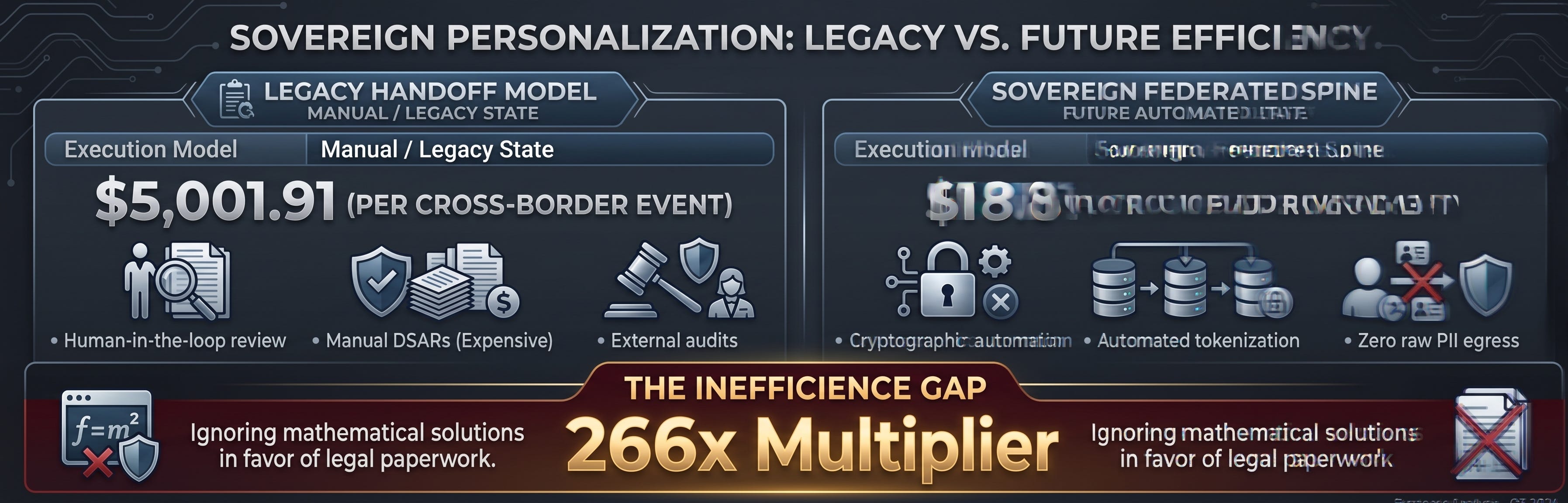
When you scale this inefficiency across 40 global markets, running roughly 21,739 executions per region annually, your enterprise is quietly bleeding $4.33 billion in direct operational waste every single year.
3. The Jevons Paradox: Why Making Compliance Cheaper Will Break Your Company
What happens when you use tools to simply speed up manual compliance? Due to a high elasticity of demand (an Elasticity Factor of 1.38), reducing the cost of cross-jurisdictional personalization causes the volume of requests to explode, which immediately overwhelms the remaining human bottlenecks in the system.
It is incredibly tempting to look at the pain of data mapping and DSAR fulfillment and decide to buy a shiny new SaaS tool to automate the workflow. This is known as “Sustaining Innovation”—putting a better engine on a broken wagon.
But data privacy operations suffer from the Jevons Paradox. William Stanley Jevons famously observed in the 19th century that making coal use more efficient didn’t reduce coal consumption; it massively increased it. The same is true for cross-border data execution.
If you cut the cost of a compliant personalization execution by 1%, demand for it grows by 1.38%. Customers who were previously suppressed from receiving personalized offers suddenly become reachable. If you buy a tool that cuts your per-execution cost by 50%, your volume explodes by 69%.
Because your architecture still fundamentally relies on humans—senior compliance directors reviewing edge cases, lawyers approving cross-border transfers—this volume rebound will crush your staff.
“You cut the per-execution cost by 266x, and the volume explodes by even more. The savings don’t bank—they get consumed by the next human bottleneck... You didn’t eliminate the human; you just moved them upstream.”
Efficiency tools are a treadmill, not a destination. To survive, you must architect the human entirely out of the execution loop.
4. The “SPY” Metric: You Are Losing 35% of Your Customers to Latency
What is the true cost of cross-border data compliance friction? An estimated 35% of cross-jurisdictional personalization attempts are abandoned or suppressed due to the manual latency and friction required to clear compliance checks.
While organizations are busy agonizing over the $4.3 billion in operational waste, they are ignoring a much larger, more terrifying number: $38.05 billion. This is the estimated global transaction pipeline value preserved if you eliminate the abandonment rate.
When a customer in Europe accesses a US-hosted platform, the system has to tokenize, verify, and check consent routing. If those checks take longer than the 200-300 millisecond latency budget, the customer either experiences a timeout, gets served a generic, non-personalized fallback experience, or simply abandons the cart.
To fix this, forward-thinking leaders are abandoning traditional coverage metrics and adopting Sovereign Personalization Yield (SPY).
SPY measures the percentage of cross-border interactions that actually survive regulatory filtering to deliver a compliant, personalized response within the latency budget.
Most legacy enterprises baseline at a dismal 20% to 40% SPY. This means 60% to 80% of your personalization potential is stranded by your own compliance architecture. If you can lift your SPY by 25 to 30 percentage points, you can unlock $30 million to $150 million in recovered Annual Recurring Revenue (ARR) for a typical Fortune 500 firm.
5. The Agentic Inversion: Move the Engine, Not the Data
How do you personalize a global experience without moving raw data across borders? You must decouple model-parameter IP from raw-record custodianship by utilizing a federated learning spine. You move the machine learning model to the local data nodes, train it there, and only export non-identifiable, mathematical weight updates (gradients) back to the global center.
For the last decade, the default architectural recommendation was to centralize all raw user touchpoints into a massive, unified global data lake. Today, under GDPR and China’s PIPL, that architecture is a catastrophic regulatory liability.
The solution requires a complete structural inversion. You must stop trying to bring the data to the engine. Instead, bring the engine to the data.
In a federated personalization network:
Local nodes process locally: A sovereign node in Frankfurt trains on German resident clickstreams.
Only math crosses borders: The local node emits encrypted, differentially private mathematical weight updates (gradients). Raw PII never leaves the country.
Global models aggregate: A central server aggregates these mathematical deltas to improve the global algorithm, without ever seeing a single user’s name or email.
This isn’t just a clever workaround; it is a physical guarantee. You cannot leak raw PII across a border if raw PII is never placed into the transit layer to begin with.
6. The Illusion of the Global Master Record
Why is a centralized identity graph dangerous? A unified, cross-border identity graph acts as a massive “master reconciliation honeypot” that inherently violates strict data transfer rules and exposes the enterprise to catastrophic breach liabilities.
Marketing departments love the idea of a “Customer 360” view—a single, golden master record that tracks a user seamlessly from a flagship store in London to a mobile app in Tokyo.
To achieve defensible sovereignty, you must violently kill the centralized identity graph.
Instead of an illegal master reconciliation table, modern architectures use ad-hoc, session-scoped cryptographic link tokens. When a customer initiates a cross-jurisdictional session, the system generates a one-time cryptographic token that links their fragmented profiles only for the duration of that specific interaction. The moment the session ends, the link evaporates.
By deleting the persistent identity graph, you instantly eliminate the 40+ undocumented “shadow data flows” that plague typical enterprise audits. You make it mathematically impossible to violate residency laws because the persistent cross-border data simply does not exist.
7. Turning Customers into Compliance Suppliers (Demand Inversion)
Who should own the personalization egress decision? The customer (or their localized data steward), operating a “Jurisdictional Veto Toggle,” should retain ultimate authority over whether mathematical parameter deltas are allowed to leave their home jurisdiction.
Currently, enterprises try to own the personalization decision unilaterally. They use coercive, all-or-nothing consent forms to pull data from the user to the vendor. This turns every customer interaction into a depreciating asset that consumes your compliance budget and increases your liability.
The final inversion is to flip this dynamic. By implementing a “Preference Vault” at the local node, users or regional data stewards can surgically opt-in to specific feature parameters (e.g., “Allow shopping preferences, but block health context”).
“We move the decision to the data rather than the data to the decision, stripping away the entire egress-decision matrix.”
When you externalize the attestation and consent to the customer’s chosen local authority, the enterprise no longer holds the proving keys. You shift the regulatory liability to the party best positioned to bear it, and you turn compliance from a hostile extraction into a bidirectional, value-generating negotiation.
The Path Forward: From Paperwork to Physics
The era of “paper compliance” is over. Standard Contractual Clauses and massive spreadsheets mapping shadow data flows are no longer a defense; they are a confession of architectural failure.
Global enterprises are leaking $46.2 billion annually because they are throwing human labor and localized cloud storage at what is fundamentally a mathematical aggregation problem.
To win the next decade of customer experience, you must transition from relying on documentation to enforcing physics. By deploying a federated learning spine, utilizing differential privacy, and enforcing runtime interception at the network edge, you can drive your per-execution costs down from $5,000 to $18. You can recover the 35% of customers you are currently losing to latency timeouts. And you can sleep soundly knowing your data borders are secured by cryptography, not promises.
Are you ready to stop managing compliance theater and start engineering defensible personalization?
Is your organization interested in true innovation? Or does it prefer to just look busy and hire consultants? The world is changing quickly. If you’re not adapting to it, you’re not innovating. I work with organizations who are serious about attacking problems and who are tired of defending the current paradigm. Is that you? (my availability is limited).
Submit a problem or challenge: Click here
Book an appointment: Click here
Email me: mike@pjtbd.com
Call me: +1 678-824-2789
Join the community: Click here
Follow me on 𝕏: https://x.com/mikeboysen
Articles - jtbd.one - De-Risk Your Next Big Idea
Always attack…Never defend


