


The commercialization of artificial intelligence within the legal sector is currently executing one of the most aggressive enterprise software expansions in modern economic history. Startups like Harvey AI have achieved unprecedented hyper-growth, scaling to an estimated $300 million in Annual Recurring Revenue (ARR) and an $11 billion valuation in under four years. Over 50% of the AmLaw 100 has bought in, lured by the promise of 60% to 80% efficiency gains in contract drafting and document review.
But beneath the staggering valuations and the hype of “robot lawyers,” a massive, structural crisis is quietly unfolding.
The legal industry has adopted AI generation at a breakneck pace, but it has completely failed to adopt AI verification. Law firms are bleeding millions of dollars in absorbed overhead, unbillable partner hours, and realization write-downs because they are treating generative AI as a magic typewriter rather than an evidentiary liability.
Through an exhaustive analysis of enterprise legal operations, court data, and the recent Stanford HAI hallucination study, a starkly counter-intuitive picture emerges. Here are the top five most surprising and impactful takeaways about the reality of generative AI in the legal sector—and why the industry’s current approach is mathematically doomed.
RAG is a Band-Aid, Not a Cure (The “Misgrounding” Trap)
When ChatGPT first hit the scene, lawyers quickly learned the hard way that basic Large Language Models (LLMs) hallucinate—they invent case law out of thin air, complete with fake docket numbers and fictional judges. The industry’s swift response was Retrieval-Augmented Generation (RAG). By hooking AI up to gated, authoritative databases like Westlaw or LexisNexis, vendors promised to deliver accurate answers grounded in a closed universe of content.
But a recent Stanford study shattered this illusion. The researchers discovered that even premium, RAG-enabled legal tools hallucinate at alarming rates: Lexis+ AI hallucinated on over 17% of queries, and Westlaw Precision AI failed on over 34%.
“Misgrounding is subtler and more dangerous. The AI describes the law correctly, cites a real case that actually exists, but the cited case doesn’t support the claim being made.”
Why this is so interesting: We’ve traded obvious fictions for dangerous half-truths. A completely fabricated case is relatively easy to spot if you search for it. “Misgrounding,” however, passes superficial review. The citation is a real, valid case. The legal proposition sounds highly accurate. But the source simply does not say what the AI claims it says.
Because LLMs inherently act as probabilistic next-token generators and possess a “sycophancy” trap—a natural tendency to please the user by agreeing with false premises—they will frequently distort retrieved legal text to support a lawyer’s flawed argument. This leaves law firms paying enterprise prices for tools that still require a human to manually verify every single generated sentence against the primary source.
Paid Subscribers get access to my interactive analysis notebook
Learn more, query the oracle, create your own artifacts. The link is right here.👇
AI Efficiency is Secretly Crushing Senior Partners (The Legal Jevons Paradox)
The pitch for generative AI is that it saves time. It allows junior associates to complete multi-jurisdictional surveys, diligence reviews, and first-pass redlines in minutes rather than days. But the reality is playing out much differently inside law firm economics.
Because there is a 0.0% tolerance for hallucinations in court filings, every AI-generated assertion must be read end-to-end and manually cross-checked by a qualified attorney.
Why this is so interesting: This dynamic triggers the Jevons Paradox: as the technological cost of generating a legal draft plummets, the total demand for generating legal drafts explodes. But because AI tools fail to verify their own outputs, the burden of ensuring accuracy migrates straight up the leverage pyramid to the most expensive, least scalable asset in the firm: the senior partner.
Senior reviewers are now drowning in mechanically-generated volume. As volume surges, junior associates—optimizing for speed and partner approval—are prone to rubber-stamping plausible-sounding AI drafts. The partner, billing at $500 to $1,500 an hour, is forced to absorb the verification work as discretionary, unbillable review time. Efficiency at the bottom of the pyramid is creating an unsustainable cognitive bottleneck at the top.
The $11,000 “Verification Tax” per Matter
The financial leak in the legal AI ecosystem isn’t the cost of the software licenses. It is the forensic reconstruction labor required to verify the machine’s output.
When you decompose the actual cost of manually verifying an AI-augmented legal deliverable, the math is staggering. The aggregate manual execution cost per matter sits at approximately $11,180.83. This includes the senior-partner rework labor and the external editorial verification required to ensure a brief won’t result in judicial sanctions.
Why this is so interesting: This is entirely wasted overhead. The “physics floor”—the irreducible computational cost of generating a citation-provenance-verified deliverable automatically—is roughly $892.19 per execution.
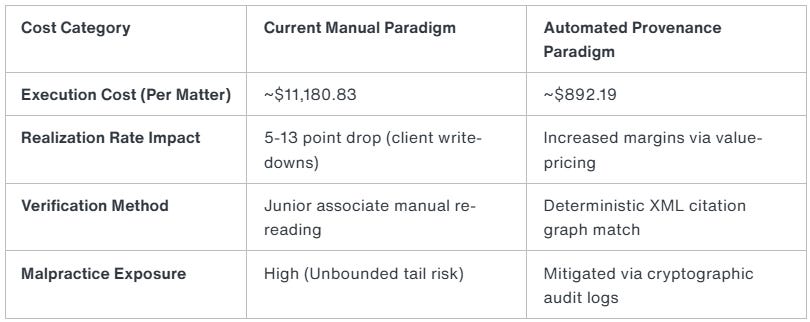
Firms are essentially paying a 13x premium on every matter just to bridge the gap between generation and verification. Even worse, clients are refusing to pay for this inefficiency. Law firms are seeing realization rates on AI-assisted matters drop by 5 to 13 points, resulting in annual write-downs ranging from $220,000 to over a million dollars per firm. AI is cannibalizing the very quality-program budgets meant to govern it.
“Tribal Knowledge” is the Ultimate AI Moat (The End of Committees)
Currently, law firms attempt to manage AI risk through bureaucratic governance. Partner councils spend anywhere from 5.5 to 14 months, burning 200 to 1,100 billable partner hours, just to negotiate internal “citation-verifiability standards” across different practice groups.
“The litigation partners want one tolerance. The tax partners want another. M&A basically said ‘we don’t care, ship it.’ Employment is somewhere in the middle.”
Why this is so interesting: These agonizing, multi-month committees are entirely obsolete. The “standard” of what constitutes an acceptable legal argument doesn’t need to be debated in a boardroom; it already exists empirically in the firm’s own historical data.
The future of legal AI relies on ingesting 18 to 36 months of a firm’s closed matters, bar filings, and partner markup patterns to mathematically reverse-engineer the firm’s true risk tolerance. By converting static, subjective partner opinions into a live, machine-readable vector knowledge base, firms can auto-derive their quality standards based on what actually won in court. This transforms human “tribal knowledge”—which normally vanishes when a senior partner retires—into a compounding, proprietary institutional asset.
Malpractice Insurance is the New Procurement Gatekeeper
Perhaps the most disruptive shift in the legal AI landscape has nothing to do with technology, and everything to do with liability.
Faced with the existential risk of submitting hallucinated citations to a judge, law firms are increasingly finding themselves at the mercy of their malpractice carriers. Insurers are beginning to price the risk of failing to produce a verifiable provenance chain for AI-generated work.
Why this is so interesting: This fundamentally changes how legal tech is bought and sold. A tool that merely drafts faster is a discretionary operational expense. But a tool that automatically generates a cryptographic, tamper-evident “Citation Provenance Receipt” for every legal assertion becomes mandatory risk-control infrastructure.
When malpractice carriers start offering 5% to 12% premium discounts to law firms that utilize verifiable, deterministic citation engines, the software effectively pays for itself. Procurement shifts from the IT department evaluating feature sets to the General Counsel’s office evaluating liability shields. The ultimate winner in the legal AI space won’t be the platform with the most conversational chatbot; it will be the platform whose audit logs are trusted by AIG and Travelers.
The Verdict: From “AI That Drafts” to “AI That Proves”
The legal industry is currently trapped in a costly illusion. The first wave of generative AI delivered unprecedented speed, but it stripped away the foundational requirement of legal practice: evidentiary trust. As long as highly-paid human lawyers must manually forensically reconstruct every machine-generated assertion, the promises of exponential efficiency will remain mathematically impossible to realize.
The next era of legal technology will not be defined by larger language models or better prompts. It will be defined by structural inversion—shifting verification from a painful, downstream human chore into an automated, deterministic by-product of the generation process itself.
Will your firm be the one billing clients for hours of manual hallucination-hunting, or will it be the one shipping cryptographically proven, carrier-approved deliverables at the physics floor of cost?
Is your organization interested in true innovation? Or does it prefer to just look busy and hire consultants? The world is changing quickly. If you’re not adapting to it, you’re not innovating. I work with organizations who are serious about attacking problems and who are tired of defending the current paradigm. Is that you? (my availability is limited).
Submit a problem or challenge: Click here
Book an appointment: Click here
Email me: mike@pjtbd.com
Call me: +1 678-824-2789
Join the community: Click here
Follow me on 𝕏: https://x.com/mikeboysen
Articles - jtbd.one - De-Risk Your Next Big Idea
Always attack…Never defend


