

The $750,000 Slide Deck and the Anatomy of “Human ETL”
In the third quarter of 2025, a Fortune 500 logistics enterprise commissioned a top-tier management consultancy to evaluate whether to build an autonomous dispatch intelligence platform.
The invoice for the ten-week engagement totaled $750,000. The staffing model followed the classic consulting pyramid:
1 Senior Partner (0.1 FTE): $1,200/hr ($48,000)
1 Engagement Manager (1.0 FTE): $650/hr ($260,000)
2 Junior Associates / Business Analysts (2.0 FTE): $350/hr ($280,000)
Travel, Lodging, and Administrative Retainers: $162,000
When the final deliverable was presented to the board—a 114-slide PowerPoint deck accompanied by an executive summary PDF—a line-item audit of the engagement’s 1,600 logged consultant hours revealed how that capital was actually deployed:
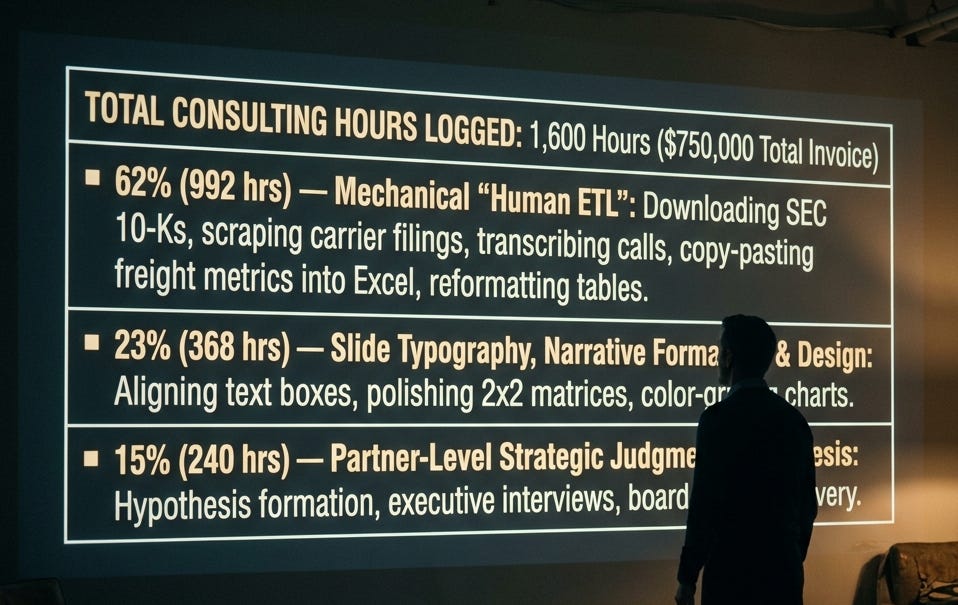
The enterprise spent $465,000 on mechanical data ingestion and formatting performed by human beings with elite degrees.
The biological consequences of this labor model were visible in the engagement’s analytical trail. In Week 6, after working twelve-hour days copying operational data across fragmented transportation spreadsheets, the associate team misattributed a $14 million fleet amortization expense to variable fuel costs. The error carried into the draft board deck uncorrected, surviving three internal reviews because the engagement manager was reviewing slides at midnight under severe cognitive fatigue.
This is not an operational anomaly. It is the inescapable physics of human labor coupling:
Traditional management consulting does not sell proprietary mathematical truths or defensible strategic moats. It sells labor-coupled, human-executed data transformation disguised as strategic expertise.
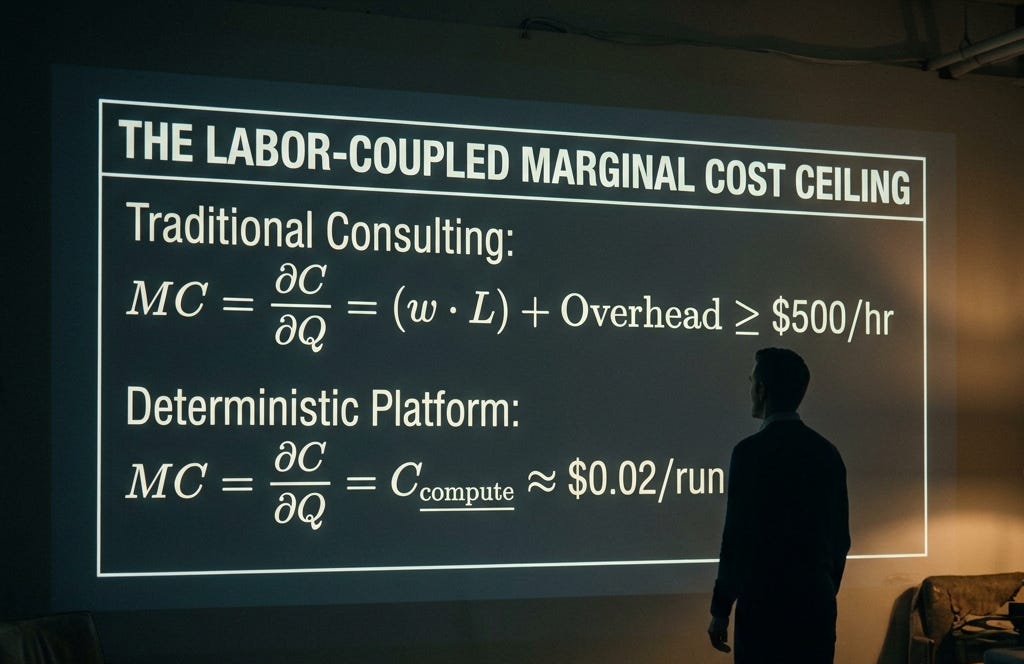
Because an advisory firm’s revenue is linearly coupled to the number of human hours billed w • L, it faces an existential disincentive to automate data discovery, standardize analytical rigor, or make strategic hypotheses falsifiable. To eliminate the 62% spent on manual data gathering would destroy more than half of the firm’s top-line billings.
The consulting business model is structurally incapable of operating at the computational limit. Venture Proof was built to replace it (for many use cases).
Reasoning by Analogy vs. First Principles (The Physics Gap)
The foundational methodology of traditional strategy consulting is reasoning by analogy.
When a strategy practice undertakes an engagement, it begins with industry benchmarking. It interviews executive peers, gathers vendor reports, and compares the client against the median performance of its competitors:
“Competitor A spends 4.2% of revenue on IT dispatch; your organization spends 4.8%.”
“Best-in-class industrial manufacturers allocate 18% of operating budget to procurement management.”
“The industry standard operating model requires an eight-layer reporting hierarchy.”
Reasoning by analogy accepts the existing operational cost structure as an immutable law of physics. It assumes that because every incumbent in the industry employs hundreds of analysts to reconcile purchase orders, write compliance reports, or monitor supply chain disruptions, those human workflows are necessary. It seeks to optimize the status quo by 10% to 15%: hire offshore contractors to reduce hourly rates, install an ERP add-on to speed up data entry, or re-tier vendor contracts.
Benchmarking does not produce strategic advantage. It guarantees that an enterprise replicates the structural waste of its competitors.
Venture Proof rejects analogy in favor of First Principles Thinking. It strips an operational problem down to its irreducible physical, computational, and thermodynamic requirements:
First Principle: Strategic de-risking requires proving the existence of unaddressed customer friction and confirming an economic arbitrage gap against physical limits before deploying balance sheet capital.
When you strip away historical corporate convention, every commercial workflow consists of two numbers:
The Numerator: The current commercial cost of executing the workflow using status quo human labor, administrative overhead, legacy software subscriptions, and advisory fees.
The Denominator: The Physics Floor Limit—the irreducible cost of executing that same job using pure computation, energy, API data transport, and automated data pipelines.
The relationship between these two numbers defines the Inefficiency Arbitrage Ratio (Physics Gap):
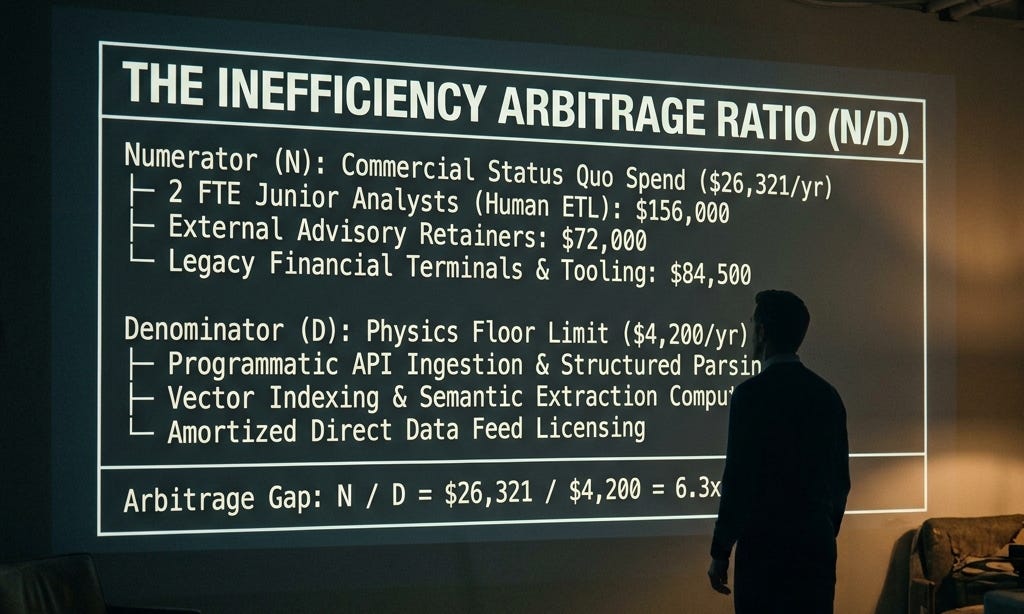
Consider the private equity asset monitoring sector. A mid-market fund managing 14 portfolio companies spends an average of $26,321 per company per year on junior analysts, quarterly consulting reviews, legacy financial terminals, and compliance travel.
The actual physical requirement—ingesting raw regulatory filings via programmatic APIs, extracting standardized financial schemas, and identifying material operational anomalies across balance sheets—costs $4,200 per company per year in compute cycles and data feeds.
For every $1.00 of physical and computational work required to maintain operational awareness, the market spends $6.30 on human friction and corporate overhead.
In traditional consulting, this gap is masked behind qualitative narratives. If a strategy fails, the consultancy points to “poor change management” or “flawed internal execution.” The advice is unfalsifiable.
In Venture Proof, the inefficiency ratio is computed by a deterministic math engine with zero generative AI drift. The arithmetic is exact:
If N/D ≈ 1.0, the market is operating near its physical efficiency limit. The platform enforces a hard stop: kill the venture immediately before deploying capital.
If n/D >> 1.0, the economic arbitrage is mathematically proven in dollars, not justified through subjective PowerPoint prose.
The Universal Assembly Line: 12 Deterministic Stages vs. 12 Weeks of Ambiguity
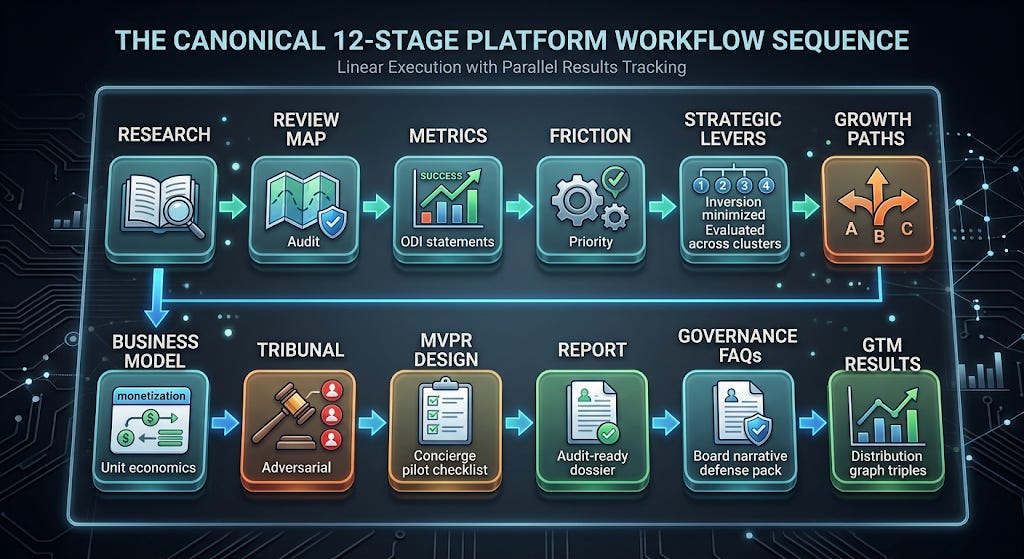
Traditional strategy engagements are unstructured by design. A 12-week consulting project begins with vague “discovery interviews,” wanders through subjective stakeholder workshops, and concludes with a frantic deck-assembly sprint in the final fortnight. Because the process is bespoke, it cannot be audited, verified, or replicated.
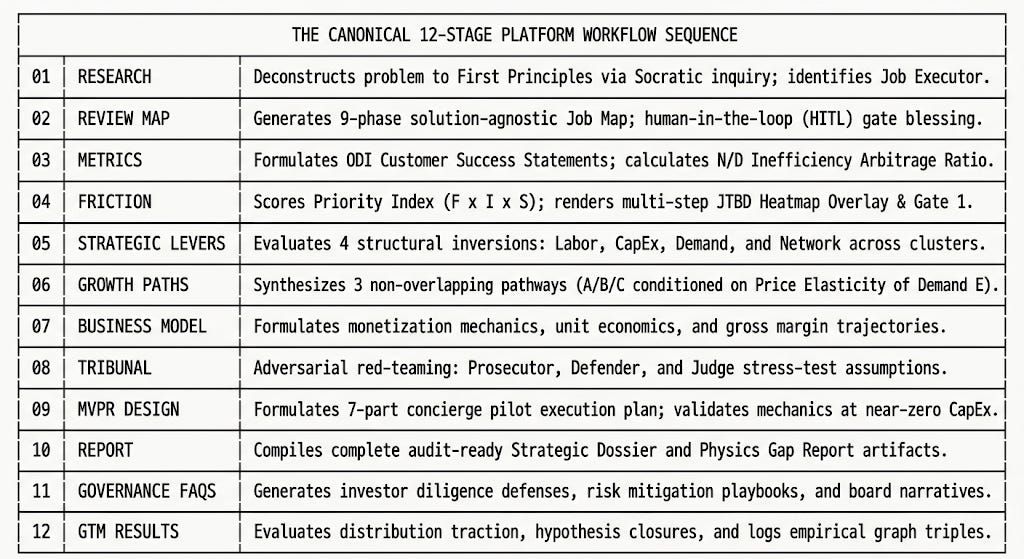
Venture Proof treats strategy formulation as an industrial assembly line. Every business problem, regardless of industry vertical, is routed through the canonical 12-Stage Platform Workflow Sequence:
The Solution-Agnostic Job Map vs. Premature Solution Bias
The most pervasive flaw in corporate strategy is premature solution bias.
Consulting firms organize their practices around solution silos: the Cloud Practice, the Supply Chain Practice, the Org Design Practice. When a client brings a problem to the firm, the diagnostic is contaminated from Day 1 by what that specific partner is incentivized to sell. A cloud consultant sees a cloud migration problem; an org design partner sees a restructuring problem.
Venture Proof prevents solution bias by separating problem topology from solution mechanics.
In Stage 2 (Review Map), the system constructs a universal, chronological 9-phase process map that describes the core job independent of technology or vendors:
In Stage 3 (Metrics), the platform generates strict Outcome-Driven Innovation (ODI) Customer Success Statements (CSS) adhering to mathematical grammar:
Example: Minimize + the time in minutes + required to reconcile freight bill anomalies + across multi-modal carrier invoices.
The Multi-Step JTBD Heatmap Overlay
Traditional analysts attempt to find a single “bottleneck step” to optimize. But enterprise workflows rarely fail at a single point; they fail across interconnected friction clusters.
In Stage 4 (Friction Scoring), Venture Proof quantifies customer pain across every step of the job journey using the Priority Index, verified transcript evidence, and empirical provenance scoring:
The Priority Index:
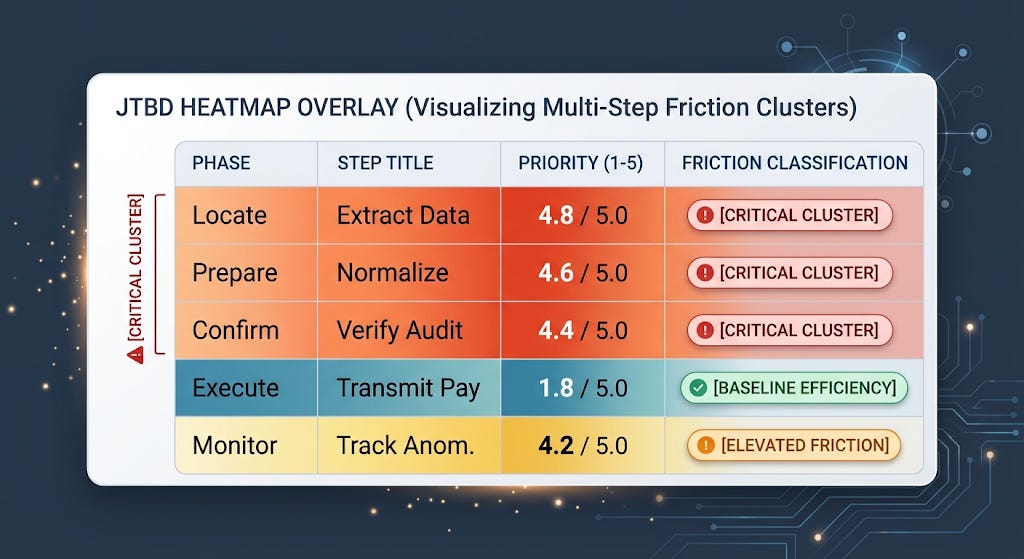
The system renders an interactive JTBD Heatmap Overlay across the entire 9-phase map. It does not isolate a single step; it reveals the entire multi-step topology of economic waste.
Only after the friction clusters are mathematically verified does the platform proceed to evaluate solutions.
The Four Structural Inversions: Rewriting the Unit Cost Curve
Consultancies offer operational recommendations that shift a cost curve downward by a fixed percentage C₁ → C₁ − Δ. They change the position of the curve, not its fundamental mathematical geometry.
Venture Proof evaluates Structural Inversion—systematically deploying four decoupling levers that rewrite the underlying cost and scale equations of the business model.
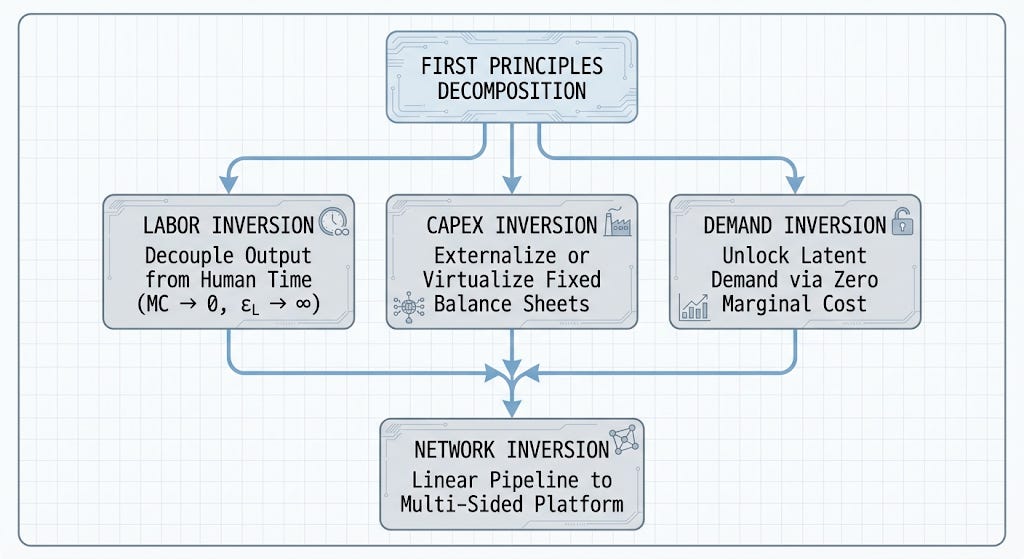
The Labor Inversion (Decoupling Output from Human Time)
Traditional service delivery scales linearly with headcount: C(Q) = Overhead + Q · (w · L).
Labor Inversion replaces human execution with deterministic compute pipelines. As the labor hours per unit $L$ approach zero:
The enterprise scales output volume by 100x with zero incremental hiring.
The CapEx Inversion (Externalizing Fixed Assets)
Incumbent strategies require heavy balance sheet commitments: dedicated servers, proprietary physical facilities, long-term real estate leases.
CapEx Inversion shifts fixed balance sheet weight Fₖ into variable, consumption-metered operational expense or programmatic multi-tenant virtualization:
By externalizing infrastructure to public compute rails and edge runtimes, the payback period collapses from years to days.
The Demand Inversion (Unlocking Latent Demand via Elasticity)
Traditional consulting designs products for existing, top-tier enterprise budgets, requiring multi-million-dollar outbound sales armies, enterprise procurement cycles, and high Customer Acquisition Costs (CAC).
Demand Inversion models the Price Elasticity of Demand ($E$) across the market:
When a structural labor inversion collapses unit delivery costs by 90%, the venture can drop end-user pricing by 80%. If demand is highly elastic (|E| > 1.0), this price collapse triggers the Jevons Paradox Rebound: total market consumption surges exponentially, unlocking vast latent demand among non-consumers who could never afford legacy consulting retainers.
The Network Inversion (Transforming Pipelines into Platforms)
Linear businesses operate as one-to-one service pipes: firm produces output, customer consumes output.
Network Inversion re-architects the delivery mechanism so that every incremental user or transaction automatically generates proprietary structured data, edge models, and cross-party utility:
Each customer interaction strengthens the underlying knowledge graph, making the platform progressively harder for an incumbent to replicate.
Three Non-Overlapping Strategic Growth Pathways
In Stage 6 (Growth Paths), the platform does not output a generic list of “strategic initiatives.” It synthesizes three distinct, non-overlapping strategic trajectories:
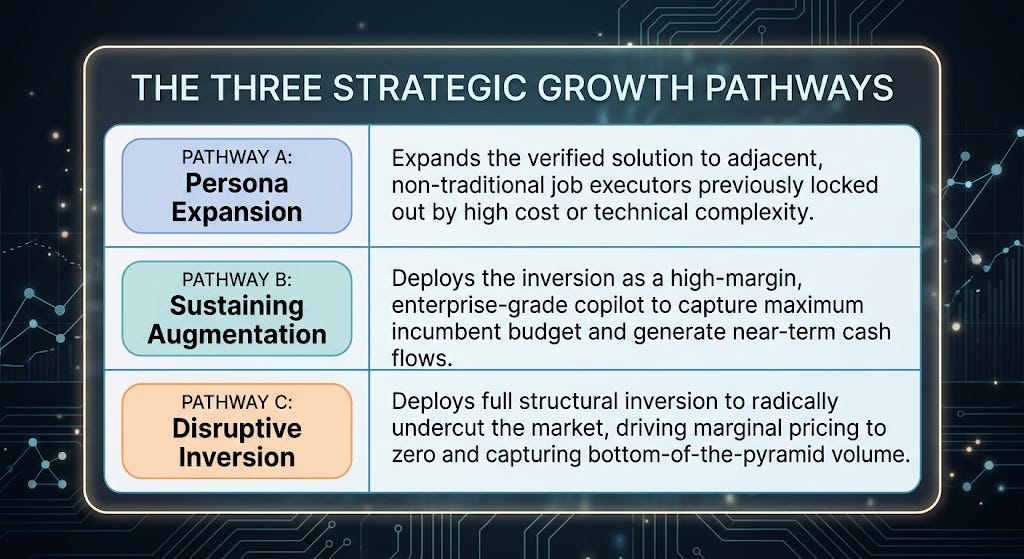
Path B generates the cash flow required to build Path C. The strategic choices are explicit, mathematically modeled, and conditioned on real-world elasticity parameters.
The Red-Team Tribunal vs. The “Confirmation Bias” Deck
The dirty secret of executive advisory is that management consultants are rarely hired to discover the truth. They are hired to provide political air cover.
When an executive team prepares a multi-million-dollar corporate restructuring or an M&A acquisition, they hire a prestigious firm to produce a deck that validates the CEO’s predetermined thesis. The consulting team knows who signs their checks. They have zero incentive to tell the board that the venture’s unit economics are fatally flawed or that customer demand is an illusion.
The result is confirmation bias institutionalized at institutional scale.
Venture Proof eliminates confirmation bias through an automated, adversarial Tribunal Engine (Stage 8).
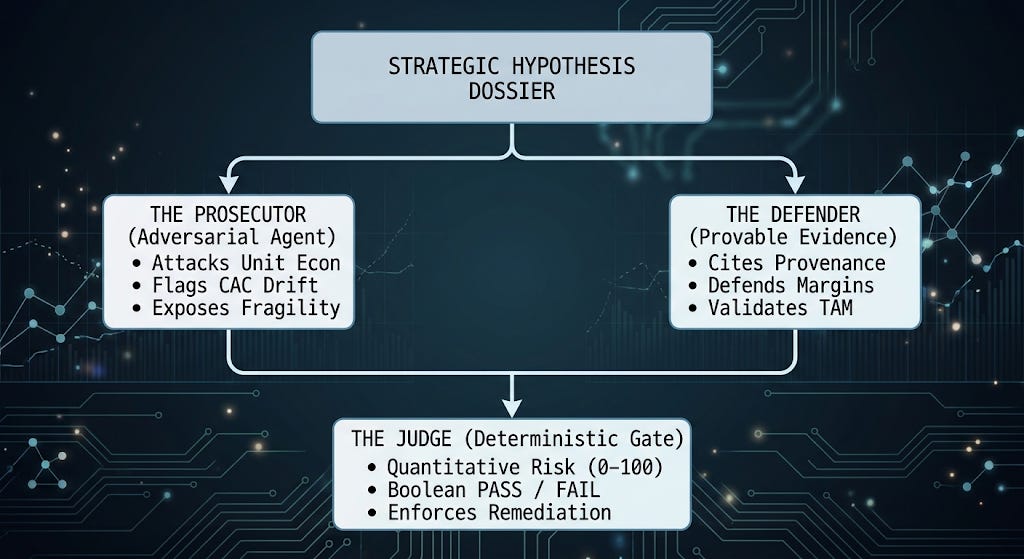
The Tribunal does not rely on a single, agreeable model response. It executes a multi-pass clash across distinct agent personas operating under strict procedural schemas:
The Prosecutor Persona: Systematically attacks the strategy. It interrogates customer friction provenance, models regulatory enforcement shocks, identifies hidden balance sheet liabilities, and exposes unit economic sensitivities.
The Defender Persona: Mounts a rigorous defense using only verified data tokens, source citations, and mathematical proofs extracted during the Research and Metrics stages. It cannot invent narrative fluff; it must cite empirical evidence.
The Judge Persona: Weighs the adversarial arguments, calculates a quantitative Composite Risk Score (0–100), and renders a binding Boolean verdict:
PASSorFAIL.
If the strategy fails the Tribunal’s stress test—if the Risk Score exceeds the threshold—the platform triggers an automated remediation loop. It rejects the hypothesis, highlights the specific failure modes, and refactors the underlying growth pathways and unit economics before a single dollar of capital is deployed.
The Tribunal does not care about boardroom politics. It cares about mathematical survival.
Real Options & The MVPr (Why “Big Bang” Roadmaps Are Dead)
The traditional consulting engagement concludes with a “Three-Year Strategic Transformation Roadmap.”
This roadmap invariably calls for:
An 18-month software development cycle.
A multi-million-dollar systems integration contract.
Massive upfront CapEx deployed before a single real customer has validated the solution mechanic.
According to research across corporate innovation initiatives, more than 70% of these large-scale digital transformations fail to deliver their promised ROI. They fail because they place a massive, monolithic bet on an unproven hypothesis.
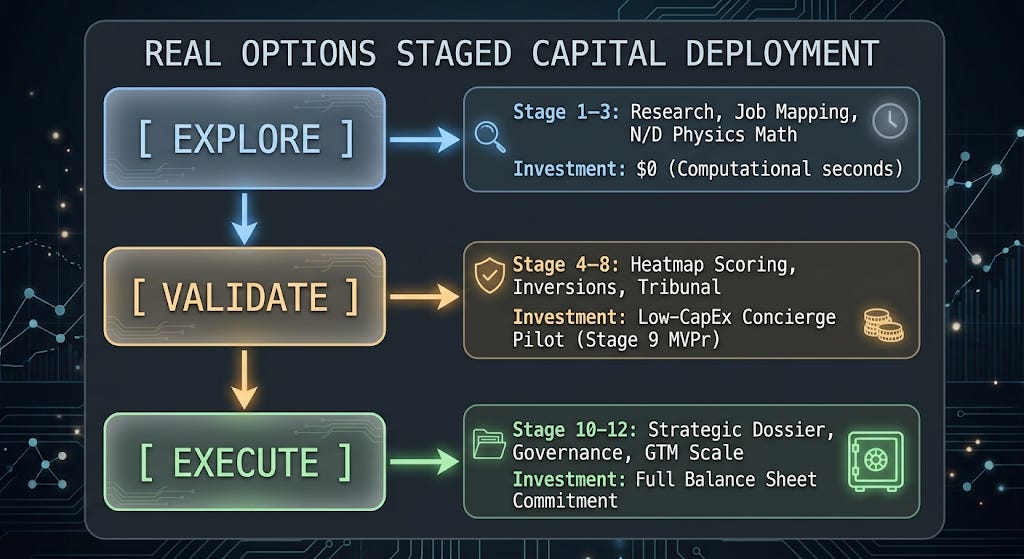
Venture Proof manages capital through the rigorous financial framework of Real Options. Capital is deployed in staged, gated bets: Explore → Validate → Execute.
In Stage 9 (MVPr Design), the platform generates a 7-part Minimum Viable Prototype (MVPr) concierge execution plan.
The MVPr is not an MVP. An MVP is a stripped-down software product that still requires expensive engineering cycles. An MVPr is a low-CapEx, operational concierge test designed to manually validate the inversion mechanic, friction relief, and customer willingness-to-pay without writing production software.
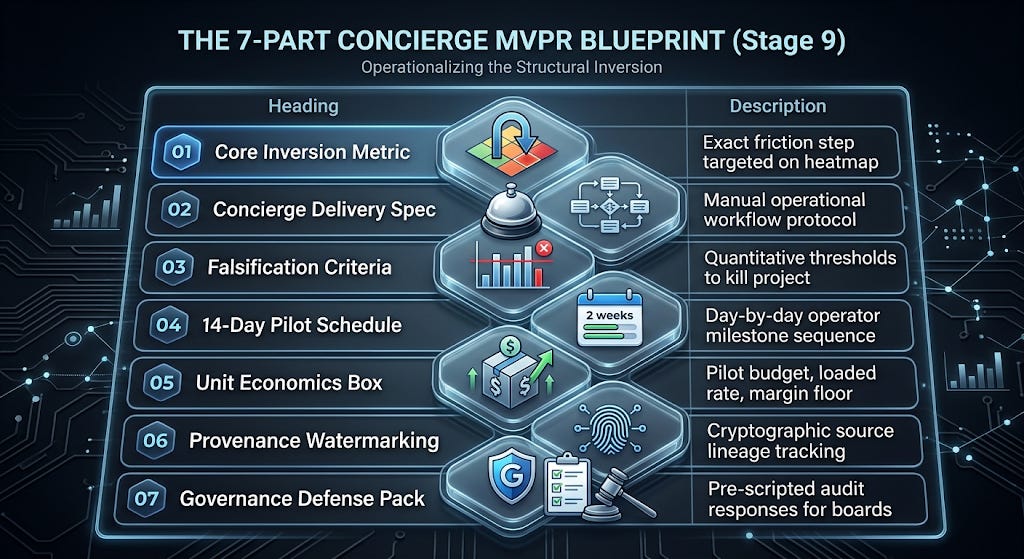
By forcing the strategy to prove its core mechanic through a 14-day concierge pilot, the enterprise validates demand and execution viability at near-zero capital risk.
If the pilot succeeds, the venture earns the right to software automation. If it fails, the project is abandoned with zero balance sheet impairment.
The Economic Endgame: The Inevitable Collapse of Analog Advisory
The management consulting industry is trapped in the classic Innovator’s Dilemma.
Its entire corporate architecture—partner equity distribution, associate recruitment pipelines, billable hour utilization quotas, and global real estate overhead—is optimized for a world where data extraction and synthesis require manual human labor.
The economic reality is stark:
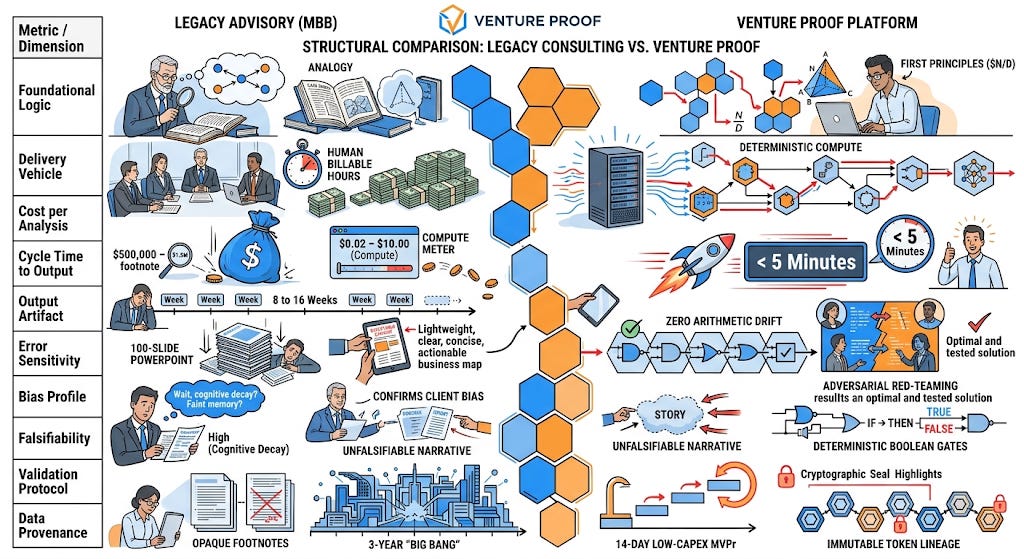
When an enterprise can generate a mathematically verified, red-teamed, audit-ready strategic dossier in five minutes for the cost of cloud compute, paying $750,000 to an army of generalist associates becomes a fiduciary breach of board oversight.
Strategy is no longer an artisanal craft practiced by charismatic partners in mahogany boardrooms. It is an empirical, computational discipline.
The consulting firms will attempt to adapt. They will announce internal AI chatbots, rebrand their slide-generation tools, and market “AI-powered strategy practices.” But these are cosmetics applied to a dying chassis. As long as their revenue model relies on billing human hours, they cannot compete with a deterministic platform whose marginal cost of execution approaches zero.
The physics are clear. The billable-hour monopoly is over.
The future of strategy belongs to First Principles, mathematical falsifiability, and Venture Proof.
Is your organization interested in differentiated innovation? The world is changing quickly. If you’re not adapting to those changes, you’re not innovating. Seeking reassurance from consultants fails, nearly always (sometimes they get lucky). I work with organizations who are serious about attacking problems using first principles. Many have been burned once, and they don’t want it to happen again. Is that you? (my availability is limited).
Submit a problem or challenge: Click here
Book an appointment: Click here
Email me: mike@pjtbd.com
Call me: +1 678-824-2789
Join the community: Click here
Follow me on 𝕏: https://x.com/mikeboysen
Articles - jtbd.one - De-Risk Your Next Big Idea
Slaying the Sacred Cows of Innovation


