


The State 3 Empirical Anchors (The Bedrock Reality):
[The Hard Financial Baseline]: The current average rate for a mid-level U.S. freelance performance video editor is ~$35/hour, establishing the absolute human labor floor Icon was competing against.
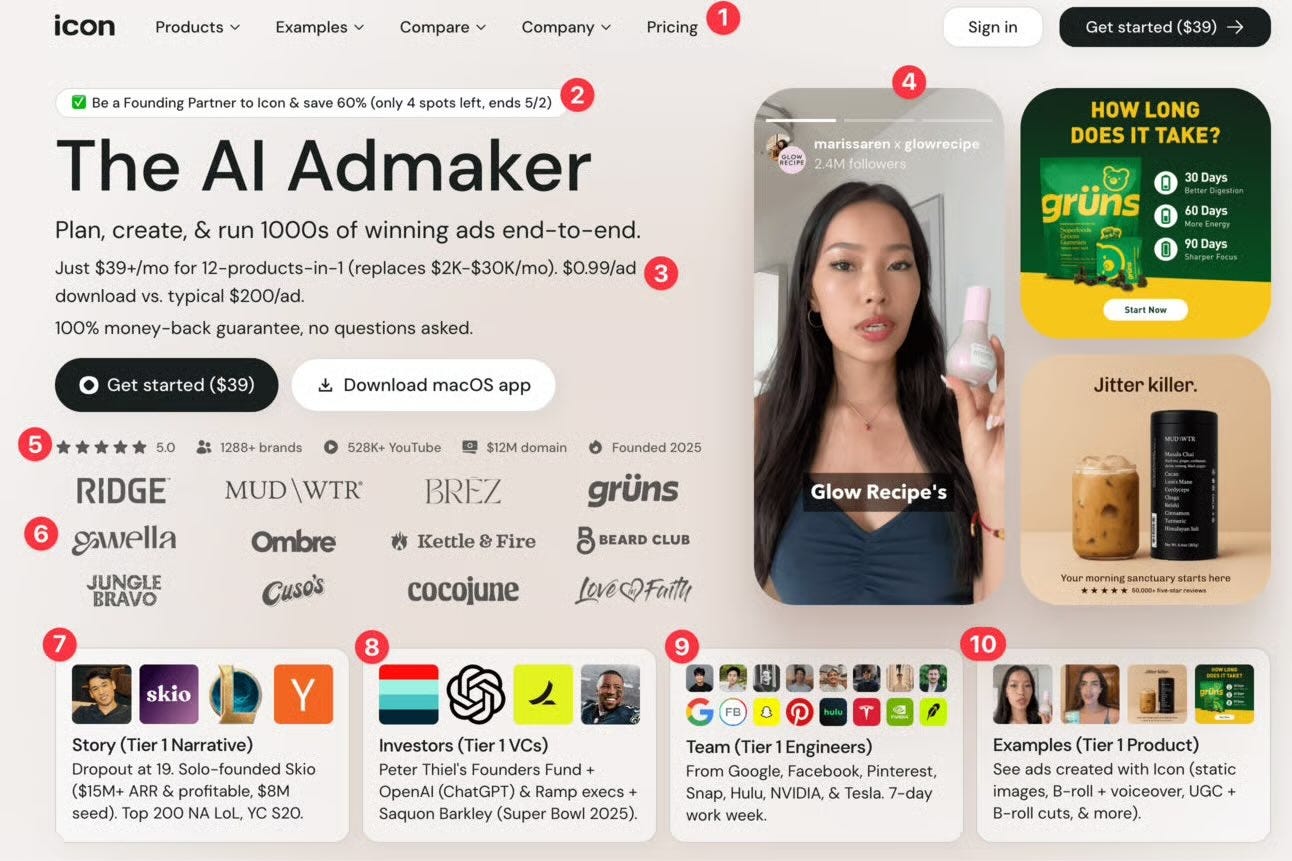
[The Market/Unit Evidence]: In 2025/2026, the average market rate for a single human-produced UGC video ad is $198. This is the exact price-to-value ratio the market is willing to pay for authentic content.
[The Structural Constraint]: Icon pivoted from a $39/month flat SaaS subscription to a $1,000–$3,000/month “Managed Service” tier. This pivot is empirical proof that their automated software failed to deliver a viable end product without massive human-in-the-loop intervention.
[The Compute Floor]: High-performance cloud GPU rendering for video editing (e.g., AWS Deadline Cloud/custom pipelines) incurs linear, unavoidable compute costs per second of rendered output, meaning aggressive usage by performance marketers on a flat $39/month fee results in negative gross margins.
[The Jevons/Scale Reality]: Icon mandated 7-day workweeks for “Founding Engineers.” This proves the technical architecture was not scaling automatically; the system required brutal, unsustainable human engineering OPEX to patch the AI’s edge-case failures and keep the rendering pipeline functional.
Chapter 1: The First Principles Failure (The ID10T Index of AI Video)
Software promises infinite scale, but AI video generation is bound by the brutal physics of GPU compute. Icon promised to obliterate the $198 agency video cost with a flat $39/month subscription. This created a mathematical impossibility: matching unlimited, compute-heavy rendering demands against a fixed, low-tier revenue stream. The system didn’t fail due to bad marketing; it failed due to physics.
The Denominator: Compute Costs vs. Human Labor
The First Principles floor of video production is not software; it is computational energy and time. A mid-level freelance video editor costs roughly $35/hour, representing a variable cost structure that scales directly with output. If a brand wants ten ads, they pay for the corresponding human hours. The economics are perfectly balanced.
Icon attempted to replace this variable human cost with a $39/month flat fee. However, high-fidelity cloud GPU rendering (the digital floor) incurs linear, non-negotiable compute costs per second of rendered output. When a performance marketer generates fifty ad variations in a day, the compute cost instantly exceeds the $39 monthly subscription fee, resulting in deeply negative gross margins for Icon.
The “99% Complete” Trap
The AI Uncanny Valley creates a massive, hidden QA bottleneck that destroys the expected efficiency delta. Icon promised an ad that was “99% complete” in under 5 minutes. However, the final 1%—a stiff robotic inflection, an improperly rendered hand, or an awkward pacing transition—renders the entire asset unusable for high-conversion paid media.
Fixing this final 1% requires human intervention. Because the user is forced to manually patch these bizarre AI hallucinations within Icon’s clunky proprietary editor (AdCut), the cognitive load and time spent troubleshooting often exceeds the time it would take a $35/hr human editor to simply build the ad from scratch in Premiere Pro. The “solution” shifted the waste from production to quality assurance.
The Lattice Decision Matrix: Human Editing vs. The 99% AI Trap
Core assertion: Delivering an asset that is “99% complete” with AI is functionally worse than delivering a 0% complete asset, because it forces the human user into an unpredictable, high-friction QA loop to fix hallucinations.
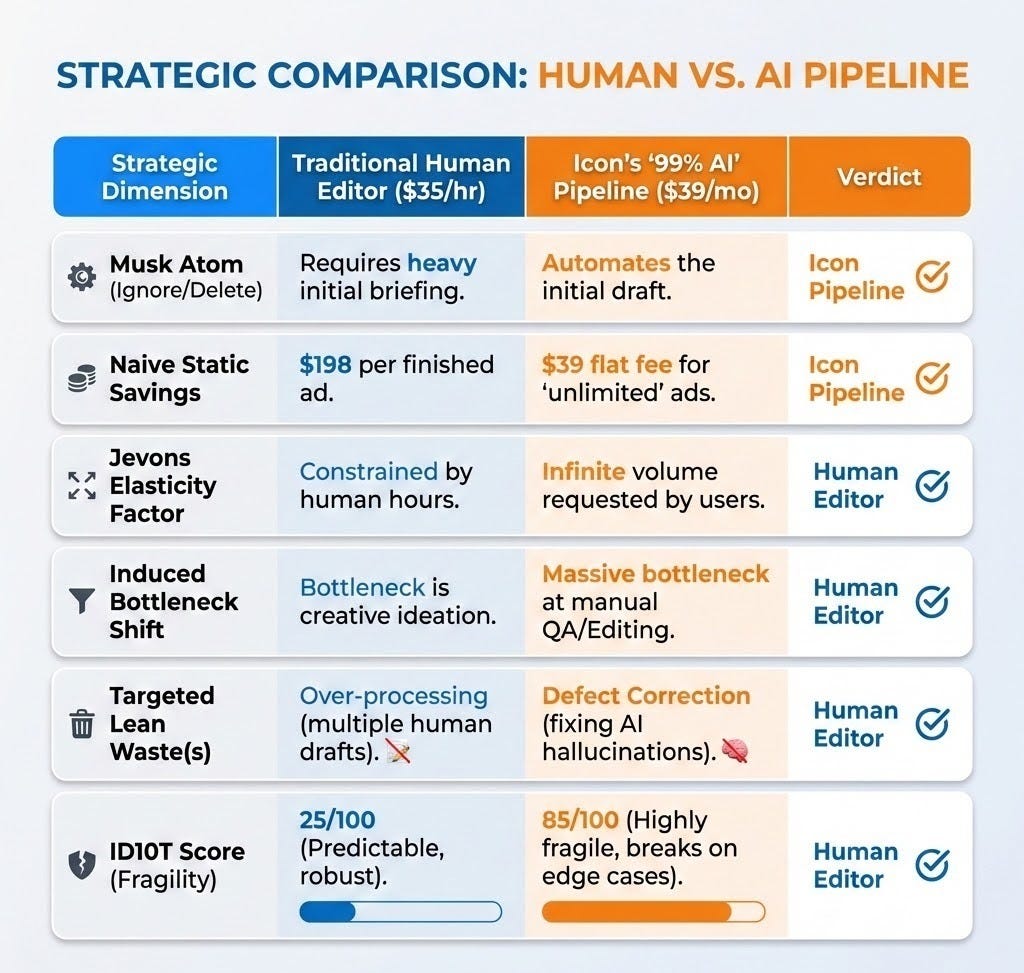
Implication: Icon’s architecture fails because it optimizes the easiest part of the process (drafting) while exponentially increasing the hardest part of the process (correcting uncanny AI defects in a web browser).
The Jevons Paradox of Ad Variations
The Jevons Paradox dictates that as the cost of a resource decreases, the consumption of that resource dramatically increases. Icon fundamentally misunderstood the behavior of their core Job Executor: the performance marketer. Performance marketing is a volume game. If you reduce the cost and friction of generating an ad to near-zero, the marketer will not generate the same amount of ads and save money; they will generate a thousand variations to test against the algorithm.
By dropping the marginal cost of a creative test to zero for the user, Icon unleashed a tidal wave of compute demand on their own servers. The marketer clicked “generate” 500 times, searching for the perfect variant. Because Icon bore the linear cost of the cloud rendering, the user’s rational optimization behavior actively bankrupted the platform. Making a process 10x faster simply crushed the system’s most expensive computational bottleneck.
Chapter 2: The Structural Pivot (From SaaS to Agency)
Software scales infinitely; human labor does not. When Icon’s core product failed to deliver on its automated promises, the company was forced to quietly pivot from a high-margin tech platform into a low-margin, high-stress creative agency. This structural collapse was inevitable the moment their algorithm encountered the unpredictable reality of high-performance media buying.
Why the $39/mo Model Broke
SaaS unit economics rely entirely on the relationship between Customer Acquisition Cost (CAC) and Lifetime Value (LTV). To survive selling a $39/month product to performance marketers—a highly skeptical, ad-blind demographic—Icon needed users to retain their subscriptions for at least six to twelve months to recoup their initial marketing spend.
This retention model collapsed under the weight of the product’s actual output. When users realized the platform was clunky, buggy, and required extensive manual Defect Correction to fix AI hallucinations, they churned immediately after month one. A high CAC combined with a one-month LTV of $39 is a mathematical death sentence for a venture-backed startup. The software failed the fundamental test of value: it created more friction than it removed.
The “Managed Service” Confession
The quiet introduction of a $1,000 to $3,000+ “Managed Service” tier was not an up-sell; it was a structural confession. By offering to have their internal team build the ads for the client, Icon publicly admitted that their “14-in-1” self-serve AI was incapable of generating a finished, conversion-ready asset without heavy human intervention.
This pivot destroyed their valuation multiple. Venture capital funds tech companies at 10x to 20x revenue because software requires zero marginal cost to replicate. Agencies, however, trade at 1x to 2x revenue because every new client requires hiring another human editor. Icon inverted from a scalable technology platform into a traditional human-led agency, desperately trying to hide their human OPEX behind an “AI” brand narrative.
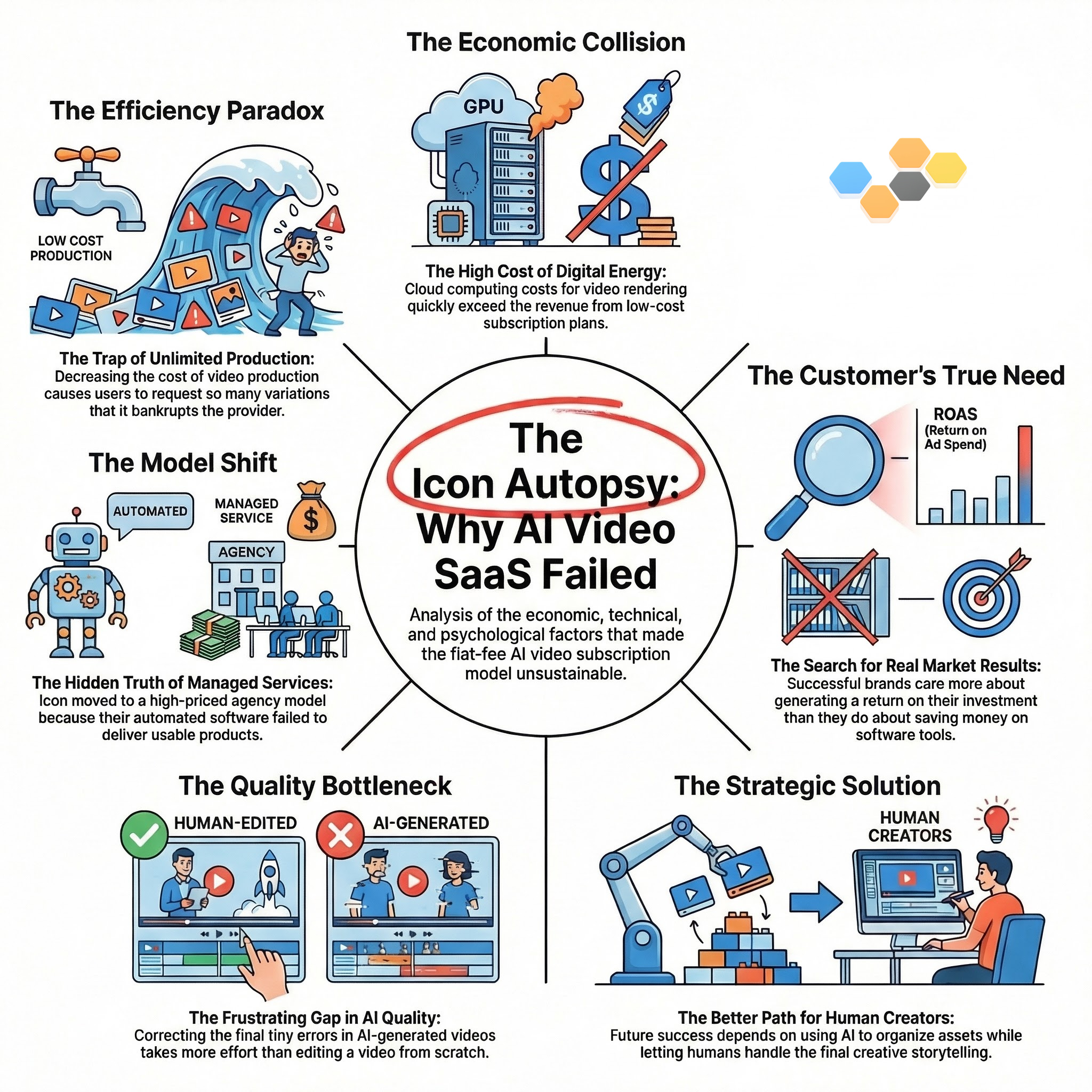
The 7-Day Workweek Symptom
Toxic hustle culture is rarely just a cultural failing; it is almost always a symptom of a broken technical architecture. Icon’s viral job listing demanding mandatory 7-day workweeks and stating that engineers would be “badgered and harassed without respite” is the ultimate proof of an unscalable system.
When your AI cannot cleanly automate the core workflow, and you have promised enterprise clients a $3,000/month “Managed Service” deliverable, you are forced to use your highest-paid talent to manually patch the leaks. This is the Lean Waste of Over-processing. Instead of building scalable infrastructure, Icon’s engineers were likely functioning as over-glorified technical support, manually fixing render failures, pipeline crashes, and edge-case bugs to fulfill client deliverables. Relying on the brute-force physical exhaustion of your engineering team is not a moat; it is a terminal vulnerability.
Chapter 3: Why Brands Actually Buy
Icon built a complex hammer looking for a nail. They assumed marketers were frustrated by toggling between multiple creative apps, so they built a monolithic 14-in-1 tool. But software fragmentation was merely a symptom, not the root disease. By applying Socratic Deconstruction, we expose their fatal miscalculation: brands do not want to make videos; they want to buy profitable attention.
Reframing the “Fragmented Tool” Problem
The original assumption dictated that brands wanted to consolidate their software stack to save money. This is a State 1 Hunch masquerading as strategy. For a performance marketing agency deploying $100,000 a month in media spend, saving $150 on fragmented software subscriptions (Canva, CapCut, Frame.io) is statistically irrelevant.
Icon aggressively optimized a $50 problem while completely ignoring the $50,000 problem. The true Job-to-be-Done is not “consolidate my tech stack”; it is “maximize Return on Ad Spend (ROAS).” By focusing on feature consolidation instead of conversion predictability, Icon built a brilliant solution for the wrong problem.
The Trust Deficit
Aggressive billing practices are not just public relations errors; they actively destroy the Experience Moat. According to Doblin’s 10 Types of Innovation, defensibility relies heavily on the “Service” and “Brand” layers. Icon deployed hostile dark patterns—forcing pop-ups, hiding cancellation mechanisms, and billing users post-trial.
In the B2B SaaS domain, trust is a strict binary. When a platform weaponizes its UI to trap users into a $39/month contract, it completely severs the relationship with the Job Executor. This manufactured friction creates an unrecoverable trust deficit, artificially driving up Customer Acquisition Cost (CAC) as word-of-mouth turns radically negative.
The Real Job-To-Be-Done (JTBD)
The Job Executor is the Growth Marketer, not the Video Editor. Their core struggle is discovering a high-converting creative angle before the testing budget bleeds out.
The critical Customer Success Statement (CSS) is: Minimize the time it takes to validate a new video hook against live market telemetry. Icon mistakenly optimized for raw production volume rather than strategic discovery. Providing a marketer with 50 mediocre AI videos does not solve their problem; it merely creates a new data-processing bottleneck. If the creative lacks a compelling, human-verified psychological hook, infinite variations will simply result in infinite ad account losses.
Chapter 4: The 3-Pathway Real Options Synthesis
Icon is standing at the edge of a cliff (actually, it just went over the cliff). The $39/month SaaS dream is dead, and the $3,000/month agency reality is unscalable. We need to stop pretending this is a monolithic software problem and deploy Real Options. Here are three distinct pathways to either salvage the core technology, expand the target persona, or completely invert the business model.
The Innovation Trigger Triage Matrix
Core assertion: Attempting to automate the final 1% of the Uncanny Valley is a fatal trap; we need to unbundle the process and leverage external network capacity to solve the core ROAS problem.
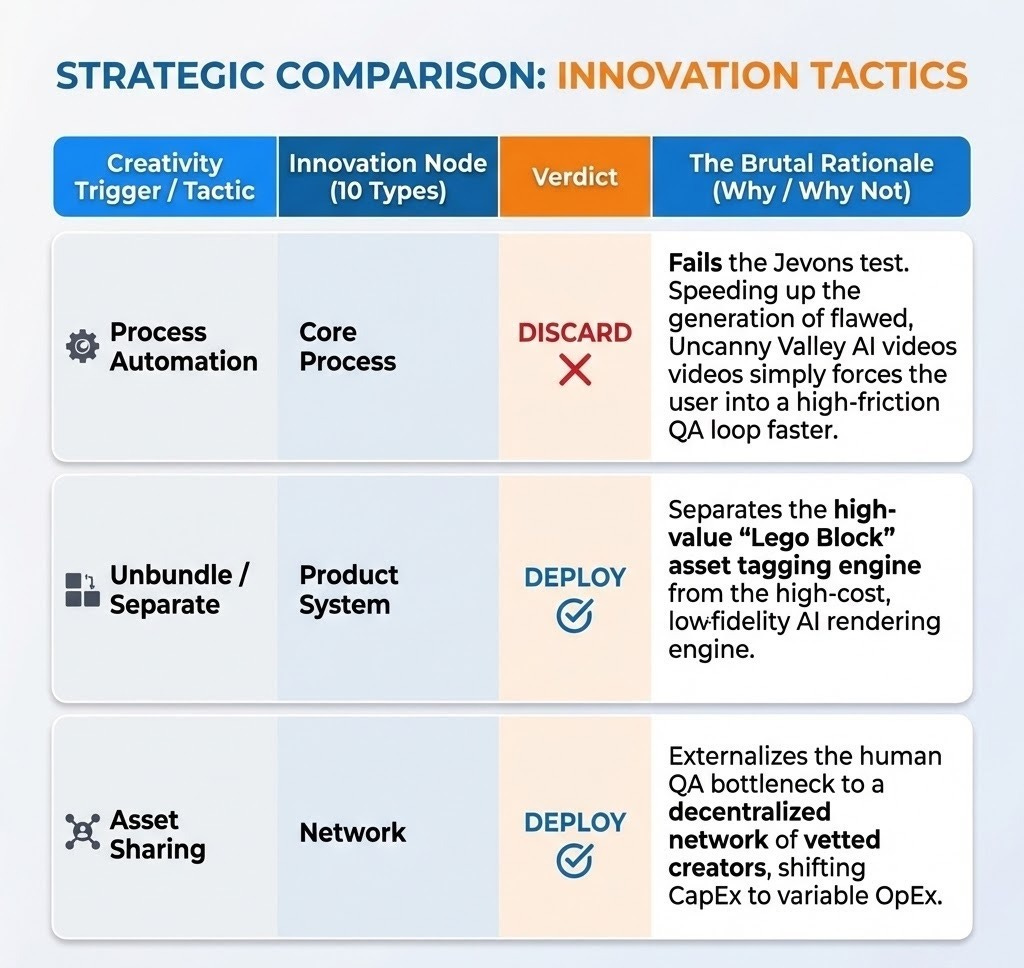
Implication: By abandoning the dream of 100% automated video rendering and focusing on asset routing and structural unbundling, Icon can eliminate their compute bleed and return to high-margin software economics.
Pathway A: Persona Expansion
The core technology is valuable, but it is being sold to the wrong Job Executor. Brands don’t want to edit video. We need to pivot from selling to frustrated brands and instead empower the $35/hr freelance editors with AI infrastructure.
By selling Icon directly to agencies and freelance creators as a backend “superpower,” the platform stops trying to replace the human and starts augmenting them. The freelancer handles the subjective “Uncanny Valley” client feedback loop, completely isolating Icon from churn risk. The tradeoff is a smaller Total Addressable Market (TAM) per user, but massive lifetime value (LTV) and zero compute-burn from endless iterations, since the expert editor pulls the exact assets they need efficiently.
Pathway B: Sustaining the Core
If Icon insists on keeping the direct-to-brand SaaS model, they have to kill the “14-in-1” narrative and fix the compute bleed immediately. They must pivot to being the ultimate AI asset manager (the “Lego Block” tagging system) and abandon full video generation.
This requires implementing strict rendering token limits to enforce positive unit economics. They need to stop trying to finish the final 1% of the video and simply supply marketers with perfectly organized, pre-tagged B-roll and automated scripts. By focusing purely on the Configuration moat (Profit Model and Structure), Icon shifts from a failing creative suite into an indispensable, sticky digital asset management (DAM) tool.
Pathway C: Disruptive Inversion
This is the Network Inversion leap. Stop generating video entirely. Use the proprietary AI not to render pixels, but to match raw brand footage with a decentralized network of vetted human creators.
Icon becomes the API that connects the demand (ROAS-hungry marketers) with the supply (creators). Brands upload raw video, the AI tags it by psychological hooks and demographics, and routes it directly to a creator who edits it natively in Premiere or CapCut. Icon takes a 20% platform cut on the transaction. This leverages Doblin’s Network innovation type, driving the marginal cost of delivery to zero while guaranteeing the brand receives authentic, human-verified creative that actually converts.
Validating Pathway C
Before deploying capital to build the API Network Inversion (Pathway C), the leadership team must stress-test the strategic reality of the pivot. This strips away the marketing spin and forces alignment on the fundamental unit economics and technical feasibility.
1. The Customer-Facing FAQ (Validating Adoption)
Q: “If Icon is an AI company, why is a human editing my video?”
A: AI is incredible at organizing raw footage into searchable Lego blocks and analyzing competitor hooks, but it fails at the subjective nuance of pacing and emotion required for high conversion. We use AI to do 90% of the heavy lifting (scripting, tagging, asset matching) so our vetted network of top-tier creators can spend their time perfecting the final 10% that actually drives ROAS.
Q: “How much does it cost?”
A: You pay a flat $50/month platform fee to access the AI asset manager and hook generator. When you are ready to produce a video, you pay a fixed marketplace rate (e.g., $150 per video). You only pay for human production when you actually need it, avoiding expensive agency retainers.
Q: “How fast is the turnaround?”
A: Because the AI pre-assembles the script and the exact matching B-roll tags, the creator receives a pre-packaged project file. Turnarounds shrink from 72 hours (traditional agency) to under 12 hours.
2. The Internal FAQ (Validating Business Viability)
Q: Market Viability: What is our evidence that marketers will buy into a marketplace model?
A: We have State 3 empirical evidence that the pure SaaS model generates unacceptable churn due to the Uncanny Valley effect. Telemetry shows marketers are willing to pay an average of $198 for authentic UGC. By pricing our marketplace at $150, we provide a 24% discount to the market average while eliminating the unpredictable $3,000/month managed service barrier.
Q: Financial Projections: How do we fix the negative gross margins from cloud rendering?
A: Under Pathway C, we entirely kill our cloud GPU rendering servers. The human creator utilizes their own local hardware (Premiere/CapCut) to render the final file. We shift our heaviest CapEx/compute burden to a decentralized external network, instantly transforming our margin structure. We take a 20% take-rate on the $150 transaction with near-zero marginal cost of delivery.
Q: Technical Feasibility: What is the single biggest risk?
A: The biggest risk is supply-side liquidity. We must attract and retain top-tier editors. If the project files our AI generates are messy or poorly tagged, editors will reject the jobs on the marketplace. The AI tagging engine must have a 99% accuracy rate to maintain creator retention.
3. The Private Equity FAQ (Value Creation Plan)
Q: Strategic Foundation: What is the enduring investment thesis for this pivot?
A: We are transforming Icon from a fragile, easily commoditized SaaS tool into a defensible, two-sided network. Algorithms will eventually commoditize pure generation, but a liquid marketplace of verified creative talent layered on top of proprietary workflow automation creates a structural monopoly.
Q: Organic Levers: How does this model scale without increasing OpEx?
A: Growth is decoupled from our internal engineering headcount. We do not need a 7-day workweek from internal staff to fulfill client orders. Scale is achieved simply by routing more API calls between brands and our external creator network, allowing revenue to scale logarithmically while headcount remains flat.
Q: Exit Optionality: What does this become?
A: Achieving liquidity on both sides of the network positions Icon not just as a software company, but as the underlying infrastructure for the entire gig economy of performance media. The acquisition target shifts from a feature roll-up by Adobe to a strategic acquisition by a major ad network (Meta/Google) looking to natively integrate human-in-the-loop creative generation into their Ads Manager.
If you find my writing thought-provoking, please give it a thumbs up and/or share it. If you think I might be interesting to work with, here’s my contact information (my availability is limited):
Book an appointment: https://pjtbd.com/book-mike
Email me: mike@pjtbd.com
Call me: +1 678-824-2789
Join the community: https://pjtbd.com/join
Follow me on 𝕏: https://x.com/mikeboysen
Articles - jtbd.one - De-Risk Your Next Big Idea
Q: Does your innovation advisor provide a 6-figure pre-analysis before delivering the 6-figure proposal?


